The memorial at the center of the Mall
Walk west from the Washington Monument along the great central axis of the National Mall, and the ground opens before you. The Reflecting Pool stretches toward the Lincoln Memorial, and halfway along that walk, to your right and left, a great oval of granite and water interrupts the green: the National World War II Memorial. It is the only memorial to a twentieth-century event on the central axis of the Mall, and its position says everything about how America finally chose to remember the war that defined the twentieth century. It sits on the former site of the Rainbow Pool, at the eastern end of the Reflecting Pool, between the Washington Monument and the Lincoln Memorial — the most prominent spot for a monument on the Mall since the Lincoln Memorial opened in 1922, and the first addition in more than seventy years to the corridor of open space that runs two miles from the Capitol to the Potomac.
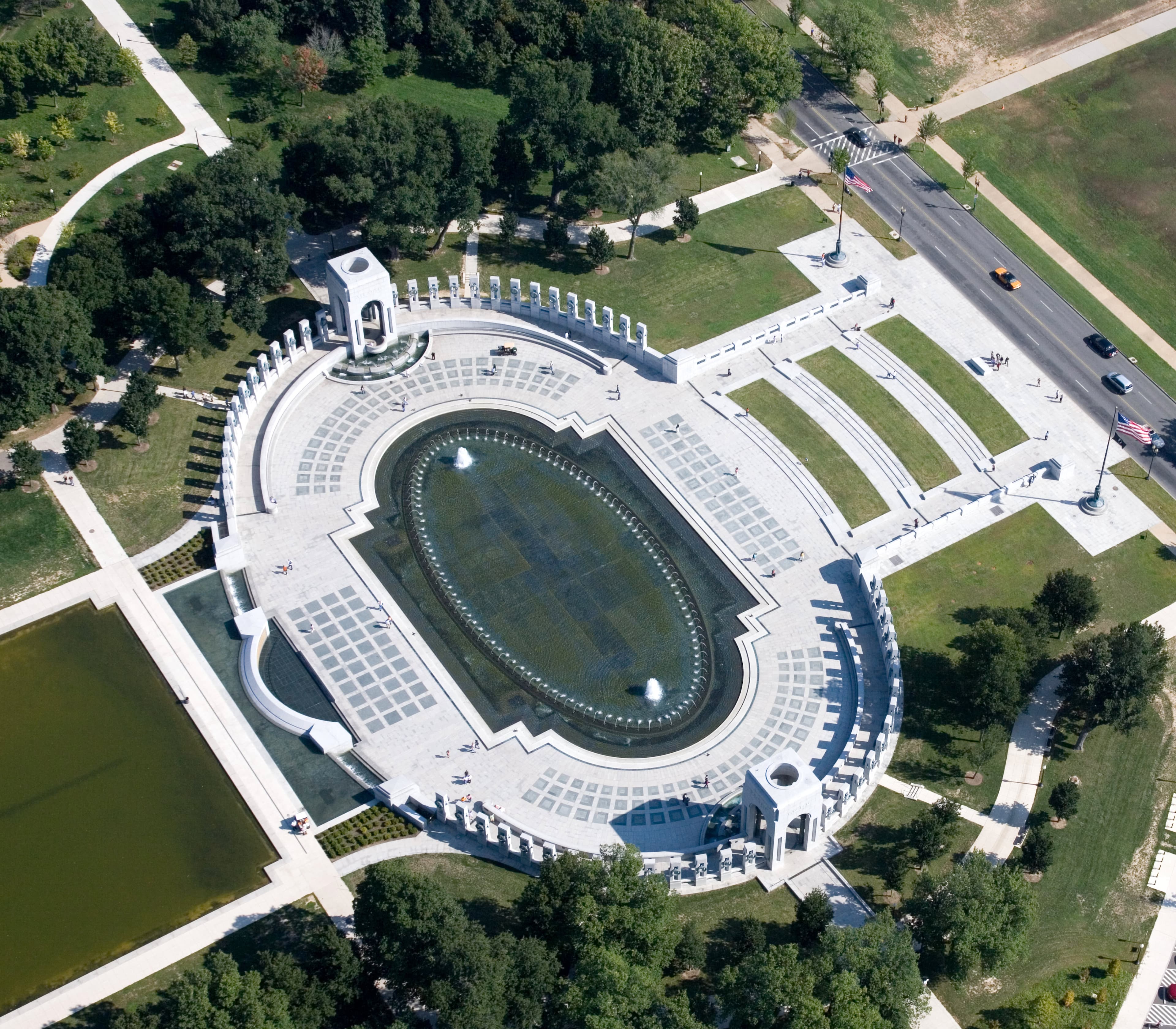
The memorial honors the service of 16 million members of the United States armed forces during World War II, and the support of millions more on the home front. More than 400,000 Americans died in the war. The memorial's design, by Austrian-American architect Friedrich St. Florian, holds all of that scale in a single, legible gesture: a sunken oval plaza ringed by 56 granite pillars, one for each of the 48 states as they stood in 1945 plus the District of Columbia and the seven territories of the time, with two 43-foot triumphal arches at the northern and southern ends, inscribed "Atlantic" and "Pacific," and a great fountain — the rebuilt Rainbow Pool — at the center. Two-thirds of the 7.4-acre site is landscaping and water, so the memorial feels less like a building and more like a place: somewhere you descend into, walk around, and sit beside.
Come down the steps or the ramps into the plaza, which is sunk six feet below the level of the Mall, and the noise of the city falls away. Water arcs from the fountain jets. The pillars rise 17 feet around you, each one inscribed with the name of a state or territory and crowned with a bronze wreath — oak for military and industrial strength, wheat for agricultural production. Under each arch, four bronze eagles carry an oak laurel wreath, the ancient symbol of victory. It is a classical design, deliberately so, and it was controversial for exactly that reason when it was unveiled. Spend an hour here, though, and the classicism stops feeling like an argument about architecture and starts feeling like what it is: a frame built to hold grief and gratitude at a national scale, in the open air, where anyone can enter it for free, at any hour.
Sixty years to build a memorial
The most remarkable thing about the World War II Memorial may be how long it took to exist. World War II ended in 1945. The memorial did not open until April 29, 2004 — nearly sixty years later, when the veterans it honors were in their late seventies and eighties and dying at a rate of more than a thousand a day. The delay was not forgetfulness. It was, in part, the sheer difficulty of agreeing on how a nation should remember a war that touched every family, and, in part, the slow machinery of building anything permanent on the National Mall.
The campaign began with one veteran. In 1987, Roger Durbin, a World War II veteran from Ohio, approached his representative, Marcy Kaptur, and asked whether a national World War II memorial could be built. Kaptur introduced legislation in December of that year, and again in 1989 and 1991, without success. She tried a fourth time in January 1993, the day after Senator Strom Thurmond introduced companion legislation in the Senate, and this time it moved: the Senate approved it in March, the House in May, and President Bill Clinton signed the World War II Memorial Act into law on May 25, 1993, authorizing the American Battle Monuments Commission to establish the memorial in Washington or its environs.
President Clinton appointed a twelve-member Memorial Advisory Board in September 1994. A nationwide design competition drew 400 submissions, and St. Florian's design was selected in 1997. The money came overwhelmingly from the American people: a direct-mail campaign brought in millions of individual donations, veterans' groups including the American Legion, the Veterans of Foreign Wars, and Veterans of the Battle of the Bulge gave generously, and a corporate effort was led by co-chairmen Senator Bob Dole — himself a decorated World War II veteran — and Frederick W. Smith, the founder of FedEx and a former Marine Corps officer. About $16 million came from the federal government; $197 million was raised in total. Ground was broken in November 2000. The memorial opened to the public on April 29, 2004, and was dedicated on May 29, 2004, in a ceremony attended by thousands of veterans, dedicated by President George W. Bush. On November 1, 2004, authority over the memorial passed to the National Park Service, which administers it today as part of the National Mall and Memorial Parks group.
Reading the memorial: pillars, arches, and water
The memorial rewards a slow, circular walk, because its meaning is arranged spatially — you are meant to read it the way you would walk a map of the war itself.
Start with the pillars. There are 56 of them, arranged in a semicircle around the plaza, each 17 feet tall and inscribed with the name of one of the 48 states of 1945, plus the District of Columbia, the Alaska Territory, the Territory of Hawaii, the Commonwealth of the Philippines, Puerto Rico, Guam, American Samoa, and the U.S. Virgin Islands. The number itself tells a story: the original design called for 50 columns, and the count grew to 56 after a campaign led by Puerto Rico's legislature, which argued — successfully — that the territories that sent their sons and daughters to the war deserved to stand in the circle too. Find your home state's pillar. Every visitor does, and every visitor pauses a little longer there. The pillars are joined by bronze wreaths and, in the original design, by a rope-like bronze garland detail; the wreaths alternate oak and wheat, a quiet reminder that the war was won not only by armies but by factories and farms.
Then look to the two arches. The northern arch is inscribed "Atlantic" and the southern one "Pacific" — the two theaters of the war, set against each other across the plaza the way the two oceans sit against each other on a map. Each arch rises 43 feet, and beneath each, four bronze eagles hold aloft a laurel wreath, sculpted by Raymond Kaskey, who created all of the memorial's bronze sculpture. Stand under the Pacific arch and look north through the fountain toward the Atlantic arch, and you are standing on the axis of the whole design: two wars, one nation, one plaza between them.
At the center is the water. The fountain occupies the rebuilt Rainbow Pool, first built in 1912 and incorporated into the memorial's design. The plaza itself measures 337 feet 10 inches long by 240 feet 2 inches wide, and the pool is 246 feet 9 inches by 147 feet 8 inches — a great sheet of water with jets arcing upward, ringed by the pillars. The water is the memorial's living element: it moves, it catches the light, it makes the sound that fills the sunken plaza. In winter the fountain is sometimes drained for maintenance, and the memorial takes on a starker, more architectural character; in summer, with the jets running and the sun on the granite, it is the most visited spot on the Mall after the Lincoln Memorial. Note that the National Park Service prohibits wading in the memorial's fountains, as it does at the other Mall memorials.
The Freedom Wall: 4,048 gold stars
Walk to the western side of the plaza, the end nearest the Lincoln Memorial and the Reflecting Pool, and you will find the part of the memorial that stops visitors cold. The Freedom Wall is a great curved wall of gold stars set against a field of stone, with a small reflecting pool of its own at its foot. There are 4,048 stars. Each one represents 100 Americans who died in World War II. In front of the wall, carved into the granite, is the inscription: "Here we mark the price of freedom."
Do the arithmetic slowly and it lands the way it is meant to: 4,048 times 100 is more than 400,000 dead — fathers, brothers, sons, daughters, friends, from every state whose pillar rings the plaza behind you. The stars were cast, like the pillar wreaths, at Valley Bronze in Joseph, Oregon, and a foundry worker there later recalled seeing buckets full of the stars going through the foundry and thinking that each one stood for 100 men: "The magnitude was overwhelming." That is the right response, and the wall is designed to produce it. Stand here for a while. Watch other visitors count, or touch a star, or simply stand still. Veterans' groups and Honor Flights still come here to lay wreaths at this wall, and the ceremonies — on Memorial Day, on Veterans Day, on the anniversaries of D-Day and V-J Day — gather here, not at the arches.
The wall is also the memorial's most photographed element after the fountain, and the most misunderstood. The stars do not name individuals; they count, in the most abstract and therefore the most devastating way, the scale of loss. For names, for individual stories, the memorial points you elsewhere — to the bas-reliefs, to the inscriptions, and to the registry of veterans maintained by the memorial's friends organization. The wall is not a roster. It is a number made visible.
The bas-reliefs, Kilroy, and the details to hunt for
Flanking the eastern entrance from 17th Street, along the two walls that guide you down into the plaza, are 24 bronze bas-relief panels by Raymond Kaskey, and they are the memorial's narrative heart. Approach on the left, toward the Pacific arch, and the panels begin with soon-to-be servicemen getting physical examinations, taking the oath, and being issued their gear; they move through combat and burying the dead and end in a homecoming scene. Approach on the right, toward the Atlantic arch, and the sequence is similar but weighted toward the European theater: preparations in England for air and sea assaults, and a final panel showing the handshake between American and Russian soldiers when the eastern and western fronts met in Germany. Live models posed for the scenes. Walk both walls, in order, and you have walked a compressed history of the American experience of the war — from induction to homecoming, from both oceans.
Then hunt for the details the designers hid in plain sight. There are two inconspicuously located "Kilroy was here" engravings in the memorial — the doodle of a bald man peering over a wall that American servicemen scrawled across Europe and the Pacific as a mark of their presence, a joke and a reassurance at once: we were here, we made it this far. Finding them has become a small ritual for visitors, especially for school groups, and the memorial's rangers will not always tell you exactly where to look. There are also inscriptions throughout the memorial drawn from the war's leaders and participants — Roosevelt, Truman, Eisenhower, Marshall, Nimitz, MacArthur — and, since June 6, 2023, the 79th anniversary of D-Day, a plaque at the Circle of Remembrance to the northwest of the memorial carrying the words of the prayer President Franklin D. Roosevelt read to the nation on the morning of June 6, 1944. Congress directed its installation in 2014, after a long debate, and it is the memorial's newest element.
The memorial was not universally loved when it opened, and it is worth knowing why, because the argument is part of its history. Critics objected to the site, saying it would interrupt the unbroken view between the Washington Monument and the Lincoln Memorial and take up open space historically used for demonstrations. Others objected to the classical style itself: one critic called it bombastic, another a hodgepodge of cliché, another "knee-jerk historicism." The sunken design was, in part, the answer to the first objection — by sinking the plaza six feet below Mall grade, St. Florian preserved the sight line between the two older monuments. The second objection has faded with time, as the memorial has become one of the most visited sites in the capital, drawing millions of visitors a year. A memorial that once seemed too grand for its subject now seems, to most visitors, exactly grand enough.
How to visit, and what to see around it
The World War II Memorial stands on the National Mall at 17th Street, between Constitution and Independence Avenues SW, on the axis between the Washington Monument to the east and the Lincoln Memorial and its Reflecting Pool to the west. The nearest Metro stop is Smithsonian station (Blue, Orange, and Silver lines), a walk east along the Mall; the memorial is also an easy walk from the Federal Triangle and Archives stations, and from the Lincoln Memorial, the Vietnam Veterans Memorial, and the Korean War Veterans Memorial, all of which sit within a short walk along the Mall's western end.
Plan to spend at least an hour, and longer if you want to read the bas-reliefs in order and sit by the fountain. The best approach is from the east, along 17th Street, so that you descend into the plaza past the bas-relief walls and see the whole oval open before you, with the Freedom Wall at the far end and the Lincoln Memorial beyond it. The best light is early morning or late afternoon, when the sun rakes across the pillars and the water; at dusk the memorial is lit, and the fountain and arches glow against the dark — one of the great evening sights in Washington. Rangers from the National Park Service staff the memorial and offer programs; the Friends of the National World War II Memorial also organizes ceremonies and maintains the veterans' registry.
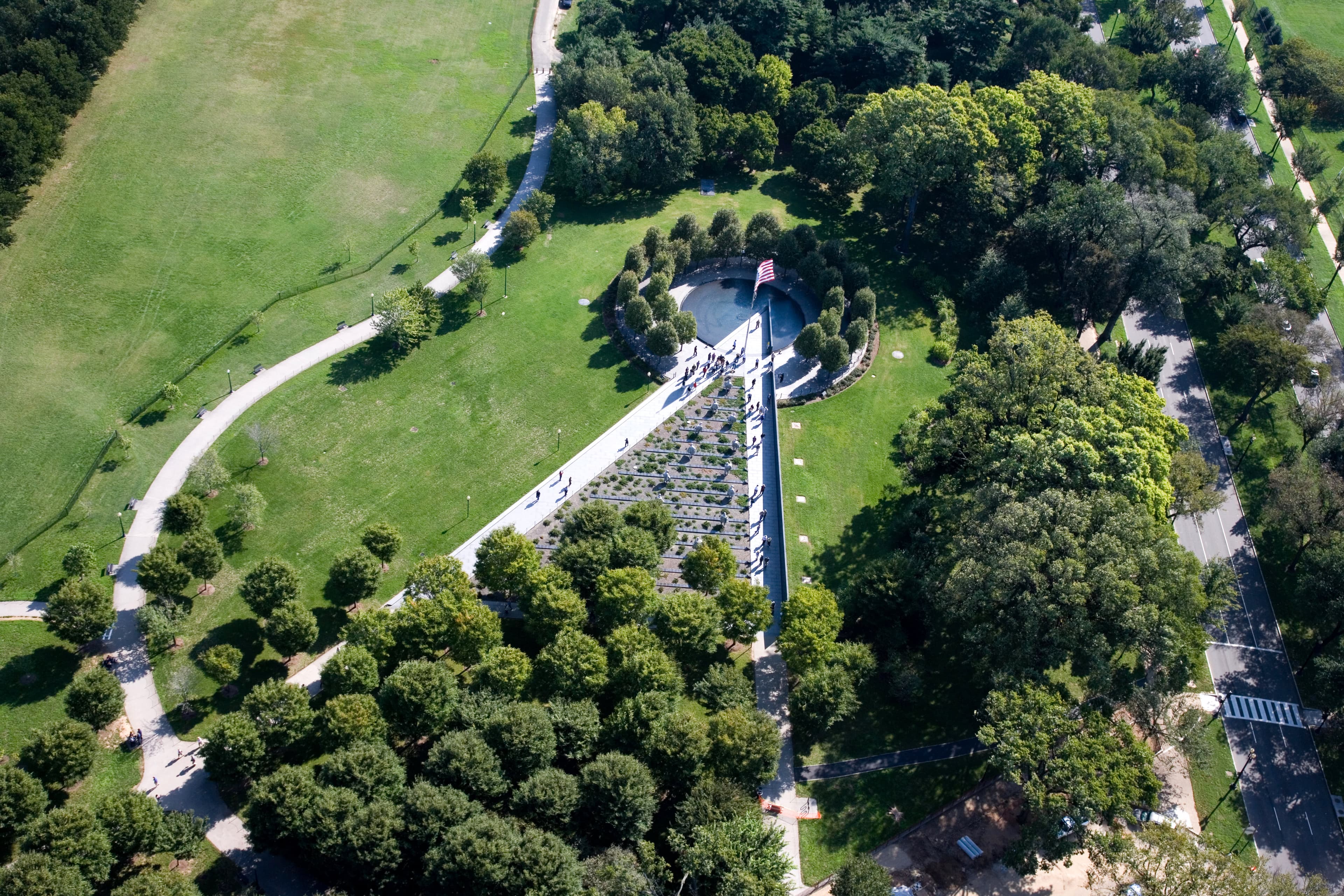
Pair the memorial with the rest of the western Mall. The Lincoln Memorial and its Reflecting Pool are a short walk west; the Vietnam Veterans Memorial and the Korean War Veterans Memorial are just north and south of the Reflecting Pool respectively; the Washington Monument rises to the east; and the museums of the Smithsonian line the Mall in both directions. A walk from the Capitol to the Lincoln Memorial, with the World War II Memorial at its midpoint, is the classic Washington walk, and it is the walk the memorial was designed to interrupt — in the best sense — by asking you to stop, descend, and remember in the middle of it.
More than eighty years after the war ended, and more than twenty years after this memorial opened, its urgency has only grown. The veterans it honors are nearly gone; the generation that built it with small donations from millions of Americans is passing too. What remains is granite, bronze, water, and stars — and the simple, overwhelming fact the Freedom Wall states without ornament: here we mark the price of freedom. Stand in the plaza, find your state's pillar, count the stars, and you will understand why it took America sixty years to build this, and why it was worth every year.
Location Photography


Architectural & Historical Highlights
- National Mall, former Rainbow Pool site at eastern end of Reflecting Pool, between Washington Monument and Lincoln Memorial
- Honors 16 million who served, millions on home front, more than 400,000 who died
- 7.4 acres, two-thirds landscaping/water, plaza 337 ft 10 in by 240 ft 2 in, sunk 6 feet, pool 246 ft 9 in by 147 ft 8 in
- 56 granite pillars 17 feet tall, 48 states of 1945 + DC + Alaska Territory + Hawaii Territory + Philippines + Puerto Rico + Guam + American Samoa + U.S. Virgin Islands
- Two 43-foot arches, Atlantic north, Pacific south, four bronze eagles each carrying oak laurel wreath
- Freedom Wall west side, 4,048 gold stars each 100 dead, inscription “Here we mark the price of freedom”
- 24 bronze bas-relief panels by Raymond Kaskey, two “Kilroy was here” engravings
- Architect Friedrich St. Florian, design selected 1997 from 400 submissions, Kaskey sculpture
- Campaign began 1987 Roger Durbin / Rep. Marcy Kaptur, World War II Memorial Act signed May 25, 1993 by President Clinton
- Fundraising $197 million total, about $16 million federal, co-chairs Sen. Bob Dole and Frederick W. Smith
- Groundbreaking November 2000, opened April 29, 2004, dedicated May 29, 2004 by President George W. Bush, transferred to NPS November 1, 2004
- FDR D-Day prayer plaque at Circle of Remembrance opened June 6, 2023
- Administered by NPS, National Mall and Memorial Parks