The room where Boston decided
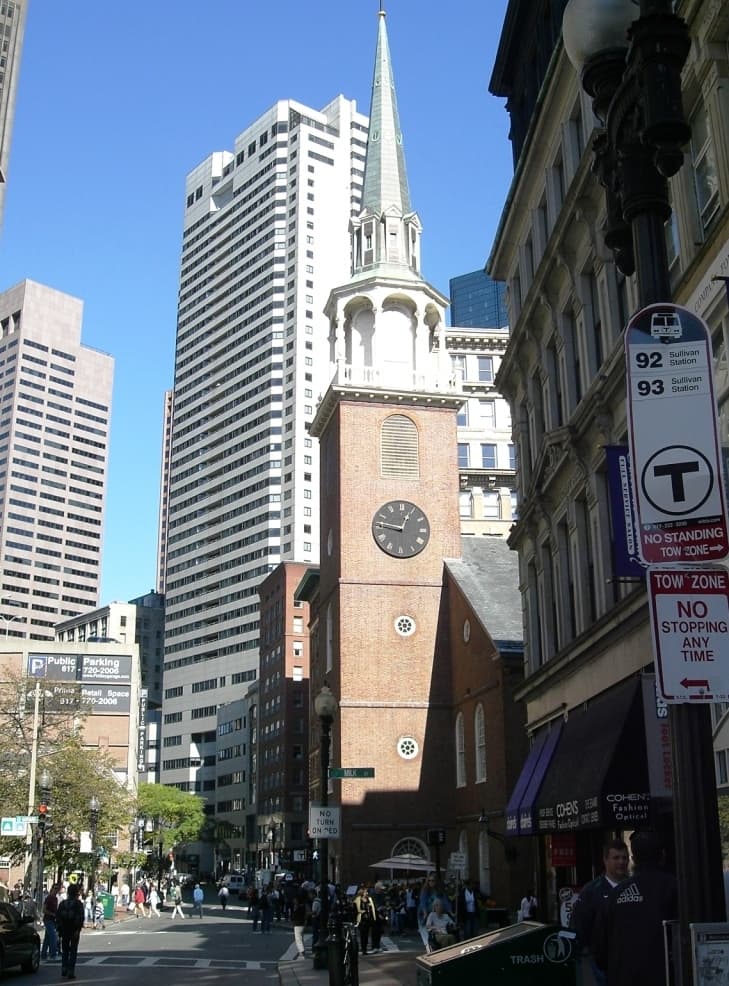
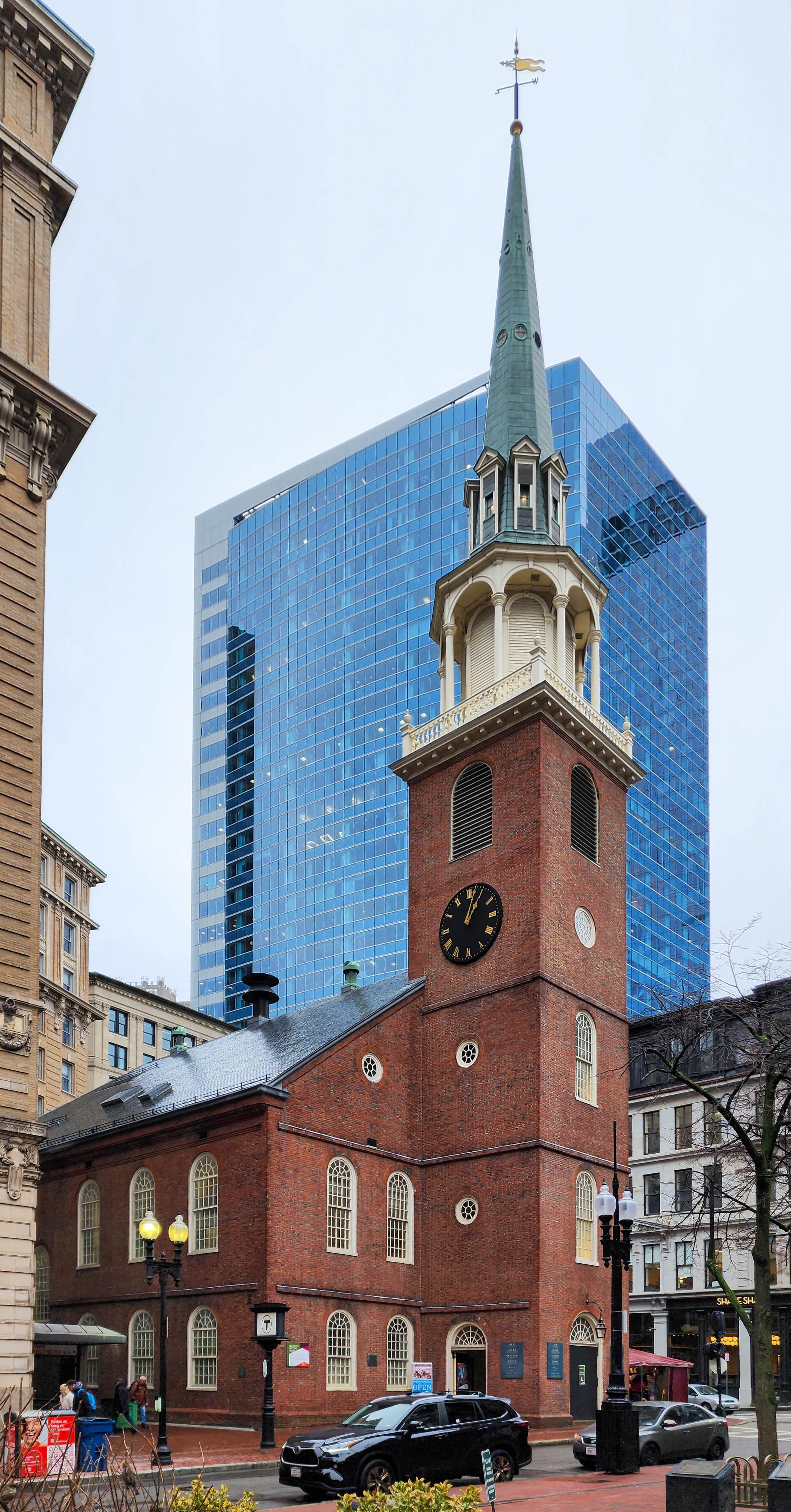
There are buildings you visit to admire, and buildings you visit to stand where something happened. Old South Meeting House, at the corner of Washington and Milk Streets in Downtown Boston, is firmly the second kind. From the street it is handsome but unassuming: a red-brick Georgian box with two tiers of arched windows and a tall white steeple rising 183 feet above the sidewalk, squeezed between the office towers and shopfronts of Downtown Crossing. Step inside, though, and you are standing in the largest public room in colonial Boston — the room where the town gathered when it had something important to decide, and where, on one cold December night in 1773, it decided to start a revolution.
That is what makes Old South a first-time visitor's essential stop rather than an optional one. Boston's Freedom Trail is full of places where history happened, but few of them let you sit in the actual hall, among the box pews, and picture the crowd. At Old South you can. The meeting hall survives in its original proportions, the pulpit stands where the speakers stood, and the galleries run around the walls where the overflow crowd pressed in. When the guides describe the night of the Boston Tea Party, they are not pointing at a plaque on an empty lot. They are describing something that happened in the room you are standing in.
The building is also, unusually, still doing the job it was built for. Old South was never only a church: from its earliest years it was Boston's town meeting hall in all but name, the place big enough to hold the public when Faneuil Hall could not. Today it is a museum, but it remains an active center for civic discussion, lectures, and debate — a "haven for free speech," in the National Park Service's phrase — which feels less like a slogan than a job description once you know the building's story.
A Puritan meeting house built for a growing town
Old South began as the Third Church of Boston, a congregation gathered in 1669 by dissenters from the city's First Church. Their first building on this site was a modest wooden meeting house, known as the Cedar Meeting House. By the 1720s Boston had outgrown it, and the congregation commissioned something far grander: a brick meeting house designed by Robert Twelves and built by the master mason Joshua Blanchard, who would later build Faneuil Hall. Completed in 1729, it was the largest building in colonial Boston — a deliberate statement that this congregation, and this town, intended to be heard.
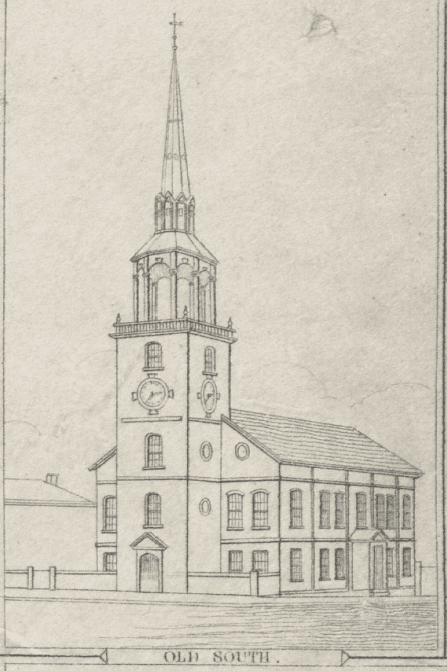
The architecture tells you what kind of building this is. The exterior is Georgian, in the manner of Christopher Wren's London churches: red brick laid in Flemish bond, tall round-arched windows in two tiers, and a projecting tower on Washington Street crowned by a white wooden steeple with an open colonnaded belfry. The steeple, with its gilded weather vane, became one of the landmarks by which Bostonians oriented themselves; a century and a half later it would appear, unmistakable, in the earliest surviving aerial photograph of an American city, James Wallace Black's 1860 balloon view "Boston as the Eagle and the Wild Goose See It."
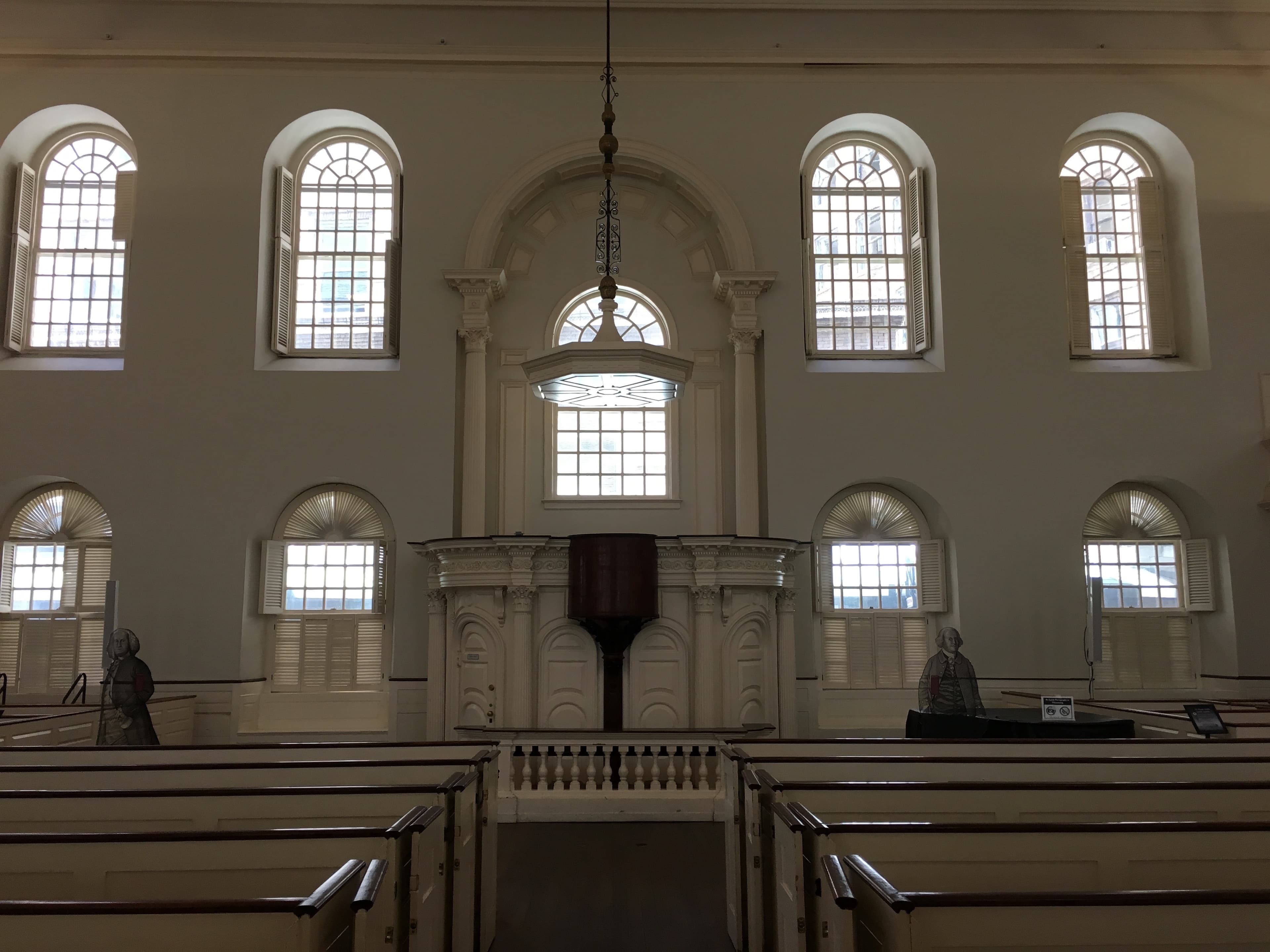
Inside, the plan follows the traditional New England meeting house rather than an English parish church. There is no long nave leading to an altar. Instead, the hall is a broad, nearly square room, with the pulpit set against the long wall and the congregation gathered around it in box pews — high-sided wooden enclosures, rented by families, that kept out drafts and kept neighbors close. Galleries run around the other walls, carried on columns, so that hundreds more could pack in above the main floor. The arrangement was practical, but it was also political: everybody could see the speaker, and the speaker could see everybody. A room built for preaching turned out to be a perfect room for public debate.
The congregation's ministers were among the leading minds of colonial Boston — Samuel Sewall, Thomas Prince, and others whose sermons and writings shaped the town's political imagination. But the building's fame rests less on its Sunday services than on what happened there on weekdays, when the town borrowed it for meetings too big for anywhere else.
December 16, 1773: the night of the Tea Party
The meeting that made Old South famous began as an overflow. On November 29, 1773, after the tea ship Dartmouth arrived in Boston Harbor carrying East India Company tea subject to the Townshend duty, a public meeting at Faneuil Hall drew a crowd too large for the hall, and the gathering adjourned to Old South — the only room in town big enough. For weeks the standoff continued: the ships sat at Griffin's Wharf, the tea unsold and unloaded, while mass meetings at Old South debated what to do.
On the afternoon of December 16, 1773, the final meeting convened. More than 5,000 colonists packed the meeting house and spilled into the surrounding streets — an extraordinary crowd for a town of about 16,000 people. Samuel Adams presided, and the question before the meeting was whether the tea would be landed and the duty paid, or sent back to England. When word came that Governor Thomas Hutchinson would not permit the ships to leave without unloading, Adams is reported to have declared that the meeting could do nothing more to save the country. The crowd understood the signal. Men disguised as Mohawk Indians, joined by an enthusiastic crowd, marched down Milk Street to Griffin's Wharf, boarded the three tea ships — the Dartmouth, the Eleanor, and the Beaver — and threw 342 chests of tea into Boston Harbor.
The Boston Tea Party did not happen at Old South, strictly speaking: the tea went into the water at the wharf. But it was organized at Old South, debated at Old South, and launched from Old South, and that is why the building's name is inseparable from the event. It was also the scene of the annual Boston Massacre anniversary orations, including Joseph Warren's famous oration in 1772, in which the young physician and patriot leader denounced the standing army in Boston and warned of the liberties at stake. Warren would be killed at Bunker Hill three years later, but his words at Old South were already legend.
The building's role as the town's debating chamber continued through the revolutionary crisis. It was here that Bostonians argued, in public and at length, about taxation, representation, and resistance — the long, noisy, democratic process that preceded the war. If you want to understand how a colonial town talked itself into a revolution, there is no better room in America in which to think about it.
Riding school, ruin, and restoration
The British occupation of Boston, from 1775 to 1776, was deliberately humiliating for Old South. British troops gutted the interior, tearing out the pews, the pulpit, and most of the galleries, and turned the meeting house into a riding school for the Queen's Light Dragoons, with a bar installed in a balcony. The desecration was symbolic and the soldiers knew it: this was the room where the Tea Party had been planned, and they rode horses through it. Tradition holds that the manuscript of William Bradford's Of Plymouth Plantation, hidden in the tower, was among the items stolen during the occupation.
When the British evacuated Boston in March 1776, they left a wreck. George Washington is said to have visited the ruined interior afterward and wondered how a people who so venerated their own churches could have desecrated another's. The congregation did not fully restore the building until 1783, after the war, and the interior you see today is in large part a careful reconstruction: the current box pews date to a 1947 renovation based on an early architectural drawing, though two original pews survive, one of them repaired from fragments found on site. The pulpit is from 1857, and the sounding board above it — the wooden canopy that threw the preacher's voice out across the hall — dates to 1808.
The building survived the Great Boston Fire of 1872, which consumed much of the surrounding downtown, and it survived the fire's aftermath in a different way: as the city's residential districts shifted toward the Back Bay, the congregation followed, building a new church at Copley Square in 1875 and leaving the old meeting house behind. That departure nearly killed it.
Saved from the wrecking ball
By 1876 the old meeting house, empty and in a now-commercial district, was slated for demolition. What saved it was one of the first successful historic preservation campaigns in America. Public protest, led by figures including Wendell Phillips, and a fundraising drive bought the building and its land — the building itself for a modest sum, the land beneath it for far more — and in 1877 the newly formed Old South Association opened it to the public as a museum and meeting place. It was among the first museums of American history in the country, and its rescue became the model for the preservation movement that would later save countless other landmarks.
That 1877 opening is why Old South feels different from many historic houses, which were rescued decades later and furnished from scratch. Old South has been a museum for nearly 150 years — longer than it was a church after the Revolution — and its exhibits have grown up with the building. The current long-running exhibit, "Voices of Protest," traces the building's history as a place of free speech and dissent, from the Tea Party meetings through the abolitionist movement, the women's suffrage campaign, and the civil rights era, using the voices of the men and women who spoke, argued, and organized here.
The preservation work has never really stopped. The tower clock — made in the 1760s and the oldest American-made tower clock still operating in its original location — was restored in an award-winning project completed in 2009. The tower gained a new bell in 2011: an 876-pound bronze bell forged in 1801 by Paul Revere & Sons, hoisted into the steeple in October 2011 and first rung there in January 2012, returning a Revere bell to a Boston steeple after a long absence. In 2025 the Boston Landmarks Commission designated Old South a Boston Landmark, adding city protection to its National Historic Landmark status, granted in 1960, and its place on the National Register of Historic Places since 1966.
The building itself: brick, steeple, and clock
Before you go inside, take a few minutes with the exterior, because it rewards looking. The Washington Street front is the showpiece: the projecting tower with its arched doorways, the clock face high above the street, and the white steeple rising in stages — brick tower, belfry with arched openings, and a tapering spire topped by a weather vane — to 183 feet. The clock, still keeping time in its original location, is worth a glance upward: it has told Boston the hour since the 1760s, through revolution, fire, and the rebuilding of the entire neighborhood around it.
The Milk Street side is quieter and, in some ways, more revealing. The long brick elevation with its two tiers of arched windows shows the hall's true scale — this is a big room, and the windows exist to light it. Look for the small courtyard at the corner and the granite-capped section of the facade where part of the brickwork was removed for alterations to the neighboring MBTA State Street station in the 1980s: a reminder that this is a working building in a working city, not a stage set.
The contrast with the surroundings is part of the experience. Old South stands in the middle of Downtown Crossing, Boston's busiest shopping district, flanked by modern office towers that dwarf its steeple. A century ago the steeple dominated the skyline; today it holds its own by color and character alone — red brick and white wood against glass and steel. That juxtaposition is the building's story in miniature: the eighteenth century, still standing, in the middle of the twenty-first.
Inside today: pews, pulpit, and Voices of Protest
A visit begins in the meeting hall itself, and you should give it time. Sit in one of the box pews — one is furnished with eighteenth-century items, so you can picture a family settling in for a long sermon or a longer town meeting — and look up at the galleries and the pulpit. The hall is deliberately plain by church standards: white walls, dark wood, clear glass. Puritan meeting houses distrusted ornament, and the plainness focuses attention on the spoken word, which was the point. Then find the inscription along the balcony recording General Washington's visit to the ruined hall, and the exhibit panels telling the building's story in the words of the people who used it.
The "Voices of Protest" exhibit fills the hall's edges and lower levels with broadsides, artifacts, and everyday objects from colonial Boston, and it makes a case that runs through the whole visit: that Old South matters not only because of one night in 1773, but because it has hosted argument, dissent, and free speech for nearly three centuries. School groups, lectures, and public programs continue that tradition in the same room, which is why a visit here can feel less like a museum and more like a town meeting that never quite adjourned.
Allow about an hour for a first visit: half an hour in the hall and the exhibits, and time to linger over the details — the sounding board, the furnished pew, the clock mechanism stories, and the small corked vial of tea, traditionally said to be a souvenir of the Tea Party, displayed with its Chinese tea label. Then step back outside and walk the Freedom Trail in either direction: the Old State House, the site of the Boston Massacre, and Faneuil Hall are all within a few minutes' walk, and together they tell the story of the weeks and months that led to December 16, 1773.
How to visit well
Old South rewards the visitor who arrives with the story in mind, and the story is short enough to carry in your head: a big room, a town that needed it, a night when 5,000 people decided the fate of an empire's tea. Start at the Washington Street entrance, look up at the steeple and clock, then go inside and sit down. Read the balcony inscription. Stand at the center aisle and imagine the hall full — not just the pews, but the galleries, the doorways, and the street outside, all crowded with people waiting for the meeting's decision.
Then walk it. From Old South, Milk Street runs downhill toward the harbor, roughly the route the crowd took to Griffin's Wharf on the night of the Tea Party. The wharf itself is gone, rebuilt many times over, but the walk gives you the geography of the event: the meeting house, the commercial streets, and the water, all within a few minutes of one another. Finish back at the Freedom Trail, where Old South sits between the Old State House and the Old Corner Bookstore, and you will have the center of revolutionary Boston in a single short stroll.
More than 250 years after the night that made it famous, Old South Meeting House endures because it still does what it was built to do: hold a crowd, amplify a voice, and give a town somewhere to decide. Walk in, sit in a pew, and listen for a moment to the room. It has heard more argument, and more history, than almost any other room in America.
Architectural & Historical Highlights
- Old South Meeting House is a museum and historic meeting house at 310 Washington Street, on the corner with Milk Street, in the Downtown Crossing area of Boston, Massachusetts.
- Built in 1729, designed by Robert Twelves and built by master mason Joshua Blanchard, replacing the congregation's 1669 Cedar Meeting House; it was the largest building in colonial Boston at the time.
- The exterior is Georgian: red brick in Flemish bond, two tiers of round-arched windows, and a projecting Washington Street tower with a white wooden steeple rising 183 feet, topped by a weather vane.
- The interior is a broad, nearly square meeting hall with box pews, galleries on three sides, and a pulpit against the long wall; current pews date to a 1947 renovation, two original pews survive; pulpit from 1857, sounding board from 1808.
- On December 16, 1773, more than 5,000 colonists gathered at Old South for the final meeting over three shiploads of taxed tea; after the meeting, participants marched to Griffin's Wharf and threw 342 chests of tea into Boston Harbor in the Boston Tea Party.
- During the British occupation of Boston (1775–1776), troops gutted the interior and used the building as a riding school for the Queen's Light Dragoons; the building was restored in 1783.
- Old South survived the Great Boston Fire of 1872; after the congregation moved to Copley Square in 1875, the building was saved from demolition in 1876 by a public preservation campaign and opened as a museum by the Old South Association in 1877.
- The tower clock, made in the 1760s, is the oldest American-made tower clock still operating in its original location; restored in a project completed in 2009. A bronze bell forged in 1801 by Paul Revere & Sons was hoisted into the tower in October 2011 and first rung there in January 2012.
- Designated a National Historic Landmark in 1960, listed on the National Register of Historic Places in 1966, and designated a Boston Landmark in 2025. It is a stop on Boston's Freedom Trail, operated today by Revolutionary Spaces.
- The long-running exhibit "Voices of Protest" tells the building's history as a place of free speech and dissent, from the Revolution through abolition, women's suffrage, and the civil rights era.
Visitor details
Address: Old South Meeting House, 310 Washington Street (corner of Washington and Milk Streets), Boston, MA 02108, in Downtown Crossing, on the Freedom Trail.
Transit: State station (Blue and Orange Lines) is steps away, with an entrance adjacent to the building; Downtown Crossing station (Red and Orange Lines) is a short walk south on Washington Street.
Hours and admission: Hours, admission arrangements, and program schedules change from time to time — check the official source at revolutionaryspaces.org before visiting to confirm current hours, any admission details, and tour or program times. One admission has historically covered both Old South Meeting House and the Old State House; confirm current arrangements on the official site before visiting.
Best timing: Allow about an hour for a first visit — the meeting hall, the box pews, the pulpit and sounding board, and the "Voices of Protest" exhibit — then walk the Freedom Trail to the Old State House and Faneuil Hall nearby.