A small brick building at the center of Boston's history
There are buildings you visit for their beauty, and buildings you visit because history happened in them, and the Old State House is firmly in the second category — though it is handsome too. It is a compact, two-and-a-half-story brick building with a white cupola tower, a gabled roof, and, on its eastern gable, gilded figures of a lion and a unicorn, the heraldic symbols of the British monarchy. It stands at the intersection of Washington and State Streets in downtown Boston, hemmed in on every side by modern office towers, and the contrast is the first thing you notice: the tallest building in Boston when it was built, now one of the smallest structures on the block, still holding its ground at the head of what was once King Street, the road that ran from the town's center down to Long Wharf and the sea.
That smallness is deceptive. For most of the eighteenth century, this was the building where Massachusetts was governed, judged, and addressed. The colony's legislature, its royal governor and council, and its highest court all met on its second floor. Its balcony was the place from which laws were proclaimed, governors were welcomed, and, in the end, independence itself was announced to the people of Boston. Walk the Freedom Trail through downtown and you will come to it between the Old South Meeting House and Faneuil Hall, and it is the stop where the abstract story of the Revolution becomes concrete: a real room, a real balcony, a real street corner where a crowd gathered and shots were fired.
The building is also Boston's oldest surviving public building, and one of the oldest public buildings in the United States. It has burned, been rebuilt, served as a city hall, been carved up into shops and offices, faced demolition, and been rescued by the very civic pride it helped create. It has been a museum for well over a century now, and going inside — up its spiral stair, into the Council Chamber and the Representatives' Hall — is the closest thing Boston offers to standing inside the colonial government itself.
The Second Town House: merchants below, government above
The Old State House was not Boston's first town house. The wooden First Town House, built on this site in 1658, burned in the great fire of 1711, leaving the town, Suffolk County, and the Province of Massachusetts Bay without a meeting place. Officials moved quickly: a committee was established in 1712 to build a replacement, the province paying half the cost and the town and county a quarter each, and the Massachusetts General Court, the provincial legislature, held its first session in the new building by April 1713.
The design followed the pattern of an old English town hall, adapted to a colonial port. The first floor housed a merchants' exchange — an enclosed hall where Boston's merchants met to do business, with records rooms for the county and province — while the second floor was divided into three chambers, one for each branch of government. From west to east sat the courtroom of the Suffolk County and Massachusetts Supreme Judicial Court, the legislative chamber of the General Court, and the Council Chamber of the Royal Governor, with the governor's council. A visitor gallery added to the Representatives' Chamber in the 1760s, built at the behest of clerk Samuel Adams, may have been the first public gallery in a legislative room in the United States — an early, literal opening of government to the governed.
At 65 feet, the new Town House was the tallest building in Boston, a distinction it held until 1745, when it was surpassed by the Old North Church in the North End. But height was not its claim to importance. Its claim was that everything that mattered in colonial Boston passed through it: the governor's office, the legislature's debates, the court's judgments, the merchants' deals, and the proclamations read aloud from its balcony to the crowds on King Street below.
Fire, rebuilding, and the road to revolution
The building nearly ended in 1747. On December 9 of that year, sparks from a first-floor hearth spread rapidly, gutting the interior and destroying its goods and records. The exterior brick walls survived, and the province decided within months to rebuild on the same site, completing the work within a year. The rebuilt Town House kept the brick shell but changed the roofline: the gambrel roof gave way to a gable roof, the octagonal tower was replaced by a tiered square tower, and lion and unicorn figures adorned the eastern parapet, above the small balcony from which new laws were announced.
The rebuilt building then became the stage for the arguments that led to revolution. In 1761, in the Council Chamber, the lawyer James Otis argued against the Writs of Assistance — general search warrants that let British customs officers enter homes and warehouses at will. Otis lost the case, but the argument electrified Boston, and John Adams later wrote of that speech, "Then and there... the child independence was born." The Stamp Act and other legislation were announced from the Town House, and as pro-independence sentiment grew in the mid-1760s, friction between the legislative and executive branches, both meeting on the same second floor, became a daily fact of Boston life.
British troops arrived in Boston in September 1768 to enforce unpopular taxes, and the legislature, refusing to meet while soldiers were present, moved first to Faneuil Hall and then to Cambridge. The Town House itself was used at times as a military barracks. By 1770, the town and its garrison were living on a knife's edge, and the building at the head of King Street stood at the center of the tension — the seat of royal government, ringed by soldiers, facing a crowd that had stopped believing in either.
March 5, 1770: the Boston Massacre at its doors
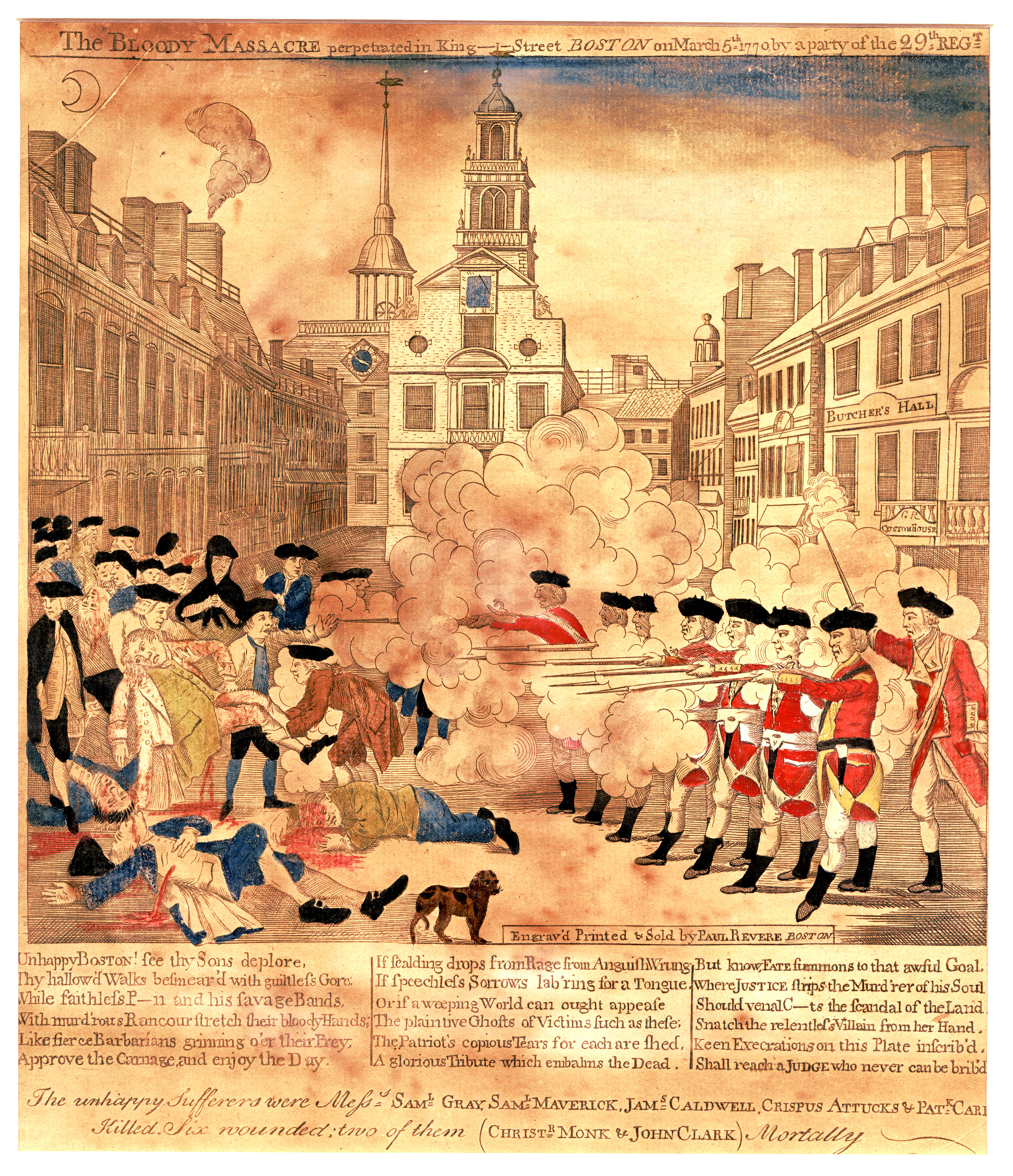
On the cold night of March 5, 1770, a confrontation between Boston residents and British soldiers outside the Town House turned deadly. What began with taunting of a British sentry escalated as more soldiers arrived; the soldiers fired into a crowd of several hundred, killing five colonists and wounding others. The dead included Crispus Attucks, Samuel Gray, Samuel Maverick, James Caldwell, and Patrick Carr. The cobblestone circle set into the pavement just east of the building today, ringed in brass with stars, marks the site of the massacre — a Freedom Trail stop in its own right, directly in front of the balcony.
In the immediate aftermath, Lieutenant Governor Thomas Hutchinson stood on the building's balcony and ordered the crowd to return to their homes, a moment captured in the popular memory of the night. The building then hosted the trials of the soldiers involved, with John Adams — a patriot, and a believer in the rule of law — defending them in court. Within weeks, Paul Revere's engraving of the event, "The Bloody Massacre Perpetrated in King Street," was circulating through the colonies, showing the Town House standing prominently behind the soldiers' volley. The engraving was propaganda — it staged the scene, borrowed heavily from Henry Pelham's earlier drawing, and showed the event in daylight though it happened at night — but it worked, and it fixed the Old State House in the American imagination as the backdrop of the Revolution's first bloodshed.
The massacre did not start the war, but it changed the argument. Boston's patriots used it to unite the other colonies, and the Town House, the seat of the government the crowd had been protesting, became a symbol of both royal authority and the cost of resisting it. Stand on State Street today, look at the balcony and the cobblestone marker below it, and the geography of that night is still legible: the building, the street, and the small patch of pavement where five men fell.
July 18, 1776: independence from the balcony
If the Massacre is the Old State House's darkest night, July 18, 1776, is its brightest day. After the British evacuated Boston in March 1776, the building became the seat of government for the new state of Massachusetts. On July 18, the Declaration of Independence was proclaimed to the people of Boston from the building's east balcony — the first public reading of the Declaration in Massachusetts.
The reading itself has a small, human comedy in it. Sheriff William Greenleaf attempted to read the Declaration from the balcony but could only muster a whisper; Colonel Thomas Crafts, a Son of Liberty, then stood beside him and read it aloud in a stentorian tone to the jubilant crowd gathered below on King Street — now, pointedly, renamed State Street. As the crowd celebrated, the lion and unicorn figures on the building, symbols of the king whose authority the Declaration had just rejected, were torn down and burned in a bonfire in the street. The building that had spoken for the king for sixty years had just spoken for a republic.
The state government continued to meet in the Old State House until 1798, when the legislature moved in procession to the new Massachusetts State House on Beacon Hill — the golden-domed building that still serves as the state capitol. The old building's career as a seat of government was over, but its second life was just beginning.
City hall, shops, rescue, and museum
After 1798, the Old State House cycled through incarnations with a speed that says something about nineteenth-century Boston. It served as Boston's city hall from 1830 to 1841, after a refurbishment by Isaiah Rogers, and then, as the city government outgrew it, it was leased to commercial tenants — shops, offices, and, by one count, dozens of small businesses crammed into its rooms. Its brick exterior was painted various colors over the decades, and its interior was repeatedly remodeled.
By the 1870s, the building was threatened with demolition: the land beneath it, at the busiest intersection in downtown Boston, was worth far more than the old building on top of it. The crisis produced one of America's early preservation stories. When the city of Chicago offered to buy the building, move it to Lincoln Park, and reassemble it there at Chicago's expense, Bostonians were stung into action. The city restored the building in 1881–1882 under architect George A. Clough — a restoration based, as it later turned out, on the wrong set of plans, Rogers's 1830 remodeling rather than the 1748 reconstruction, which is why the restored interior, including its famous spiral stair, owes more to the Greek Revival than to the Georgian original — and the Bostonian Society took over much of the building. The Old State House has functioned as a history museum ever since, through further renovations in the twentieth and twenty-first centuries, and it is now operated by Revolutionary Spaces, formed when the Bostonian Society merged with the Old South Association.
The building's honors accumulated along the way: designated a National Historic Landmark in 1960, listed in the National Register of Historic Places in 1966, and named a Boston Landmark in 1994. And the balcony kept its symbolic power. On July 11, 1976, during the American Bicentennial, Queen Elizabeth II stood on it and addressed Bostonians, noting that if Paul Revere and Samuel Adams could have known that a British monarch would one day stand on the balcony from which the Declaration was first read to the people of Boston, they would have been extremely surprised — and, she suggested, perhaps pleased that the two peoples had come together again as friends.
Visiting today: what to look for
Come to the Old State House as part of a Freedom Trail walk, and give it the better part of an hour. Start outside, on the State Street side, and look up: the lion and unicorn on the eastern gable are reproductions — the originals were burned in 1776, and the present hammered-copper figures date to later restorations — but they mark the spot where royal authority was literally displayed above the street. The balcony beneath them is the balcony of 1770 and 1776. Then walk around to the cobblestone and brass marker just east of the building, and stand where the Massacre's victims fell; the marker dates to about 1886 and was moved to its current spot when State station was renovated in the early 2010s.
Inside, the museum's rooms repay attention in proportion to what you already know. The Council Chamber, at the east end of the second floor, is where the royal governor and his council sat, where Otis argued against the Writs of Assistance, and where the balcony door opens onto State Street. The Representatives' Hall, the former legislative chamber, is where the General Court debated and where the public gallery first let ordinary Bostonians watch their government at work. The spiral stair that connects the floors through the rotunda is a product of the 1881–1882 restoration — beautiful, and a reminder that this building's history includes its own rescue. Exhibits cover the Revolution in Boston, the Massacre and its trials, and the building's later lives as city hall and commercial warren, and costumed interpreters and reenactments bring the balcony moments back to life.
Then step back outside and take in the joke the city has played on its own history: the basement of the Old State House holds an entrance to State station on the MBTA subway, so commuters on the Blue and Orange lines pass daily beneath the room where independence was debated. The building that once was the tallest in Boston now sits in the shadow of towers many times its height, and that is exactly the point. Boston grew up around it, over it, and past it, and it stayed — small, brick, and stubborn — at the corner where the Revolution began to feel real.
Key Facts
- The Old State House, originally the Second Town House, was completed in 1713 on the site of Boston's wooden First Town House (built 1658, burned 1711); the Massachusetts General Court held its first session there by April 1713.
- It is Boston's oldest surviving public building and one of the oldest public buildings in the United States; at 65 feet it was Boston's tallest building until 1745, when the Old North Church surpassed it.
- The first floor housed a merchants' exchange; the second floor held three branches of government — the court, the General Court legislative chamber, and the Royal Governor's Council Chamber.
- The building was gutted by fire on December 9, 1747; its brick walls survived and it was rebuilt within a year with a gable roof, a tiered square tower, and lion and unicorn figures on the eastern parapet.
- In 1761, James Otis argued against the Writs of Assistance in the Council Chamber; John Adams later wrote of that speech, "Then and there... the child independence was born."
- The Boston Massacre took place in front of the building on March 5, 1770; five colonists were killed — Crispus Attucks, Samuel Gray, Samuel Maverick, James Caldwell, and Patrick Carr — and Lieutenant Governor Thomas Hutchinson addressed the crowd from the balcony afterward.
- Paul Revere's engraving "The Bloody Massacre Perpetrated in King Street," published weeks after the event, shows the Town House behind the soldiers' volley; it was influential propaganda, staged and partly borrowed from Henry Pelham's drawing, and not a literal record of the night.
- On July 18, 1776, the Declaration of Independence was read to Bostonians from the building's east balcony, by Colonel Thomas Crafts after Sheriff William Greenleaf's voice failed; the lion and unicorn figures were then torn down and burned.
- The Massachusetts state government met here until 1798, when it moved to the new State House on Beacon Hill; the building served as Boston City Hall from 1830 to 1841 after Isaiah Rogers's refurbishment, then housed commercial tenants for four decades.
- Threatened with demolition, the building was rescued after Chicago offered to move it to Lincoln Park; George A. Clough restored it in 1881–1882, and the Bostonian Society took it over as a museum — it has served as a history museum ever since and is now operated by Revolutionary Spaces.
- The Old State House was designated a National Historic Landmark in 1960, listed in the National Register of Historic Places in 1966, and named a Boston Landmark in 1994.
- Queen Elizabeth II addressed Bostonians from the balcony on July 11, 1976, during the Bicentennial celebrations.
- The building stands at 206 Washington Street, Boston, MA 02109, at the intersection of Washington and State Streets, on the Freedom Trail between the Old South Meeting House and Faneuil Hall; its basement holds an entrance to the MBTA's State station.
Visitor Details
Address: Old State House, 206 Washington Street, Boston, MA 02109 (Downtown Boston, at the corner of State and Washington Streets, on the Freedom Trail)
Transit: State station (Blue and Orange lines) is at the building — the station has an entrance in the building's basement; Downtown Crossing (Red and Orange lines) and Government Center (Green and Blue lines) are both a short walk away.
Hours/Admission: Hours, admission prices, and tour or reenactment schedules change from time to time — check the official site before visiting to confirm current hours, ticket prices, and any timed-entry or program arrangements.
Best timing: Allow about an hour inside, plus time outside at the Boston Massacre marker on the State Street side. Visit as part of a Freedom Trail walk: come from the Old South Meeting House, stop at the Old State House and the Massacre marker, then continue to Faneuil Hall. Arrive early in the day for the quietest rooms, and look up at the east gable's lion and unicorn before going in — they mark the balcony where both the Massacre aftermath and the Declaration reading played out.
Location Photography