The church where the Revolution went to pray
There is a short list of Philadelphia sights a first-time visitor names without thinking — Independence Hall, the Liberty Bell, the Philadelphia Museum of Art, Reading Terminal Market — and Christ Church belongs on it, for a reason no other building in the city can claim. This is where the people who made the country actually worshipped. Not a monument built later to honor them, and not a house they once visited, but the working parish church where they sat in pews, week after week, through the years when a colony became a nation.
Christ Church was founded in 1695 as the first parish of the Church of England in Pennsylvania. Philadelphia in that year was barely a dozen years old, a Quaker-planned town of a few thousand people laid out on William Penn's grid, and an Anglican congregation was a small minority in it. The first church on this site was a modest brick-and-wood building, raised in 1696. It did not stay modest for long. As Philadelphia grew into the largest and wealthiest city in British America, so did Christ Church, until its congregation decided, in the 1720s, to build something worthy of the city's standing: the most sumptuous church in the Thirteen Colonies.
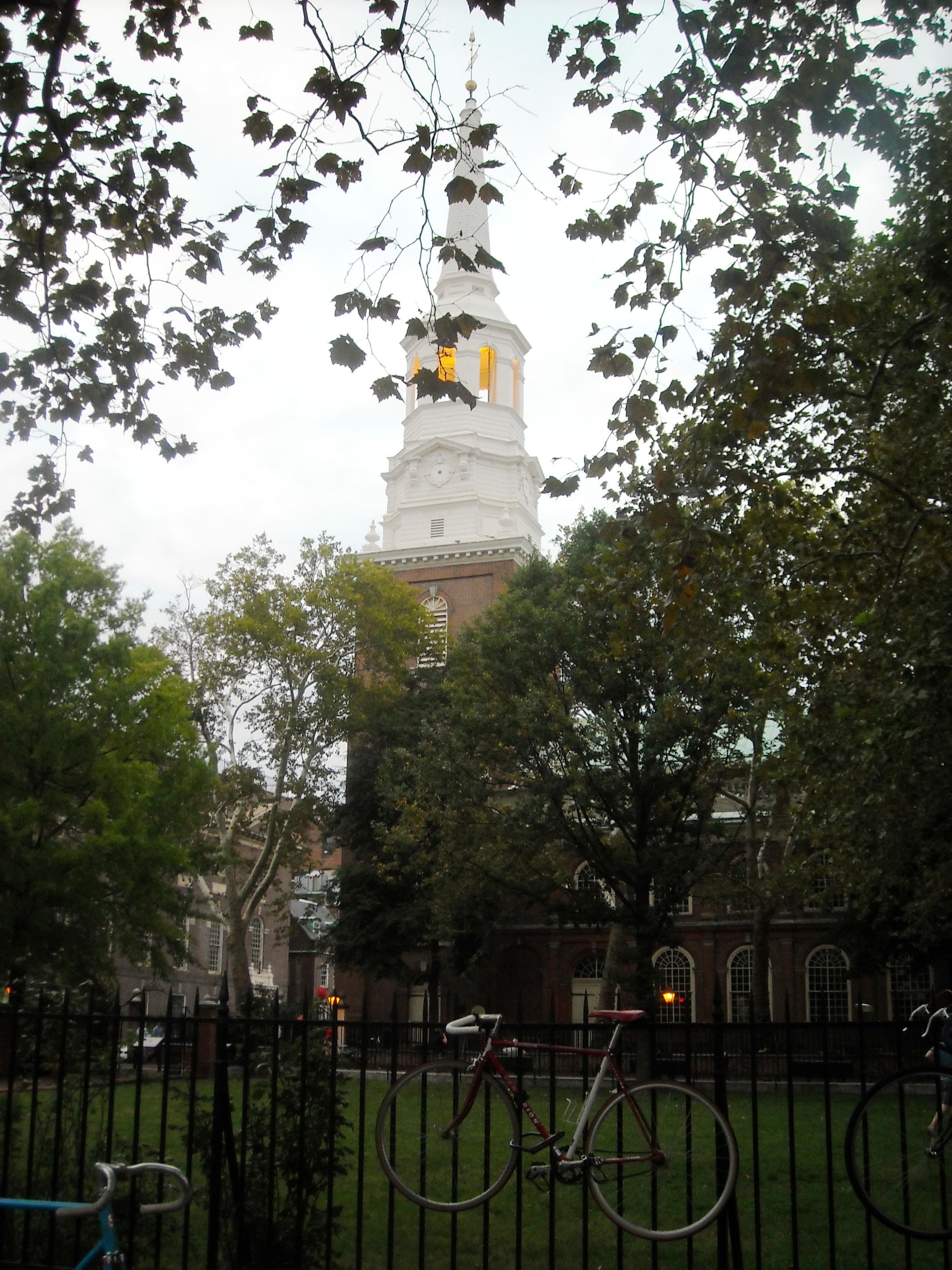
That decision produced the building you see today. The main body of the church was constructed between 1727 and 1744, and it is still considered one of the finest surviving examples of Georgian architecture in America — a symmetrical, classical design modeled on the London churches of Sir Christopher Wren, supervised by the physician and builder John Kearsley, who was likely also responsible for much of the design. Step back from the corner of 2nd and Church Streets and the proportions announce themselves at once: red brick, arched windows, a pedimented facade, and above it all the tower and steeple that would make the church famous.
The steeple that towered over America
The steeple was not part of the original build. It was added in 1754, financed in part by a lottery organized by Benjamin Franklin — the same Franklin who sat in these pews — and when it was finished, Christ Church stood 196 feet tall, the tallest building in North America. It held that distinction for decades, until the mid-19th century, and the fact still stops visitors short: in 1754, the tallest thing on the continent was not a capitol or a fortress but a parish church in Philadelphia, paid for in part by a lottery run by a printer.
The steeple matters for more than its height. It is how you find the church, rising over the low brick rooflines of Old City, and it is the reason the building photographs so well from almost any angle in the neighborhood. It also marks the church's ambition. A congregation that builds the tallest structure on the continent is not building a chapel. It is announcing that Philadelphia, and its Anglican parish, intend to matter. Within twenty years of the steeple's completion, the men who worshipped beneath it would be deciding whether to break with Britain altogether.
Fifteen signers, one congregation
The roster of Christ Church congregants reads like the index of a book about the founding of the United States. George Washington worshipped here when he was in Philadelphia, and his pew — marked, and still pointed out on tours — is one of the most quietly thrilling sights in the city: a plain wooden box pew, no grander than its neighbors, where the future first president sat. Benjamin Franklin was a parishioner and vestryman, and the man who organized the steeple lottery. John Adams attended. Betsy Ross, the seamstress of flag legend, worshipped here too. In all, fifteen signers of the Declaration of Independence were members of the congregation.
The church's role in the Revolution went beyond its pews. Its rector, Jacob Duché, led the opening prayers of the First Continental Congress in 1774. Its later rector, William White — rector for 57 years — served as chaplain to the Continental Congress and to the United States Senate, and in 1785 became the first Presiding Bishop of the newly independent Episcopal Church, the American church born out of the Church of England parishes that had just broken with Britain. That is why Christ Church is sometimes called the birthplace of the Episcopal Church in America: the institution was, in a real sense, organized here, by the men who led this parish.
When National Days of Prayer were declared during the Revolutionary years, Washington and the legislative bodies attended Christ Church en masse. The church was also, from its earliest decades, a place where the contradictions of colonial Philadelphia were visible: during its first century, a quarter of the city's free and enslaved Black residents were baptized here, and the parish ran a religious school for enslaved people. In 1794, Absalom Jones — who had worshipped at Christ Church — was ordained as the country's first African American Episcopal priest, after founding the African Episcopal Church of St. Thomas with Richard Allen. The full story of the church includes those baptisms, that school, and that ordination, not only the famous pews.
Inside: Palladian windows, the wineglass pulpit, and Penn's font
The interior is the reason to go inside rather than admire the steeple from the street. It is a handsome, light-filled Georgian room: fluted columns, rows of wooden box pews, and tall Palladian windows — the arched, three-part windows named for the Renaissance architect Andrea Palladio — that flood the nave with daylight. The effect is elegant without being ornate, classical without being cold, and it is remarkably intact. You are looking at an 18th-century room, not a reconstruction of one.
Three features repay a slow look. The first is the wineglass pulpit, built in 1769 by the Philadelphia cabinetmaker Thomas Folwell. It takes its name from its shape: a slender stem rising to a flared sounding board above, like a wineglass in profile, and it is one of the finest pieces of colonial woodwork in the country. The second is the great chandelier, hanging from the ceiling since its installation in 1740, still in use. The third is the baptismal font — a 14th-century stone font sent to Philadelphia in 1697 from All Hallows-by-the-Tower in London, the church where William Penn himself had been baptized. It is still in use at Christ Church today, which means the font that baptized Pennsylvania's founder now baptizes Philadelphia children three centuries later. Look for it near the rear of the church, and remember that it predates the building around it by more than three hundred years.
The church also holds communion silver presented by Queen Anne around 1710, and its archives and artifact collection are among the richest of any American parish. Guided tours, usually lasting 20 to 30 minutes, are offered when services are not in session, and volunteers are often on hand to point out the details — Washington's pew, the font, the pulpit — that are easy to walk past without a guide. A self-guided visit works well too, but the guided tour is worth it for the stories attached to each object.
The burial ground is a different place — and worth the walk
One point of confusion is worth clearing up before you visit, because even good guides sometimes blur it. The church building at 2nd and Church Streets has its own small churchyard, where two signers of the Declaration are buried. But the famous burial ground — the one with Benjamin Franklin's grave — is a separate site, Christ Church Burial Ground, a few blocks away at the corner of 5th and Arch Streets. Do not expect to find Franklin's grave beside the church. It is a short walk west, and it is very much worth making.
The burial ground at 5th and Arch is the final resting place of more than 4,000 people, including five signers of the Declaration of Independence, among them Franklin and his wife Deborah. Franklin's grave is visible from the street through a gated opening in the brick wall at Arch Street, and visitors have long tossed pennies onto the flat ledger stone in homage to his maxim "a penny saved is a penny earned" — so many that the stone is often speckled with coins. The burial ground is a quiet, tree-shaded contrast to the church itself: a walled garden of old stones in the middle of Old City, and the right second stop after the church. The two sites together tell the story better than either alone — the place the Founders worshipped, and the place where several of them rest.
Old City around the church
Christ Church sits in the heart of Old City, the most walkable historic neighborhood in America, and it anchors a day as naturally as Independence Hall does. Elfreth's Alley, the oldest continuously inhabited residential street in the country, is a few blocks north. The Betsy Ross House is a short walk away. Independence Hall and the Liberty Bell are about a ten-minute walk south, and Franklin Court — the site of Franklin's house, with its ghost frame outline and museum — is nearby. The neighborhood's brick streets, 18th-century rowhouses, galleries, and cafes make it easy to spend a whole afternoon here without ever leaving the colonial city plan.
That walkability is part of the church's appeal. Unlike a museum you visit and leave, Christ Church is a place you pass on the way to somewhere else in Old City, and then stop at, and then build the rest of the day around. Come in the morning, when the light comes through the Palladian windows, and follow the visit with the burial ground, Elfreth's Alley, and a coffee on a brick side street. Or come late in the day, when the steeple catches the evening light over 2nd Street, and understand why the tallest building in colonial America was a church.
Why Christ Church endures
Historian David McCullough once said that no other church played a more significant role in the nation's birth, and the claim is hard to argue with. Christ Church was not a backdrop to the Revolution. It was where the Revolution's leaders prayed, where its chaplains served, where its new national church was organized, and where several of its signers are buried. It was also, at 196 feet, the tallest building on the continent — a physical fact that captures the ambition of the city that built it.
For a first-time visitor, the church offers something Independence Hall cannot: not the room where a document was signed, but the room where the signers sat on ordinary Sundays, in ordinary pews, listening to sermons and singing hymns, in a building that is still used for exactly that purpose every week. Christ Church remains an active Episcopal parish, not a museum, and that is the point. The doors are open, the pews are in use, the font still baptizes, and the steeple still rises over Old City — the Nation's Church, still at work, more than three centuries after its founding.
Key Facts
Christ Church was founded in 1695 as the first parish of the Church of England in Pennsylvania; the first church on the site, a modest brick-and-wood building, was raised in 1696.
The current Georgian church was built between 1727 and 1744, modeled on the London churches of Sir Christopher Wren, with construction supervised by John Kearsley, who was likely also responsible for much of the design.
The tower and steeple were added in 1754, financed in part by a lottery organized by Benjamin Franklin; at 196 feet (60 m), Christ Church was then the tallest building in North America, a distinction it held for decades.
Christ Church is known as "the Nation's Church" because its congregants included George Washington, Benjamin Franklin, John Adams, and Betsy Ross, and fifteen signers of the Declaration of Independence in all.
Rector Jacob Duché led the opening prayers of the First Continental Congress in 1774; rector William White served as chaplain to the Continental Congress and the U.S. Senate and in 1785 became the first Presiding Bishop of the Episcopal Church.
The interior features Palladian windows, fluted columns, and wooden box pews; the wineglass pulpit was built in 1769 by Philadelphia cabinetmaker Thomas Folwell; the chandelier has hung in the church since 1740.
The baptismal font is a 14th-century stone font sent to Philadelphia in 1697 from All Hallows-by-the-Tower in London, the church where William Penn was baptized; it remains in use at Christ Church.
Communion silver presented by Queen Anne (around 1710) is among the church's historic holdings.
Absalom Jones, who worshipped at Christ Church, was ordained in 1794 as the country's first African American Episcopal priest.
The church building is at 20 North American Street / 2nd and Church Streets in Old City; the Christ Church Burial Ground, where Benjamin Franklin is buried, is a separate site at 5th and Arch Streets, where more than 4,000 people rest, including five signers of the Declaration of Independence.
Christ Church is a National Historic Landmark and remains an active Episcopal parish, drawing roughly 250,000 visitors a year.
Visitor Details
Address: Christ Church, 20 North American Street (at 2nd and Church Streets), Philadelphia, PA 19106, in Old City. The separate Christ Church Burial Ground is at 5th and Arch Streets, a short walk west of the church.
Transit: The church is in walkable Old City; the 2nd Street station on the Market-Frankford Line (L) and several bus routes serve the area, and Independence Hall and the Liberty Bell are about a ten-minute walk south. The neighborhood is best explored on foot.
Hours/Admission: Hours, admission, and tour arrangements change from time to time, and the burial ground and church may keep different schedules — check the official source at christchurchphila.org before visiting to confirm current hours, any admission arrangements, and guided-tour times. Do not rely on a fixed price or fixed hours quoted elsewhere.
Best timing: Visit in the morning for light through the Palladian windows and the quietest interior, and allow time for a guided tour (usually 20–30 minutes) when services are not in session. Pair the church with the burial ground at 5th and Arch, Elfreth's Alley, the Betsy Ross House, and Independence Hall and the Liberty Bell, all within walking distance.
Location Photography