The nation's attic, on the Mall
There is a particular hush that falls over first-time visitors to the National Museum of American History, and it usually falls in the same place: the dim, climate-controlled gallery at the heart of the second floor, where the original Star-Spangled Banner hangs behind glass, enormous even now, its stars and stripes faded by two centuries of light, weather, and handling. People lower their voices without being told. Children who have been racing through the atrium go quiet. It is, quite simply, the most famous flag in America, in the room built to protect it — and it is the reason this museum, more than any other building on the National Mall, feels less like a museum than like a national attic, a place where the country keeps the things it cannot bear to throw away.
The museum holds more than three million objects, from George Washington's uniform to Dorothy's ruby slippers, from the first Teddy bear to a lunch counter from Greensboro, North Carolina. No other single building in Washington tries to tell the whole American story — social, political, cultural, scientific, and military — through the objects Americans actually touched, wore, drove, played with, and fought over. That ambition is both the museum's glory and its challenge: you cannot see it all in a day, and you should not try. The art of visiting here is choosing your threads — the flag, the presidency, the fight for rights, the machines that moved the country — and following them through three floors of galleries that reward curiosity at every turn.
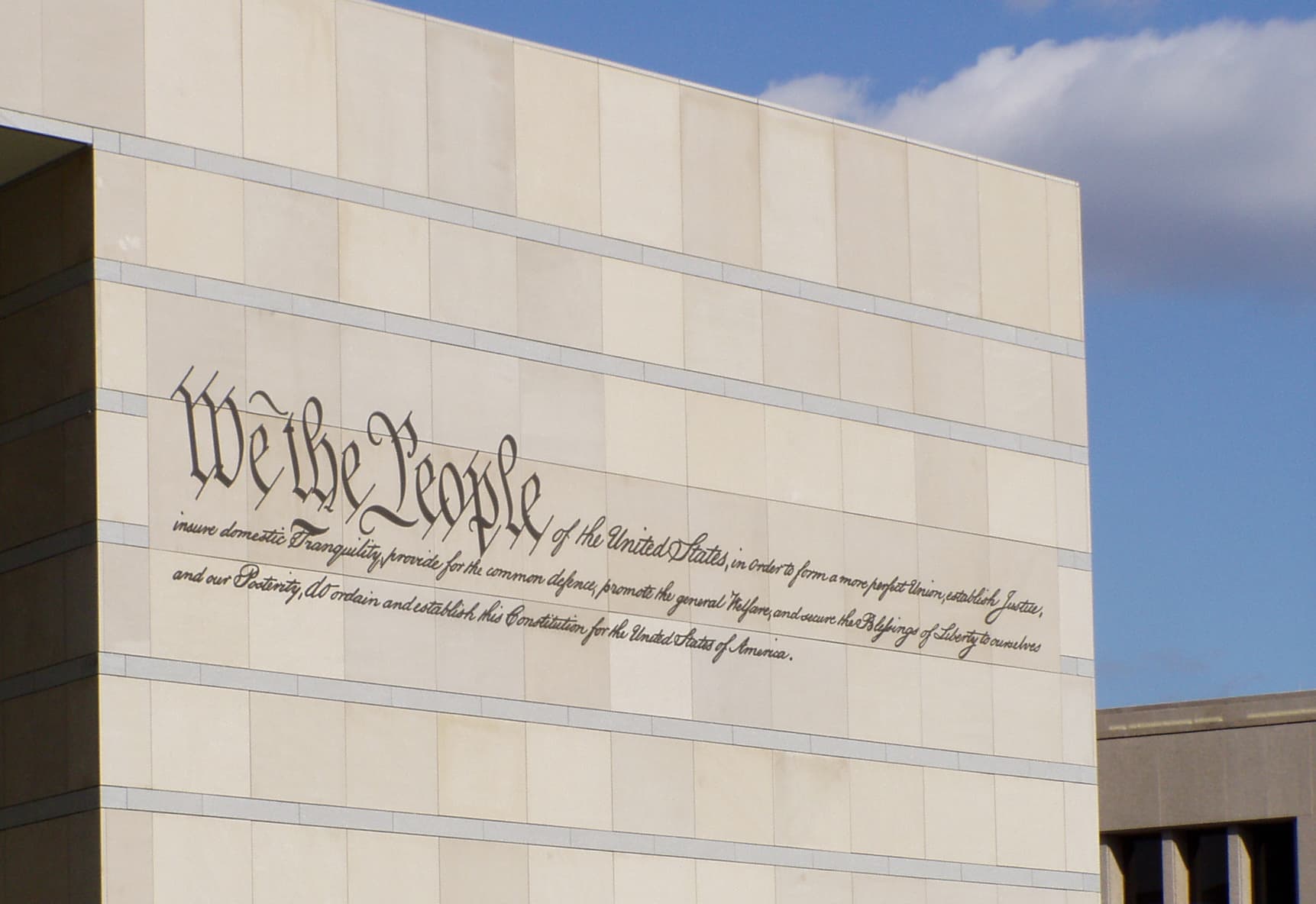
What makes the museum a signature Washington sight, the equal of the monuments outside its doors, is that its treasures are not abstractions. The Constitution and the Declaration live down the Mall at the National Archives, behind glass and guards, as ideas made law. Here, the American story is told in things: a flag sewn by a Baltimore flagmaker, a gown worn to an inauguration ball, a locomotive, a lunch counter, a kitchen reassembled piece by piece. You do not just learn American history here. You stand next to it.
1964: the Museum of History and Technology
The museum opened in January 1964 as the Museum of History and Technology, one of the last structures designed by the renowned architectural firm McKim, Mead & White. Its site, on Constitution Avenue between 12th and 14th Streets, had previously held two temporary war buildings put up in 1942, the kind of structures that were supposed to be torn down after the war and somehow never were. The new building was a statement of intent: the Smithsonian, which had collected American historical objects since the 19th century — many of them previously housed in the Arts and Industries Building and what is now the National Museum of Natural History — finally had a purpose-built home for the nation's material memory.
The name did not last. In 1980, a bill signed by President Jimmy Carter changed the museum's name to the National Museum of American History, a title that better matched what the collections had become: not a museum of machines alone, but a museum of the American people in all their variety. The building itself was renamed in turn for Kenneth E. Behring, the real estate developer whose $80 million pledge in 2000 helped fund its reinvention. A major renovation from 2006 to 2008 added a five-story skylit atrium and a grand staircase, and — most importantly — built the environmentally controlled chamber that now houses the Star-Spangled Banner. A further renovation of the west wing, begun in 2012, added new exhibition spaces, public plazas, and an education center, with its floors reopening in stages between 2015 and 2017.
The museum's first director, Frank A. Taylor, had overseen the move of the great locomotive 1401 into the building while its walls were still going up in 1961 — a 280-ton Southern Railway Pacific-type passenger locomotive, built in 1926, that had to be eased into place on a pulley system before the building closed around it. That image, of a machine too big for the doors, is a fitting emblem for the whole institution: the collection has always been slightly too large, too various, and too beloved to fit neatly anywhere, and the building has been growing around it ever since.
The Star-Spangled Banner: the flag at the center
Every visit should begin, or at least pause longest, at the flag. The Star-Spangled Banner is the 15-star, 15-stripe garrison flag that flew over Fort McHenry in Baltimore during the British bombardment of September 13–14, 1814. It was sewn in 1813 by Baltimore flagmaker Mary Young Pickersgill and her assistants, and it measured roughly 30 by 42 feet when new — large enough, by design, for the British to see it from miles away. On the morning of September 14, after a night of shelling, the American lawyer Francis Scott Key, detained aboard a British ship, saw the great flag still flying over the fort and wrote the poem "Defence of Fort M'Henry," which became "The Star-Spangled Banner" and, eventually, the national anthem.
The flag came to the Smithsonian in 1912, a gift from Eben Appleton, the grandson of Fort McHenry's commanding officer, Colonel George Armistead; for decades before that it had remained in the Armistead family, who occasionally cut pieces from it as souvenirs — one reason the flag is smaller today than it was in 1814, and why one of its stars is missing. It was restored in 1914 and again in a major conservation effort completed in 2008, when it moved into its current chamber. The gallery is kept dim and cool to protect the fragile wool and cotton, and photography of the flag itself is not permitted; an interactive display across the room offers a full-size digital reproduction that visitors can explore by touch, learning the story of each star, stripe, and repair.
Stand in that room and the museum's whole argument comes into focus. The flag is not displayed as a relic of a war. It is displayed as a working object that survived a night of bombardment, a century of family keepsakes, and two restorations — and that still, somehow, means something to everyone who walks in. Few museum experiences in America are as quietly moving, and none is as central to what this building is for.
The American Presidency and the First Ladies
If the flag is the museum's heart, the presidency galleries are its spine. The American Presidency exhibition traces the office from George Washington to the present through the objects presidents actually used: campaign memorabilia, inaugural gowns and accessories, presidential china, and the tools of the job. Its signature artifact is Horatio Greenough's colossal statue of George Washington, sculpted in 1840 for the Rotunda of the United States Capitol to mark the centennial of Washington's birth — a half-draped, toga-clad Washington that startled 19th-century visitors and still startles today, a reminder that the young republic imagined its first president in the heroic language of Rome.
Nearby, the First Ladies exhibition is one of the museum's most beloved traditions, and one of its oldest: First Ladies' gowns were collected by the Smithsonian as early as 1912 and displayed in the Arts and Industries Building before they moved to this museum in the 1960s. The exhibition pairs inaugural gowns with the stories of the women who wore them, from Martha Washington onward, and it draws some of the museum's largest and most loyal crowds. The gowns are not presented as fashion alone. Each one is a window onto a moment — a war, a depression, an assassination, a cultural shift — and onto the unelected, often underestimated role that presidential spouses have played in American public life. It is, in its quiet way, one of the most feminist rooms in Washington: a history of power told through the women who stood beside it, and sometimes steered it.
The presidency galleries also hold the harder stories. The museum does not flinch from the fact that the office has been held during slavery, segregation, war, and scandal, and its exhibitions on the presidency sit in conversation with the galleries on civil rights and protest elsewhere in the building. That willingness to show the whole record — the triumphs and the failures, side by side — is what separates a national museum from a national monument.
Within these walls: rights, protest, and the Greensboro lunch counter
The second floor's other great landmark object sits within sight of the flag, and the pairing is deliberate. The Greensboro lunch counter is an eight-foot section, with four stools, of the F. W. Woolworth lunch counter in Greensboro, North Carolina, where on February 1, 1960, four North Carolina A&T students — Ezell Blair Jr. (now Jibreel Khazan), Franklin McCain, Joseph McNeil, and David Richmond — sat down at the "whites only" counter, politely asked for service, and, when refused, stayed in their seats in protest. Over the following six months, hundreds of students, civil rights organizations, churches, and community members joined the protest and boycotted the store, and on July 25, 1960, the lunch counter was desegregated.
When the Greensboro Woolworth's closed in 1993, museum curators negotiated with the company and the local community, and a section of the counter was donated to the Smithsonian in 1994; volunteers from the local carpenters' union removed it, and it has been on display ever since. Curators placed it within view of the Star-Spangled Banner on purpose: the flag that inspired the anthem and the counter where four young men demanded that the anthem's promises apply to them, in the same field of vision. It is one of the most powerful juxtapositions in any American museum, and it works precisely because both objects are real — not replicas, not dioramas, but the actual counter and the actual flag.
Around these landmarks, the museum's galleries on American ideals, democracy, and the struggle for rights widen the story: the fight for the vote, the labor movement, immigration, and the changing meaning of citizenship. The artifact walls that line the first and second floor center cores — 275 feet of glass-fronted cases organized by theme, from arts and popular culture to business, medicine, technology, and America's role in the world — let visitors browse the collection the way they might browse a library, one surprising object at a time.
Machines that moved America: transportation and innovation
The museum began life as a museum of history and technology, and its technology galleries remain among its strongest. The first floor's America on the Move exhibition tells the story of transportation — from the 1831 John Bull locomotive, one of the oldest surviving steam locomotives in America, to automobiles, streetcars, and the highway culture that reshaped the country's geography — through full-size vehicles set into streetscapes that recreate the world they moved through. It is a gallery that children love and adults linger in, because the machines are not behind ropes: they are life-size, in context, and unmistakably real.
The innovation story continues in the galleries on invention, business, and everyday life. The museum holds the apparatus of Herman Hollerith's tabulating machines, ancestors of the modern computer; the tools of American workshops and factories; and the domestic objects — kitchens, appliances, toys — through which ordinary life changed. Julia Child's kitchen, removed from her Cambridge home in 2001 and reassembled here piece by piece, complete with her copper pans and handwritten recipe cards, is a perennial favorite: a working kitchen that taught a generation of Americans to cook French food, preserved exactly as she left it.
On the third floor, The Price of Freedom: Americans at War traces the nation's military history, anchored by the 1776 gunboat Philadelphia, sunk in the Battle of Valcour Island during the Revolutionary War and raised from Lake Champlain in 1935 — the oldest surviving American fighting vessel. Nearby, Entertainment Nation explores how film, music, sports, and theater have shaped American identity, from Dorothy's ruby slippers to costumes from Hamilton. The museum's argument, across all these galleries, is consistent: American history is not only made in capitols and battlefields. It is made in kitchens, workshops, ballparks, and movie theaters, too.
Visiting the National Museum of American History well
The museum rewards a plan, not a marathon. Two to three hours covers a satisfying visit; a full day still leaves galleries unseen. Start at the Star-Spangled Banner on the second floor — go early, before the crowds gather — then choose two or three threads and follow them: the presidency and First Ladies, the Greensboro counter and the democracy galleries, and one of the big machine galleries, America on the Move or The Price of Freedom. Save the artifact walls for browsing between galleries; they are the museum's best argument for slowing down.
Then step outside and let the Mall do its work. The museum sits between the National Museum of Natural History to the east and the National Museum of African American History and Culture to the west, with the Washington Monument rising to the south across Madison Drive. Pair it with either neighbor, or with the National Archives down Constitution Avenue, where the Declaration and the Constitution wait. From the museum's Constitution Avenue entrance, the whole logic of the Mall is laid out in front of you: a nation's memory, kept in public, free to anyone who walks in. That is the National Museum of American History's real exhibit, and it costs nothing to see.
Key Facts
The museum opened in January 1964 as the Museum of History and Technology, one of the last structures designed by the architectural firm McKim, Mead & White, on a site that had previously held two temporary war buildings constructed in 1942.
In 1980, a bill signed by President Jimmy Carter renamed it the National Museum of American History; the building is also known as the Kenneth E. Behring Center.
It is located at 1300 Constitution Avenue NW, between 12th and 14th Streets, on the National Mall in Washington, DC, at coordinates 38.8911° N, 77.0300° W.
The museum received 2.1 million visitors in 2023, making it one of the most visited museums in the United States.
The original Star-Spangled Banner, sewn in 1813 by Mary Young Pickersgill and her assistants, flew over Fort McHenry during the British bombardment of September 13–14, 1814, inspired Francis Scott Key's poem, and was given to the Smithsonian in 1912 by Eben Appleton, grandson of Colonel George Armistead. It is displayed in a dim, climate-controlled chamber on the second floor.
A renovation from 2006 to 2008 added a five-story skylit atrium and the Star-Spangled Banner chamber; a west wing renovation begun in 2012 added exhibition spaces, public plazas, and an education center, reopening in stages from 2015 to 2017.
The Greensboro lunch counter section on display — four stools and eight feet of counter — is from the F. W. Woolworth store in Greensboro, North Carolina, where four North Carolina A&T students staged a sit-in on February 1, 1960; the counter was desegregated on July 25, 1960, and the section was donated to the Smithsonian in 1994.
Horatio Greenough's statue of George Washington, sculpted in 1840 for the Rotunda of the United States Capitol, is the signature artifact of the presidency galleries on the second floor.
First Ladies' gowns have been collected by the Smithsonian since 1912 and were displayed in the Arts and Industries Building before moving to this museum in the 1960s.
The 1776 gunboat Philadelphia, sunk at the Battle of Valcour Island and raised from Lake Champlain in 1935, is the oldest surviving American fighting vessel and anchors the third floor's military history galleries.
The 1831 John Bull locomotive and the 1926 Southern Railway locomotive 1401, moved into the building in 1961 while it was still under construction, anchor the museum's transportation story.
Julia Child's kitchen, removed from her Cambridge home in 2001, was reassembled in the museum complete with her cookware and recipe cards.
The museum's director is Anthea M. Hartig, and its official website is americanhistory.si.edu.
Visitor Details
Address: 1300 Constitution Ave NW, Washington, DC 20560 (between 12th and 14th Streets NW, on the National Mall)
Transit: Metrorail Federal Triangle station (Blue, Orange, Silver lines) is the closest stop, a short walk to the Constitution Avenue entrance; the Smithsonian station is also nearby. Several Metrobus routes serve Constitution Avenue and the Mall.
Hours/Admission: Admission is free, verified against the Smithsonian's official site in this session (si.edu states "Admission is free" and the museum's own site lists "Free admission"). The Smithsonian's official listing gives hours as daily except December 25, 10 a.m. to 5:30 p.m.; check americanhistory.si.edu before visiting, as hours can change.
Best timing: Arrive at opening and go straight to the Star-Spangled Banner gallery before crowds build, then pick two or three gallery threads rather than trying to cover all three floors. Pair the visit with the neighboring National Museum of Natural History or the National Museum of African American History and Culture, or walk to the National Archives for the Declaration and Constitution.
Location Photography