The museum the Constitution itself chartered
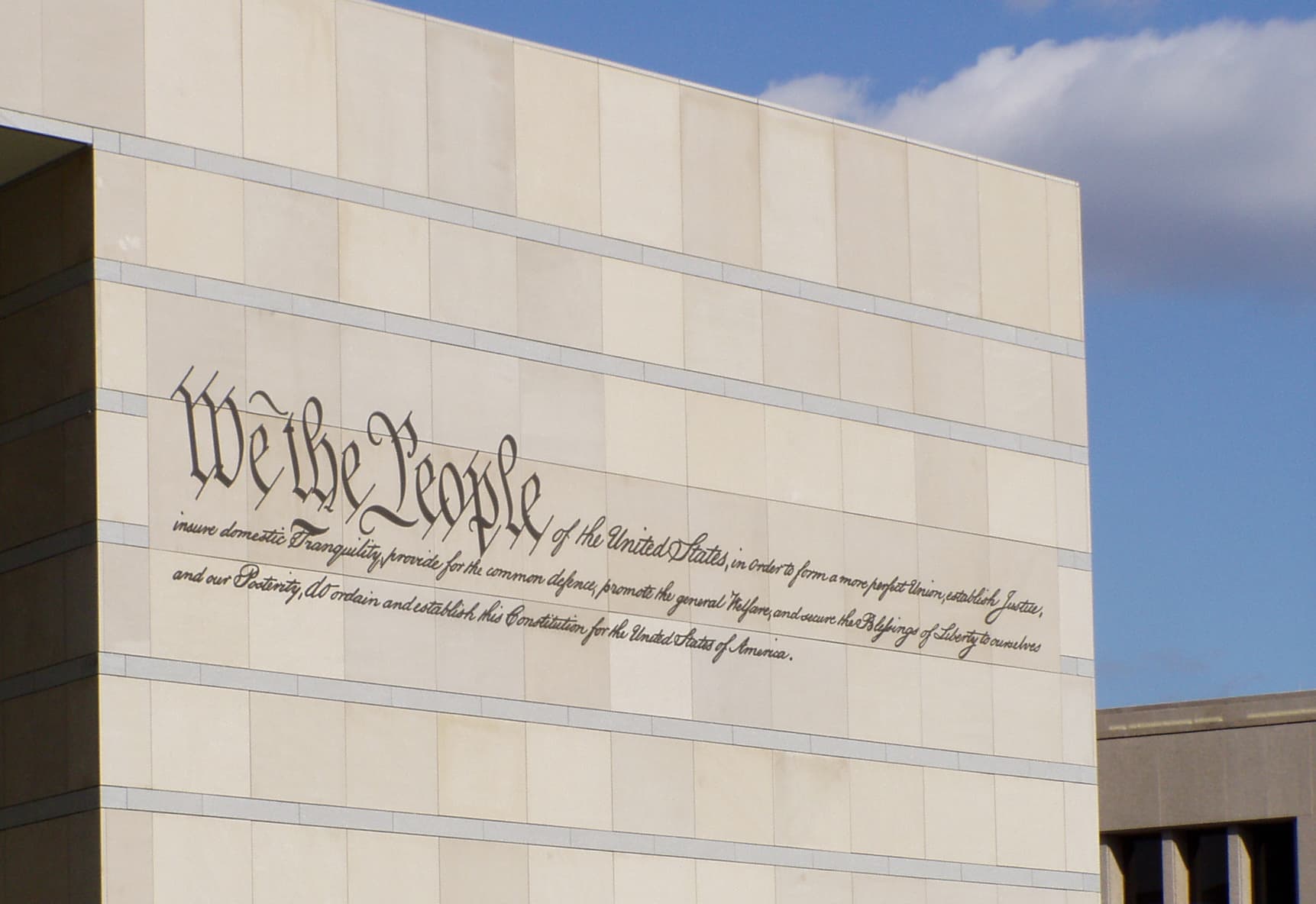
Stand on the north end of Independence Mall in Philadelphia and look south: past the lawns and the Liberty Bell Center, your eye lands on Independence Hall, the red-brick building where the Constitution was debated and signed in the summer of 1787. Turn around, and you face its modern counterpart — a broad, light-filled building of banded Indiana limestone and glass, its facade carrying the Constitution's opening words in oversized script: "We the People." This is the National Constitution Center, and it is the only institution in America that Congress itself chartered to explain the Constitution to the American people.
The Center exists because of an act of Congress, not just a good idea. The Constitution Heritage Act of 1988, approved on September 16, 1988, and signed by President Ronald Reagan, defined the Center as lying "within or in close proximity to Independence National Historical Park" and charged it with a mission stated in deliberately nonpartisan terms: to "disseminate information about the United States Constitution on a non-partisan basis in order to increase the awareness and understanding of the Constitution among the American people." That mandate — education, not advocacy — is the reason the Center has been able to host presidential debates, Supreme Court justices, and school groups in the same rooms without becoming a mouthpiece for any of them.
The idea had been waiting a long time. A museum to celebrate the Constitution was first proposed around the document's centennial in 1887, and the idea was revived for the bicentennial in 1987. But it took the 1988 act, a public-private partnership, and more than a decade of fundraising and construction before ground was broken on September 17, 2000 — the 213th anniversary of the signing of the Constitution, with President Bill Clinton attending the ceremony. The Center opened on July 4, 2003, joining the historic sites of what is often called "America's most historic square mile."
Its address is itself a small piece of constitutional trivia: 525 Arch Street. The number was chosen because May 25 — 5/25 — was the date in 1787 on which the Constitutional Convention began in Philadelphia.
Limestone, glass, and a deliberate restraint
The building was designed by Pei Cobb Freed & Partners, with Henry N. Cobb as the partner in charge, and it was given one of the hardest design briefs in American civic architecture: anchor the north end of Independence Mall, complement Independence Hall without overshadowing it, and hold thousands of visitors a day. The result is a study in deliberate restraint. The public space totals 160,000 square feet, including 75,785 square feet of exhibit space, built from American materials — 85,000 square feet of Indiana limestone, 2.6 million pounds of steel, and a half-million cubic feet of concrete — at a construction cost of about $137.5 million.
The facade's most distinctive feature is its banded stone: large pieces of buff Indiana limestone broken up by narrower horizontal bands of light gray Chelmsford granite. The limestone pieces run three feet high; the granite bands, eight inches. The pattern gives the big building a human scale and, as project architect Craig Dumas put it, "a basic design module that breaks up the mass and provides continuity between the exterior and interior." The great front porch — about 40 feet high and 140 feet wide — is roughly the height and width of the central section of Independence Hall, a deliberate echo across the Mall. And on the limestone wall beside the porch, the Preamble is inlaid in painted stainless steel in large scroll script, replicating the handwriting of the original document: "We the People of the United States, in order to form a more perfect union..."
Critics noticed the restraint. Witold Rybczynski wrote in The New York Times that the building was "quiet but assertive, respectful of its surroundings, considerate of its public, this building is destined to take its place among the nation's leading public monuments." George Will, writing in The Washington Post, called it "a modernist jewel of America's civic life" at the far end of the Mall. The glass matters as much as the stone: the design's expanses of glass were meant to symbolize openness and transparency — the idea that a government of the people should be visible to the people.
Freedom Rising: the Constitution as theater
Every visit to the Center is designed to begin the same way: in the Kimmel Theater, a 350-seat star-shaped theater on the ground floor, for "Freedom Rising," a 360-degree live-actor and multimedia production that tells the story of the Constitution from its framing to the present day. A live actor narrates from the center of the room while film and images sweep around the circular screen, carrying the audience from the Constitutional Convention through the Civil War, the expansion of voting rights, and the civil rights era. It runs about fifteen minutes, and it sets the Center's tone: this is not a museum where you read plaques in silence. It is a museum where the document is performed, argued over, and brought into the present.
From the theater, visitors move upstairs to the main exhibition, "The Story of We the People," which fills the second floor. The gallery is organized as two experiences in one. An outer ring chronicles why America has a Constitution at all — the chronology of constitutional history, from the failures of the Articles of Confederation through the Convention, ratification, and the amendments that followed. An inner ring is hands-on: it shows how the Constitution works, with interactive exhibits that let you cast a vote in a voting booth, take the presidential oath at a podium, sit at a Supreme Court bench and rule on a case, and explore the balance of powers among the three branches.
The artifacts along the way are chosen to make abstract principles concrete: a chair from the First Congress in 1790, shackles from slavery, a copy of the Emancipation Proclamation. The gallery's "American National Tree" uses touchscreens to highlight one hundred citizens who have shaped America's constitutional history. And the Center is candid about one thing visitors often ask: the original Constitution is not here. It is housed at the National Archives in Washington, D.C. What the Center does hold includes rare early printings — among them a copy of the Pennsylvania Packet, the first public printing of the Constitution — and rotating treasures from the Historical Society of Pennsylvania and other lending institutions, including drafts in James Wilson's own hand showing how the Preamble evolved from a document drafted in the name of the confederated states into one that begins "We the People."
Signers' Hall: 42 founders, frozen mid-argument
The visit ends, as it should, in Signers' Hall — the Center's most popular room and one of the most photographed interiors in Philadelphia. The hall recreates the Assembly Room of the Pennsylvania State House (now Independence Hall) on the final day of the Constitutional Convention, and it is filled with 42 life-size bronze statues of the delegates who were present: the 39 who signed the Constitution on September 17, 1787, and the three who refused — George Mason, Edmund Randolph, and Elbridge Gerry, set slightly apart from the rest, as dissenters were.
The statues were created by artists at StudioEIS in Brooklyn, who worked from portraits and written descriptions to make the likenesses as accurate as possible. George Washington stands presiding at the front; Benjamin Franklin sits with his cane; James Madison and Alexander Hamilton are mid-conversation. Visitors are invited to walk among them, pose beside a favorite framer, and shake a bronze hand. Each statue has a nameplate at its feet, so you can identify every delegate — and notice, as docents like to point out, just how short or tall the founders actually were. The room's power is its refusal to idealize: these are not marble gods on pedestals but men caught in a moment of conviction, compromise, and doubt, arguing over representation, federal power, and slavery — the same arguments the Center's exhibits trace into the present.
Elsewhere in the building, the Center's role as "America's Town Hall" is on full display. The Grand Hall Overlook, with the flags of the states suspended above it, looks out over Independence Mall toward Independence Hall. The Center has hosted a 2008 Democratic presidential primary debate between Hillary Clinton and Barack Obama, a town hall with Senator John McCain, and a 2006 Pennsylvania Senate debate between Rick Santorum and Bob Casey. On September 10, 2024, it hosted the second presidential debate of that cycle — the first debate between Donald Trump and Kamala Harris, and the first time the two candidates had ever met. In 2006, the Center also became the home of the Philadelphia Liberty Medal, the annual award established in 1988 to honor men and women of courage and conviction who strive to secure the blessings of liberty around the world.
A museum that keeps arguing
The Center's third identity, alongside museum and town hall, is as a headquarters for civic education. Its Interactive Constitution project, launched online in 2015, brings together scholars from across the legal and philosophical spectrum to explain nearly every provision of the Constitution — where they agree, and where they do not — and it has made the Center's website one of the most visited museum websites in the country. Its Annenberg Center for Education and Outreach develops lesson plans and teaching tools used in classrooms nationwide.
That educational mission has kept the building evolving. In 2021, the Freedom Forum donated the four-story First Amendment facade from Washington's former Newseum — the stone panel inscribed with the First Amendment's text — for display in the Center's second-floor atrium. New galleries have taken on the Civil War and the 19th Amendment, and the Center's theater programs have told lesser-known histories, including the Black experience after the Civil War. The building that opened in 2003 as a museum of a single document has become, in practice, a museum of the argument the document started — and never finished.
That is the right way to visit it. Come for Signers' Hall and Freedom Rising, but stay for the argument: the voting booth, the oath, the Supreme Court bench, the dissenters standing apart in the corner of the hall. The Center's own charter says its job is to increase the awareness and understanding of the Constitution "on a non-partisan basis." Two blocks from where the document was signed, it does that job the way the framers did theirs — in public, in person, and with the disagreement left visible.
Key Facts
The National Constitution Center was created by the Constitution Heritage Act of 1988, approved September 16, 1988, and signed by President Ronald Reagan; its congressional charter charges it with disseminating information about the Constitution "on a non-partisan basis."
Groundbreaking was held September 17, 2000, the 213th anniversary of the signing of the Constitution, attended by President Bill Clinton; the Center opened July 4, 2003.
The Center is at 525 Arch Street, Philadelphia — the address chosen because May 25 (5/25) was the date the Constitutional Convention began in 1787.
The building was designed by Pei Cobb Freed & Partners (Henry N. Cobb, partner in charge); Ralph Appelbaum Associates designed the visitor experience. The public space is 160,000 square feet, with 75,785 square feet of exhibit space; construction cost about $137.5 million.
The facade carries the Preamble's opening words, "We the People," inlaid in painted stainless steel, and the building uses 85,000 square feet of Indiana limestone banded with Chelmsford granite.
"Freedom Rising," the Center's opening theater production, is a 360-degree live-actor and multimedia show in the 350-seat star-shaped Kimmel Theater.
The main exhibition, "The Story of We the People," includes an outer chronological ring and an inner interactive ring where visitors can vote, take the presidential oath, and sit at a Supreme Court bench.
Signers' Hall holds 42 life-size bronze statues by StudioEIS of Brooklyn: the 39 delegates who signed the Constitution plus the three dissenters — George Mason, Edmund Randolph, and Elbridge Gerry.
The Center does NOT house the original Constitution, which is kept at the National Archives in Washington, D.C.
The Center became home to the Philadelphia Liberty Medal in 2006; the award was established in 1988.
The Center has hosted major debates, including the 2008 Clinton–Obama primary debate and the September 10, 2024, Harris–Trump presidential debate — the first meeting of those two candidates.
The Center's Interactive Constitution, launched online in 2015, unites scholars across the spectrum to explain nearly every constitutional provision.
In 2021 the Freedom Forum donated the former Newseum's four-story First Amendment facade for display in the Center's second-floor atrium.
The Center drew about 817,000 visitors in 2011, and the Philadelphia Inquirer has described it as attracting about a million visitors a year.
Visitor Details
Address: National Constitution Center, 525 Arch Street, Philadelphia, PA 19106, on Independence Mall at the north end, two blocks from Independence Hall
Transit: 5th Street/Independence Hall station (Market–Frankford Line) nearby; PATCO Franklin Square station; SEPTA bus routes 38, 44, and 48; Philly PHLASH downtown loop
Hours/Admission: Hours and admission vary by season and program, and the Center hosts ticketed town-hall events — check constitutioncenter.org for current hours, admission, and timed-entry requirements before your visit rather than relying on a fixed schedule.
Best timing: Start with Freedom Rising in the Kimmel Theater, then work through The Story of We the People on the second floor, and finish in Signers' Hall — the visit flows in that order by design. Pair it with Independence Hall and the Liberty Bell Center on the same Mall walk; the three sites together tell the full arc from Declaration to Constitution.
Location Photography