A wall that is not a wall
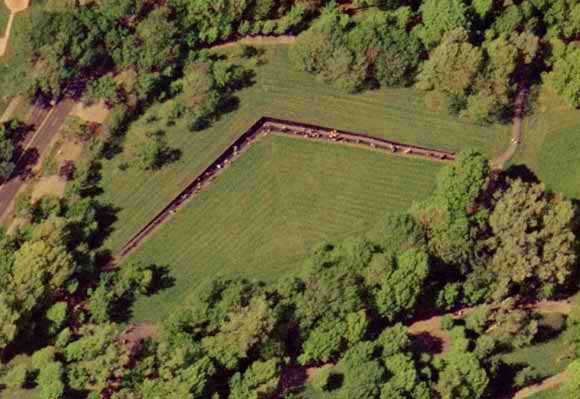
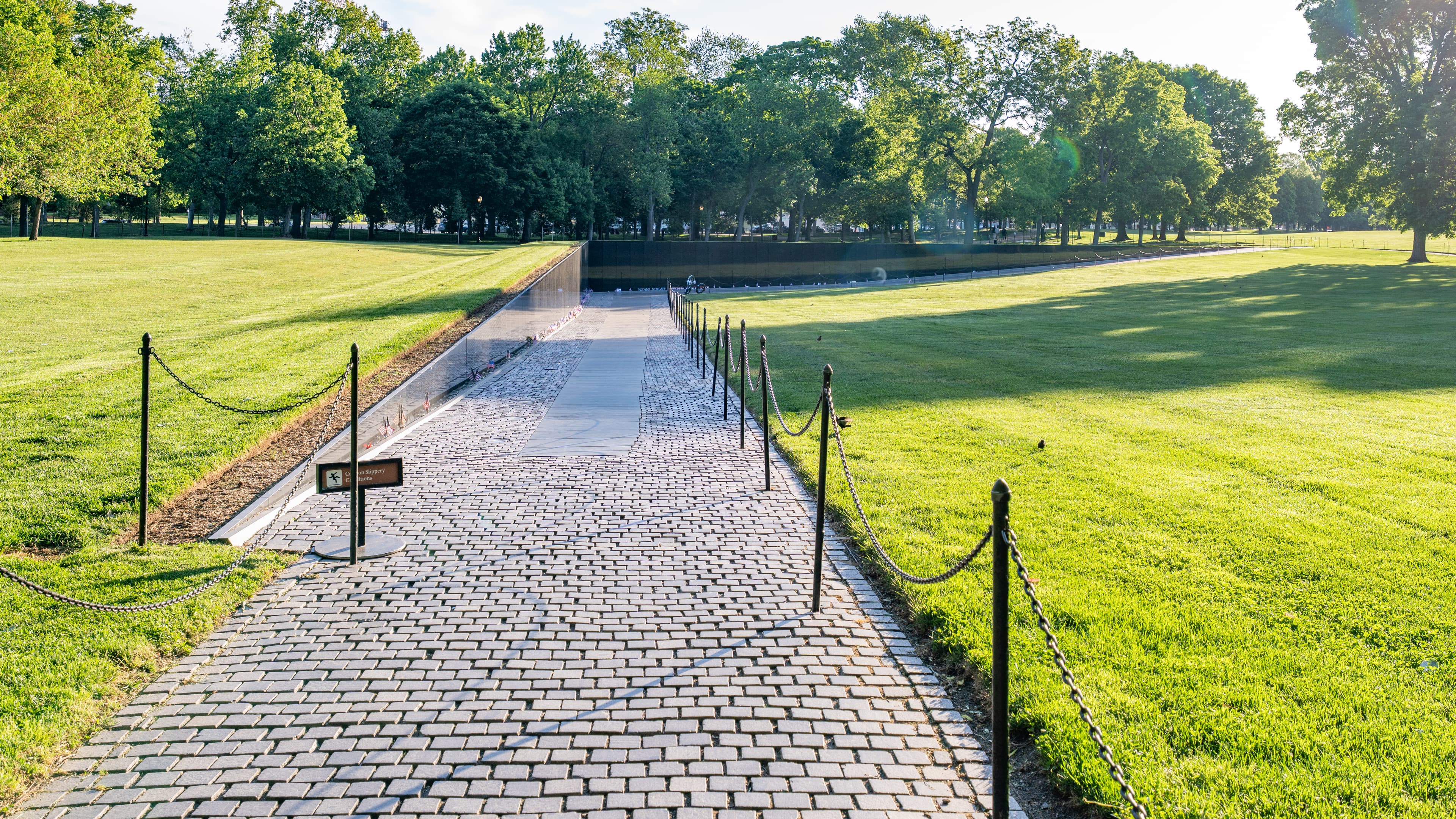
The first thing to understand about the Vietnam Veterans Memorial is that it does not look like a memorial at all, at least not in the way Washington usually builds them. There is no dome, no towering obelisk, no hero on a pedestal. Walk east from the Lincoln Memorial along the tree-lined path in Constitution Gardens and the ground itself seems to open: two long walls of polished black granite rise out of a grassy slope, meet at an angle, and sink back into the earth. The walls are low at their far ends — barely eight inches high — and grow to more than ten feet at the center, where they join. From most of the National Mall, the memorial is invisible. You have to descend into it.
That descent is the whole design. The memorial, dedicated on November 13, 1982, was the work of Maya Lin, a 21-year-old Yale architecture student who won a national design competition that drew 1,421 entries. Her proposal was radical in its restraint: a V-shaped cut in the earth, its two arms 246 feet long, each pointing toward one of Washington's great landmarks — one arm toward the Washington Monument, the other toward the Lincoln Memorial. The polished granite would carry the names of the Americans who died or remain missing from the Vietnam War, listed not by rank or branch but in the order in which they were lost. Lin described the wall as a wound in the earth that would, over time, heal. Visitors were meant to walk down into it, read the names, and walk back up into the light.
The effect on a first visit is difficult to prepare for. The granite is so highly polished that it acts as a mirror: as you read a name, you see your own face reflected beside it, and the trees and sky behind you. The memorial makes no argument and tells no story of victory. It simply presents the scale of the loss, name by name, and lets the visitor feel it. Around three million people come here every year, making it one of the most visited memorials in the country — and one of the quietest places on the Mall, despite the crowds.
The names, in the order they were lost
There are more than 58,000 names on the Wall — 58,318 at the time of dedication, with a small number added since as cases were resolved or reclassified. The ordering is the memorial's most distinctive choice, and the one that shapes how every visit unfolds. The names are arranged chronologically by the date of casualty, beginning at the center vertex, where the first and last casualties of the war meet, and running outward along each arm toward the low ends. Within each day, the names are alphabetical.
This means the Wall does not read like a monument. It reads like a timeline. The earliest names, from the late 1950s and early 1960s, sit near the center at the memorial's deepest point, where the walls tower overhead. As you walk outward, the war's escalation is written in the density of the panels: the late 1960s, when American casualties peaked, fill panel after panel with thousands of names, while the later years thin out again toward the low, quiet ends. A cross beside a name marks a service member missing in action; a diamond marks one confirmed dead. A circle around a cross marks a missing service member whose remains have since been recovered — the Wall's quiet way of keeping its record current.
Finding a single name is part of the ritual. Near the entrances, directories list every name with its panel and line number, and volunteers and park rangers help visitors locate them. Many visitors bring paper and a pencil to make a rubbing of a name, a practice that began almost immediately after the dedication and continues today. At the base of the Wall you will often see flowers, flags, letters, and photographs left beside particular names — offerings from family members, fellow veterans, and strangers. These items are collected daily by the National Park Service and preserved in an archive, a collection that has grown to hundreds of thousands of objects.
The controversy that became a consensus
It is hard, now, to remember how fiercely this design was fought over — but the fight is part of the memorial's story, and it explains why the site looks the way it does today. When Lin's design was announced in 1981, critics called it a "black gash of shame," an insult to the veterans it was meant to honor. They objected to nearly everything about it: that it was black rather than white, horizontal rather than vertical, sunk into the ground rather than rising above it, and abstract rather than figurative. The Secretary of the Interior at the time put construction on hold until a compromise was reached.
The compromise produced the two additions that now flank the Wall. In 1984, Frederick Hart's bronze statue The Three Soldiers was dedicated near the Wall's western approach: three young servicemen, in uniform and carrying weapons, gazing toward the granite panels — a traditional, figurative counterpoint to Lin's abstraction, deliberately placed so that the soldiers appear to be looking at the names. In 1993, the Vietnam Women's Memorial followed, honoring the women — above all the nurses — who served in the war: Glenna Goodacre's bronze group shows three uniformed women tending a wounded soldier, a few hundred feet south of the Wall. A flagstaff carrying the American flag and the emblems of the service branches was added as well.
What is striking, four decades on, is how completely the controversy dissolved. In 2007, the American Institute of Architects ranked the memorial tenth on its list of America's favorite architecture, and today the Wall, the statue, and the women's memorial read as a single composition rather than a compromise. The traditional elements did not diminish Lin's design; they gave visitors more than one way into the same grief. Most visitors now see all three parts in a single slow walk, and the site feels whole.
What the granite is, and why it shines
The Wall's power is inseparable from its material. The granite came from Bangalore, in southern India, chosen for its deep black color and its reflective quality; the panels were cut and fabricated in Barre, Vermont, and the names were inscribed in Memphis, Tennessee, using a photoemulsion and sandblasting process. The result is a surface that is both a page and a mirror — dark enough to read as solemn, polished enough to throw back the world around it.
That reflectivity is not an accident of the stone. Lin intended the mirror effect: the living visitor's reflection, superimposed on the names of the dead, collapses the distance between past and present. Photographers have returned to the effect ever since — the American flag reflected in the panels, visitors' faces floating among the names, the Washington Monument visible in the polished surface from certain angles. It is also why the Wall changes so dramatically with the light. At midday, the names are crisp and the reflections sharp; at dusk, the panels darken and the names seem to recede; at night, under the memorial's lighting, the Wall takes on a hushed, almost private quality. If you can, visit twice: once in daylight, once after dark.
The design's geometry rewards attention, too. Stand at the vertex and look down each arm: one frames the Washington Monument, the other the Lincoln Memorial, tying the memorial to the two poles of the Mall's symbolic landscape. Walk the full length of both arms — the path is less than a quarter of a mile in total — and notice how the ground falls away beneath you and rises again, so that you enter the memorial from the world and return to it. The memorial is not a place you look at. It is a place you move through.
The rituals of a visit
No other memorial in Washington is used the way this one is. Veterans return here in groups, sometimes in uniform, sometimes decades after their service, and stand for a long time at a particular panel. Family members search for a father's or brother's name and leave a letter. School groups arrive noisy and leave quiet. On Veterans Day and Memorial Day, ceremonies at the Wall draw thousands, and the reading of names — a tradition that began with the dedication's five-day "National Salute to Vietnam Veterans" in November 1982 — remains the memorial's most solemn ritual.
The items left at the Wall have become a story of their own. The National Park Service collects everything left at the memorial each evening — teddy bears, medals, cans of beer, wedding rings, handwritten notes — and preserves them in a dedicated collection. A rotating selection is displayed at the National Park Service's museum collection facilities, and the archive is itself a kind of second memorial: a record, object by object, of how Americans have grieved in public for forty years. The practice began spontaneously, on the day before the dedication, when visitors started leaving mementos at the base of the panels; it has never stopped.
If you are visiting for the first time, the best approach is unhurried. Start at the directories near the entrances to find any name you are looking for, then walk the Wall slowly, from one end to the vertex and out the other side. Continue to the Three Soldiers statue and the flagstaff, then to the Vietnam Women's Memorial to the south. The whole circuit takes under an hour at a strolling pace, and it pairs naturally with the Lincoln Memorial, a short walk west, and the World War II Memorial to the east.
Why it endures
The Vietnam Veterans Memorial endures because it solved a problem no other memorial in Washington had faced: how to honor service in a war the country had not agreed about. The traditional language of monuments — triumph, glory, heroism rendered in bronze and marble — would have been a lie, or at least an argument, about Vietnam. Lin's design refused the argument altogether. It named the dead, in the order they died, and left the rest to the visitor.
That refusal is why the memorial still feels contemporary. It became the model for a generation of memorials that followed, from the 9/11 Memorial in New York to the National Memorial for Peace and Justice in Montgomery, all of which borrow its grammar: names, chronology, descent, reflection. And it is why the Wall remains, year after year, the most emotionally charged ground on the National Mall — not because it tells visitors what to feel, but because it gives them, in 58,000 names, the full weight of what was lost, and the silence in which to feel it.
Come for the history, and you will leave with something else: the memory of your own face, reflected in black granite, beside a name you will not forget.
Key Facts
- The Vietnam Veterans Memorial, commonly called the Wall, was dedicated on November 13, 1982, in Constitution Gardens, adjacent to the National Mall and just northeast of the Lincoln Memorial.
- It was designed by Maya Lin, a 21-year-old Yale architecture student, whose entry won a national design competition that received 1,421 submissions.
- The memorial consists of two black granite walls, each about 246 feet long, meeting at a 125-degree angle at a central vertex and tapering from more than 10 feet tall at the center to about 8 inches at the ends.
- More than 58,000 names are engraved on the Wall — service members who died or remain missing as a result of service in Vietnam and Southeast Asia — listed chronologically by date of casualty, alphabetically within each day, with no distinction of rank or branch.
- One arm of the Wall points toward the Washington Monument and the other toward the Lincoln Memorial.
- The granite was quarried near Bangalore, India, fabricated in Barre, Vermont, and inscribed in Memphis, Tennessee.
- The memorial was initially controversial for its abstract, non-traditional design; the compromise additions were Frederick Hart's bronze statue The Three Soldiers, dedicated in 1984, and Glenna Goodacre's Vietnam Women's Memorial, dedicated on November 11, 1993.
- The memorial is maintained by the National Park Service and receives around three million visitors a year.
- In 2007, the American Institute of Architects ranked the memorial tenth on its "List of America's Favorite Architecture."
- Items left at the Wall are collected daily by the National Park Service and preserved in an archive that now holds hundreds of thousands of objects.
Visitor Details
Address: 5 Henry Bacon Drive NW, Washington, DC 20002 (Constitution Gardens, National Mall, just northeast of the Lincoln Memorial)
Transit: Foggy Bottom–GWU station (Blue, Orange, and Silver lines) is the nearest Metro station, with a walk through the National Mall area to Constitution Gardens; the memorial is also a short walk from the Lincoln Memorial and the World War II Memorial
Hours/Admission: The memorial is an open-air National Park Service site. Hours and any admission or program details vary, so check the official National Park Service source (nps.gov/vive) before visiting.
Best timing: Visit once in daylight and, if possible, again after dark, when the memorial's lighting changes the character of the polished granite; allow under an hour for a slow circuit of the Wall, the Three Soldiers statue, and the Vietnam Women's Memorial.
Location Photography