The steeple that started a war
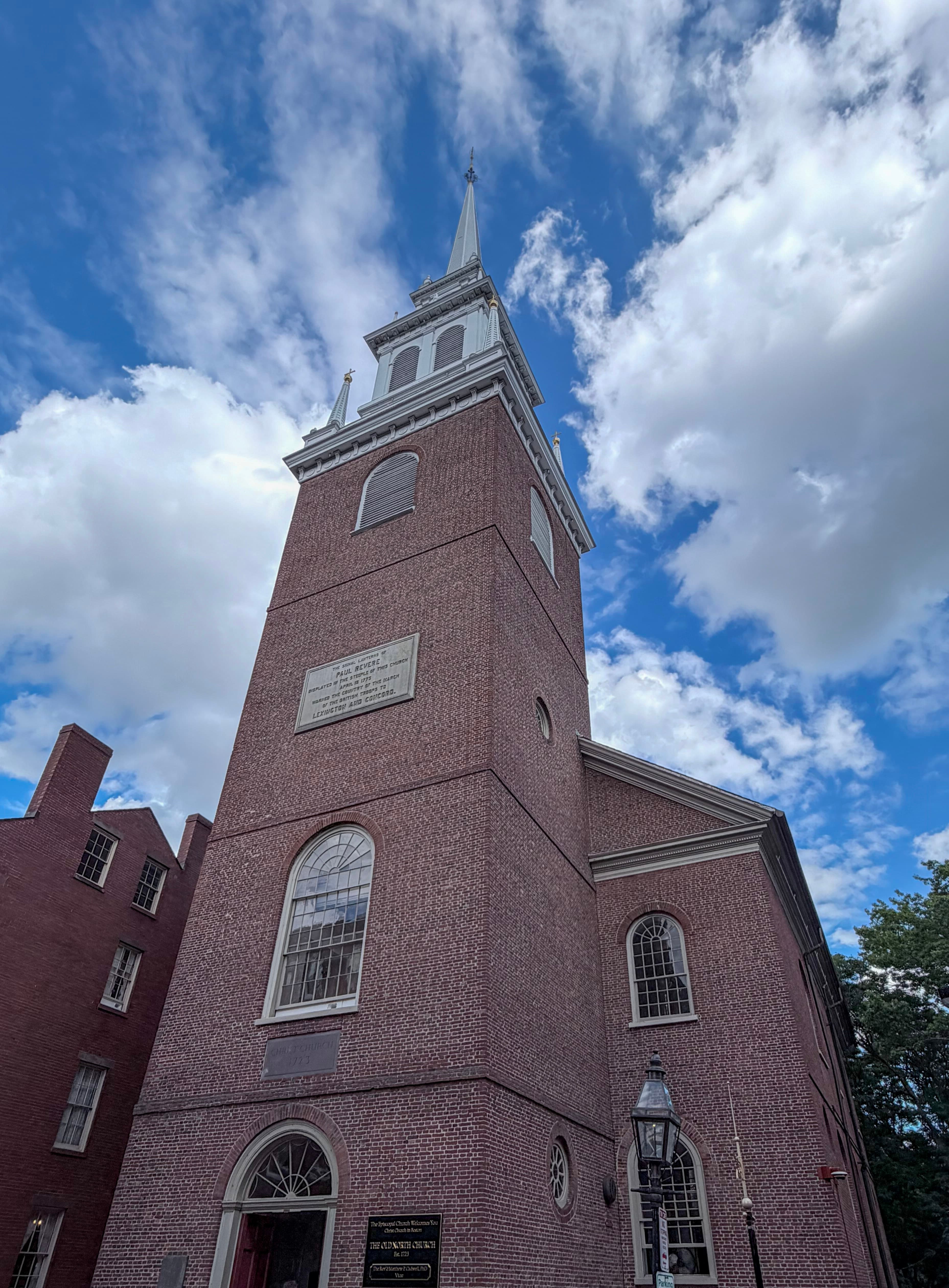
Every first-time visitor to Boston knows the line before they know the building: "One if by land, and two if by sea." It comes from Henry Wadsworth Longfellow's 1860 poem "Paul Revere's Ride," and it describes the signal hung in the steeple of the Old North Church on the night of April 18, 1775. Two lanterns meant the British regulars were crossing the Charles River by boat toward Lexington and Concord. One would have meant they were marching overland. The men watching from Charlestown saw two, and the countryside was warned.
The church that carried that signal is still standing at 193 Salem Street in the North End, and it is the oldest standing church building in Boston. Officially it is Christ Church in the City of Boston, an Episcopal congregation founded in 1723. Its white, 191-foot steeple has been a landmark for sailors, soldiers, and sightseers for three centuries, and it remains an active church as well as one of the most visited stops on the Freedom Trail, between the Paul Revere House and Copp's Hill Burying Ground.
The signal itself lasted less than a minute. That brevity was the point: the lanterns had to be seen by the patriots waiting across the river in Charlestown, and then hidden before British patrols in occupied Boston could react. Church sexton Robert Newman and vestryman Captain John Pulling Jr. are credited with carrying the lanterns up the steeple's 154 steps, while Thomas Bernard kept watch outside. Historians still debate exactly who did what that night, and the church itself presents the story with that uncertainty intact — which is part of what makes the place feel honest rather than mythic. The signal was a backup plan, not the main one: Paul Revere was already rowing across the river to carry the warning in person, and the lanterns were insurance in case he was captured on the way.
A Georgian church built for a divided town
Christ Church was Boston's second Anglican congregation, founded because King's Chapel had grown too crowded. The congregation bought land in the North End in 1722, and the brick church rose quickly: the cornerstone was laid in April 1723 and the first service was held on December 29 of that year, with the Reverend Timothy Cutler preaching. The design, guided by vestryman and bookseller William Price, followed the London churches of Sir Christopher Wren — a rectangular nave, a tall western tower, round-arched windows in two tiers, and a classical restraint that stood in sharp contrast to the plain Puritan meetinghouses around it.
That Anglican identity made the church a complicated place in revolutionary Boston. Its congregation included both Loyalists loyal to the Crown and Patriots pushing toward independence, and its liturgy still included prayers for the king. The church's rector on the eve of the Revolution, Mather Byles Jr., was a Loyalist who resigned the very night of the lantern signal. The congregation stopped meeting during the war years, and the building survived the occupation, the siege, and the evacuation of Boston to become, in time, a symbol of the side that had used its steeple against the Crown.
The building you see today is the third steeple's church. The original spire, completed in 1740, was blown down in the Great Gale of October 1804. Its replacement, generally attributed to Charles Bulfinch, stood until Hurricane Carol toppled it on August 31, 1954. The current steeple, hoisted into place in 1955, is a deliberate replica of the original, and it still carries the original weathervane: a gilded banner topped with a star, made by Deacon Shem Drowne, one of colonial Boston's celebrated craftsmen.
Inside: box pews, bells, and the oldest clock in the room
Step inside and the first thing you notice is how bright and white the interior is. The nave is lined with high box pews, the kind colonial families bought, furnished, and sat in for generations — the closer to the altar, the higher the price. Paying for a pew was the practice here until 1912, and many pew doors still carry the names of their original owners on small plates. The Revere family pew, number 54, is among the most visited. The galleries above, reached by staircases at the rear, were where those who could not afford a box pew sat — including, in the church's early years, free and enslaved Black worshippers, who were relegated to the upper gallery. The church does not hide that part of its story, and it is worth sitting with it as part of the building's full history.
Look up and you will see the two brass chandeliers, gifts of Captain William Maxwell, first lit on Christmas Day 1724. At the rear of the church stands the clock built in 1726 by Avery and Bennett, considered the oldest working clock in an American public building, with four wooden cherubim above it, installed in 1746 — figures that, by tradition, were plundered from a French vessel by a sea captain and donated to the church. The organ case and the Palladian window behind the pulpit complete a room that feels far more English than Puritan, which is exactly what its builders intended.
Above you, in the belfry, hangs the oldest set of change-ringing bells in North America: eight bells cast in Gloucester, England, by Abel Rudhall in 1744 and hung in 1745. One bears the inscription, "We are the first ring of bells cast for the British Empire in North America." Paul Revere himself signed a contract as a bell ringer here in 1750, when he was a teenager. The bells were restored in 1894 and again in 1975, and they are still rung regularly by the MIT Guild of Bellringers.
The crypt, the gardens, and the third lantern
Below the nave lies the crypt, where more than 1,100 people are buried in 37 tombs built between 1732 and 1860. Among them are British Major John Pitcairn, killed at Bunker Hill; Samuel Nicholson, the first captain of the USS Constitution; and Timothy Cutler, the church's first rector. A guided Behind the Scenes tour is the way to see the crypt, along with the bell chamber and the steeple stairs — the self-guided visit covers the sanctuary and the exhibits.
Outside, the church complex is a small world of its own. The 18th Century Garden behind the church grows plants of the period; the Washington Memorial Garden holds memorial plaques; the St. Francis Garden recalls the Italian chapel that is now the gift shop; and the Third Lantern Garden commemorates a lantern lit by President Gerald Ford in 1975 to open the Bicentennial celebrations. Near the entrance, look for the plaque describing the lantern signal, and the Newman Window — the window through which, by legend, Robert Newman escaped after hanging the lanterns. The church is candid that the escape story is probably a tall tale, and that even Newman's exact role is debated. The lantern now hanging in that window was Ford's Bicentennial gift.
One more detail rewards a close look: the bust of George Washington inside the church, said to be the first memorial to the first president, which the Marquis de Lafayette reportedly called the best likeness of Washington he had ever seen. It is a reminder that this building did not freeze in 1775. Presidents from James Monroe to Gerald Ford, and Queen Elizabeth II, have all passed through its doors, and the congregation still worships here every Sunday.
Visiting Old North: how to do it well
Old North rewards a slow visit. Start at the Paul Revere House, a few minutes away on North Square, then follow the Freedom Trail's red line to Salem Street and let the steeple pull you in — the approach up Hull Street, with the church framed at the end of the lane, is one of the great first views in Boston. Inside, give yourself time to read the plaques: the Revere pew, the Washington bust, the Pitcairn memorial, and the tablets of rectors and vestrymen all repay attention.
Pair the church with its neighbors. Copp's Hill Burying Ground, uphill on Hull Street, holds the graves of North End merchants, artisans, and sea captains, and it is where British artillery stood during the Battle of Bunker Hill. Then walk back down into the North End for dinner — the neighborhood's Italian restaurants and pastry shops are part of the visit, not an afterthought. If you are here on April 18, the church's annual lantern ceremony reenacts the signal, and it is one of the most moving small events in the city's calendar.
Key Facts
- Old North Church (Christ Church in the City of Boston) was built in 1723 and is the oldest standing church building in Boston.
- On April 18, 1775, two lanterns hung in its steeple signaled "two if by sea" — British troops crossing the Charles River by boat — launching Paul Revere's midnight ride.
- The lanterns are credited to sexton Robert Newman and Captain John Pulling Jr., with Thomas Bernard on watch; historians debate the exact roles, and the church presents that uncertainty openly.
- The first service was held December 29, 1723, under the Reverend Timothy Cutler; the congregation was Boston's second Anglican church, after King's Chapel.
- The Georgian design follows the London churches of Sir Christopher Wren; the 191-foot steeple was long the tallest structure in Boston.
- The original steeple fell in the Great Gale of 1804; its replacement fell to Hurricane Carol in 1954; the current steeple (1955) is a replica of the original and carries Shem Drowne's original weathervane.
- The belfry holds eight change-ringing bells cast by Abel Rudhall of Gloucester, England, in 1744 — the oldest set in North America; Paul Revere signed on as a bell ringer in 1750.
- The interior keeps its high box pews (paid for by families until 1912), two brass chandeliers first lit Christmas Day 1724, a 1726 clock, and four cherubim installed in 1746.
- The crypt holds more than 1,100 burials in 37 tombs, including Major John Pitcairn, USS Constitution captain Samuel Nicholson, and first rector Timothy Cutler.
- Old North is a National Historic Landmark, part of Boston National Historical Park, and stop 13 on the Freedom Trail, between the Paul Revere House and Copp's Hill Burying Ground.
Visitor Details
Address: 193 Salem Street, Boston, MA 02113, in the North End, on the Freedom Trail between the Paul Revere House and Copp's Hill Burying Ground
Hours/Admission: Hours and admission vary by season and by tour type — check oldnorth.com before visiting for current opening hours and tour availability
Best timing: Early mornings are calmest for the sanctuary; April 18 brings the annual lantern ceremony; allow about an hour for the self-guided visit and longer if you take a guided Behind the Scenes tour of the crypt and steeple
Location Photography