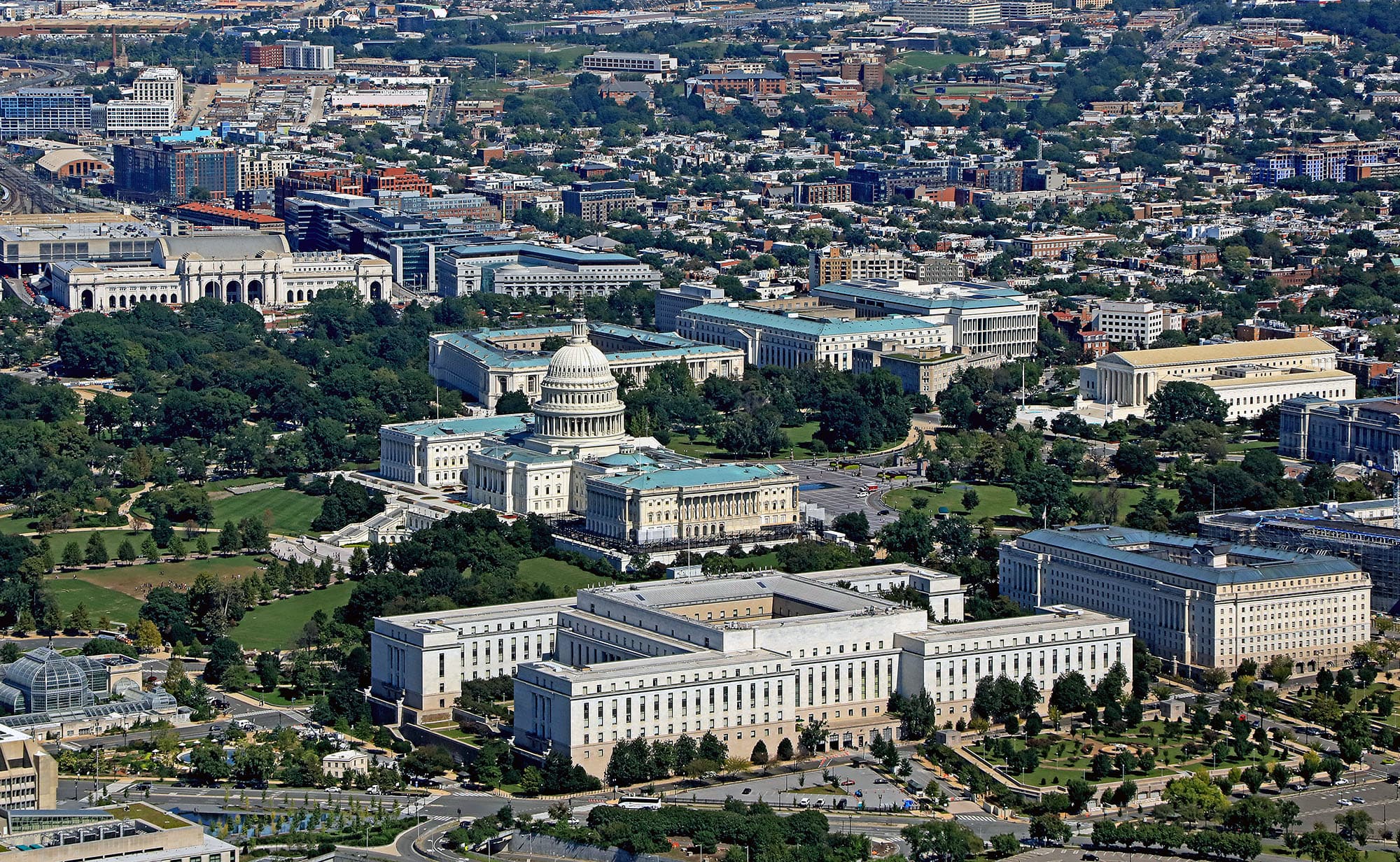
The building at the center of American democracy
No building in Washington says "America" faster than the Capitol. Its white dome rises at the eastern end of the National Mall, visible from nearly every vantage point in the city, and it has served as the meeting place of the United States Congress for more than two centuries. It is a working legislature, a museum of American art and history, and a symbol all at once — and for a first-time visitor, it is the single most important building in the capital to understand.
The Capitol's story begins with a competition. In 1792, Secretary of State Thomas Jefferson sponsored a design contest for the new nation's legislature building, and the winning entry came from William Thornton, a physician and amateur architect. His plan called for a central rotunda flanked by two wings — one for the Senate, one for the House of Representatives. President George Washington laid the cornerstone on September 18, 1793, in a Masonic ceremony, and construction began on Jenkins Hill, renamed Capitol Hill, at the eastern end of Pierre Charles L'Enfant's grand plan for the city.
Congress first met in the Capitol in November 1800, when the Senate wing was finished and the government had moved from Philadelphia to the new federal city. The House wing followed in 1807. But the young Capitol was still unfinished — and it would soon face the greatest test in its history.
The burning of 1814 and the rebuilding
On August 24, 1814, during the War of 1812, British troops marched into Washington and set fire to the Capitol, the White House, and other public buildings. The Capitol's interior was gutted; only the thick exterior walls of the two wings survived. It was a deliberate blow against the symbols of the young republic — and it nearly ended the Capitol before it had truly begun.
The rebuilding fell largely to Benjamin Henry Latrobe, the Capitol's second architect, who had already been working on the building before the war. Latrobe redesigned the interiors in a grander neoclassical style, introducing the sandstone Corinthian columns and vaulted ceilings that still define the old chambers. Reconstruction of the wings was substantially complete by 1819, and by the 1820s the Capitol stood whole again, this time with a low wooden dome over the central rotunda. Congress returned, the Supreme Court sat in its chamber, and the Library of Congress was re-established after Thomas Jefferson sold his personal book collection to replace the volumes lost in the fire.
The fire left one lasting lesson visible in the building itself: the Capitol you see today is not a single creation but a survivor, rebuilt and enlarged across generations, each of which added its own layer to Thornton's original plan.
The dome and the Statue of Freedom
By the 1850s, the growing nation had outgrown its Capitol. New states meant more representatives, and Congress authorized a major expansion under architect Thomas U. Walter: new, larger wings for the House and Senate, built of Massachusetts marble, more than doubling the building's length from about 352 feet to 746 feet. The old wooden dome suddenly looked far too small for the enlarged building, and Walter designed a replacement — a vast cast-iron dome, fireproof, in two shells, weighing nearly nine million pounds.
Construction of the dome continued through the Civil War, at President Abraham Lincoln's insistence. Lincoln understood the symbolism: as the Union fought for its survival, the dome rising over Washington told the country — and the world — that the government would endure. The work was carried out in part by enslaved laborers and freedmen, including Philip Reid, an enslaved craftsman whose skill in casting the dome's sections was essential to the project; Reid also helped assemble the statue that would crown it.
That statue is the Statue of Freedom, designed by sculptor Thomas Crawford. A 19-and-a-half-foot bronze figure of a woman in classical dress, wearing a helmet crested with an eagle's head and feathers, she was hoisted into place atop the dome on December 2, 1863, as the war still raged. She has stood there ever since, 288 feet above the ground, visible across the city — the literal capstone of the building and one of the most photographed silhouettes in America.
The Rotunda and National Statuary Hall
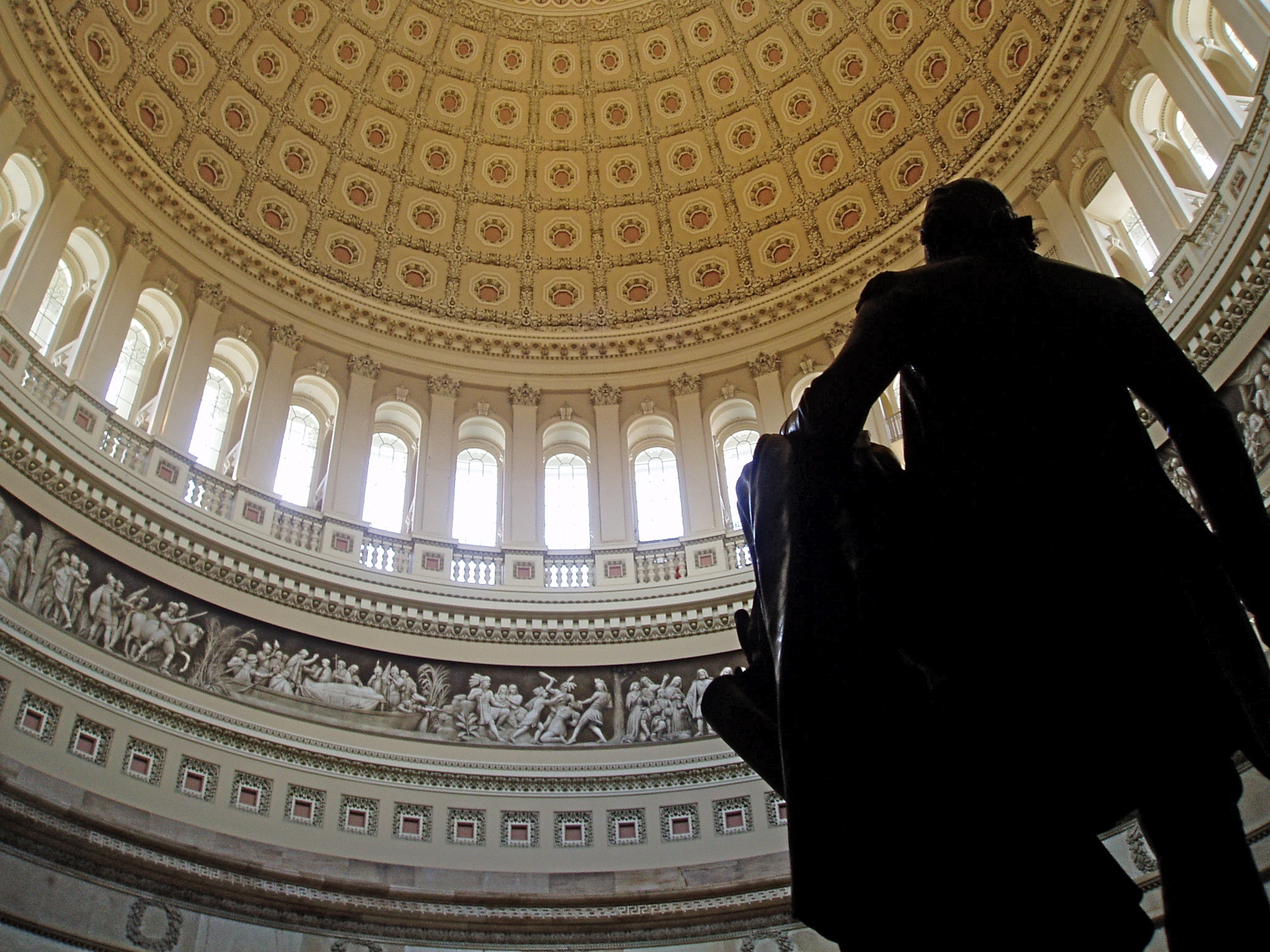
Step inside, and the Capitol's heart is the Rotunda — a great circular hall 96 feet across and 180 feet high, directly beneath the dome. Look up and you see Constantino Brumidi's "The Apotheosis of Washington," painted in 1865 on the canopy of the dome's eye: George Washington ascending to the heavens, flanked by figures representing Victory, Liberty, and the thirteen original states. Around the walls runs Brumidi's Frieze of American History, a 300-foot painted band that tells the story of the nation from Columbus's landing to the Wright brothers' first flight.
Eight enormous oil paintings hang on the Rotunda walls, four of them by John Trumbull, a veteran of the Revolution who painted scenes he had witnessed or studied firsthand: the presentation of the Declaration of Independence, the surrender of Burgoyne at Saratoga, the surrender of Cornwallis at Yorktown, and Washington resigning his commission. The Rotunda has also served as the nation's ceremonial stage — presidents and other honored Americans have lain in state here, and the space is used for the most solemn occasions of public life.
A short walk away lies National Statuary Hall, the Capitol's other great interior. This was the original Hall of the House of Representatives from 1807 until 1857, when the House moved to its larger new chamber. In 1864, Congress turned the old chamber into a gallery of statues, inviting each state to contribute two figures of its most distinguished citizens. The result is a collection of 100 statues — presidents and pioneers, inventors and civil rights leaders — arranged around a semicircular room famous for its acoustics: a whisper at one point of the room can reportedly be heard across the hall, a quirk of the domed ceiling that delighted nineteenth-century visitors. Nearby, the Hall of Columns runs the length of the House wing, lined with 28 fluted marble columns that once framed the grand corridor between the old House chamber and the new.
Visiting the Capitol and the Visitor Center
Most visits begin at the Capitol Visitor Center, the underground complex beneath the East Front plaza that opened in December 2008. It is the Capitol's front door: after security screening, visitors gather in Emancipation Hall, a great skylit space named for the enslaved laborers who helped build the Capitol, and can explore the Exhibition Hall, which tells the story of Congress and the building through documents and artifacts, including an original model of the Statue of Freedom. Guided tours of the Capitol itself are free, but they require advance booking through the official site, visitthecapitol.gov — check that site for current schedules, tour availability, and any security or access requirements before your visit, since these change. A standard tour takes you through the Rotunda, National Statuary Hall, and the Capitol Crypt, the circular room beneath the Rotunda originally intended as Washington's tomb. Note that the House and Senate galleries are separate from the tour route and are open to the public only when the chambers are in session, with gallery passes available through your representative or senator's office.
Outside, don't skip the grounds. The Capitol sits on grounds of roughly 274 acres, landscaped in the 1870s and 1880s by Frederick Law Olmsted — the same designer behind New York's Central Park — who added the marble terraces that wrap the building's base and the Summerhouse, a small open-air brick shelter north of the Capitol. Walk around to the West Front, where presidential inaugurations are held, for the classic view down the Mall toward the Washington Monument, and visit in the evening if you can: the dome, lit against the night sky, is Washington at its most iconic.
Key Facts
- The Capitol's cornerstone was laid by George Washington on September 18, 1793; the design was by William Thornton, winner of the 1792 competition.
- Congress first met in the Capitol in November 1800, in the completed Senate wing; the House wing followed in 1807.
- British troops burned the Capitol on August 24, 1814, during the War of 1812; Benjamin Henry Latrobe led the rebuilding, substantially complete by 1819.
- The 1850s expansion under Thomas U. Walter more than doubled the building's length, from about 352 feet to 746 feet.
- The cast-iron dome weighs nearly nine million pounds and was built during the Civil War at Abraham Lincoln's insistence.
- The Statue of Freedom, by Thomas Crawford, was placed atop the dome on December 2, 1863, and stands 288 feet above the ground.
- The Rotunda is 96 feet in diameter and 180 feet high, with Brumidi's "Apotheosis of Washington" (1865) on the canopy.
- National Statuary Hall, the former House chamber (1807–1857), holds 100 statues — two contributed by each state.
- The Capitol Visitor Center, beneath the East Front plaza, opened in December 2008; Emancipation Hall honors the enslaved laborers who helped build the Capitol.
- The Capitol grounds cover roughly 274 acres, landscaped by Frederick Law Olmsted in the 1870s and 1880s.
Location Photography