A State House Built Slowly, and Built to Last
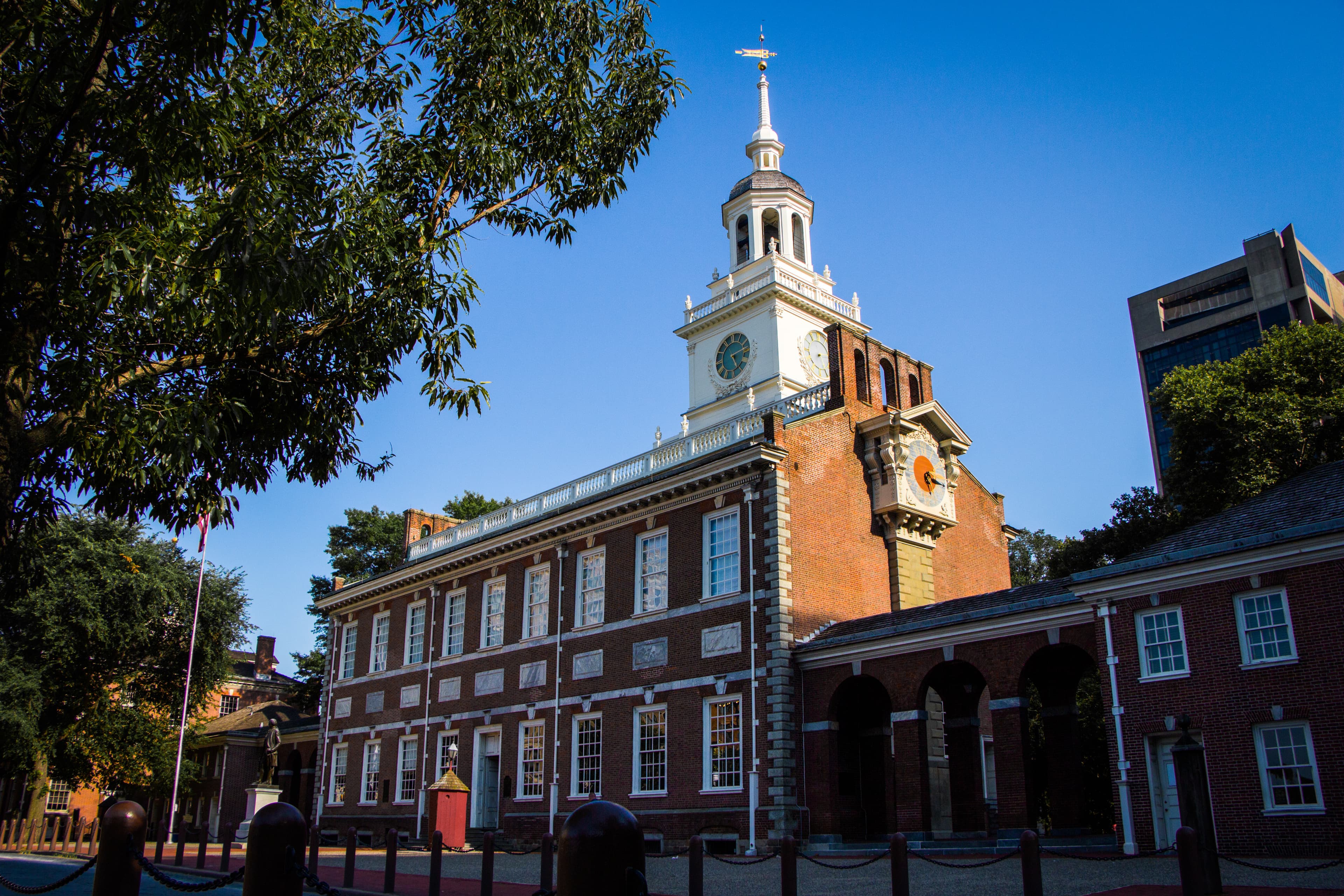
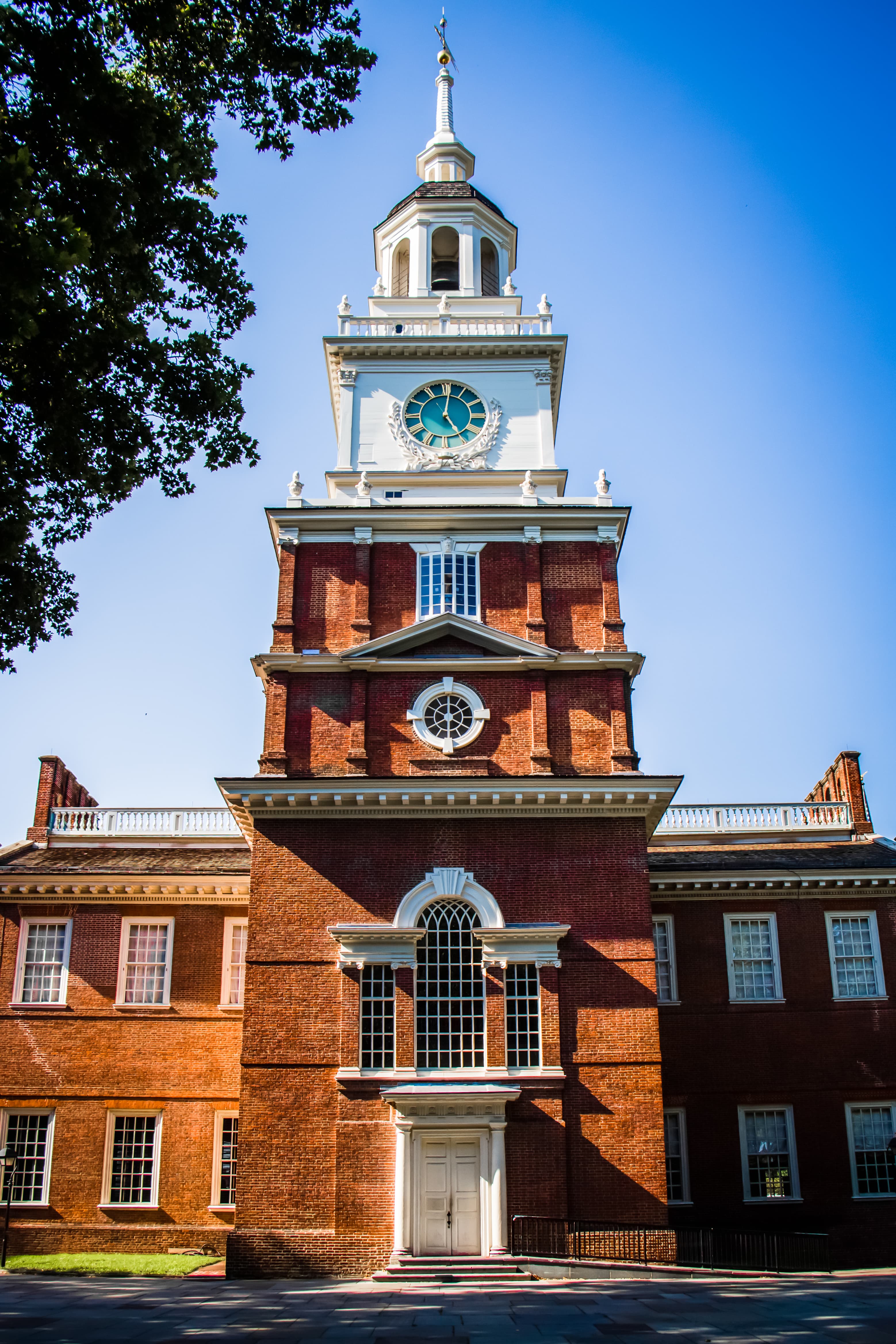
Independence Hall began life as the Pennsylvania State House, and it was built the way colonial governments paid for things: slowly, as money allowed. Construction started in 1732 on Chestnut Street, then at the western edge of Philadelphia, to designs by master builder Edmund Woolley and lawyer-legislator Andrew Hamilton. The red-brick Georgian building — a central block flanked by smaller wings and arcaded corridors, topped by a wooden steeple — was not finished until 1753, and even then Philadelphians were proud of it: contemporaries called it the greatest ornament in the town. In the tower hung a clock and, from 1753, a new bell ordered from London for the colony's assembly — the bell the world now knows as the Liberty Bell.
For its first four decades the building did ordinary government work. The Pennsylvania Provincial Assembly met in the ground-floor Assembly Room, the colony's supreme court sat across the hall, and the governor's council chambered upstairs. Nobody designing it imagined it as a shrine. It was a working capitol for one prosperous colony — which is exactly what makes what happened inside it next so improbable. The room was meant for debating taxes and land disputes. History had larger plans for the agenda.
1776: The Summer of Independence
From May 1775, the Second Continental Congress met in the Assembly Room, and in fourteen months the room became the engine room of a revolution. On June 14, 1775, the delegates created the Continental Army and put George Washington in command of it. A year later they turned to the question of independence itself: on July 2, 1776, Congress voted for the Lee Resolution declaring the colonies free, and on July 4 it formally adopted the Declaration of Independence, its text largely Thomas Jefferson's. Four days later the Declaration was read aloud to a crowd in the State House yard — today's Independence Square — while bells rang across the city.
The room's work was repeatedly interrupted by the war it had started. Congress fled Philadelphia twice during the British occupation of 1777–78, meeting in Baltimore, Lancaster, and York, where the Articles of Confederation were approved. It returned to the State House in July 1778 and sat there until 1783, first as the revolutionary Congress and then under the Articles. The building had declared a nation; now it had to help govern a loose confederation of thirteen of them — and by the mid-1780s it was becoming clear, to many of the same men, that the confederation was not working.
1787: The Convention and the Rising Sun
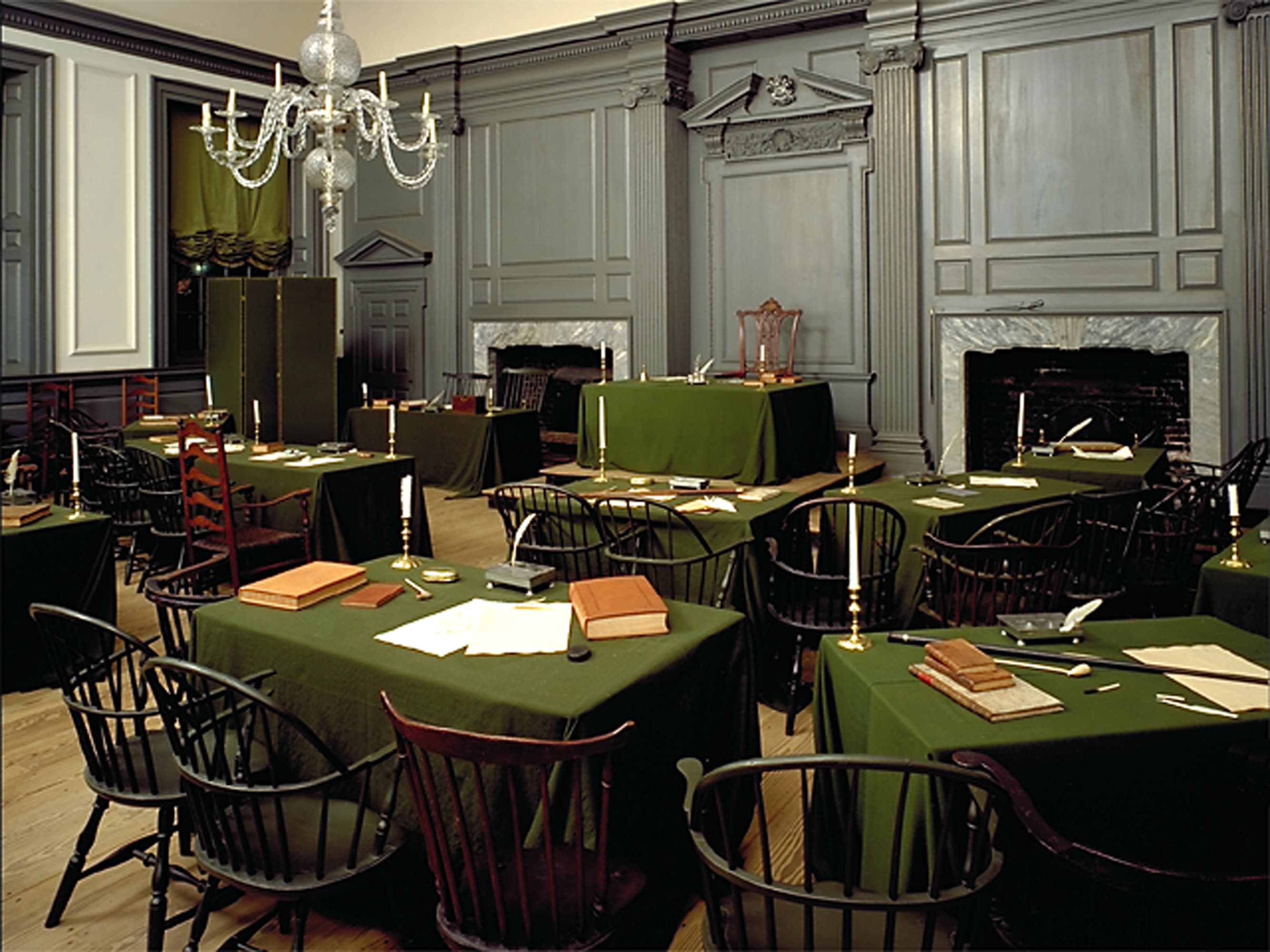
In May 1787 the delegates came back to the same room to fix the Articles of Confederation — and instead, behind closed doors and shuttered windows through a sweltering Philadelphia summer, wrote an entirely new Constitution. Washington presided from a carved armchair made in 1779 by cabinetmaker John Folwell, its crest rail bearing a gilded half-sun. Benjamin Franklin, at 81 the oldest delegate, watched that sun all summer without deciding what it meant. When the finished document was ready for signing on September 17, 1787, Franklin pointed to the chair and remarked, as James Madison recorded it, that painters had found it difficult to distinguish a rising sun from a setting one — "but now at length I have the happiness to know that it is a rising and not a setting sun."
The room still holds the furniture of both foundings. On the president's table sits the silver Syng inkstand, made in Philadelphia in 1752, which tradition holds was used at the signing of the Declaration in 1776 and again at the signing of the Constitution in 1787 — one inkwell for both documents. The green baize-covered tables and Windsor chairs arranged for the tour are period pieces and careful reconstructions, assembled by the Park Service from receipts, diaries, letters, and the 1780s painting Congress Voting Independence. Across the vestibule, the Supreme Court Chamber and, upstairs, the Governor's Council Chamber complete a building that contains, floor by floor, the whole machinery of colonial government.
Museum, Relic, and the Long Work of Saving It
The building's second career began almost as soon as its first ended. Pennsylvania's government left for Lancaster and then Harrisburg, and by 1816 the state was ready to tear the old State House down and sell the land for building lots. The City of Philadelphia bought the property instead — an early act of historic preservation, decades before the term existed. From 1802 to 1827 the upper floor had already been a museum: Charles Willson Peale filled it with portraits of Revolutionary heroes and natural history specimens, mastodon skeleton included. In 1824 the Marquis de Lafayette, touring the young republic, was received here, and the building picked up the name it keeps: the Hall of Independence.
The 19th century layered meaning onto the room. William Strickland gave the tower a new steeple in 1828, the one that crowns the building today. In April 1865, Abraham Lincoln's body lay in state in the Assembly Room on its long journey home to Springfield, and more than 300,000 mourners filed through. In 1915 former president William Howard Taft presided here over the founding of the League to Enforce Peace, an ancestor of the League of Nations. The federal government took custody in 1948, when Congress created Independence National Historical Park, and Park Service historians then undertook one of the most meticulous restorations in American preservation — stripping paint layer by layer to recover original colors and woodwork, and refurnishing the Assembly Room to its 1776–87 appearance, work completed in 1965. In 1979 UNESCO named Independence Hall a World Heritage Site, one of very few American buildings honored for the ideas associated with it rather than its architecture alone. The City of Philadelphia still owns it; the National Park Service cares for it.
Independence Hall Today
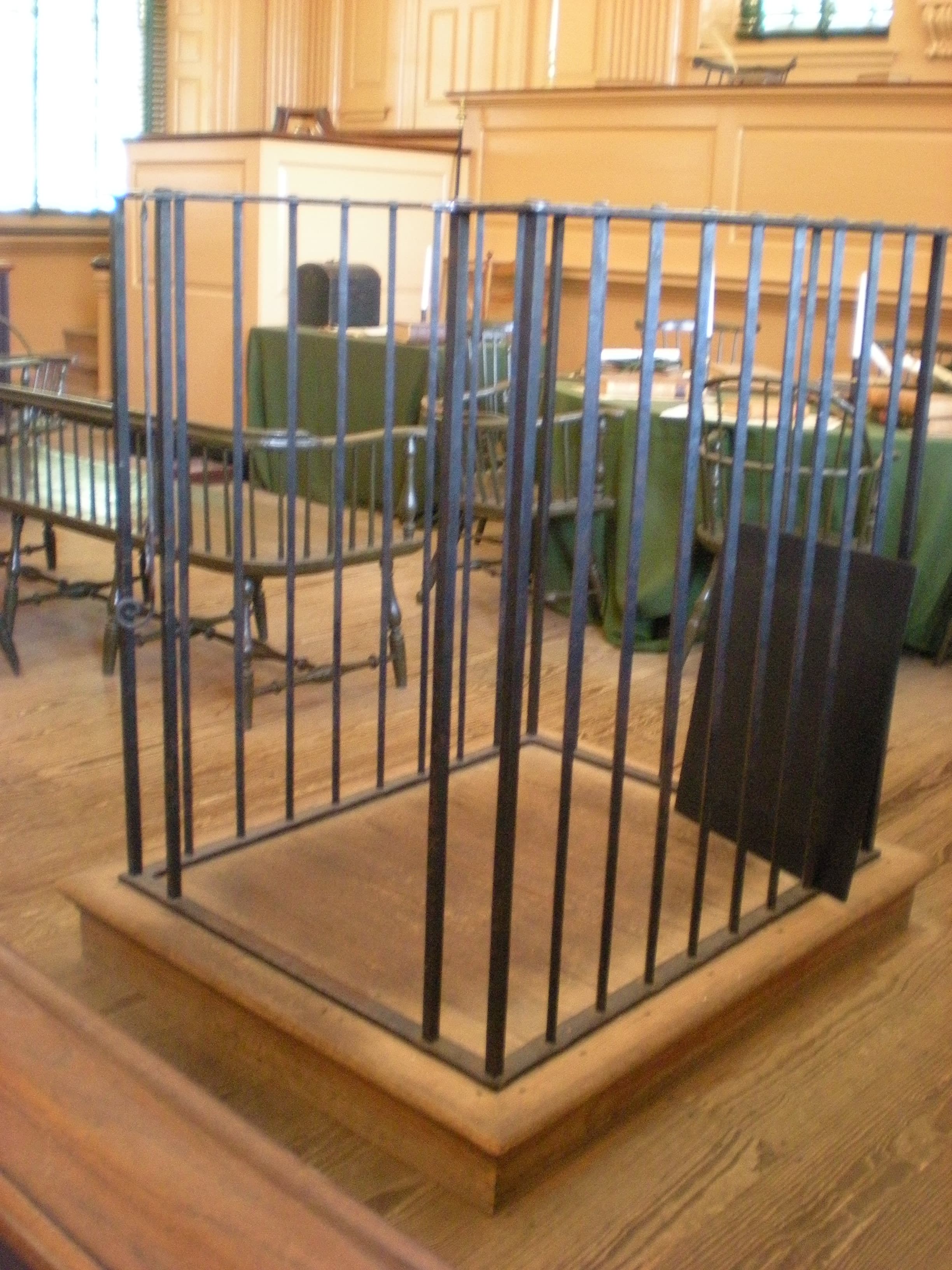
A visit today is a ranger-led walk through the ground floor: the Supreme Court Chamber, with its raised judge's bench and dock for the accused, and then the Assembly Room itself, where the ranger's talk covers both summers — 1776 and 1787 — in the room where they happened. An expanded late-afternoon tour climbs to the second floor, to the council chamber and the Long Room where Peale's museum once stood. The building anchors a square of supporting acts: Congress Hall next door, where Congress actually sat during Philadelphia's decade as the temporary capital in the 1790s; Old City Hall across the square; and, across Chestnut Street in the Liberty Bell Center, the old State House bell itself. You enter through security screening on the square's south side — plan for it the way you would at a courthouse, because that is, in a sense, what the building still is: a place where the public business of memory gets done, one twenty-minute tour at a time.
Key Facts
- Built 1732–1753 as the Pennsylvania State House, designed by Edmund Woolley and Andrew Hamilton; red-brick Georgian with wings and arcades; the present steeple is William Strickland's 1828 replacement for the rotted original.
- The Second Continental Congress met in the Assembly Room from 1775: it created the Continental Army (June 14, 1775) and adopted the Declaration of Independence on July 4, 1776.
- The Constitutional Convention sat in the same room from May to September 1787; the Constitution was signed on September 17, 1787, with George Washington presiding from the carved "Rising Sun" chair — the subject of Benjamin Franklin's famous rising-sun remark, recorded by James Madison.
- The silver Syng inkstand (1752) on the president's table is traditionally identified as the inkstand used at both the 1776 and 1787 signings.
- Abraham Lincoln's body lay in state in the Assembly Room in April 1865; more than 300,000 mourners passed through the hall.
- Designated a UNESCO World Heritage Site in 1979 and managed by the National Park Service as the centerpiece of Independence National Historical Park (established 1948); the City of Philadelphia retains ownership.
Visitor Details
Address: 520 Chestnut Street, Philadelphia, PA 19106 (the GPS address given by the National Park Service) — between 5th and 6th Streets, Old City. Entry is through a security screening building on the south side of Independence Square, reached from 5th Street between Chestnut and Walnut.
Transit: SEPTA's Market-Frankford Line stops at 5th Street (Independence Hall) station, a short walk away; Jefferson Station (Regional Rail) is a few blocks northwest, and the Philly PHLASH and Market Street buses serve the historic district.
Hours/Admission: Per the National Park Service (checked 2026-10-21): morning open house 9:00–10:30 am requires no tickets; ranger-led tours then run every 20 minutes from 10:40 am and require timed tickets reserved through recreation.gov (a $1 per-ticket handling fee; the tour itself is free), with an expanded second-floor tour last in the day. Schedules shift seasonally — the NPS page lists tours running later from November 1 — so confirm current times on nps.gov/inde before you go. All visitors pass through airport-style security screening.
Best timing: The first tours of the morning are the calmest, and the no-ticket open house rewards early arrivals. In summer, book recreation.gov tickets days ahead and arrive at least 30 minutes before your tour time to clear the screening line. Pair the hall with the Liberty Bell Center directly across Chestnut Street — it needs no ticket — and with Congress Hall on the same square.