Built to Outfight Anything She Couldn't Outrun
USS Constitution was born of embarrassment. In the early 1790s, Barbary pirates were seizing American merchant ships in the Mediterranean and holding their crews for ransom, and the young United States had no navy worth the name to answer them. Congress responded with the Naval Act of 1794, funding six frigates, and Philadelphia ship designer Joshua Humphreys drew something new: frigates longer, broader, and more heavily timbered than anything in European service, built with diagonal riders and hulls of dense Southern live oak, fast enough to escape a ship of the line and strong enough to destroy any frigate they met. Constitution, named by President George Washington himself, was the third of the six. Shipwright Edmund Hartt built her in his North End shipyard — a short walk from where she floats today — with copper sheathing rolled in Paul Revere's Massachusetts foundry. She cost about $300,000, a staggering sum for the new republic, and slid into Boston Harbor on October 21, 1797. Her first work was unglamorous and essential: hunting French privateers in the Quasi-War, then sailing in 1803 as Commodore Edward Preble's flagship against Tripoli, where her guns bombarded the corsair port and the peace treaty with Tripoli was signed aboard her in June 1805.
"Huzzah! Her Sides Are Made of Iron!"
The War of 1812 made her immortal, and it began with a humiliation she turned into legend. In July 1812, barely a month into the war, Constitution found herself becalmed off New Jersey with a five-ship British squadron closing in. For 57 hours, in brutal heat, her crew towed her with rowboats, ran kedge anchors ahead and hauled her forward hand over hand, wet the sails to catch whispers of wind, and finally pumped 2,300 gallons of drinking water overboard to lighten her — and outran them all. A month later, on August 19, 1812, she met the frigate HMS Guerrière alone in the Atlantic. Captain Isaac Hull's heavier broadsides and superior sailing dismantled the British ship, and witnesses saw Guerrière's cannonballs strike Constitution's live-oak flank and rebound into the sea. A sailor's cry — "Huzzah! Her sides are made of iron!" — gave the ship the name she has carried ever since: Old Ironsides. Guerrière was so shattered that Hull burned her the next morning rather than tow her to port. Constitution sailed home to Boston and a hero's welcome, but the news mattered more than the tonnage: the upstart American navy had beaten the Royal Navy ship-to-ship, and the country that was losing the war on land had something to cheer.
Java, Cyane, Levant: The Undefeated War
The Guerrière fight was not a one-off. On December 29, 1812, off Brazil, Constitution under Captain William Bainbridge met HMS Java. The battle was a brawl: Java's fire shot away Constitution's wheel, forcing her crew to steer by the tiller ropes below deck, and Bainbridge was wounded twice and refused to leave the fight. Java ended the day a dismasted wreck and was burned — though Bainbridge salvaged her wheel and had it installed on Constitution, where she steered by the prize of her own victory. The shock ran so deep that the British Admiralty ordered its frigate captains not to engage the big American frigates one-on-one at all. Constitution's last fight of the war was her most audacious: on February 20, 1815, off Madeira — days after the peace treaty was signed across the Atlantic, though no one at sea knew it — Captain Charles Stewart took on two British warships at once, HMS Cyane and HMS Levant, and beat them both in a single evening action. When armorers later examined her hull, they found twelve British 32-pound cannonballs embedded in the oak, none of which had passed through. She emerged from the war undefeated, having captured or destroyed five British warships — Guerrière, Java, Pictou, Cyane, and Levant — a record no American sailing warship has ever matched.
Saved by a Poem, Then by Pennies
Twice, America has had to rescue its rescuer. In 1830 a Navy survey condemned the aging frigate as unseaworthy, and a Boston newspaper reported — mistakenly — that she would be scrapped. A young Oliver Wendell Holmes answered with a poem, "Old Ironsides," published in the Boston Daily Advertiser and reprinted nationwide, and the public outcry forced the Navy to rebuild her instead. She went on serving: a 52,000-mile circumnavigation of the globe in 1844–46, duty as a Naval Academy training ship through the Civil War, a last Atlantic crossing carrying American exhibits to the Paris Exposition of 1878. By the 1920s she was rotting again, and this time the rescue came in coins. A national campaign fronted by the Elks and aimed squarely at schoolchildren — donate your pennies to save Old Ironsides — raised much of the near-million-dollar restoration cost, supplemented by the sale of souvenirs made from her own discarded timbers. Recommissioned in 1931, she repaid the country with a three-year national tour, calling at some ninety ports on the Atlantic, Gulf, and Pacific coasts so that the millions who had paid for her could walk her decks. She has been a Boston fixture ever since — leading the tall ships into the harbor for the Bicentennial in 1976, when the neighboring USS Constitution Museum opened its doors.
She Still Sails
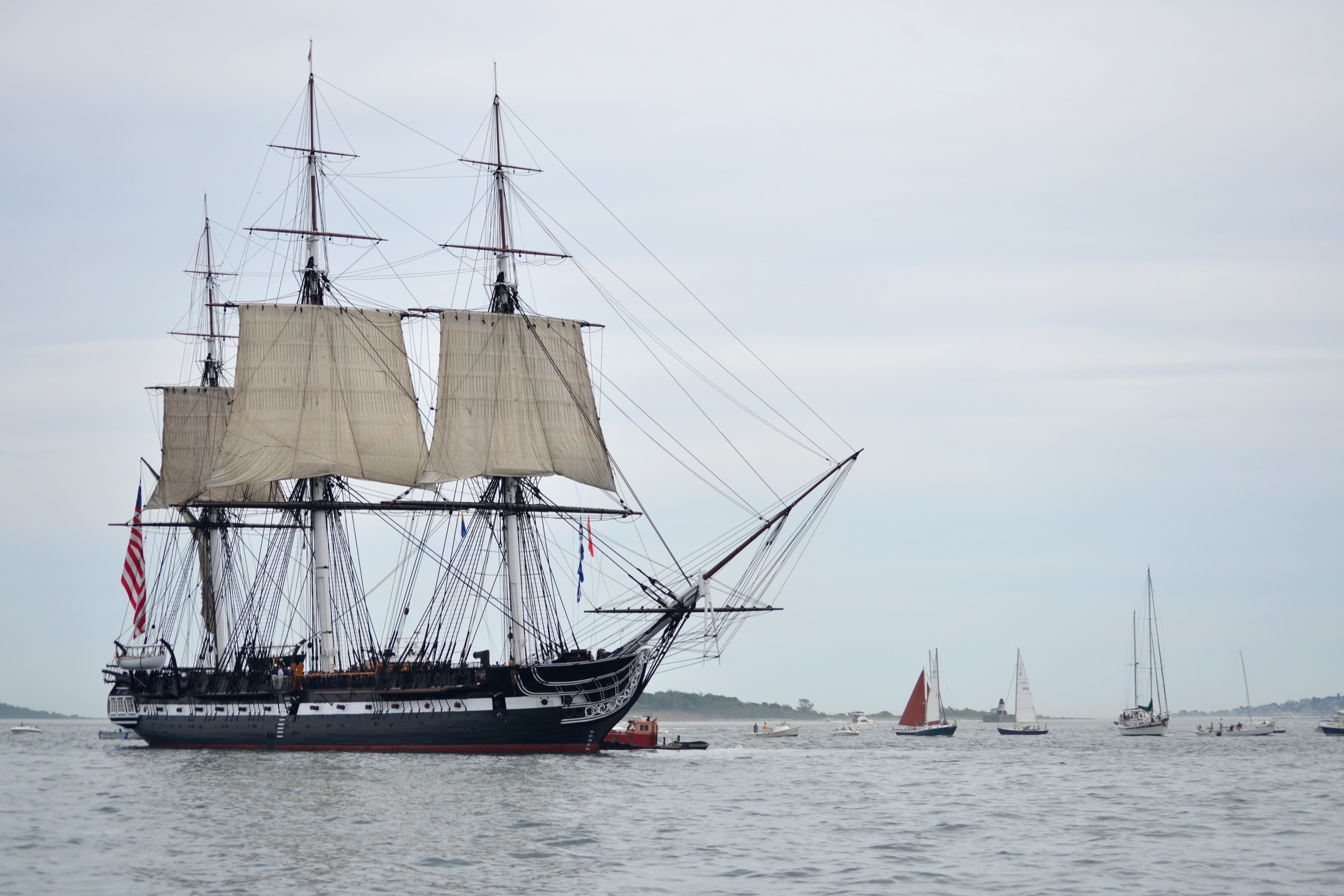
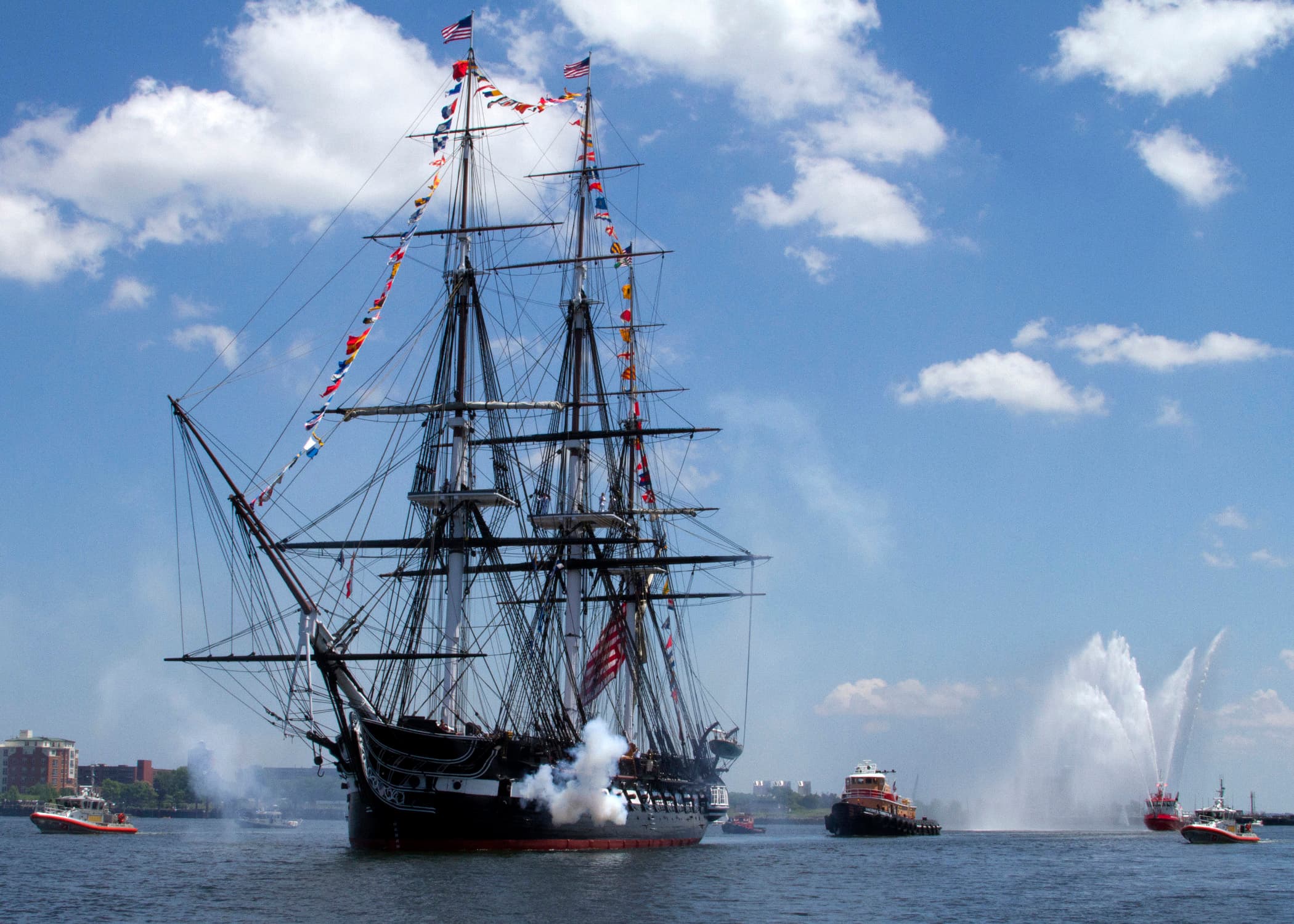
Here is the thing no other museum ship in America can say: Constitution is not a museum piece. She remains a commissioned warship of the United States Navy — designated America's Ship of State — with a crew of about 75 officers and sailors, all active-duty, for whom assignment aboard her is coveted special duty. The sailors maintain her, study her history, and give the free tours themselves, in modern uniform rather than costume. And she still goes to sea. Every year she makes at least one "turnaround cruise": tugs ease her out of Pier 1 into Boston Harbor, she fires her saluting battery off Castle Island, and she returns to her berth facing the opposite direction, so that sun and weather age both sides of the hull evenly. Members of the public can even ride along, chosen by an annual lottery. Twice in living memory she has done more than turn. On July 21, 1997, two months shy of her 200th birthday, Constitution was towed into Massachusetts Bay, cast off, and sailed under wind alone for the first time in 116 years. On August 19, 2012 — the exact bicentennial of the Guerrière battle — she did it again, her own crew setting sail in the harbor where the news of 1812 first landed. HMS Victory in England is an older commissioned ship, but she sits in dry dock. Constitution floats, sails, and salutes. That is the difference.
Walking Her Decks Today
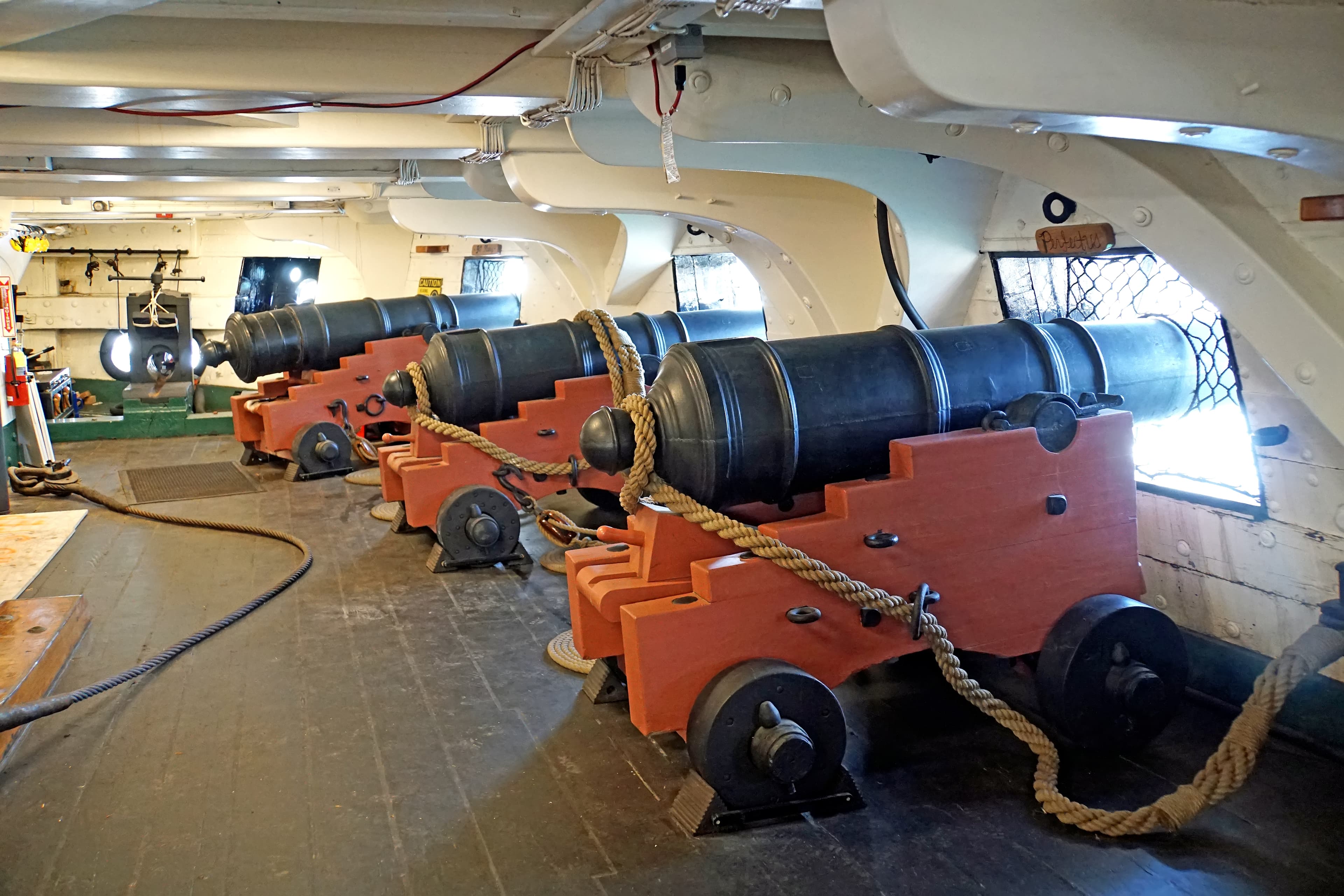
A visit starts with the honest machinery of a working Navy installation: a security screening and, for adults, a photo ID. Then you climb the gangway onto the spar deck, where her crew demonstrates sail handling and the carronades stand along the rail, and descend to the gun deck, the long oak room where the 24-pounder long guns — faithful replicas cast in 1930, as all her guns now are — run out from their ports over the water. Below that, the berth deck shows how 450 men ate, slept in hammocks slung between beams, and lived inside the hull you have been reading about. The sailor-guides are the exhibit's best feature; ask one about the Guerrière fight and you will get it with sound effects. Next door, in a granite shipyard building at the foot of Pier 2, the separate USS Constitution Museum fills the gaps the ship cannot: hands-on exhibits on her construction, her battles, and the ordinary sailors' lives aboard, including a chance to haul lines and try a hammock. Between the two, allow two hours. You are standing at the last stop on the Freedom Trail, and Bunker Hill's obelisk rises a few streets away — but visitors consistently rank the living ship above the monument. Monuments are finished. This one still has a crew.
Key Facts
- One of the six original frigates of the U.S. Navy, authorized by the Naval Act of 1794, designed by Joshua Humphreys, built at Edmund Hartt's North End shipyard, and launched October 21, 1797; named by George Washington.
- Earned the nickname "Old Ironsides" on August 19, 1812, when British shot from HMS Guerrière was seen to bounce off her live-oak hull; she defeated five British warships in the War of 1812 (Guerrière, Java, Pictou, Cyane, Levant) and was never defeated in battle.
- Saved from scrapping in 1830 by Oliver Wendell Holmes's poem "Old Ironsides," and again in the 1920s by a national restoration campaign funded substantially by schoolchildren's penny donations; she then toured some ninety U.S. ports in 1931–34.
- The world's oldest commissioned warship still afloat, and America's Ship of State: she carries an active-duty crew of about 75 U.S. Navy sailors and makes at least one turnaround cruise into Boston Harbor each year, with public riders chosen by lottery.
- Sailed under her own power in 1997 for the first time in 116 years, and again on August 19, 2012, the bicentennial of the Guerrière victory.
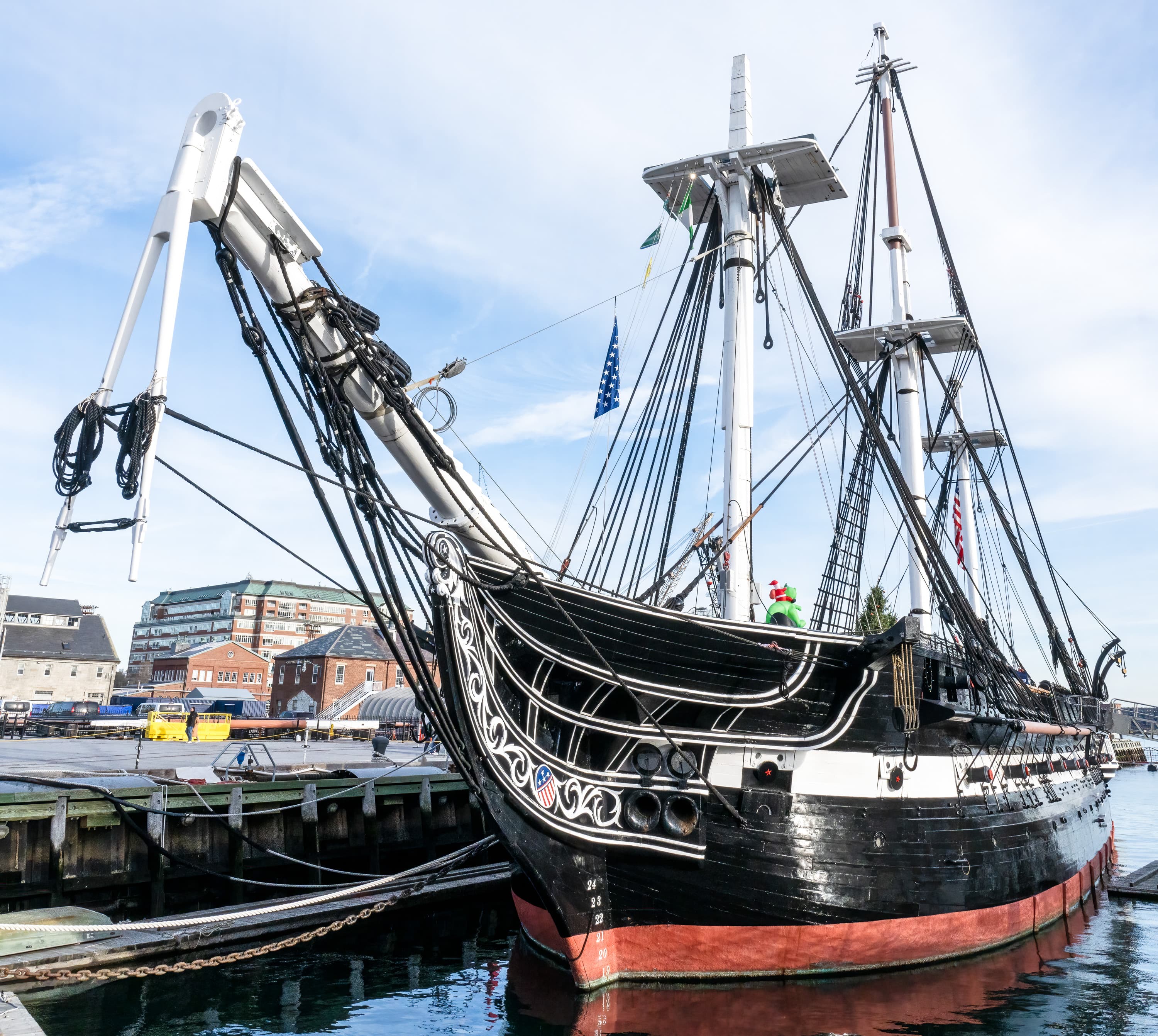
- Berthed at Pier 1 of the Charlestown Navy Yard, the final stop on Boston's Freedom Trail; the independent USS Constitution Museum next door opened in 1976.
Visitor Details
Address: USS Constitution, Pier 1, Charlestown Navy Yard, Boston, MA 02129. The adjacent USS Constitution Museum is in Building 22 at the foot of Pier 2.
Transit: The MBTA ferry (F4) from Long Wharf lands at the Charlestown Navy Yard, a few minutes' walk from the ship. Or ride the Orange or Green Line to North Station and follow the Freedom Trail's red line over the Charlestown Bridge (about 15–20 minutes on foot); MBTA bus 93 also serves the Navy Yard area from downtown.
Hours/Admission: Touring the ship itself is always free, first-come, first-served, with tours led by her active-duty crew. In the main season the ship has recently been open Tuesday–Sunday, 10 am to 6 pm, with shorter hours and fewer days in the colder months; she closes for certain holidays and maintenance, so check the ship's official page on navy.mil before you go. All visitors pass a security screening, and everyone 18 or older must show a valid federal or state photo ID (a passport works). The separate museum next door is open daily and charges a suggested admission — see ussconstitutionmuseum.org for current hours.
Best timing: A weekday morning right at opening, before the Freedom Trail crowds and school groups build, gives you the quietest decks and the shortest security line. The year's great spectacle is the turnaround cruise, traditionally around the Fourth of July, when the ship goes underway and fires a 21-gun salute off Castle Island — watch from the Navy Yard waterfront or Castle Island itself, and enter the Navy's public lottery months ahead if you want to be aboard.