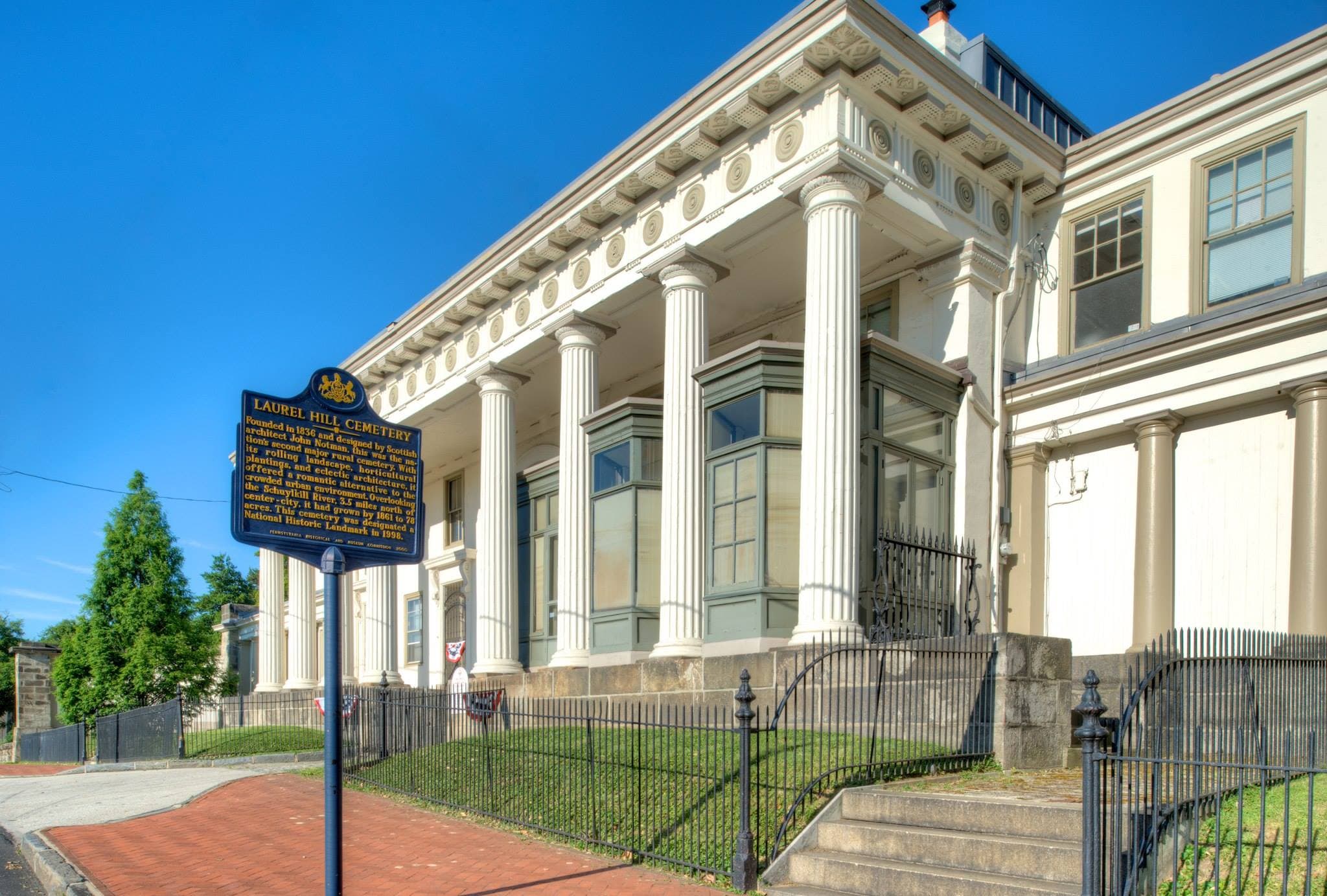
A Daughter's Burial and a New Kind of Cemetery
Laurel Hill began in private grief. John Jay Smith — librarian, editor, and horticulturist — was distressed by the treatment of his deceased daughter's remains at the Arch Street Meeting House burial ground, where graves stood in mud and water. "Philadelphia should have a rural cemetery on dry ground," he wrote, "where feelings should not be harrowed by viewing the bodies of beloved relatives plunged into mud and water." In 1836 Smith joined with prominent Philadelphians including Benjamin Wood Richards, William Strickland, and Nathan Dunn to form the Laurel Hill Cemetery Company. Three miles north of the city's edge, on the east bank of the Schuylkill River, they bought the 32-acre former estate of businessman Joseph Sims, a property known simply as Laurel Hill. The idea they were importing — following Boston's Mount Auburn, founded five years earlier — was that a cemetery could be a designed landscape in its own right: rural, picturesque, non-denominational in spirit, and open to the public as a place of instruction and calm, not merely a ground for burial. Laurel Hill was the second major rural cemetery in the United States, and Philadelphia took to it immediately.
Notman's Terraces Above the Schuylkill
Designs were solicited from leading architects, including William Strickland and Thomas Ustick Walter, but the commission went to John Notman, a young Scottish-American architect who read the steep site correctly. Rather than fight the hillside, Notman strung the grounds in terraces descending toward the river, threaded by winding drives and paths, so that monuments appear and disappear along the curves and the Schuylkill opens below. His gatehouse on Ridge Avenue — a massive Roman arch within a classical colonnade, topped by a great ornamental urn — still marks the main entrance. In the courtyard before it, the founders installed Old Mortality, a group of three sandstone statues acquired in 1836 from the Scottish sculptor James Thom, depicting Sir Walter Scott in conversation with the elderly stonecutter of Scott's tale, who traveled the Highlands re-carving the weathered names of the dead, his pony beside him. It was a mission statement in sculpture: this place existed to keep memory in repair. The grounds grew by purchase — the Rawle estate to the south in 1844, the Stoever tract in 1855, the Pepper estate between them in 1861 — reaching the present 74 acres above the river, and a bridge carried the drives across what is now Hunting Park Avenue to join the sections into one landscape.
A Park Before Philadelphia Had Parks
From its opening, Laurel Hill was intended as a civic institution, and the public treated it as one. In an era before Philadelphia had public parks, museums, or arboretums, the cemetery offered ordinary people art, architecture, horticulture, and river views previously available mainly to the wealthy on their estates. The draw was enormous: writer Andrew Jackson Downing reported nearly 30,000 visitors between April and December 1848, and by 1860 an estimated 140,000 people a year were passing through the gates — so many that the cemetery had to issue admission tickets to manage the crowds and protect the plantings. To secure its prestige, the founders had the remains of Revolutionary heroes reinterred here, among them Charles Thomson, secretary of the Continental Congress; Thomas McKean, a signer of the Declaration of Independence; David Rittenhouse, first director of the United States Mint; and Hugh Mercer, killed at Princeton. The monuments that multiplied along the terraces made the grounds an open-air gallery of American sculpture, in marble, granite, sandstone, and cast iron, in Classical, Gothic, and Egyptian Revival styles. The honest history includes its exclusions, too: lot sales were restricted in practice largely to white Protestants, a policy formally changed only in 1973.
Generals, Industrialists, and a Soul Leaving a Tomb
During and after the Civil War, Laurel Hill became Philadelphia's resting place of record. Some forty Civil War-era generals are buried here, most famously George Gordon Meade, the Union commander at Gettysburg, alongside naval hero Commodore Isaac Hull of the USS Constitution, polar explorer Elisha Kent Kane in his family's hillside tomb, and the city's industrial builders: Matthias W. Baldwin of Baldwin Locomotive Works, Henry Disston of the Disston saw works, and financier Peter A. B. Widener along the rows of mausoleums locals call Millionaire's Row. The single most famous monument is the William Warner tomb, where sculptor Alexander Milne Calder — who would later model the William Penn atop City Hall — carved a woman lifting the lid of a sarcophagus as the soul escapes upward in a curl of stone smoke. It is Victorian Philadelphia's whole theology of death in one image: the body a box, the spirit visibly leaving it. Elsewhere the inscriptions do quieter work — publishers, physicians, brewers, and reformers whose names still sit on the city's schools, streets, and institutions, filed here in family lots by the thousand. Laurel Hill holds more than 11,000 family lots and over 33,000 graves.
Decline, Rescue, and a Landmark First
The 20th century was less kind. As burial fashion moved to the suburbs — including Laurel Hill's own sister ground, West Laurel Hill in Bala Cynwyd, founded by Smith in 1869 — the old cemetery fell out of favor. Graves were neglected, monuments vandalized, and the terraces Notman planted grew shaggy. The rescue came from Smith's own descendants and supporters, who in 1978 founded the Friends of Laurel Hill Cemetery to raise funds, restore monuments, and run the tours and research that argue for the place in public. The designations followed their advocacy: Laurel Hill was listed on the National Register of Historic Places in 1977, and in 1998 it became the first cemetery in the United States designated a National Historic Landmark — a recognition that what survives here is not just a burial ground but one of the founding landscapes of the American park movement, substantially intact, gatehouse to river terraces.
Laurel Hill Today
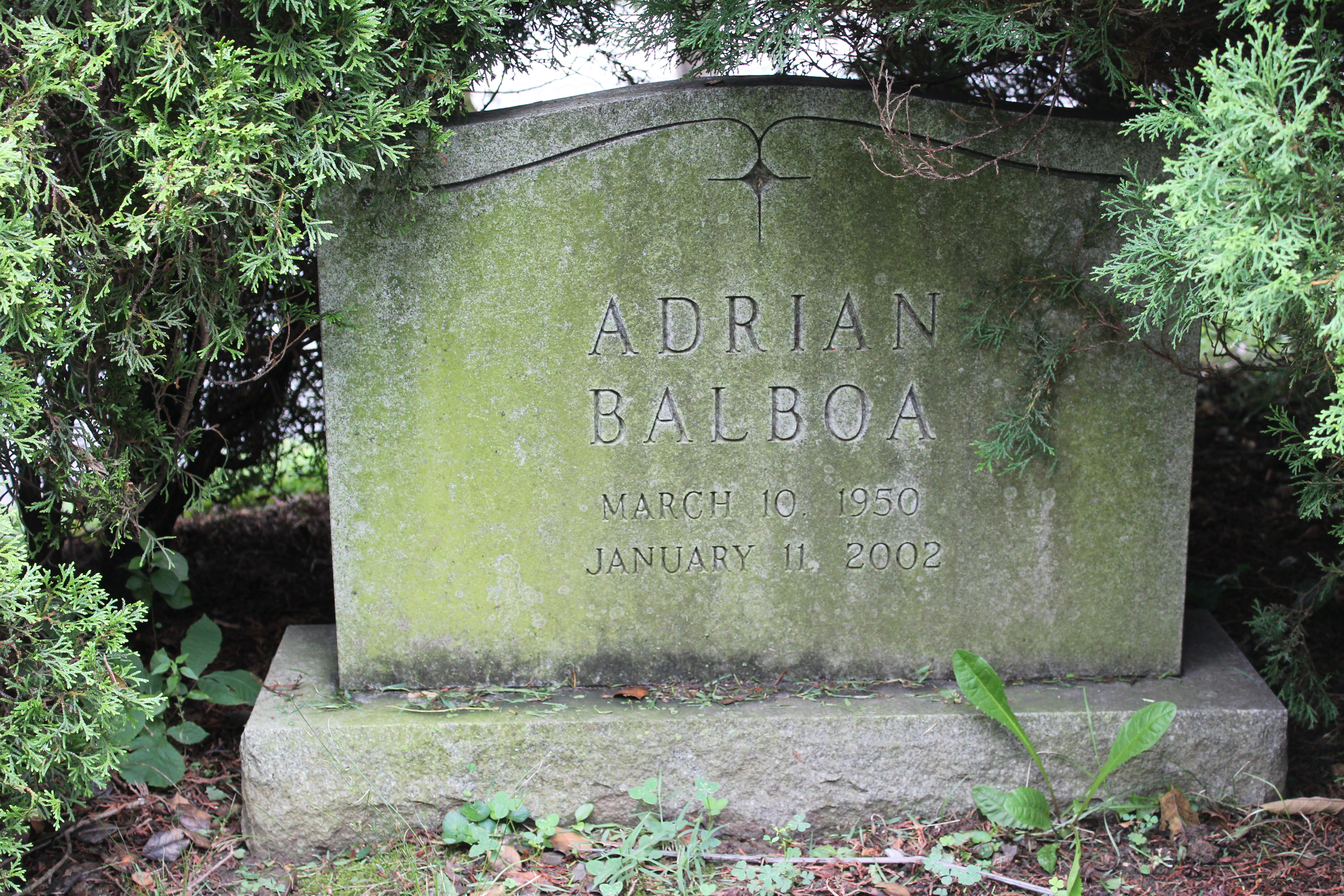
The cemetery now operates as Laurel Hill East, paired with West Laurel Hill under one organization, and the living have reclaimed it on the founders' original terms. The grounds are an accredited arboretum of more than 6,000 trees and shrubs representing some 700 species, which makes an autumn walk here one of the great free shows in Philadelphia — the monuments are almost incidental to the maples. Guided tours, concerts, movie nights, and the annual RIP 5K run through the sections, and thousands visit each year simply to walk the drives. Two headstones near the gatehouse draw their own pilgrims: the graves of Adrian Balboa and Paulie Pennino, fictional characters from the Rocky films, whose prop stones — used in Rocky Balboa (2006) and Creed (2015) — stand where Rocky stood to talk to them. Nearby is a more recent beloved marker, for Phillies broadcaster Harry Kalas, whose tombstone is shaped like a microphone and flanked by seats from Veterans Stadium. That layering is Laurel Hill in summary: a working cemetery, a sculpture garden, an arboretum, and a film set, still doing the job John Jay Smith designed it for in 1836 — keeping the names legible, and the grounds worth walking.
Key Facts
• Founded in 1836 by John Jay Smith and partners on the former Sims estate above the Schuylkill; designed by Scottish-American architect John Notman, with terraces descending to the river and a Roman Doric gatehouse on Ridge Avenue.
• The second major rural cemetery in the United States, after Boston's Mount Auburn; it holds 74 acres, more than 11,000 family lots, and over 33,000 graves.
• A popular public landscape before Philadelphia had parks: nearly 30,000 visitors in part of 1848 and an estimated 140,000 a year by 1860.
• Notable burials include Gettysburg commander George Meade and some 40 Civil War-era generals, industrialists Matthias Baldwin, Henry Disston, and Peter A. B. Widener, and explorer Elisha Kent Kane; Alexander Milne Calder's William Warner monument is its most famous sculpture.
• Listed on the National Register of Historic Places in 1977 and designated a National Historic Landmark in 1998 — the first cemetery in the United States so designated. It is also an accredited arboretum with over 6,000 trees and shrubs in 700 species.
Visitor Details
Address: Laurel Hill East, 3822 Ridge Avenue, Philadelphia, PA 19132 (main entrance and gatehouse on Ridge Avenue at Clearfield Street)
Transit: SEPTA bus route 61 (the Ridge Avenue Line) from 9th Street in Center City stops at Clearfield Street, across from the Cemetery Gatehouse; alternatively, SEPTA bus route 60 on Allegheny Avenue ends at Ridge Avenue, a one-block walk south (per the cemetery's official visitor directions). A pedestrian entrance is at Kelly Drive and Hunting Park Avenue.
Hours/Admission: Per the cemetery's official site, gate hours are 7 am to 7 pm during daylight time (spring through fall) and 7 am to 5 pm during standard time; the Laurel Hill East office is open Monday–Friday 8:30 am–4:30 pm and Saturday–Sunday 9:30 am–4:30 pm. The grounds are open to walkers; tours and events are scheduled separately and some are ticketed — check the official site's calendar before visiting.
Best timing: Morning light on the river terraces, or any clear autumn day for the arboretum's color. Allow at least two hours for the gatehouse, Millionaire's Row, the Warner monument, and the walk down toward the Schuylkill; the main drives are paved but the inclines are steep.
Location Photography