Ten Acres Half a Mile Beyond the City Limits
In June 1897, William and Mary Brickell sold the City of Miami a rocky ten-acre tract for $750. The city had been incorporated only the year before, by a vote in which Black and Bahamian residents made up about a third of the incorporators. The new cemetery sat about half a mile north of the city limits, reached by a narrow wagon-track county road, on high, rough ground that early Miamians considered good for little else. Miami City Cemetery — formally the City of Miami Cemetery — is today the only municipal cemetery in Miami-Dade County, enclosed by a stone wall and iron fence just north of downtown, where the traffic of NE 2nd Avenue runs past ground that has barely changed its purpose in almost 130 years. It was added to the National Register of Historic Places on January 4, 1989. To walk it is to read the first draft of Miami, before the railroad hotels, before the land boom, before the skyline — a frontier town's burial ground that the modern city grew up around and, unusually, never removed.
The First Burials and a Divided Ground
The cemetery's first burial was never recorded. It was an elderly Black man, buried on July 14, 1897. The first recorded burial followed six days later: H. Graham Branscomb, a 24-year-old Englishman who died of consumption on July 20, 1897. That pairing — an unnamed Black pioneer first, a named white immigrant second — captures the ground's founding contradiction. From its inception the cemetery was subdivided by race: white burials on the east end, Black burials on the west. The division was a faithful map of Jim Crow Miami. Black and Bahamian workers provided much of the labor that physically built the city, yet deed clauses confined their living neighborhoods to the northwest, in what became Overtown, and the cemetery extended that geography into death. Later sections layered religion and service over the original split. In 1915 the Beth David congregation — Miami's first Jewish congregation, founded as B'nai Zion — began a walled Jewish section in the northwest, its gate marked with Stars of David. Catholic, American Legion and Spanish-American War sections followed, and military burials line the north and south fences. About 9,000 people now rest here, and the sections still teach, at a glance, how early Miami sorted its own.
Julia Tuttle and the Pioneer Circles
Two circular plots anchor the grounds. The most visited holds Julia Tuttle, the "Mother of Miami," buried in 1898 as roughly the twelfth person interred here. Tuttle owned the land on the north bank of the Miami River, sent Henry Flagler orange blossoms after the Great Freeze of 1894–95 to prove her groves had survived, and deeded him land to bring his Florida East Coast Railway south — the deal that made Miami a city in 1896. She died of pneumonia just two years later, and her grave, marked plainly rather than grandly, remains a pilgrimage point for anyone who wants to stand at the city's origin. Around her rest the other founding names: the Burdines of department-store fame, their mausoleum among the grounds' most imposing; the Peacocks, who had built Coconut Grove's first hotel; the Sewells, including John Sewell, Miami's third mayor; John B. Reilly, its first mayor; and Dr. James Jackson, the pioneer physician who established the city's first hospital. The second circle, raised by the United Daughters of the Confederacy, memorializes the Civil War dead — in a striking Florida reconciliation, 66 Confederate and 27 Union veterans are buried in the same small cemetery.
Oolitic Stone, Tropical Green and Carrie Miller in Concrete
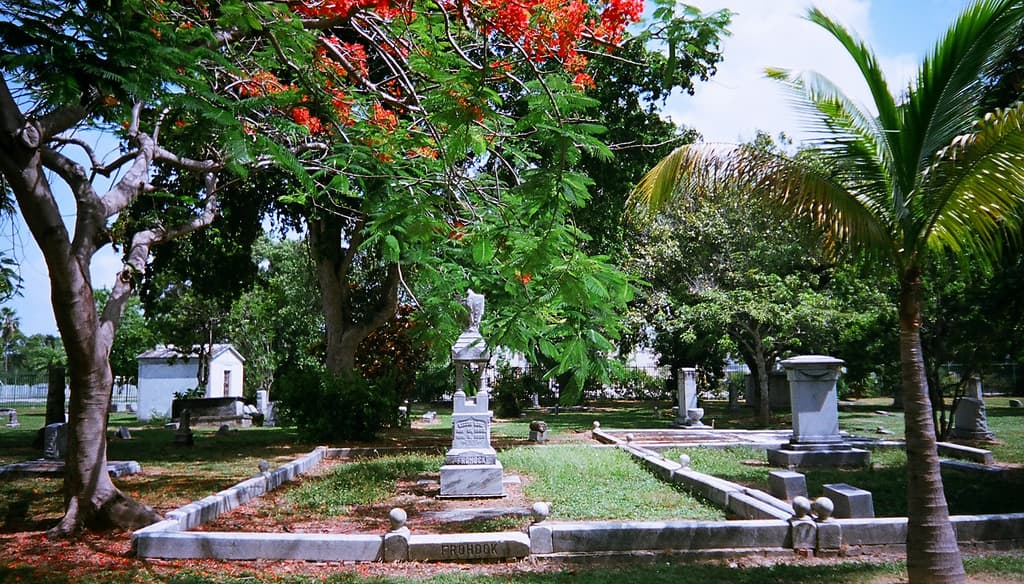
Miami sits on oolitic limestone, a soft, porous rock formed from ancient sandbars, and its first gravediggers cut markers from the ground itself. The cemetery is said to hold the only known five oolitic limestone gravestones in the world — fragile, weather-softened stones that could exist nowhere else, because nowhere else buried its dead in quite this geology. Digging here was never easy; the thin soil over rock is one reason some markers lean and sink, anchored in almost nothing. Above ground, the place reads less like a manicured memorial park than a tropical oasis: mature palms, gumbo limbo and flowering trees shade Greek Revival mausoleums and Victorian tablets, and roots have been known to embrace the smallest stones. And then there is the grave everyone asks about. Carrie Barrett Miller's burial is a room-sized monolith of concrete, inscribed to explain itself: her body was moulded in a solid block of concrete on December 4, 1926, so that after the body turned to dust, her sleeping form would remain. HistoryMiami's annual cemetery tours still stop there, alongside the graves of civil rights leader the Rev. Theodore Gibson and Bernard Mackey of the Ink Spots quartet — proof that the grounds kept collecting Miami's story long after the pioneer era closed.
Deeds, Restoration and a Cemetery That Never Closed
Unusually, plot owners here actually hold deeds to their burial land — one reason the cemetery's upkeep has always been a negotiation between the city, which manages it through its Parks and Recreation Department, and the families who own and tend individual plots. About 1,000 open plots remain, but burial is tightly restricted: you must be a deedholder or prove a family relationship to one; friends of the family do not qualify. Even so, the cemetery is not a museum piece — between ten and twenty burials still take place every year. For decades the grounds deteriorated, stones toppling in the thin soil and crypts suffering break-ins. In 1997, Enid Pinkney and Penny Lambeth began a restoration effort that advocates describe as a transformation, resetting markers, documenting burials and drawing new attention to the neglected western section, where many of Miami's early Black leaders now have renewed markers. Hurricane Irma toppled trees and damaged stones in 2017, a reminder that preservation here is a recurring job, not a finished one. What survives is irreplaceable: the one place where Miami's first generation — founders and laborers, mayors and musicians, both armies of the Civil War — still lies together, divided by old lines on the ground and united by everything the city became above it.
Key Facts
- Founded in 1897 on ten acres sold to the City of Miami by William and Mary Brickell for $750, a year after Miami's incorporation; located at 1800 NE 2nd Avenue and added to the National Register of Historic Places on January 4, 1989.
- First burial (unrecorded) was an elderly Black man on July 14, 1897; first recorded burial was H. Graham Branscomb, 24, on July 20, 1897. The grounds were subdivided from the start, with white burials east and Black burials west; a walled Jewish section began in 1915.
- About 9,000 burials include Julia Tuttle, the "Mother of Miami" (buried 1898), the Burdine, Peacock and Sewell families, first mayor John B. Reilly, and pioneer physician Dr. James Jackson.
- Both sides of the Civil War rest here — 66 Confederate and 27 Union veterans — with a memorial circle erected by the United Daughters of the Confederacy.
- The site is said to hold the only known five oolitic (limestone) gravestones in the world. Carrie Barrett Miller's 1926 grave is a solid block of concrete moulded around her body.
- Plot owners hold actual deeds; about 1,000 plots remain open but burial requires being a deedholder or proving family relationship. Ten to twenty burials still occur each year. A restoration begun in 1997 by Enid Pinkney and Penny Lambeth revived the grounds.
Visitor Details
Address: 1800 NE 2nd Avenue, Miami, FL 33132
Transit: Served by Miami-Dade Transit bus routes along NE 2nd Avenue and Biscayne Boulevard, north of downtown; the Metromover's Omni loop and the Metrorail at Government Center are the nearest rail connections, a walk or short bus ride away. Street parking is available on surrounding streets — check signs carefully.
Hours/Admission: Per the City of Miami's official parks directory, park hours are Monday–Friday 8 am–5 pm and Saturdays, Sundays and holidays 8 am–4 pm. No admission fee is listed for visiting the grounds on the City's page; check miamigov.com's City Cemetery page for current hours before you go, and note that HistoryMiami Museum's guided cemetery tours are separate, ticketed events.
Best timing: Go in the morning, when the limestone and mausoleums catch low light and the heat has not yet built. Allow an hour to walk both circles and the Jewish and western sections. It is an active cemetery — keep voices low, do not lean on fragile historic stones, and give any visiting family its privacy.
Location Photography