A Circle in the Concrete
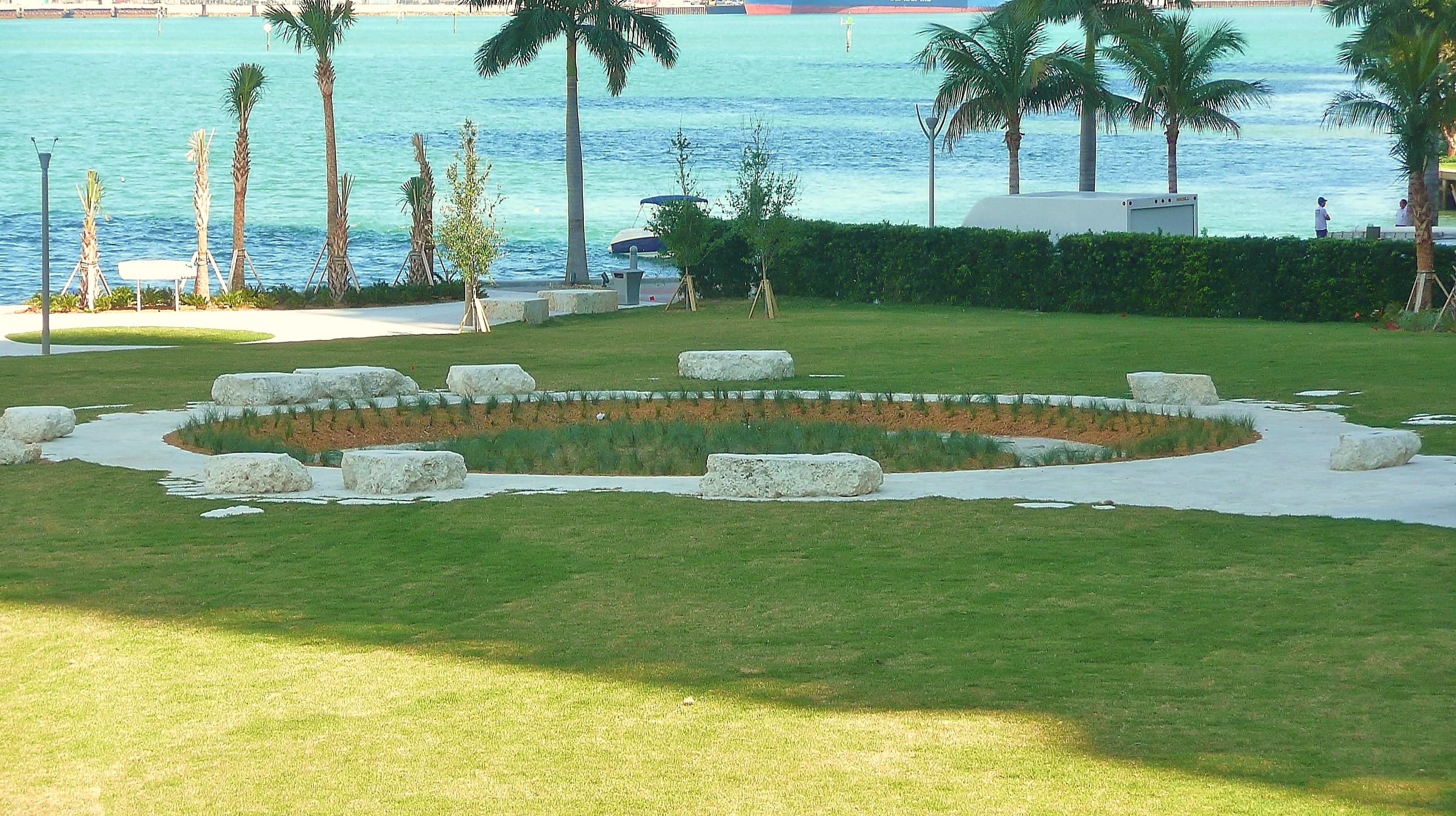
Stand at 401 Brickell Avenue, where the Miami River bends into Biscayne Bay, and Miami's two histories occupy the same few acres. Behind you rise the towers of Brickell, the densest forest of high-rises in the American South. In front of you, on a 2.5-acre spit of grass and pavement called Brickell Point, a circle 38 feet across is marked out on the ground — the visible trace, at Miami Circle Park, of something far older than the city around it. The circle itself is not a ruin you can touch. What archaeologists found here in 1998 — 24 large holes, or basins, cut into the oolitic limestone bedrock, ringed by roughly 600 smaller postmolds — was judged too fragile to leave exposed. After years of study and argument, it was carefully reburied beneath layers of limestone fill, and the park that opened in 2011 presents its outline, interpretive panels, and an audio tour above the protected original. You are, in effect, looking at a portrait of the artifact rather than the artifact. In a city famous for building over its past, that restraint is the story.
The Tequesta Capital at the River's Mouth
The people who cut the circle were the Tequesta, the Indigenous inhabitants of the Biscayne Bay shore long before Miami existed. Radiocarbon dating of burnt wood from the site returned ages of roughly 1,800 to 2,000 years, and the site as a whole is dated broadly between about 500 BC and AD 900 — which makes the circle older than any other known permanent settlement structure on the East Coast of the United States. Archaeologists believe the ring was the foundation of a substantial building — the postholes of a structure, possibly raised on posts against flooding, possibly a council house or ceremonial building — in what may have been the Tequesta's principal village, their capital at the river's mouth. The finds support the idea of a place that mattered. Alongside the expected shell tools, shark teeth, and stone implements of a fishing people, excavators recovered two basalt axe-heads, or celts, of a stone traced to the region of Macon, Georgia, some 600 miles away — untouched and apparently placed with care. Arranged in the floor of the feature were a complete five-foot shark skeleton aligned east to west, a bottlenose dolphin cranium, and the shell of a sea turtle. Whatever happened here, it was not an ordinary house, and the river mouth was a trading crossroads reaching deep into the continent centuries before Europeans arrived.
1998: The Apartments Come Down
For most of the twentieth century, the circle slept beneath an apartment complex at 401 Brickell Avenue, on land once owned by William Brickell, a co-founder of Miami. In 1998 the developer Michael Baumann bought the property for $8.5 million, demolished the apartments that July, and planned a luxury condominium. City historic-preservation rules required an archaeological survey first, and it was only after Bob Carr, then director of the Miami-Dade County Historic Preservation Division, pressed the point that the salvage excavation went ahead, carried out by the county division with the Archaeological & Historical Conservancy and volunteers. The team began finding holes cut into the bedrock. The project's land surveyor did the geometry: the holes fell on a perfect circle 38 feet in diameter, and by projecting from its center he predicted where the missing holes should be. Digging found them — 24 basins completing an unbroken ring, surrounded by hundreds of smaller holes and a rich scatter of artifacts, from shell tools and axe-heads to human teeth and charcoal from ancient fires. A routine pre-construction survey had become one of the most significant archaeological discoveries in North America.
A Fight Over What It Was — and Whether It Would Survive
Not everyone was convinced. University of Florida archaeologist Jerald Milanich publicly questioned the circle's age and authenticity, suggesting the ring might be nothing more than the drain field of an old septic tank. The rebuttal came from the rock itself: geologists from the Florida Geological Survey pointed to the buildup of calcite "duricrust" on the cut faces of the circle's holes — a slow mineral crust absent from the modern septic-tank cuttings nearby — evidence that the ring was ancient, not a plumbing accident. The scholarly argument ran alongside a harder one about money and land. Baumann offered to pay to move the circle elsewhere; preservationists, Native American advocates, and much of the public insisted that moving it would destroy it. Lawsuits followed, then an injunction, and finally an extraordinary purchase: in November 1999 the State of Florida bought the 2.5-acre site for $26.7 million, using state Preservation 2000 funds and private donations, to keep the circle exactly where its makers had cut it. The Brickell Point Site was listed on the National Register of Historic Places on February 5, 2002, and designated a National Historic Landmark on January 16, 2009.
Buried on Purpose: The Park Today
The strangest decision in the circle's modern life was also the most protective one: to bury it again. Exposed limestone and ancient postholes weather quickly in Miami's rain and heat, so conservators covered the feature beneath protective layers of limestone, and the park that HistoryMiami — the museum that signed a 44-year lease to manage the site in 2008 — opened in 2011 is deliberately quiet: lawn, palms, a seawall along the river, panels telling the story, and the circle's outline marking where the ring lies below. The artifacts themselves are not here; HistoryMiami Museum, the official repository for archaeological material recovered in Miami-Dade County, holds and displays them downtown. Later excavations nearby have only widened the picture — in 2014 the Miami Herald reported further postholes and evidence of ancient habitation across downtown, confirming that Brickell Point was one part of a large, long-lived Tequesta town. So the visit is an exercise in imagination, and it rewards the effort. Come at the edge of the day, when the towers light up and the river runs dark, and the geometry on the grass reads the way it should: not as a relic Miami kept, but as the foundation Miami was unknowingly built on top of — the first address at the mouth of the river.
Key Facts
- The Miami Circle is a perfect circle 38 feet (about 11.5 m) in diameter: 24 large holes or basins cut into oolitic limestone bedrock, surrounded by roughly 600 smaller postmolds, at Brickell Point on the south bank of the Miami River.
- It is attributed to the Tequesta and dated broadly to 500 BC – AD 900; radiocarbon dates on burnt wood indicated about 1,800–2,000 years old. Finds included shell tools, shark teeth, human teeth, two basalt celts traced to near Macon, Georgia, a shark skeleton, a dolphin cranium, and a sea turtle shell.
- Discovered in 1998 during a salvage excavation led by Bob Carr after the apartment complex at 401 Brickell Avenue was demolished for a planned condominium; excavations continued into February 1999.
- The State of Florida purchased the 2.5-acre site in November 1999 for $26.7 million to preserve it in place. It was listed on the National Register of Historic Places on February 5, 2002, and designated a National Historic Landmark on January 16, 2009.
- The circle remains buried beneath protective limestone fill; Miami Circle Park, managed by HistoryMiami under a 44-year lease signed in 2008, opened in 2011 with the circle's outline, interpretive panels, and an audio tour. Recovered artifacts are held by HistoryMiami Museum.
Visitor Details
Address: 401 Brickell Avenue, Miami, FL 33131 — Miami Circle Park at Brickell Point, on the south bank of the Miami River just east of the Brickell Avenue bridge; also reached through Brickell Park at 501 Brickell Avenue.
Transit: Brickell is served by Metrorail and the free Metromover (Brickell stations), a short walk from the park. Driving is possible but Brickell traffic and limited street parking make rail the easier option.
Hours/Admission: This is an outdoor public park space, not a museum: the archaeological feature itself is buried for protection, so what you visit is the marked circle outline, interpretive panels, and riverfront grounds — there are no visitor facilities on site. Check HistoryMiami's website for any scheduled tours, programs, or temporary closures before you go.
Best timing: Early morning or near sunset, when the park is quiet and the light is low over the river mouth. Allow about 30 minutes, and pair it with HistoryMiami Museum downtown, where the artifacts recovered from the site are held and displayed.
Location Photography