A Cemetery of National Memory, a Mile and a Half from the Capitol
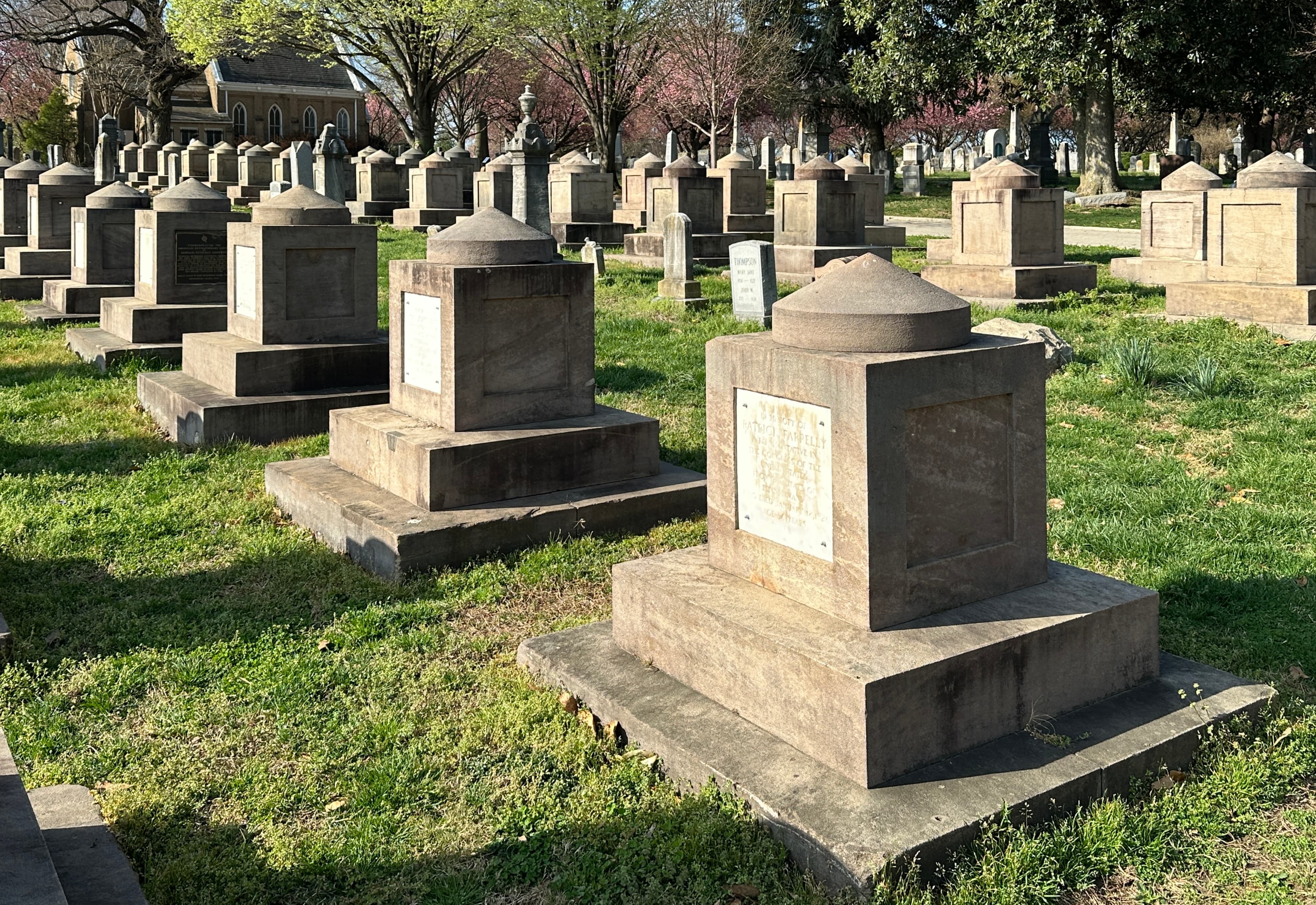
Congressional Cemetery occupies 35.75 acres of rolling ground on the west bank of the Anacostia River, about a mile and a half southeast of the U.S. Capitol. It looks like a handsome Victorian burial ground — until the rows come into view: long ranks of identical sandstone blocks, each a cube on a stepped base topped with a small cone, marching across the older sections in the same grid L'Enfant laid out for the city itself. Those are the Latrobe cenotaphs. Around them lie more than 65,000 burials — a vice president, nineteen senators, seventy-one representatives, six Cabinet members, veterans of every American war, and the builders, photographers, composers, chiefs, and madams of the young capital.
The cemetery is often described as the first true national cemetery in the United States — founded in 1807, half a century before Arlington. Yet it has never been a federal institution: it is owned by Christ Church, an Episcopal parish on Capitol Hill, and run by a nonprofit preservation association. It is still an active burial ground, and on any given morning its most numerous visitors are neighborhood dogs, running off-leash under a membership program that quite literally saved the place.
The Parish Burial Ground That Congress Adopted
The cemetery began as a local fix for a planning oversight: L'Enfant's plan for the capital made room for avenues and public buildings, but almost none for burying the dead. In April 1807, citizens associated with Christ Church bought a 4.5-acre square between E and G Streets and 18th and 19th Streets Southeast; in 1812 they deeded it to the church, and it took its official name, Washington Parish Burial Ground. That first summer, Senator Uriah Tracy of Connecticut became the first member of Congress buried there.
In 1817 the church set aside one hundred plots for members of Congress who died in Washington, and Congress responded in kind: from 1823 to 1876 it funded the cemetery's expansion, improvements, and the funerals of its own dead. By 1830 the public had settled on the name "Congressional Cemetery," whatever the deed said. Purchases between 1849 and 1869 grew the grounds to 35.75 acres, shifting in style as they grew — the earliest sections keep the city's stern grid, the later acres the rural cemetery movement's park-like landscaping.
Latrobe's Cenotaphs: A New Terror to Death
The cemetery's signature objects were born of a practical problem and a great architect's taste. Members of Congress died in the capital regularly in the early republic, far from home, and Congress wanted a uniform way to mark them. Benjamin Henry Latrobe — the nation's first professional architect, then repairing the burned Capitol — supplied the design: a stout cube of Aquia Creek sandstone on a stepped plinth, its faces recessed in plain panels, crowned by a short cylinder and a conical cap. It was radically modern, all geometry and restraint. The same Aquia sandstone built the Capitol and the early White House, and the cenotaphs were likewise painted white, tying the burial ground visually to the federal city.
The word cenotaph means "empty tomb," and many of these are literally that. The cemetery counts 179 Latrobe cenotaphs; only a portion mark actual remains, the rest commemorating members buried elsewhere — a practice that began by accident in the 1830s, when Congress erected Representative James Lent's monument even after his family had moved his body to New York. Not everyone admired them. In 1876 Senator George Hoar of Massachusetts killed a bill that would have required the design for future burials, observing that "the thought of being buried beneath one of those atrocities brought new terror to death." Only two cenotaphs have been added since: Hale Boggs's in 1972, after his plane vanished in Alaska — a true empty tomb — and Tip O'Neill's in 1994.
A Vault for Presidents, and the Company in the Ground
Near the center of the grounds stands the Public Vault, a partially subterranean classical-revival structure built with federal funds in 1832–34, its marble facade announcing PUBLIC VAULT through vent holes in its iron doors. It was the capital's holding room for the distinguished dead — and its temporary residents included three presidents: William Henry Harrison in 1841, who rested there for three months, longer than the single month he served as president; John Quincy Adams in 1848; and Zachary Taylor in 1850. First Lady Dolley Madison spent two years in the vault, the longest known stay, while money was raised to return her to Montpelier.
The permanent residents are just as telling. Vice President Elbridge Gerry, the only signer of the Declaration of Independence buried in Washington, lies here, as do John Philip Sousa, the Marine Band's March King; Mathew Brady, the Civil War's defining photographer; Belva Lockwood, the first woman to argue before the Supreme Court; FBI director J. Edgar Hoover and his associate Clyde Tolson; Choctaw chief Pushmataha; and Robert Mills, designer of the Washington Monument. The Arsenal Disaster Monument marks a darker day: in 1864 an explosion at the nearby arsenal killed twenty-one women and girls packing cartridges, and President Lincoln led their funeral procession here.
Decline, Neglect, and a Rescue Led by Dogs
After 1876 Congress lost interest, and for a century the cemetery faded from national shrine to, by the 1970s, something close to abandonment. Christ Church's membership and endowment shrank, monuments toppled, maintenance stopped, and the grounds became known to drug dealers and prostitutes. The Association for the Preservation of Historic Congressional Cemetery took over in 1976, but progress was slow until an improbable coalition arrived: a 1996 C-SPAN broadcast brought a hundred airmen from Andrews Air Force Base, who showed up unannounced to mow all thirty-five acres — a military service day that has been an annual tradition since. In 1997 came the masterstroke: the K9 Corps, which lets members walk their dogs off-leash across the grounds. The dog walkers brought daily eyes, income, and a constituency that would not let the place sink again. The National Trust listed the cemetery among America's 11 Most Endangered Historic Places in 1997, Congress supplied a $1 million matching endowment grant in 1999, and in 2011 the cemetery was designated a National Historic Landmark.
Gay Corner: Matlovich, Hoover, and a Section Found Nowhere Else
In the cemetery's northwest, near the graves of Hoover and Tolson, stands one of the most quietly defiant headstones in America. Leonard Matlovich was a decorated Air Force technical sergeant — Bronze Star, Purple Heart, three tours in Vietnam — who in 1975 deliberately challenged the military's ban on gay service members by coming out to his commanding officer; that September he appeared on the cover of Time under the headline "I Am a Homosexual." Discharged anyway, he became a leading gay-rights activist, and in the 1980s he bought two plots here, pointedly near Hoover — the FBI director who had spent the 1950s and 1960s hunting gay federal employees as "sexual deviates." Matlovich designed his own stone before his death from AIDS in 1988: a black granite marker reading "A Gay Vietnam Veteran" above his self-written epitaph — "When I was in the military, they gave me a medal for killing two men and a discharge for loving one."
Other LGBTQ veterans, activists, and couples chose plots around his, and the cluster grew into what the cemetery calls Gay Corner — a section it describes as the only LGBTQ section in any cemetery in the world. Gay-rights pioneer Frank Kameny has a memorial marker nearby, and activist Barbara Gittings is buried here. The corner now hosts Pride gatherings and the annual Pride Run. It is a fitting final turn: a burial ground invented for congressmen has become a record of Americans the official city once preferred not to see.
Key Facts
- Founded April 4, 1807, as the Washington Parish Burial Ground by citizens associated with Christ Church; deeded to the church in 1812 and still owned by Christ Church, Washington Parish. Now 35.75 acres (about 14 ha) holding more than 65,000 burials and memorials.
- Designated a National Historic Landmark on June 14, 2011 (listed on the National Register of Historic Places June 23, 1969). The U.S. government owns 806 burial plots in the cemetery, administered by the Department of Veterans Affairs.
- The cemetery counts 179 Latrobe cenotaphs — identical Aquia Creek sandstone monuments designed by Benjamin Henry Latrobe for members of Congress who died in office; the practice ran from the early republic until 1876, with only two added since (Hale Boggs, 1972; Tip O'Neill, 1994).
- The Public Vault (built 1832–34 with federal funds) temporarily held three presidents — William Henry Harrison (1841), John Quincy Adams (1848), and Zachary Taylor (1850) — and First Lady Dolley Madison for two years.
- Notable burials include Vice President Elbridge Gerry, John Philip Sousa, Mathew Brady, Belva Lockwood, J. Edgar Hoover, Clyde Tolson, Alain Locke, Tom Lantos, Cokie Roberts, and Leonard Matlovich.
- Revived after decades of decline by the Association for the Preservation of Historic Congressional Cemetery (managing since 1976) and the K9 Corps dog-walking program (founded 1997), whose members supply about 20% of operating income.
Visitor Details
Address: Congressional Cemetery, 1801 E Street SE, Washington, DC 20003. Main entrance at 18th and E Streets SE, on the west bank of the Anacostia River in the Hill East / Capitol Hill area.
Transit: Potomac Avenue Metro station (Blue/Orange/Silver) is about three blocks west; Stadium-Armory station is about two blocks north. Free street parking is available on surrounding streets.
Hours/Admission: The grounds are open to general visitors daily from 7:00 AM to 7:00 PM, and the cemetery remains an active burial ground — expect funerals, and note that some events close the grounds to dogs. Self-guided walking tours are available on site and on the official site; docent-led introductory tours run most Saturdays at 11:00 AM from April through November (per the cemetery's official FAQ, introductory tour tickets are $5 and special-topic tours $10 — confirm current details at congressionalcemetery.org before visiting). Off-leash dog walking is reserved for K9 Corps members (day passes for visiting dogs have been offered at the gatehouse; check the official site for current rules), and the cemetery is closed to dogs on Saturdays from 11:00 AM to 3:00 PM.
Best timing: A Saturday morning in spring or fall, pairing the 11:00 AM docent tour with time to wander; late October brings the popular Soul Strolls evening tours, and early morning is best for quiet, the cenotaph rows in raking light, and the full K9 Corps in action.
Congressional Cemetery — Context Photography