A Palace for the Newcomers
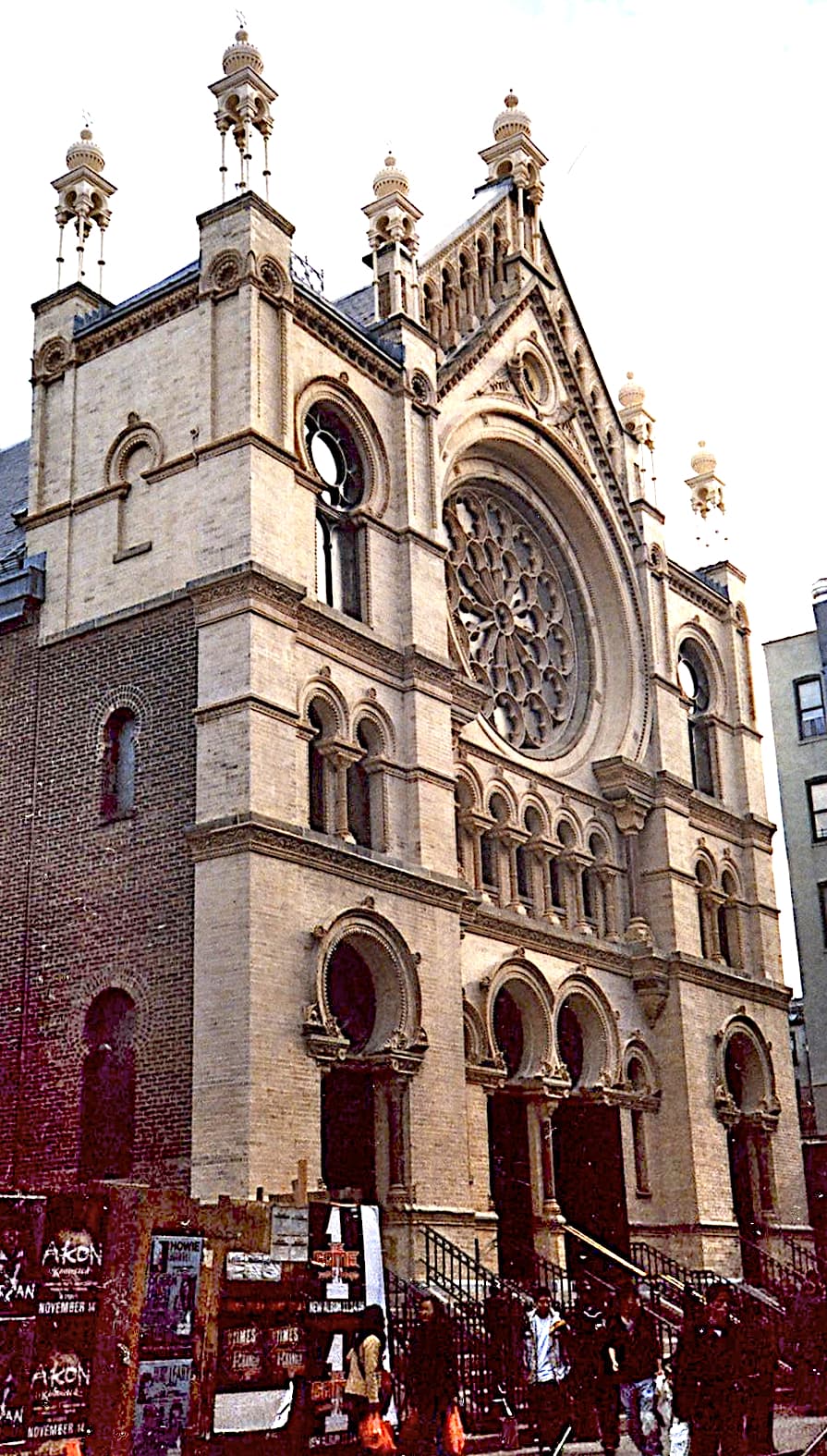
The Lower East Side of the 1880s was the densest neighborhood on earth, and its newest arrivals — Jews fleeing pogroms in Russia and Eastern Europe — were determined to announce themselves. On September 4, 1887, just before the High Holy Days, they dedicated the Eldridge Street Synagogue at 12 Eldridge Street, between Canal and Division. It cost $91,907.61, an enormous sum raised dollar by dollar from garment workers and pushcart peddlers. It was one of the first synagogues in the United States built by Eastern European Jews, and they built it like people who had something to prove: a Moorish Revival palace with minaret-like finials, horseshoe arches, and a rose window, rising over a street of tenements.
The congregation, Kahal Adath Jeshurun, had been founded in 1852 as Beth Hamedrash and had already merged with another congregation by the time ground was broken in September 1886. At its peak, between roughly 1890 and 1915, it counted as many as 800 member families. On a Sabbath morning the sanctuary — with its 50-foot vaulted ceilings — held a cross-section of the most crowded Jewish neighborhood in the world.
Two Catholic Architects and a Moorish Dream
Here's the detail that always stops people: the architects were two Catholic brothers from Germany. Peter and Francis William Herter — the Herter Brothers — were tenement architects. The Eldridge Street Synagogue was their first synagogue commission, and they approached it the way outsiders sometimes do, with total commitment to the assignment. They gave the building a Moorish Revival vocabulary — the style 19th-century Europe associated with the golden age of Spanish Jewry — layered with Gothic and Romanesque elements: pointed arches, keyhole windows, terra-cotta ornament, and those unmistakable rooftop finials that read, from down the block, almost like minarets.
Walk up to the facade and the building starts talking in numbers. The great rose window is ringed by twelve small round windows — the twelve tribes of Israel. Below it sit four entrance doors — the four matriarchs — with the two central doors for men and the two side doors for women, reflecting Orthodox practice. Five keyhole windows above the ark stand for the five Books of Moses. Ten tablets along the roofline carry the Ten Commandments. Nothing on the exterior is decoration for its own sake.
Inside the Numbers
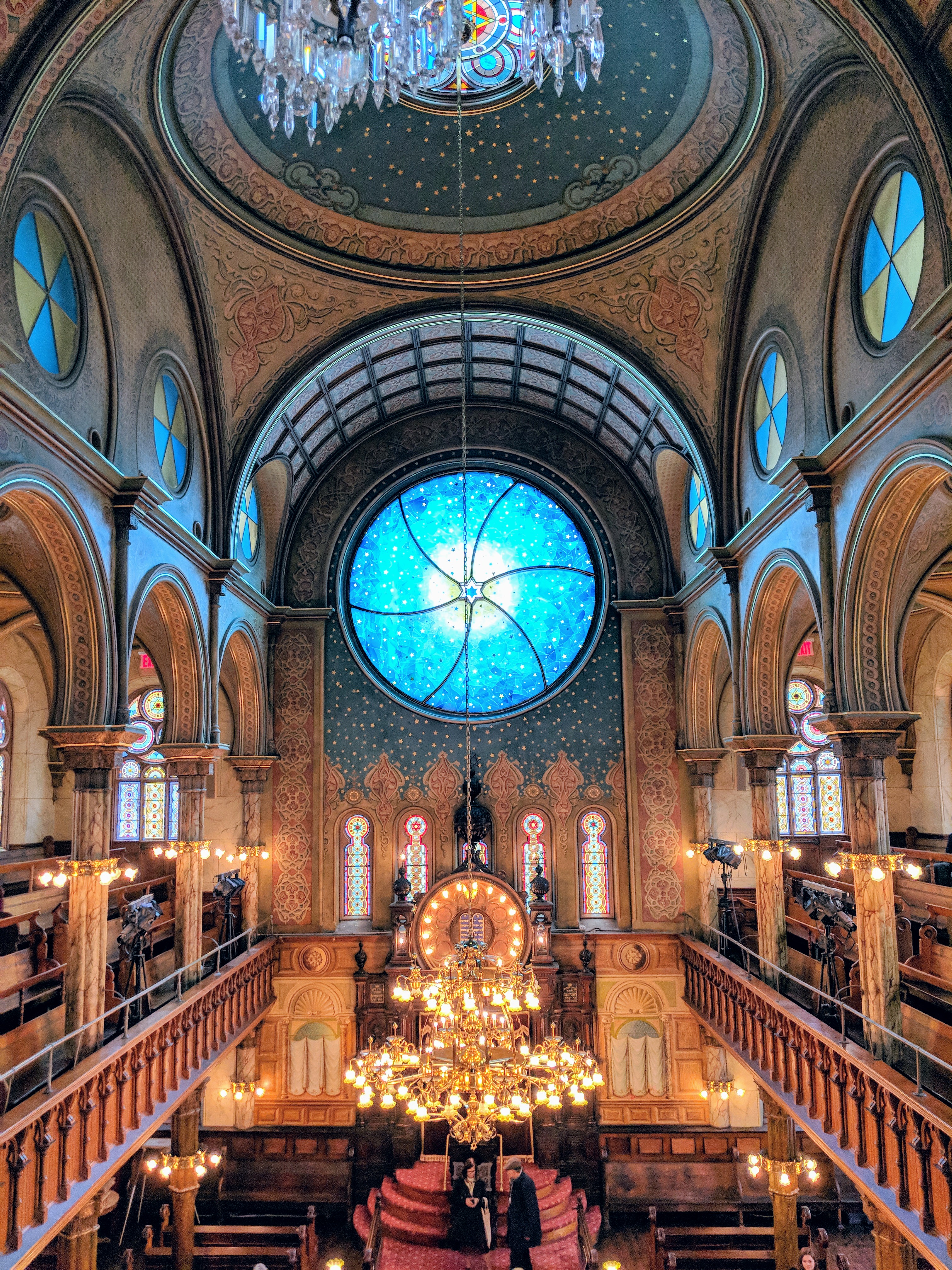
The interior keeps the code going. The sanctuary is a single soaring room under a vaulted ceiling, ringed by a women's balcony, with a central walnut bimah — the raised reading platform — placed, per Orthodox tradition, in the middle of the room rather than at the front. Behind it stands a hand-carved walnut Torah ark. The walls are covered in hand-stenciled patterns: stars, leaves, and geometric bands in blue, rose, and gold, respecting the Orthodox prohibition on depicting human or animal figures. Sixty-seven stained-glass windows filter the light; some 85 percent of the panes are original.
Overhead hangs the room's great anchor: a massive brass chandelier with 75 lights, originally gaslit and electrified in 1907. When the building was restored, rewiring and polishing that chandelier was one of the signature jobs. Stand under it and look up, and the whole immigrant-ambition story compresses into a single object — built by people who had arrived with nothing, paid for in installments, and meant to outshine anything they'd left behind.
The Long Sleep
The congregation's fortunes tracked the neighborhood's. Immigration restriction — above all the Immigration Act of 1924 — choked off the flow of newcomers, and as earlier immigrants prospered and moved to the Bronx, Brooklyn, and beyond, the pews emptied. By mid-century the great sanctuary was too big and too expensive to maintain. In 1954 the congregation closed the main sanctuary and retreated to the basement beth midrash, a small study-and-prayer room, where services continued. Upstairs, the dust settled. Literally: when preservationists first walked through in the early 1980s, the dust on the benches was thick enough to write in, the roof leaked, and pigeons roosted in the balconies.
The rescue began in 1986, when Roberta Brandes Gratz — an urbanist and writer who had been stunned by the building's condition — founded the Eldridge Street Project. What followed was one of the great grassroots preservation campaigns in American history: roughly 18,000 volunteers and donors, some twenty years of work, and around $20 million raised. Plasterers re-created the stenciled walls by hand. Stained glass was repaired pane by pane. In December 2007, on the building's 120th anniversary, it reopened as the Museum at Eldridge Street.
There's one deliberate scar left from the restoration. On the left balcony, a section of wall was left unrestored — bare plaster and faded paint — as a witness to what the building looked like when the project began. It's the most honest square footage in the room.
The Rose Window That Wasn't There
The restoration was declared complete in 2007, but one element was still missing: the great rose window. The original had been lost, and a 19th-century intervention in its place was never satisfactory. In 2010, the museum unveiled the solution: a new 16-foot rose window designed by artist Kiki Smith with architect Deborah Gans. Made of more than 1,200 pieces of mouth-blown glass, with over 650 stars scattered across a deep blue field, it doesn't imitate the 1887 original — it answers it. Smith's window depicts a starry sky, and standing in the sanctuary at the right hour, it's the first thing your eye finds. A contemporary artwork, installed in a 19th-century frame, in a building rescued by 20th-century volunteers: the layers don't fight each other.
Still a Synagogue
This is the part visitors sometimes miss. The Museum at Eldridge Street is a museum, but the building is still a working Orthodox synagogue. Congregation Kahal Adath Jeshurun — now merged with Anshe Lubz — still owns the building and still holds services there. The museum and the congregation share the space the way the building's history demands: the downstairs beth midrash that kept the flame alive during the decades of dust is still in use, and the great sanctuary upstairs hosts both tourists and worshippers.
The museum runs docent-led tours and maintains exhibits on Jewish immigrant life, but the strongest exhibit is the room itself — and the knowledge that the people who built it, lost it, and saved it were, across four generations, the same community. Few buildings in New York can tell an immigration story that completely. Fewer still let you stand inside the ending.
Key Facts
- Dedicated September 4, 1887, the Eldridge Street Synagogue was one of the first grand U.S. synagogues built by Eastern European Jewish immigrants; it cost $91,907.61.
- Designed by Catholic German brothers Peter and Francis William Herter in Moorish Revival style; its facade encodes Jewish symbolism (12 tribes, 4 matriarchs, 5 Books of Moses, 10 Commandments).
- The main sanctuary closed in 1954; the Eldridge Street Project (founded 1986) led a ~20-year, ~$20M restoration, reopening as the Museum at Eldridge Street in December 2007.
- The 16-foot rose window by Kiki Smith and Deborah Gans (1,200+ pieces of glass, 650+ stars) was installed in 2010; the building is a National Historic Landmark (1996) and still houses an active Orthodox congregation.
Location Photography


Visitor Details
Address: 12 Eldridge Street, New York, NY 10002
Transit: F to East Broadway (~5 min walk); B/D to Grand St (~5 min walk)
Hours/Admission: Open Sunday–Friday 10am–5pm, closed Saturdays. Adults $15; students & seniors $10; children 5–17 $8; under 5 free. Pay-what-you-wish Mondays and Fridays. (Verified on eldridgestreet.org, Oct 2026 — confirm before visiting.)
Best timing: Weekday mornings are quietest; docent-led tours run throughout the day and the Bloomberg Connects app offers a self-guided digital tour.