October 16, 1846: The Demonstration
The patient was already waiting when the dentist arrived late. William Thomas Green Morton, a 27-year-old Boston dentist, had been up perfecting his apparatus — a blown-glass inhaler with brass fittings and a middle chamber holding a sponge soaked in sulfuric ether — and he walked into the operating theater of Massachusetts General Hospital fifteen minutes behind schedule. The audience of physicians and medical students had nearly given up on him. On the table sat Edward Gilbert Abbott, a young printer with a vascular tumor beneath his jaw, a growth he had carried since birth. He had been tied to his chair so he would not choke on his own blood. Morton held the mouthpiece of his new device — later called the Morton Etherizer — to Abbott's lips and told him to breathe deeply and slowly. Within three to four minutes, Abbott had fallen into an unconscious, sleeplike state. John Collins Warren, the hospital's senior surgeon and the first dean of Harvard Medical School, then made his incision and removed part of the tumor from Abbott's neck. When Abbott woke, he said he had felt a scratching sensation, but no pain. "Feels as if my neck's been scratched," he reportedly told Warren. Warren turned to the skeptical crowd and delivered the line that made history: "Gentlemen, this is no humbug." Everyone in the room understood the reference. The previous year, in this same theater, dentist Horace Wells had attempted a public demonstration of nitrous oxide as an anesthetic, only for his patient to groan in pain — and the audience had shouted him down with cries of "Humbug!" This time there was no groaning. Surgeon Henry Jacob Bigelow published his account within weeks, and within months the news had reached Europe. Abbott was discharged, well, on December 7; he died in 1855, at thirty.
A Theater Built for Daylight
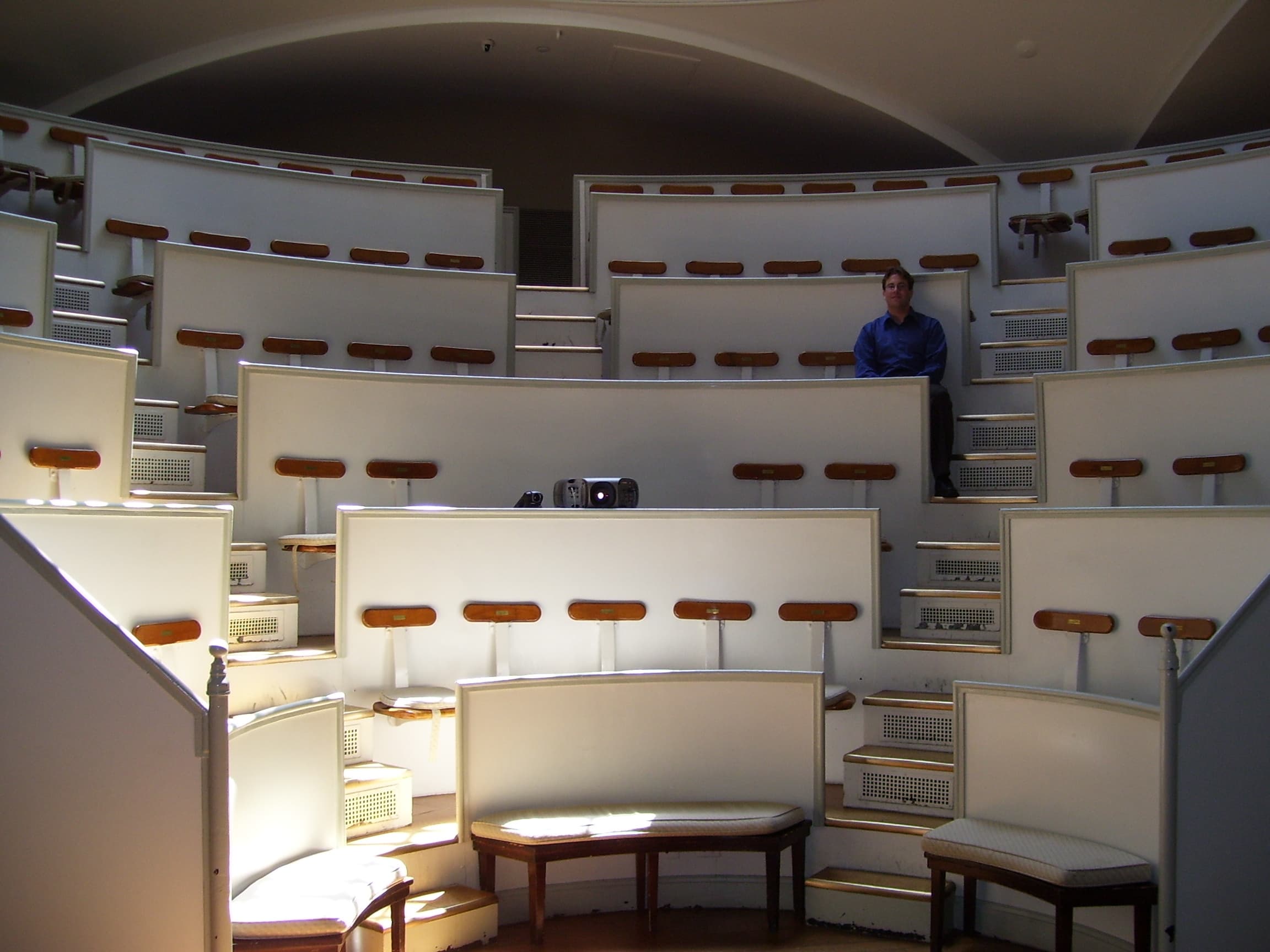
The Ether Dome was not built for fame. It was built because surgeons needed light. The room sits at the top of the Bulfinch Building, the original Massachusetts General Hospital, which opened in 1821. Charles Bulfinch designed it; Alexander Parris executed the construction after Bulfinch left for Washington to work on the U.S. Capitol. Inmates at Charlestown Prison cut the white Chelmsford granite for its Greek Revival walls. Placing the operating theater on the top floor served two purposes. The saucer-shaped cupola overhead funneled natural light down onto the operating table — there was no electric lighting, and a surgeon needed to see. And the height muffled the sounds below: for most of its working life, this was a room where conscious patients were cut, and their screams carried. The steeply banked seats along the south wall gave every observer a clear view of the table at the center. From 1821 to 1867 it served as the hospital's operating room, the site of more than 8,000 operations performed between 1821 and 1868. After the ether demonstration, the theater took the name it still carries. The room was designated a National Historic Landmark on January 12, 1965, and added to the National Register of Historic Places on October 15, 1966 — recognition not of its architecture alone, but of what happened inside it on a single October morning.
The Mummy, the Statue, and the Skeleton
Walk into the Ether Dome today and the strangest thing is not the surgical history — it is the company the room keeps. Near the entrances stand two figures that were present in the amphitheater on the day of the original demonstration and remain in attendance now: a replica of the Apollo Belvedere, the Greek god of medicine, and Padihershef, an Egyptian mummy. Padihershef has a good claim to being the hospital's oldest patient. The mummy and its coffin were brought to Boston in 1823 and given to Massachusetts General Hospital to help raise funds to keep the young institution running — the first intact Egyptian mummy in the United States. A teaching skeleton from the early nineteenth century hangs nearby; it can be spotted in the background of daguerreotypes showing ether being administered in the dome in 1847, a reminder of the era's uneasy relationship with anatomy and the bodies it studied. The cases around the room hold more: a replica of Morton's original glass etherizer, period surgical instruments, early anesthetic devices, posters, and plaques. The seats themselves carry brass plates inscribed with the names of figures important to the discovery of ether. And on the north wall hangs "Ether Day 1846," a ten-by-seven-foot mural by Warren and Lucia Prosperi, unveiled on October 16, 2001.
The Fight Over Who Discovered It
Morton did not invent ether, and he was not even the first to use it in surgery. A Georgia physician, Crawford W. Long, had removed a tumor from the neck of James Venable under ether on March 30, 1842 — more than four years before Ether Day — but he never published his findings until 1849, and the medical world moved on without him. Wells, Morton's former dental partner, had the nitrous oxide idea first and the public humiliation to show for it. Harvard chemist Charles T. Jackson claimed he had suggested the ether to Morton in the first place, and the two men spent twenty years locked in a bitter pamphleteering war over credit. Morton spent the rest of his life chasing recognition and a fortune that never came. In 1868, after reading a newspaper item crediting Jackson, he threw himself into a pond in New York's Central Park and died soon after, probably of a stroke. He was 48. What Morton did do — and what the Ether Dome commemorates — was the public demonstration. Surgery before anesthesia was a race against the patient's endurance; afterward, it could become deliberate, methodical, and humane. It was Boston physician and poet Oliver Wendell Holmes Sr. who supplied the word for what Morton had wrought: anesthesia. October 16 is still observed in Boston as Ether Day, and around the world as World Anesthesia Day.
A Working Room, Not a Relic
The Ether Dome is not roped off behind glass. It remains a teaching amphitheater and lecture hall, in active use by the hospital — which is exactly why visiting requires a little planning. The room is free and generally open to the public on weekdays from 9 a.m. to 5 p.m., but it closes for lectures, conferences, and faculty meetings, and hospital guidance notes that public access can be restricted. Call 617-724-9557 before you go. Pair the visit with the Paul S. Russell, MD Museum of Medical History and Innovation next door at 2 North Grove Street — free, open Monday through Friday 9 to 5 and Saturdays 11 to 5 from April through October.
Key Facts
- On October 16, 1846, dentist William T.G. Morton publicly demonstrated ether anesthesia here while surgeon John Collins Warren removed a tumor from patient Edward Gilbert Abbott's neck.
- The amphitheater sits atop the Bulfinch Building (opened 1821) and served as Massachusetts General Hospital's operating room from 1821 to 1867, hosting more than 8,000 operations.
- The room still holds its 1846 fixtures: the mummy Padihershef (brought to Boston in 1823), a replica of the Apollo Belvedere, and a 19th-century teaching skeleton.
- October 16 is observed as Ether Day in Boston and World Anesthesia Day internationally; the Dome was designated a National Historic Landmark in 1965.
Location Photography