A reading room before public libraries
The Boston Athenæum was founded in 1807, decades before the free public library existed in America. It grew out of the Anthology Society, a club of young Boston literary men who published the Monthly Anthology and wanted a reading room to go with it. Their model was the Athenæum and Lyceum of Liverpool, England; their first librarian was William Smith Shaw. The institution's seal, chosen in 1814, reads Literarum fructus dulces — "Sweet are the Fruits of Letters." The original terms were simple: a ten-dollar yearly subscription bought access to the rooms, and members could bring guests. The books, at first, did not circulate at all — not even members could take them home. What the founders were building was closer to a European subscription library than anything America had seen: a place where readers were known by name, where the same families would occupy the same chairs for generations. It worked. More than two centuries later, the Athenæum still operates on the membership model, one of the last of its kind in the country.
The house on Beacon Street
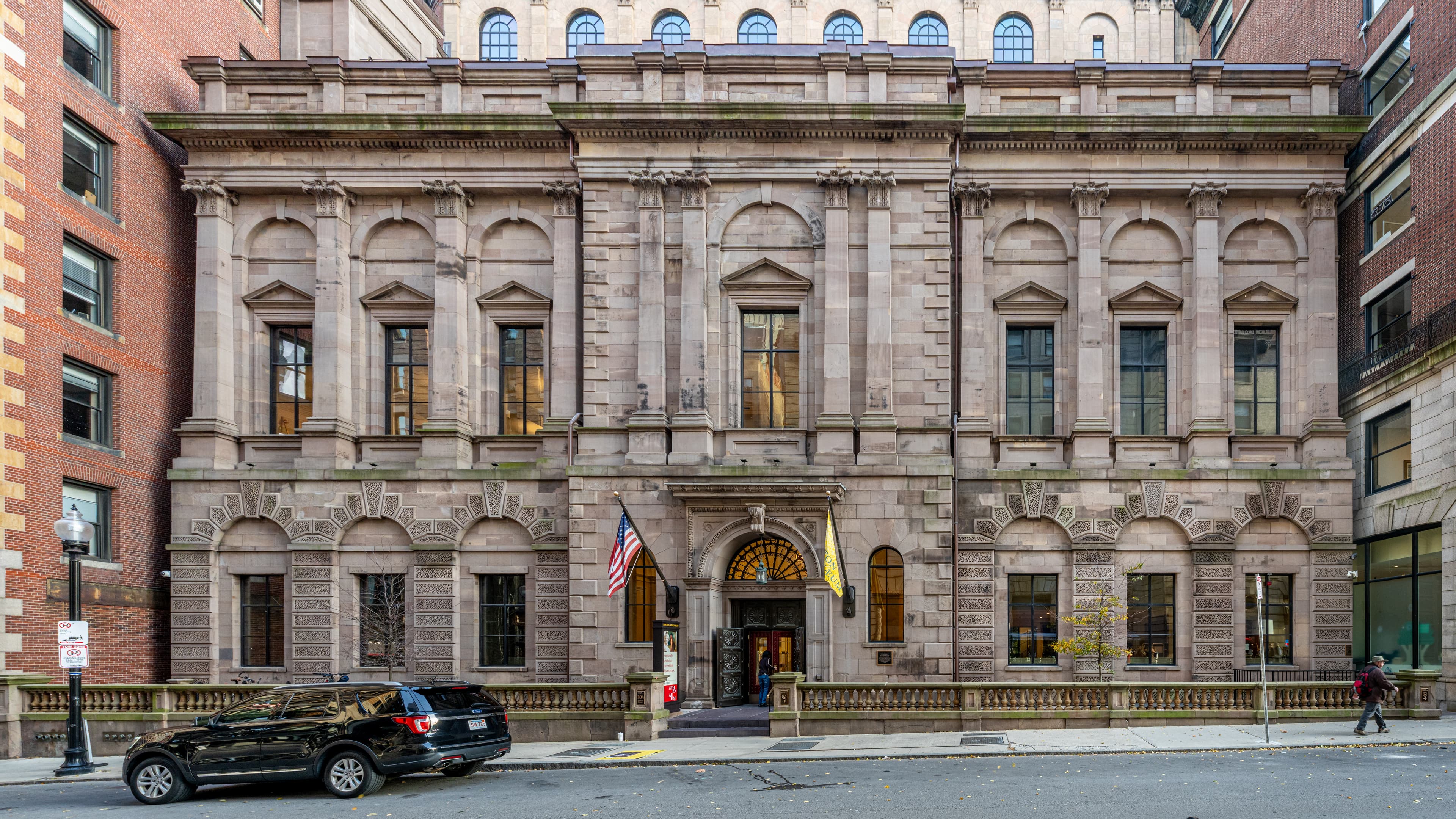
The Athenæum outgrew two earlier homes — rented rooms, then a house by King's Chapel Burying Ground, then a Pearl Street mansion — before building for itself. In 1847 the cornerstone was laid on Beacon Street, on a lot overlooking the Granary Burying Ground, and the new building opened in 1849. The architect was Edward Clarke Cabot, an artist and dilettante whose design won a competition. His neo-Palladian facade of Patterson sandstone was unlike anything else in Boston, and it solved a peculiar problem: an ingenious ground-level arch spanning graves in the burying ground freed more space on every floor above. Inside, the first floor held the sculpture gallery, the second the library, the third the paintings gallery. In 1913–14 the firm of Bigelow and Wadsworth added two set-back stories — including the celebrated fifth-floor reading room, a long, silent hall under the roof — and fireproofed the building. A ten-story Snead drum stack was threaded through the core to hold the growing collection. The building was declared a National Historic Landmark in 1966, and a major renovation from 1999 to 2002 added climate control and new first-floor gallery space. Through it all, the red doors on Beacon Street have barely changed.
What the shelves hold
The numbers only hint at it: more than half a million circulating books, over 100,000 rare volumes, and 100,000 works of art — paintings, sculpture, prints, photographs, decorative arts. The collection's particular strengths read like a syllabus of American history. The Athenæum holds the largest surviving portion of George Washington's personal library from Mount Vernon, complete with his bookplates and occasional marginalia. It owns Jean-Antoine Houdon's busts of Washington, Benjamin Franklin, and Lafayette that once belonged to Thomas Jefferson. There is a first-edition copy of John James Audubon's The Birds of America, a 1799 set of Francisco Goya's Los Caprichos, and one of the world's most important collections of primary material on the American Civil War. Then there is the macabre showpiece: a copy of the Narrative of the Life of James Allen, an 1837 death-bed confession of a Massachusetts highwayman, bound — at Allen's reported request — in the author's own skin, and given to the Athenæum before 1864 by the daughter of the man Allen once tried to rob. Testing by the Anthropodermic Book Project has confirmed the binding is human skin. It sits in the collection as a reminder that old libraries keep everything, including the things no one quite knows what to do with.
The portraits that got away
For nearly 150 years the Athenæum owned the most famous face in America: Gilbert Stuart's unfinished 1796 portrait of George Washington, the image engraved for the one-dollar bill, along with its companion portrait of Martha Washington. The trustees bought the pair in 1831 for $1,500, raised by subscription. From 1876 they hung on loan at the Museum of Fine Arts — itself an institution the Athenæum helped bring into being, when its trustees backed the creation of a separate museum and its galleries hosted the MFA's first exhibitions. In 1979 the Athenæum, needing money, agreed to sell the two portraits to the Smithsonian's National Portrait Gallery for $5 million. Boston erupted; the city sued to block the sale. The eventual compromise, completed in 1980, had the MFA and the National Portrait Gallery buy the portraits jointly, and they have split their time between Boston and Washington ever since. The episode says something about what the Athenæum had become: an institution whose holdings were too important to belong to one city, or to stay quietly private.
Members and the public
The membership rolls are a condensed history of American letters: Ralph Waldo Emerson, Nathaniel Hawthorne, Louisa May Alcott, Oliver Wendell Holmes Sr. and Jr., John Quincy Adams, Margaret Fuller, Francis Parkman, Amy Lowell, John F. Kennedy, Edward M. Kennedy. But the Athenæum is not sealed shut. The public can visit the first floor, with its sculpture, rotating exhibitions, and the children's library, for a modest admission fee; guided art and architecture tours open more of the building's twelve floors on a schedule. Research appointments in Special Collections — 200,000 rare and unique items — are free and open to all. Full membership, with borrowing privileges and access to every floor, starts at $524 a year for individuals and $350 for those 40 and under, and day memberships are available for visitors who want the full run of the place. The building keeps generous hours: Monday through Thursday 9 am to 8 pm, Friday and Saturday 9 am to 5 pm, closed Sundays. Stand in the fifth-floor reading room, where talking has been discouraged for a century, and look out over the Granary Burying Ground — the city has changed completely around it, and the room has not.
Key Facts
- Founded 1807 by Boston's Anthology Society; among the oldest independent libraries in the United States.
- Beacon Street building opened 1849 (architect Edward Clarke Cabot); expanded 1913–14 with the famed fifth-floor reading room; National Historic Landmark.
- Holdings include the largest portion of George Washington's Mount Vernon library, Houdon busts once owned by Jefferson, and a book bound in human skin.
- Membership library with public first-floor access, guided tours, and free Special Collections research appointments.
Location Photography