A Doctor's Radical Idea
In 1825, Dr. Jacob Bigelow invited a group of Boston's civic leaders to his house and proposed something nobody had tried in America: a cemetery built like a landscape garden. Bigelow was a physician and a Harvard professor, and his concern was practical as much as philosophical. Boston's dead were buried in crowded churchyards — King's Chapel, the Old Granary, Copp's Hill — where graves pressed against homes and businesses, and many feared the overcrowded ground was a public health hazard. Bigelow wanted the dead moved to open country, laid to rest among trees and hills instead of stacked in grim urban plots. The newly formed Massachusetts Horticultural Society took up the cause. In 1831 it bought a 72-acre farm on the Cambridge–Watertown line for $6,000 — land Harvard students had long called "Sweet Auburn" after Oliver Goldsmith's 1770 poem "The Deserted Village." The Massachusetts legislature authorized the ground for use as a garden or rural cemetery. Henry Alexander Scammell Dearborn, the society's president, drew the design with surveyor Alexander Wadsworth, laying roads and paths along the land's natural contours in 1831–32. Bigelow, who had studied the great Père Lachaise cemetery in Paris, shaped the whole conception: winding avenues, ponds, and plantings arranged so that a burial ground would also be a place for the living to walk and think. On September 24, 1831, Supreme Court Justice Joseph Story — the cemetery association's first president — dedicated Mount Auburn before a crowd, delivering an address so influential that historian Garry Wills treats it as a forerunner of Lincoln's Gettysburg Address. Even the word "cemetery" was a quiet revolution: from the Greek for "sleeping place," it replaced the harshness of "graveyard" with something gentler. Death, the founders argued, could be contemplated in a garden rather than feared in a churchyard.
The Gate, the Tower, and the Sphinx
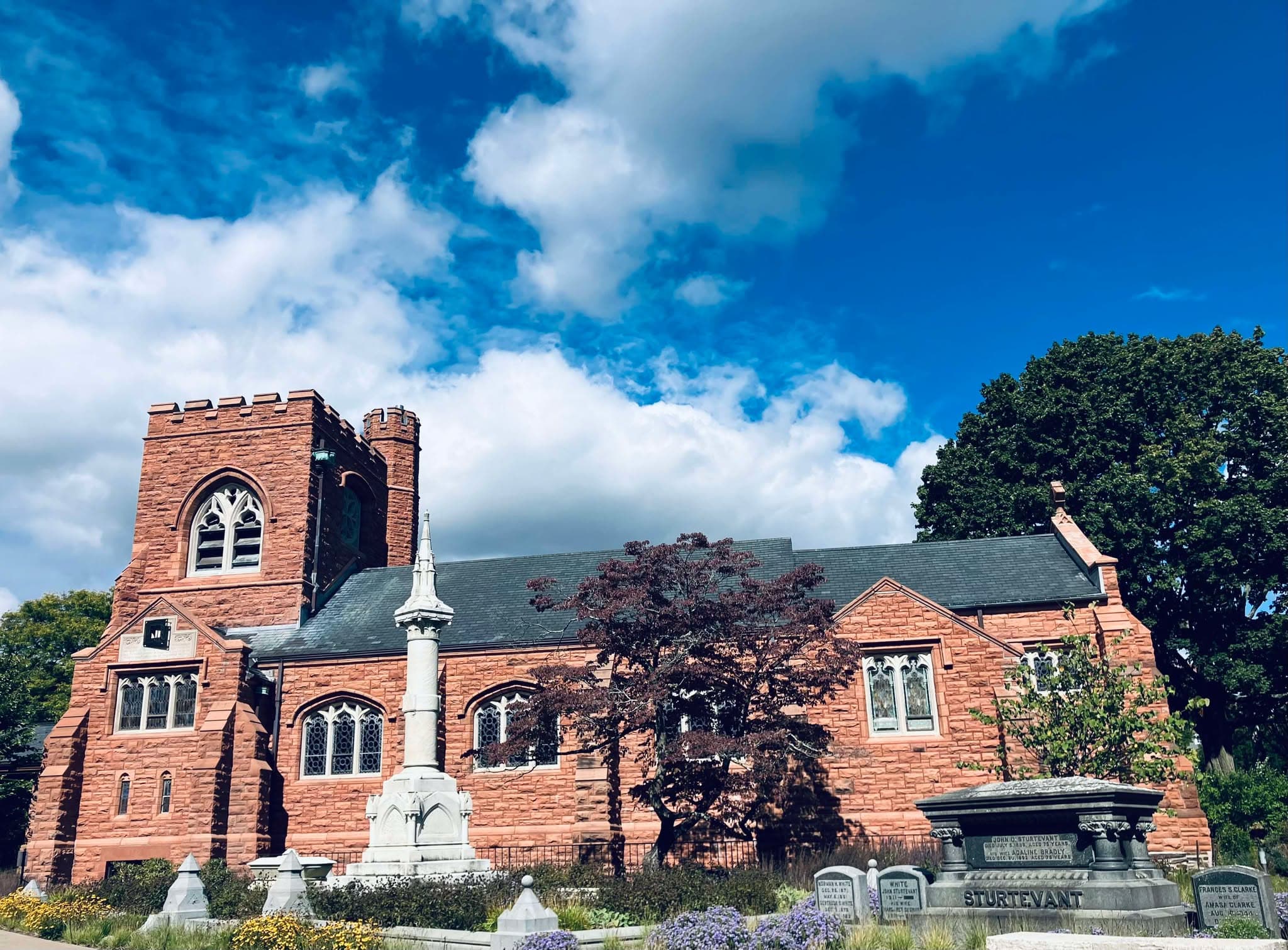
You enter through one of the strangest and most beautiful doorways in New England. The Egyptian Revival gateway — designed by Bigelow himself, first raised in wood in 1832 and rebuilt in Quincy granite in 1842–43 — stands 25 feet high and 60 feet long including its lodges. Its cornice stone was said to be the largest single piece of carved granite set in an American building at the time. The outside face carries a verse from Ecclesiastes: "Then shall the dust return to the earth as it was and the spirit shall return unto God who gave it." Inside, facing the grounds: "Mount Auburn consecrated September 24th, 1831." Climb the 125-foot central hill and you reach Washington Tower, the 62-foot Quincy granite observatory Bigelow designed and built between 1852 and 1854 as a monument to George Washington. From the top, the panorama runs across the cemetery's ponds and treetops to the Boston skyline, Harvard's campus, the Charles River — and on clear days, all the way to Wachusett Mountain. Below it sits Bigelow Chapel, the Gothic Revival mortuary chapel Bigelow designed in the 1840s, its Scottish stained glass surviving every renovation since. The most startling monument stands on the chapel lawn: a 15-foot granite Sphinx. Bigelow commissioned it after the Civil War to honor two things at once — the preservation of the Union and the destruction of slavery. Carved from a single block of Hallowell, Maine granite by the young Irish-American sculptor Martin Milmore and his brother Joseph, it was set in place in August 1872. The inscription reads, in Latin and English: "American Union Preserved; African Slavery Destroyed; By the Uprising of a Great People; By the Blood of Fallen Heroes." Bigelow chose the sphinx as the fusion of intellect and physical force — his emblem for a remade America.
The Westminster Abbey of America
They call Mount Auburn the Westminster Abbey of America, and the roster earns it. The poets came first and never left: Henry Wadsworth Longfellow, Oliver Wendell Holmes, James Russell Lowell and his daughter Amy Lowell, who won the Pulitzer Prize for poetry. Nearby lie the painter Winslow Homer, "Battle Hymn of the Republic" author Julia Ward Howe, abolitionist senator Charles Sumner, and the theologian William Ellery Channing. The scientists and reformers are here too: nurse and asylum reformer Dorothea Dix, cookbook author Fannie Farmer, Supreme Court Justice Felix Frankfurter, psychologist B. F. Skinner, geodesic-dome architect Buckminster Fuller, presidential adviser McGeorge Bundy, and Charles Bulfinch, the architect of the U.S. Capitol's first dome. Mary Baker Eddy, founder of Christian Science, rests beneath a huge white neoclassical monument overlooking Halcyon Lake — one of the most photographed memorials in the grounds. Margaret Fuller has a monument in the family plot, though her body was lost in a shipwreck off Fire Island in 1850. More than 93,000 people are buried at Mount Auburn, and the cemetery, still active and nondenominational, continues to make room for new ones.
A Park That Happens to Be a Cemetery
Mount Auburn succeeded so completely as a landscape that it stopped being only a cemetery. In the 1840s it ranked among the most visited tourist destinations in the nation, mentioned alongside Niagara Falls and Mount Vernon; some 60,000 people walked its paths in 1848 alone. A sixteen-year-old Emily Dickinson wrote home about her visit in 1846. Landscape designer Andrew Jackson Downing studied the crowds and concluded that a republic owed its citizens great public grounds — the argument his protégé Frederick Law Olmsted would carry into Central Park a decade later. Within fifteen years of Mount Auburn's opening, nine major cemeteries were designed in its image, from Green-Wood in Brooklyn to Laurel Hill in Philadelphia. Historians now place it on the direct line between Capability Brown's English landscape gardens and Olmsted and Vaux's Central Park. It remains, two centuries on, one of the finest designed landscapes in the country — and a working arboretum. More than 5,500 trees representing nearly 700 species grow here, many tagged with botanical labels, and the grounds are a Massachusetts Important Bird Area where over 220 bird species have been recorded since 1958. Designated a National Historic Landmark District in 2003, Mount Auburn is Watertown's largest contiguous open space and Cambridge's quietest. Come in October, when the maples turn and the light slants across the stones, and you will understand what Bigelow understood: that a beautiful landscape can change how a culture meets death.
Key Facts
- Founded 1831; dedicated September 24, 1831, by Supreme Court Justice Joseph Story — America's first rural (garden) cemetery.
- Conceived by Dr. Jacob Bigelow; designed by Henry A. S. Dearborn with surveyor Alexander Wadsworth for the Massachusetts Horticultural Society.
- 174 acres spanning Cambridge and Watertown; 5,500+ trees (nearly 700 species); National Historic Landmark District (2003).
- Burials include Longfellow, Oliver Wendell Holmes, Mary Baker Eddy, Buckminster Fuller, Dorothea Dix, Julia Ward Howe, and Winslow Homer.
Location Photography
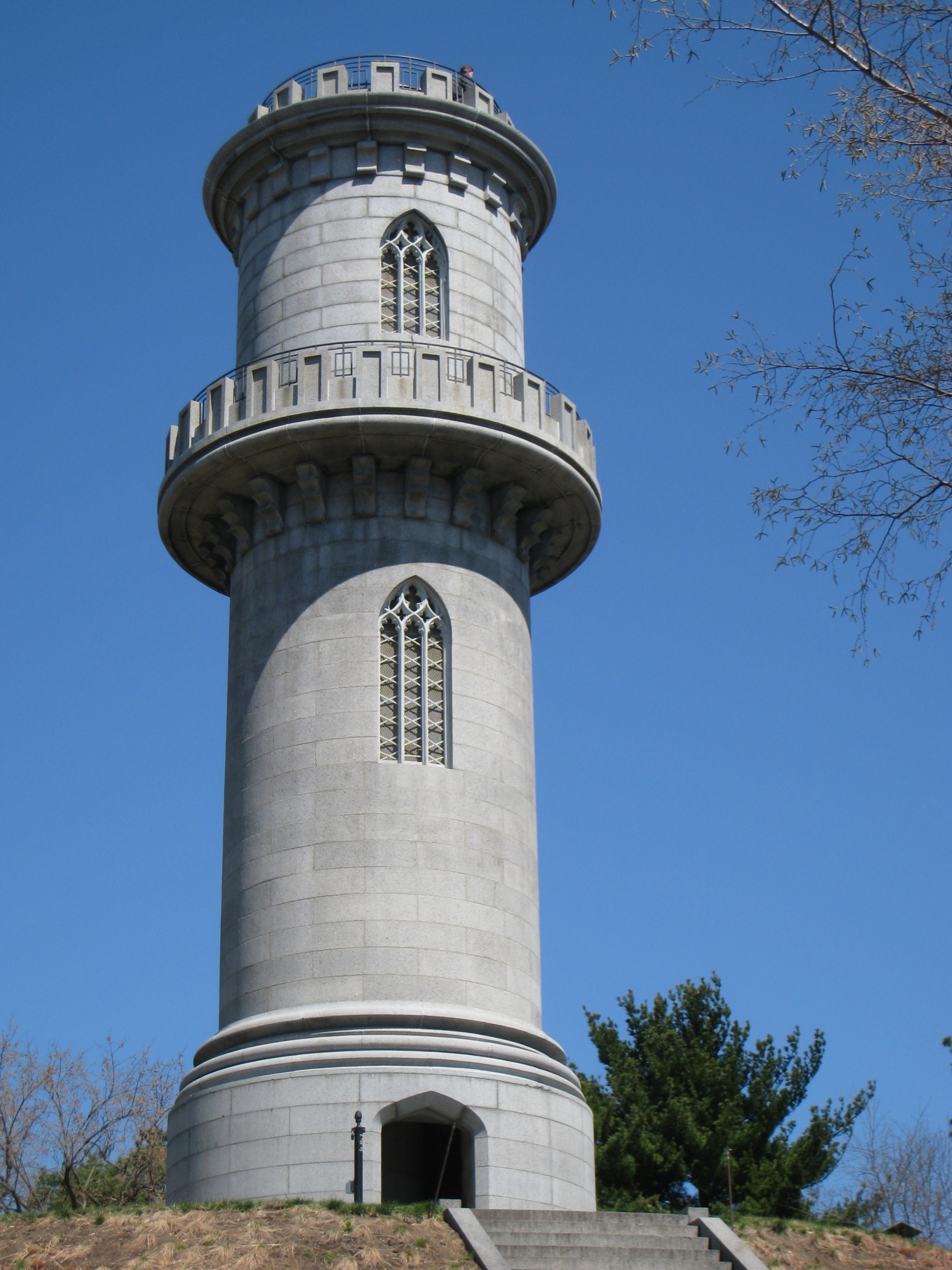


Photo Credits
Hero photo: Thisyearsgirl88, CC BY 4.0, via Wikimedia Commons.
Photo: Daderot, Public Domain, via Wikimedia Commons.
Photo: Mmangan333, CC BY-SA 4.0, via Wikimedia Commons.
Photo: Rizka, CC BY-SA 4.0, via Wikimedia Commons.