From Vilna to Phillips Street
In 1888, a group of Jewish immigrants from the Vilnius region of Lithuania — Vilna in Yiddish — formed a landsmanshaft, a mutual-aid society of people from the same hometown, on the north slope of Beacon Hill. They prayed in each other's apartments until their numbers grew enough to need a real home.
In 1906 they bought the former Twelfth Baptist Church at 45 Phillips Street and worshipped there for a decade, calling themselves Congregation Anshei Vilner, "the People of Vilnius." In 1916 the city took the building by eminent domain to expand a school, handing the congregation $20,000 to leave.
Rather than scatter, the families pooled the money and built their own synagogue down the street. On December 11, 1919, they laid the cornerstone at 18 Phillips Street. The shul they raised was plain on purpose: a poor immigrant congregation spending its one windfall on permanence rather than ornament.
A century later it is the last intact immigrant-era synagogue in Boston, out of more than fifty that once stood across the city. In the first half of the twentieth century, dozens of immigrant synagogues crowded this corner of Beacon Hill and the West End; by the 1980s the Jewish community had nearly all moved to the suburbs, and the shul stood all but abandoned.
An architect and a congregation build together
The congregation hired Max Kalman, the only Jewish architect practicing in Boston at the time, to design the building. Kalman, a lawyer as well as an architect, had designed numerous tenements on the North Slope and in Dorchester and Brighton; the shul was his most personal commission.
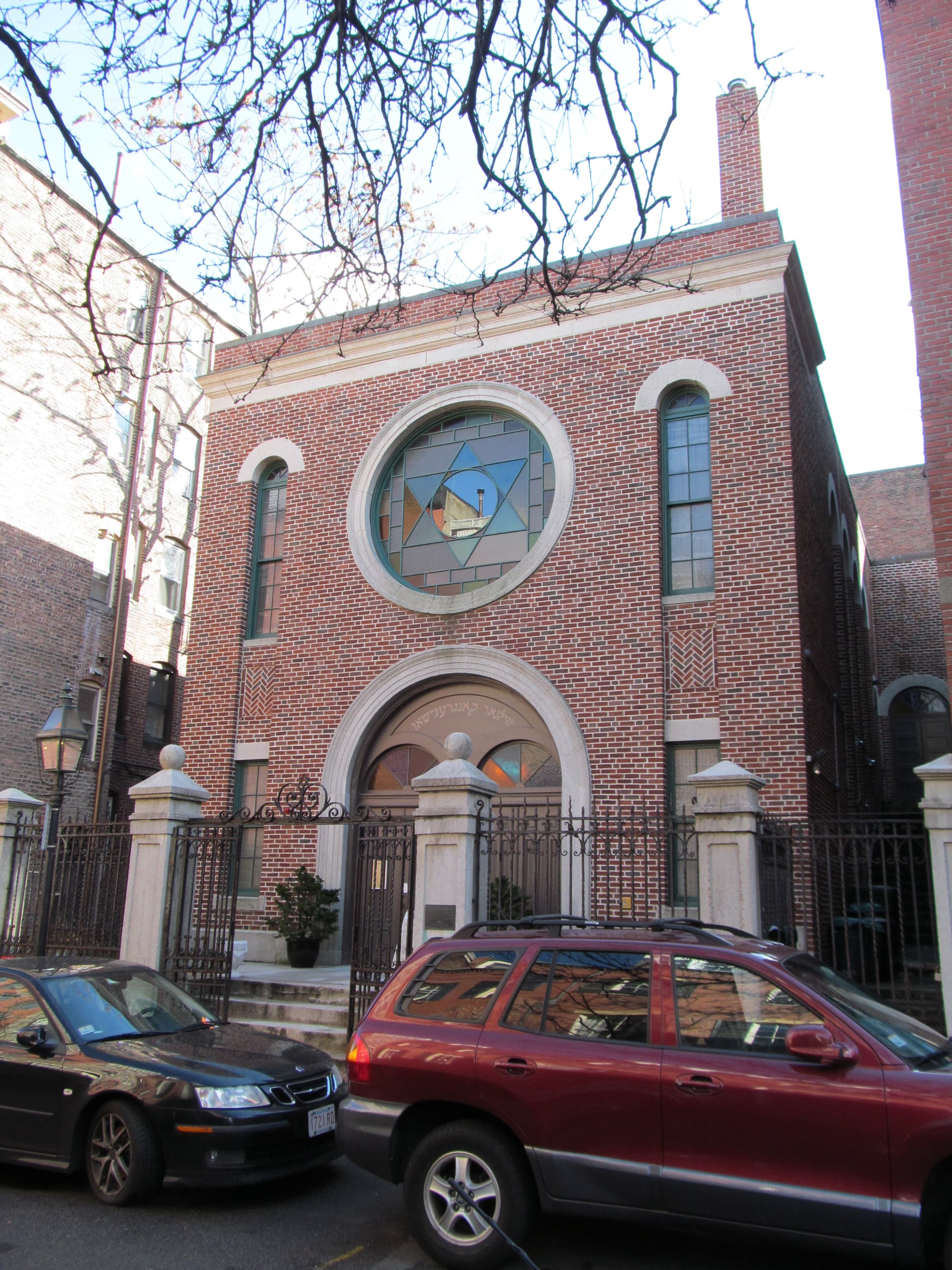
Kalman gave them a narrow two-story red-brick facade with a flat cornice that blends into the Beacon Hill streetscape, broken by one unmistakable feature: a large stained-glass tondo framing a Star of David above the entrance, flanked by tall, slender windows. The odd L-shaped lot dictated the plan — in the Orthodox tradition, the women's section sits in a separate wing to the right.
The real surprise is upstairs. The sanctuary occupies the upper floor, lit by three generous skylights that wash the room in daylight. Young men of the congregation helped with the construction itself, and members painted the walls and ceiling with decorative murals in the tradition of the wooden synagogues of Eastern Europe. The building was never meant to impress architects; as a preservationist later put it, it is representative of the immigrants who built it rather than of any high style. That is exactly what makes it worth seeing.
Pews with a past
When the congregation left 45 Phillips Street, they carried the old church's wooden pews down the block and installed them in the new sanctuary — and those benches carry a second history. The Twelfth Baptist Church was known as the church of the fugitive slave; its pews once seated self-emancipated Black worshippers and volunteers of the 54th Massachusetts Infantry Regiment, the Black Civil War regiment made famous by the film Glory.
If you look closely at the pew ends, you can still see where the arms of the large crosses that decorated them were removed when the church became a synagogue. It is a rare thing: a single row of seating that holds the histories of two communities that each made the north slope of Beacon Hill home — first Black Bostonians, then the Jewish immigrants who followed them into the neighborhood. The congregation's own marble plaques from 1923, listing members in Yiddish and English, still hang on the sanctuary walls.
Paint under paint
For decades, visitors saw only beige walls. Beneath the beige were three distinct layers of murals — folk-art painting in the Eastern European synagogue tradition, applied when the shul was built and redone twice in the years after.
When the first layer was uncovered and restored in 1998, historians were startled: earlier scholarship had assumed Boston's Jewish immigrants imitated the austere style of New England meetinghouses to fit in. The Vilna's congregants had done the opposite, choosing bright pastel designs rooted in the old country.
The surviving murals include mosaics and painted scenes of the ancient Jewish homeland — Bethlehem, Hebron, Rachel's tomb — rendered in a building raised before the State of Israel existed. They are among the only examples of pre-war Jewish mural art left in the United States; the great painted wooden synagogues of Eastern Europe, the tradition's source, were nearly all destroyed in the Holocaust. Recovery is slow and funded piece by piece, and much of the artwork remains under paint, waiting.
The last one standing
The congregation thrived through the 1920s and 1930s, then thinned as families moved to the suburbs and federal immigration quotas choked off new arrivals. In 1985 the Vilner Congregation became the last of the West End's seven immigrant-built synagogues to close; the final member, Mendel Miller, held one last service and locked the door. The building sat in disrepair for more than a decade.
In 1995 a nonprofit, the Boston Center for Jewish Heritage, took possession and began the long work of saving it: a new roof, rebuilt windows, a sprinkler system, a furnace, nearly a decade of cleanup. About three million dollars went into the architectural restoration.
Today the building is The Vilna Shul — Boston's Center for Jewish Culture, a living museum and community center hosting exhibits on Boston Jewish history, concerts, life-cycle events, and Havurah on the Hill's Shabbat gatherings. It welcomes thousands of visitors a year: tourists, school groups, and descendants of the North Slope's immigrant families coming to see where their people prayed. In 2025 it merged with the Jewish Arts Collaborative, filling the old sanctuary with new programming. From landsmanshaft to landmark, it is still doing what it was built to do: give newcomers a place to belong.
Key Facts
- Built 1919 by Lithuanian Jewish immigrants of Congregation Anshei Vilner; cornerstone laid December 11, 1919; architect Max Kalman.
- Last surviving intact immigrant-era synagogue in Boston, of 50+ that once stood citywide.
- Pews carried over from the Twelfth Baptist Church once seated fugitive slaves and 54th Massachusetts Regiment volunteers.
- Three layers of rare pre-war Eastern European-style murals hidden under beige paint; restoration ongoing since 1998.
Location Photography