A Fortress Built to Make Men Penitent
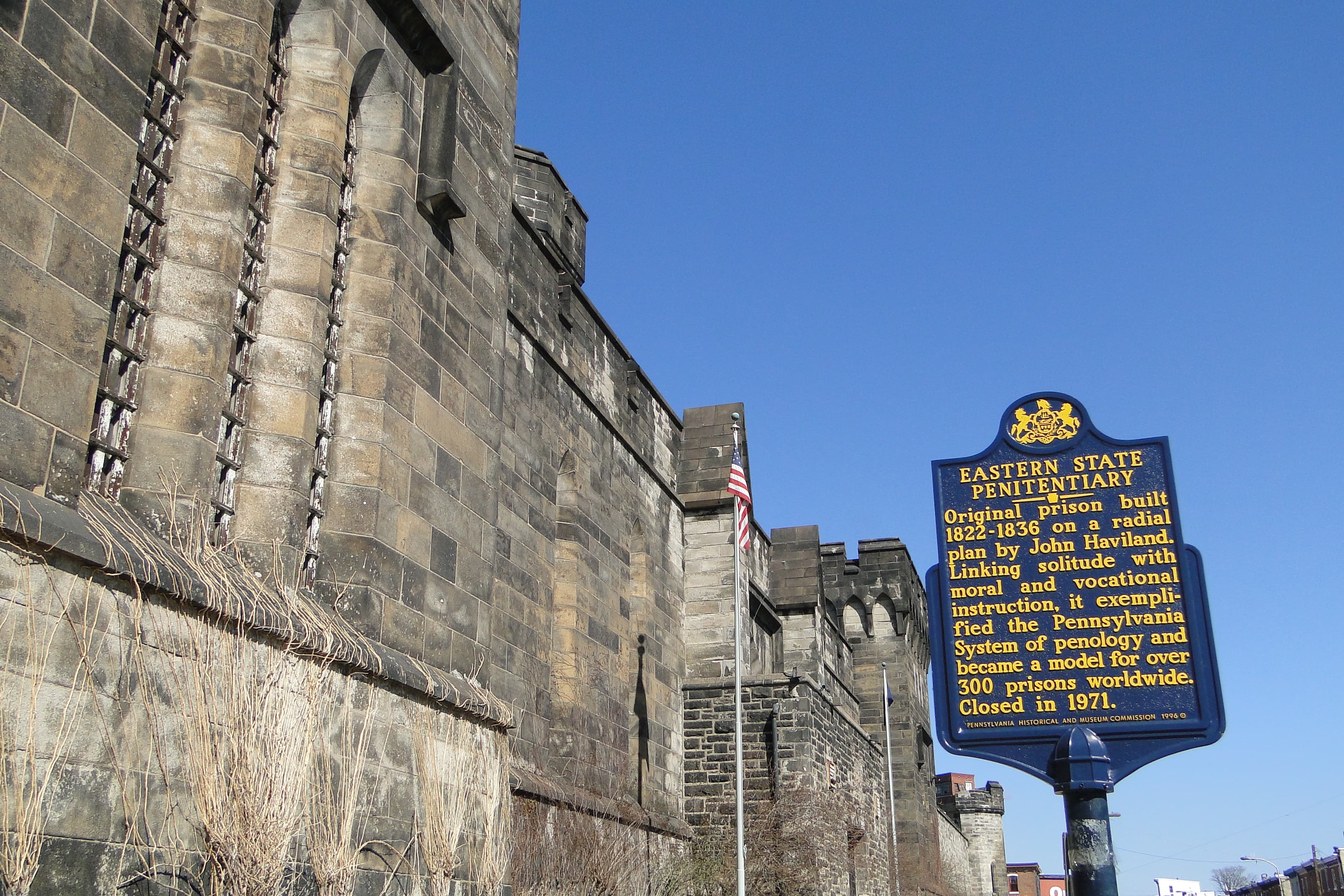
Eastern State Penitentiary was built on an eleven-acre property in what is now Fairmount that Philadelphians called Cherry Hill, a raised former cherry orchard the Commonwealth of Pennsylvania bought in 1821, northwest of the built-up city. Construction began in 1822 to a design by the British-born architect John Haviland, and the prison opened on October 25, 1829, receiving its first prisoner, Charles Williams. Haviland gave it a deliberately frightening neo-Gothic face — high stone walls, battlements, and a gatehouse built to look like a medieval portcullis — because the building itself was meant to be part of the punishment, a warning visible before a crime was committed. Inside, the plan was the opposite of a dungeon: seven cellblocks radiating from a central rotunda like spokes from a hub, so a small staff in the center could watch corridors stretching away in every direction. At its completion it was the largest and most expensive public structure ever erected in the United States. It is generally considered the world's first true penitentiary — a word that matters, because the place was not designed simply to hold people. It was designed to make them penitent.
The Pennsylvania System
The regime Eastern State pioneered was called the Pennsylvania system, or separate system, refined here from an experiment first tried at Philadelphia's Walnut Street Jail. Each prisoner lived entirely alone. He slept, ate, worked, and exercised in isolation: a single cell with a skylight prisoners called the "Eye of God," a flush toilet and running water — plumbing and central heating that were advanced for the 1820s — and, behind the cell, a small private exercise yard enclosed by high walls. Exercise was timed so that neighbors were never out at once. Meals and work materials passed through a small opening in the wall. When a prisoner did have to leave his cell, a hood was pulled over his head so no other prisoner could recognize him. The warden was legally required to visit every inmate every day, and overseers to see each inmate three times a day, but prisoners could not visit with family or friends. The theory, promoted by the Society for Alleviating the Miseries of Public Prisons, was that silence and solitude would force a man to confront the ugliness of his crimes and genuinely reform. The practice could be crueler than the theory: punishments recorded at Eastern State included cold showers, an iron gag fastened over the tongue, restraint chairs, and the low, dark punishment cells under Cellblock 14 known as "the hole."
A Wagon Wheel Copied Around the World
Whatever its human cost, the architecture was a triumph of influence. Eastern State's radial, hub-and-spoke plan and its system of separate confinement became the model for more than 300 prisons in Europe, South America, Russia, China, Japan, and across the British Empire — a Philadelphia idea rebuilt on almost every continent. The prison itself kept growing past its design. The original seven blocks, first built one story high and then two, were meant for a few hundred prisoners held one to a cell; additional cellblocks were wedged between the originals, and by 1870 the prison held 671 people in 560 cells. Overcrowding quietly broke the system it was built to prove. Prisoners found ways to communicate anyway, the flushing system meant to prevent messages between cells had to be redesigned repeatedly, and in 1913 Eastern State officially abandoned solitary confinement and operated as a congregate prison for the rest of its life. The famous visitors had seen the flaw early. Charles Dickens, who in 1842 asked to see Eastern State above almost everything else in America, condemned its isolation as a slow tampering with the brain, worse, he wrote, than any torture of the body. Alexis de Tocqueville came to study it too, and the argument the two men started — reform or cruelty — has never really left the building.
Capone, Sutton, and a Century of Wear
In its long second act as an ordinary, crowded prison, Eastern State accumulated the stories a landmark needs. Al Capone spent about eight months here in 1929–30 after an arrest on a weapons charge in Philadelphia, held in a cell that, by prison standards, was remarkably furnished — his stay remains the site's most requested stop. Bank robber Willie Sutton was here too, and on April 3, 1945, he was among twelve inmates who escaped through a 97-foot tunnel they had dug under the wall over the course of a year; Sutton was recaptured the same day, and renovations in the 1930s had already turned up some thirty other, unfinished tunnels. There was even a dog, Pep, assigned inmate number C-2559 in 1924 — legend says Governor Gifford Pinchot sentenced him for killing a cat, though a contemporary report suggests the governor donated his dog to raise inmate morale. The later additions tell a grimmer story: Cellblock 15, built in 1956 and known as Death Row, was the last major construction, though executions were never carried out here. A major riot in January 1961 was the largest in the prison's history. Eastern State was designated a National Historic Landmark in 1965, closed as a state prison in 1970, held city prisoners briefly until 1971, and then simply sat empty — a forest growing up inside the cellblocks, stray cats colonizing the corridors — while redevelopment plans, including condominiums and a shopping mall, circled the property.
A Stabilized Ruin That Still Argues About Prisons
The rescue, when it came, chose not to tidy the place up. In 1988 the Eastern State Penitentiary Task Force persuaded Mayor Wilson Goode to halt redevelopment, the city having bought the property in 1980, and in 1994 the site opened to the public for history tours. It is preserved as a stabilized ruin: roofs and walls are made safe and weather-tight, but the peeling paint, crumbling plaster, and a barber's chair alone in a rotting room are left as found, because the decay is part of the evidence. The main audio tour, "The Voices of Eastern State," is narrated by actor Steve Buscemi and built around the voices of people who lived and worked inside. Visitors can walk the vaulted cellblocks, see Capone's cell and the restored Alfred W. Fleisher Memorial Synagogue, dedicated in 1929, and consider site-specific art installations placed in individual cells. The visit deliberately does not end in 1971. It ends with "Prisons Today: Questions in the Age of Mass Incarceration," an exhibit on the modern American prison system, and the site now runs a Center for Justice Education alongside the museum. In the fall, the fundraiser now called Halloween Nights fills the cellblocks with haunted houses. It is an odd double life — part ruin, part classroom, part haunted attraction — but it fits a building that was always an argument about what a prison is for, made in stone.
Key Facts
• Designed by John Haviland and opened October 25, 1829, on an 11-acre former cherry orchard known as Cherry Hill; at completion it was the largest and most expensive public structure in the United States, and is considered the world's first true penitentiary.
• Creator of the "Pennsylvania system" of separate confinement: prisoners lived, ate, worked, and exercised entirely alone in skylit cells with private exercise yards, under a skylight called the "Eye of God."
• Its radial hub-and-spoke plan and solitary system were the model for more than 300 prisons worldwide; Charles Dickens visited in 1842 and sharply condemned the isolation system.
• Notable inmates included Al Capone (1929–30) and bank robber Willie Sutton, one of twelve men who escaped through a 97-foot tunnel on April 3, 1945; the prison also gave a dog, Pep, inmate number C-2559 in 1924.
• Designated a National Historic Landmark in 1965, closed in 1970–71, left abandoned for more than two decades, and reopened to the public as a historic site in 1994, preserved as a stabilized ruin.
Visitor Details
Address: 2027 Fairmount Avenue, Philadelphia, PA 19130 (between Corinthian Avenue and North 22nd Street, in Fairmount)
Transit: Fairmount neighborhood, northwest of Center City — a walkable distance from the Philadelphia Museum of Art and the Benjamin Franklin Parkway.
Hours/Admission: The official site lists audio tours available every day from 10 am to 5 pm, with last entry at 4 pm, plus 45-minute guide-led tours; the building is unheated and much of the visit is effectively outdoors, so dress for the weather. Confirm current hours, seasonal closures, and admission prices on easternstate.org before visiting and buy tickets there — do not rely on prices quoted elsewhere.
Best timing: Allow about two hours, and longer if you take the guide-led tour and the mini tours. Weekday mornings are the quietest for the cellblocks; fall brings the separately ticketed Halloween Nights event, when daytime crowds grow as well.
Location Photography