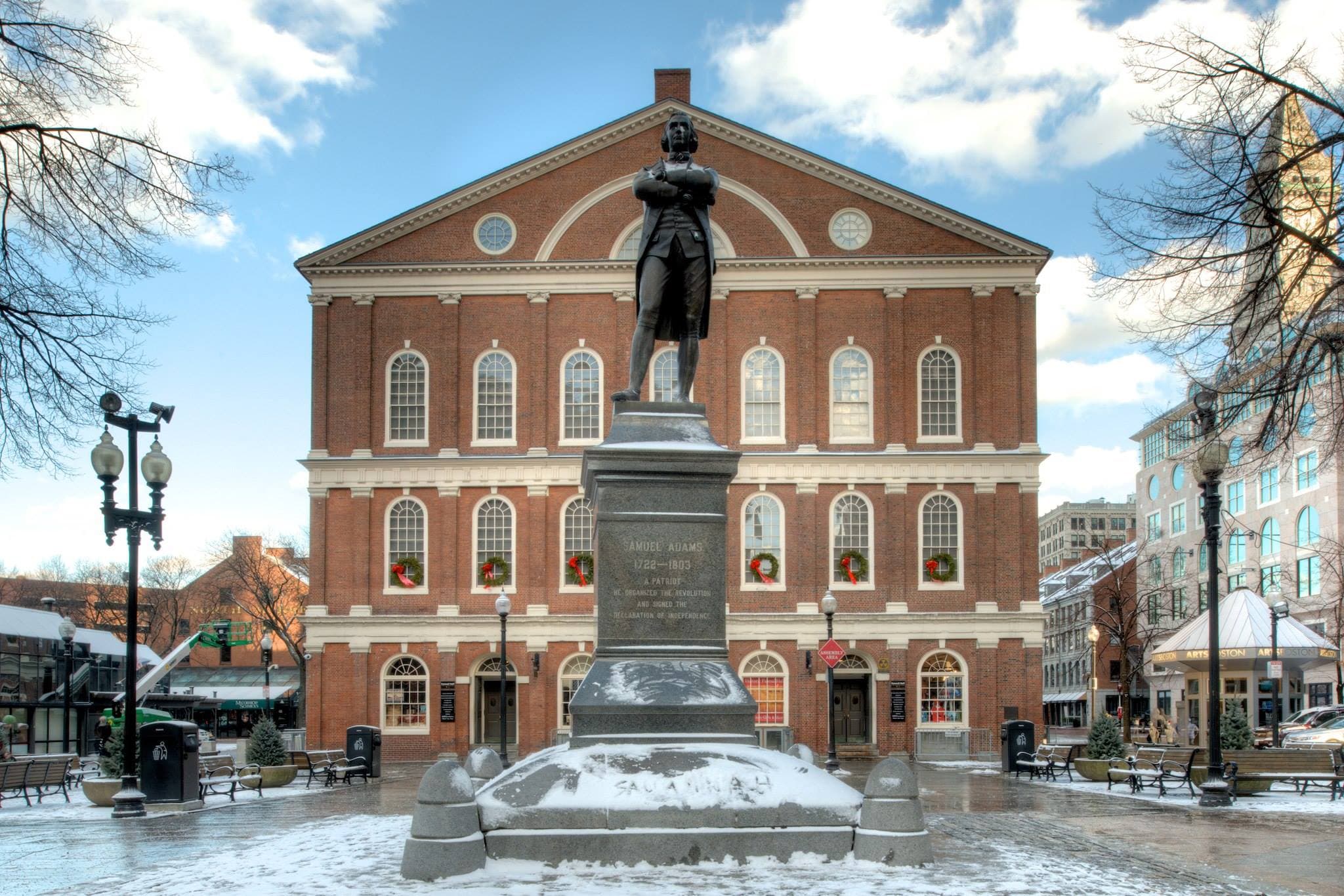
Peter Faneuil's 1742 Gift
Every great public building in Boston has a donor story, but few are as bluntly practical as this one. In 1740, Peter Faneuil, a wealthy Boston merchant, offered the town a market house at his own expense. Boston had been arguing for years about where — and whether — to build a central market. Farmers and fishermen sold from scattered stalls and carts, prices were hard to police, and the town's open-air trading was chaotic. Faneuil's offer cut through the debate: he would pay for the building, and the town would get both a regulated marketplace and a public hall in a single structure.
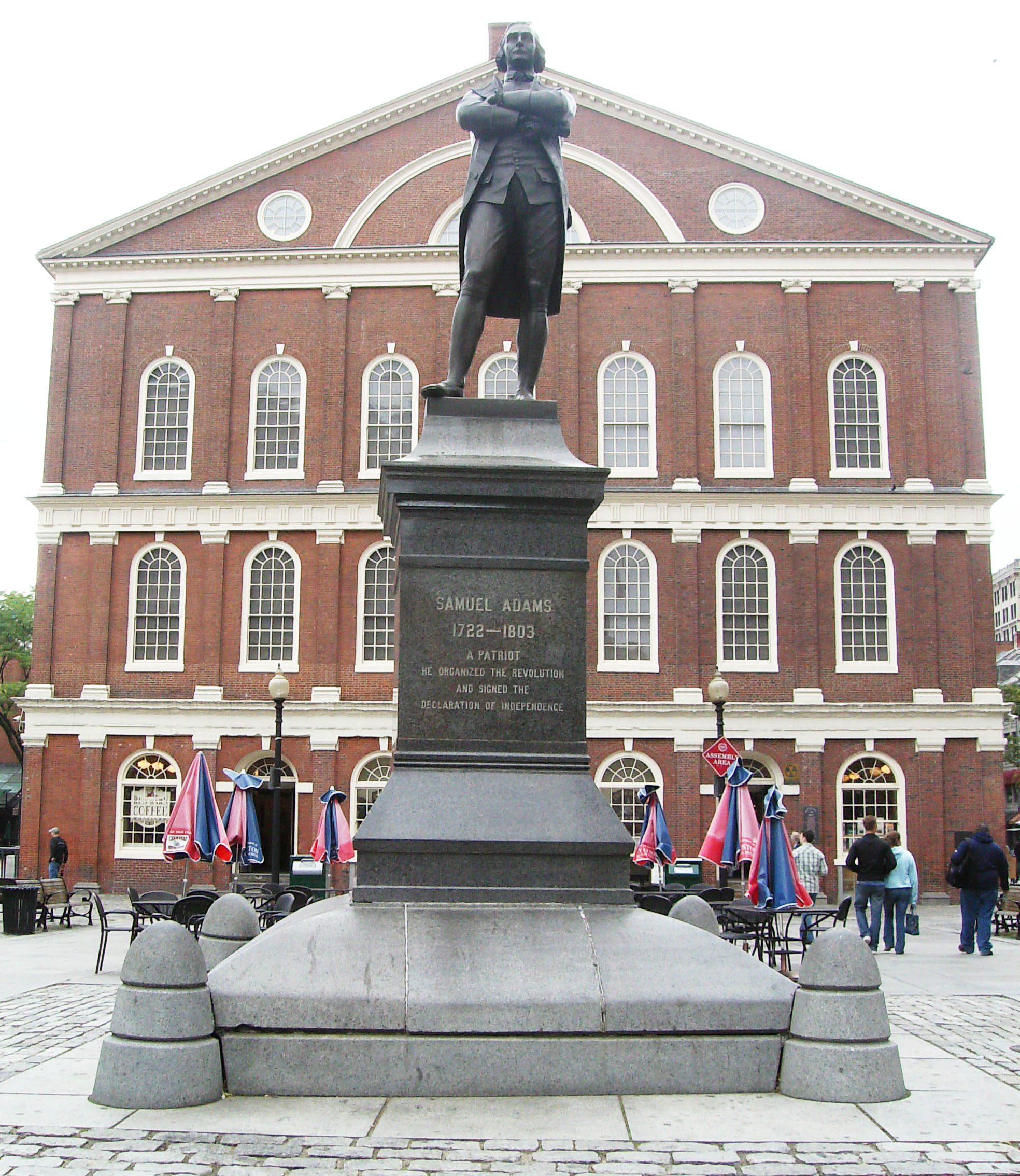
Faneuil died in March 1743, before the building was finished, but his gift stood. The town accepted it, completed the work, and opened Faneuil Hall in 1742 as a market hall in the Georgian style, designed by the artist John Smibert. It was modest by today's standards — two stories, a market floor at street level, and a meeting room above — but it solved two problems at once. Boston finally had a central place to buy and sell food under one roof, and it had a room large enough for the town meeting, the beating heart of New England self-government.
That dual purpose is the whole secret of Faneuil Hall. Most market halls are just markets. Most meeting halls are just meeting halls. Faneuil Hall was both from the first day, and the two uses fed each other. People came to buy bread and stayed to hear an argument. People came to a town meeting and left with provisions. The building sat at Dock Square, close to the working waterfront, so it was never a monument set apart from daily life. It was where Boston shopped, and therefore where Boston talked.
It is worth pausing on Peter Faneuil himself, because the full story is more complicated than a plaque allows. Faneuil was a successful merchant in a port city whose prosperity was tied to trade, including trade in enslaved people. His fortune, like those of many prominent colonial Bostonians, was built in an economy that included slavery. The hall that bears his name later became a stage for abolitionists arguing for freedom — a contradiction the building itself seems to hold without resolving. To visit Faneuil Hall honestly is to hold both facts at once: a generous civic gift, and a history that includes the very injustices later speakers came here to denounce.
The Marketplace Below, the Meeting Hall Above
Step inside the original arrangement and the logic is immediately clear. The ground floor was an open market arcade, where butchers, bakers, and produce sellers rented stalls. The town could regulate weights, prices, and quality in a way that scattered street trading never allowed. Upstairs, the meeting hall — later called the Great Hall — was a long, galleried room where the town gathered to debate taxes, elect officers, and decide matters of war and peace.
That upstairs room is why the building matters far beyond its bricks. In colonial Boston, the town meeting was not a ceremony; it was government. Adult male property holders debated and voted in person, and Faneuil Hall's hall was big enough to hold the argument. When the imperial crisis deepened in the 1760s and 1770s, the hall became the natural place for Bostonians to gather, protest, and organize. Samuel Adams, James Otis, and their allies spoke here against the Stamp Act, the Townshend duties, and the Tea Act. The speeches were not polite lectures. They were calls to action, delivered to a crowded room that could — and did — spill out into the square and onward to the wharves.
A fire in 1761 damaged the building, and it was rebuilt and enlarged in the years that followed, but the arrangement survived: commerce below, democracy above. The arrangement also explains the building's nickname, the "Cradle of Liberty," a name that stuck because so many of the ideas and protests that led to American independence were first aired, argued, and voted on in this room. The phrase is sometimes attributed to later generations looking back, but the sentiment was real at the time. Boston's revolution was planned in rooms like this one, in public, in front of neighbors.
Look up as you enter today and you will see the other famous resident of the roof: the gilded grasshopper weathervane. Crafted by Shem Drowne in 1742, the copper grasshopper has watched over Dock Square for nearly three centuries. One story says it was modeled on the weathervane of London's Royal Exchange; another says Drowne simply liked grasshoppers. Whatever the origin, it became a symbol of the marketplace itself — so much so that the area was sometimes called "Grasshopper Market" — and, by legend, a test of true Bostonian identity: a real Bostonian, the story goes, could tell you what sat atop Faneuil Hall.
Bulfinch's 1806 Expansion
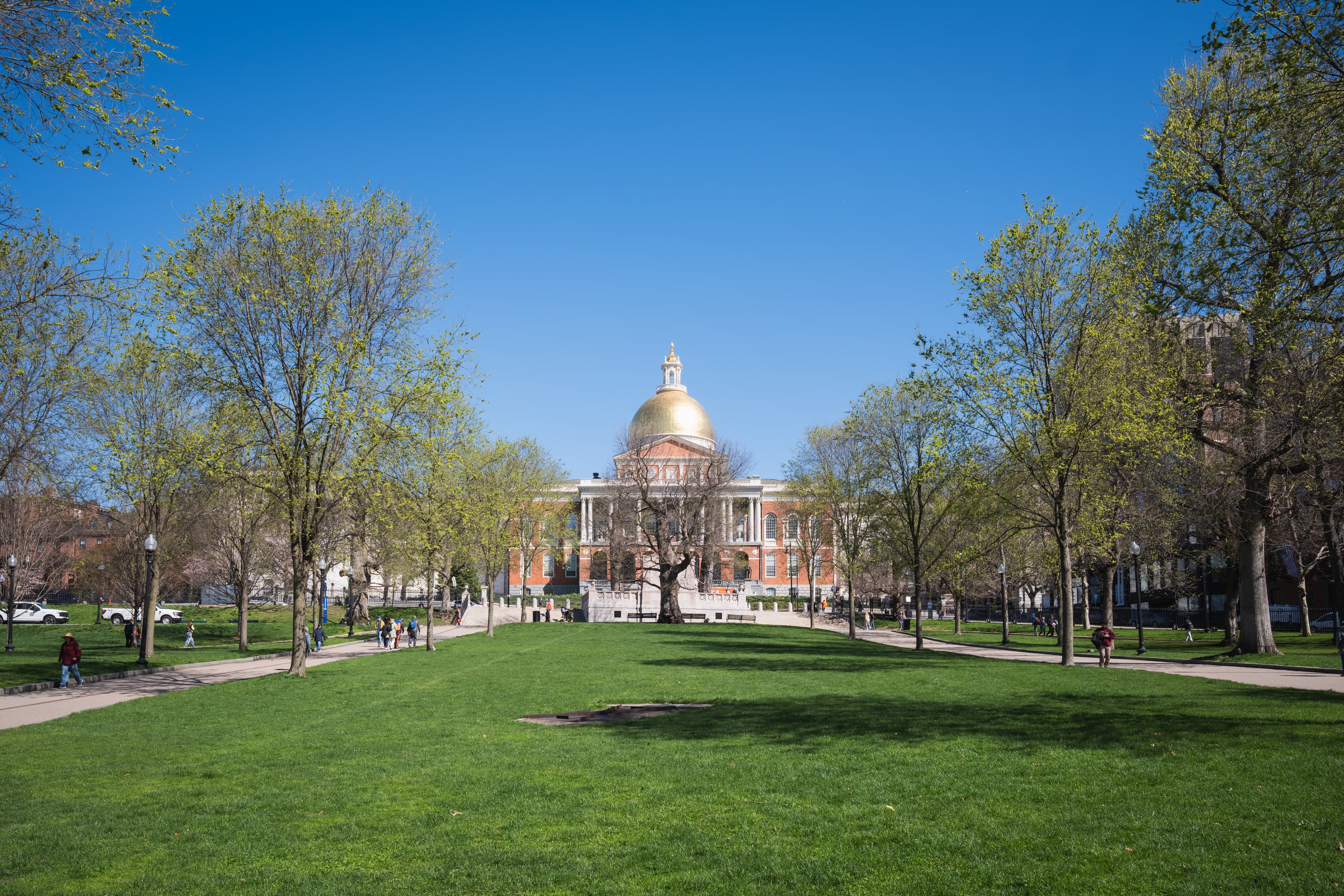
By the early 1800s, Boston had outgrown its market hall. The town was now a city, trade had expanded, and the original two-story building was too small for both its market and its meetings. In 1805–1806, the city hired its most celebrated architect, Charles Bulfinch — the same man who designed the Massachusetts State House on Beacon Hill — to enlarge Faneuil Hall.
Bulfinch's solution was bold and, from the street, almost invisible in its cleverness. He widened the building by adding width to the sides and raised it by an additional story, nearly doubling its footprint while keeping the original proportions and Georgian character. The enlarged hall could now hold far larger crowds, and the market floor gained more stalls. The cupola and the grasshopper were retained, the brickwork was extended in matching style, and the building that emerged in 1806 is, in its essentials, the building you see today.
That is a remarkable fact to carry into a visit. When you stand in front of Faneuil Hall, you are not looking at a colonial relic preserved under glass. You are looking at a working building that was deliberately, thoughtfully enlarged for a growing city — and then kept in use, restored, and adapted for another two centuries. Later work, including a major fireproofing rebuild in 1898–1899 that replaced the wooden structure with steel and concrete while resetting much of the original trim, kept the building standing and safe without erasing its character. The Great Hall you enter now, with its portraits, its gallery, and George Healy's large 1850 painting of Daniel Webster addressing the Senate, is the product of that long chain of care.
Bulfinch's expansion also set the stage for what came next. A bigger hall meant bigger audiences, and bigger audiences meant that Faneuil Hall's second century of speeches could be even louder, more crowded, and more consequential than its first.
Speeches That Made It the Cradle of Liberty
If one room in America deserves the name "Cradle of Liberty," this is the leading candidate, and the case rests on who stood on its stage. In the Revolutionary era, Samuel Adams used the hall to rally opposition to British taxation and to organize the town's resistance. James Otis argued here against writs of assistance — the general search warrants that let customs officers enter homes and shops — in speeches that John Adams later said planted the seeds of independence. On November 29, 1773, a protest meeting over the tea tax began at Faneuil Hall before the crowd, too large for the room, adjourned to the larger Old South Meeting House and, days later, to the Boston Tea Party itself.
The hall did not fall silent after independence. That is the second half of its claim to the nickname, and in some ways the more impressive half. In the decades before the Civil War, abolitionists filled the Great Hall to denounce slavery. William Lloyd Garrison, Wendell Phillips, Frederick Douglass, and other antislavery speakers addressed audiences here, sometimes to applause and sometimes to hostile crowds that had to be kept at bay. The building that had hosted arguments for liberty from Britain now hosted arguments for liberty for enslaved Americans — and the arguments were made in the same room, under the same roof, by people who understood exactly what that continuity meant.
Later generations kept the tradition alive. Suffragists argued here for women's right to vote. Labor leaders argued here for workers' rights. In the twentieth and twenty-first centuries, presidents, senators, and presidential candidates have used Faneuil Hall as a backdrop precisely because the room carries that history with it: to speak here is to join a conversation that began in the 1760s and never really stopped. The hall is still used for public forums, debates, and civic ceremonies today, and the National Park Service, which operates it as part of Boston National Historical Park, keeps it open as a working public space rather than a sealed museum.
Stand in the Great Hall and the portraits on the walls make the point without a word of commentary. Revolutionary activists, abolitionists, and political leaders gaze down from the gallery, a visual roll call of the people who argued here. It is a room designed for speech — high-ceilinged, galleried, with a stage at one end — and it still rewards a speaker who knows how to fill it.
Quincy Market Behind It
Walk through Faneuil Hall and out the other side, and you arrive at the second half of this story: Quincy Market. Built in 1824–1826 under Mayor Josiah Quincy, for whom it is named, Quincy Market was Boston's answer to the same problem Peter Faneuil had addressed eighty years earlier — the city had again outgrown its market space. Quincy, determined to expand the market district without taking on public debt, pushed through a granite market building flanked by two long market rows, the North Market and the South Market, creating a market complex that stretched from Faneuil Hall toward the harbor.
The main Quincy Market building, designed by Alexander Parris in the Greek Revival style, is a long granite hall, about 535 feet in length, with a domed central rotunda. Inside, vendors sold produce, meat, fish, and provisions to a city that was growing fast. The building's cast-iron columns and open interior were innovative for their day, and the complex as a whole — Faneuil Hall, Quincy Market, and the North and South Market buildings — became Boston's commercial center, a place where wholesale and retail trade met at the edge of the waterfront.
By the mid-twentieth century, the market district had faded. Trucks, supermarkets, and suburban shopping had changed how Bostonians bought food, and the old granite halls were shabby and underused. In the 1970s, the complex was saved by one of America's first major festival-marketplace redevelopments. Restored and reopened in 1976, Quincy Market became a food hall and shopping destination, its long central corridor lined with food stalls, its rotunda a gathering place, and its surrounding plaza a stage for street performers. The restoration preserved the granite, the columns, and the dome while giving the buildings a new commercial life — a model that other American cities would copy.
Today, Quincy Market is the boisterous counterpart to Faneuil Hall's solemn hall. The food hall bustles with visitors sampling clam chowder, lobster rolls, and Boston cream pie, street performers play on the plaza outside, and the North and South Market buildings house shops and restaurants. It is touristy, and Bostonians will tell you so with a smile — but it is also genuinely continuous with the site's history. This ground has been a place to buy food and meet people since 1742. The stalls have changed; the purpose has not.
Visiting Today
The best way to visit Faneuil Hall and Quincy Market is to treat them as one experience, in the order history built them: start at Faneuil Hall, go upstairs to the Great Hall, then walk through to Quincy Market and the plaza beyond. Give the Great Hall your full attention first. The room rewards a slow look — the portraits, the gallery, the stage — and National Park Service rangers often give talks that bring the speeches back to life. Then let Quincy Market be the reward: a noisy, delicious contrast to the quiet hall, and a reminder that this place was always, first, a market.
Pair the visit with the rest of the Freedom Trail, which passes directly by. The Old State House is a short walk away, the Old South Meeting House is nearby, and the North End's Paul Revere House and Old North Church are an easy stroll to the north. Faneuil Hall sits at the hinge of downtown Boston, between Government Center and the waterfront, so it works as a natural midpoint in a day of walking — a place to rest, to eat, and to remember why Boston's history feels so close at hand.
Come early if you can. The plaza fills by midday, especially on weekends and in summer, and the Great Hall is at its most powerful when it is quiet enough to hear your own footsteps. Come hungry, too: Quincy Market's food hall is built for grazing, and the plaza's street performers are part of the show. And come ready to listen, because Faneuil Hall's real exhibit is not the portraits or the grasshopper or the granite. It is the idea that ordinary people, gathered in a room above a market, can argue their way toward a freer country — and that the room is still there, still open, and still waiting for the next argument.
Key Facts
- Faneuil Hall was given to Boston by merchant Peter Faneuil and opened in 1742 as a market hall with a meeting hall above, designed by John Smibert.
- The ground floor was a regulated marketplace; the upstairs Great Hall hosted town meetings and became the stage for Revolutionary-era speeches.
- A fire in 1761 damaged the building; it was rebuilt, and Charles Bulfinch enlarged it in 1805–1806, nearly doubling its size while keeping its Georgian character.
- The gilded grasshopper weathervane atop the cupola was made by Shem Drowne in 1742 and became a symbol of the marketplace.
- Samuel Adams and James Otis spoke here against British taxation and writs of assistance; a November 29, 1773, tea-tax protest meeting began at Faneuil Hall before moving to the Old South Meeting House.
- After independence, abolitionists including William Lloyd Garrison, Wendell Phillips, and Frederick Douglass spoke in the Great Hall, as later did suffragists and labor leaders.
- Faneuil Hall is a stop on Boston's Freedom Trail and part of Boston National Historical Park, operated by the National Park Service.
- The building was designated a National Historic Landmark in 1960 and is listed on the National Register of Historic Places.
- Quincy Market, behind Faneuil Hall, was built in 1824–1826 under Mayor Josiah Quincy, designed by Alexander Parris in the Greek Revival style, with North and South Market buildings flanking it.
- Quincy Market was restored and reopened as a festival marketplace in 1976, preserving its granite hall, cast-iron columns, and domed rotunda as a food hall and shopping destination.
Location Photography