A small house with an enormous story
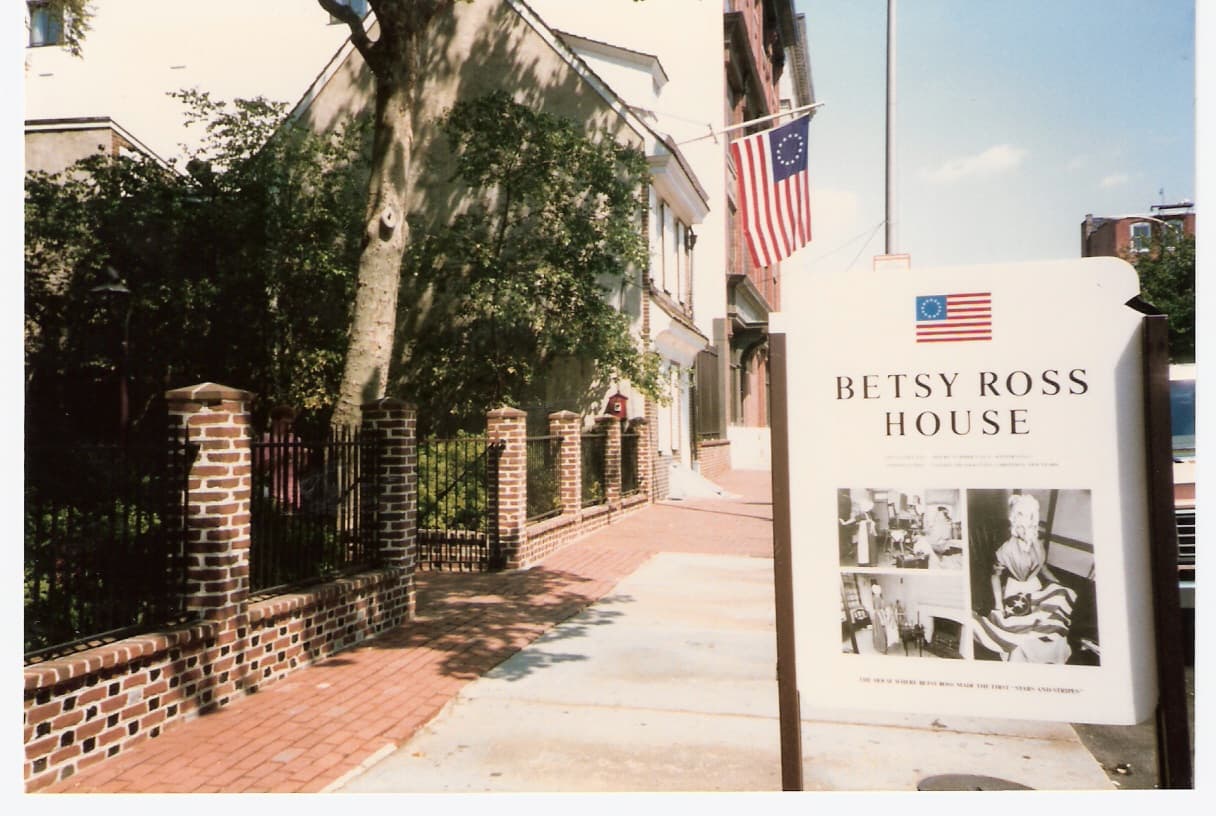
On Arch Street in Philadelphia's Old City, wedged between taller neighbors, stands a narrow three-story brick house with a sign that has stopped passersby for more than a century. This, the sign says, is where the first American flag was made. The house at 239 Arch Street is one of the most visited historic sites in Philadelphia, and it is easy to see why: the story attached to it is the founding story in miniature — a working woman, a needle, and a new nation's flag, sewn in a parlor a few blocks from where independence was declared.
The front part of the house was built around 1740, in the Pennsylvania colonial style, with the stair hall and rear section added ten to twenty years later. It is small by design, not by accident: this was a tradesperson's house and shop, not a statesman's mansion, and that is precisely the point of visiting. The rooms are narrow, the staircases wind steeply, and the whole place feels like somewhere a real person actually lived and worked — because, whatever the truth of the flag story, a real person did.
One honest caveat belongs up front, and the house itself does not hide it: the best archival evidence suggests Betsy Ross may actually have lived in the building next door, now demolished, rather than in the house that survives. The surviving house was selected as the Flag House in the late nineteenth century, and the adjacent building was later torn down. That uncertainty does not make the visit a trick; it makes it a better one. This is a place to learn how American legends are made, as well as to see a beautifully restored colonial interior.
Betsy Ross, the upholsterer
Elizabeth Griscom was born on January 1, 1752, the eighth of seventeen children in a Quaker family. As a teenager she was apprenticed to a local upholsterer, a trade that in the eighteenth century meant far more than furniture: upholsterers made and repaired bedding, curtains, tents, and military equipment, and they worked in cloth the way a carpenter worked in wood. In the shop she met a fellow apprentice, John Ross. The two eloped in 1773 — her family disapproved because John was not a Quaker — and set up their own upholstery business.
John Ross died in 1776, reportedly in a gunpowder explosion while serving with the Philadelphia militia, leaving Betsy a young widow running the shop alone in a city at war. She kept it going. She married again in 1777, to the sailor Joseph Ashburn, who died in British captivity in 1782; she married a third time in 1783, to John Claypoole, a friend of Ashburn's from prison. Through all of it she worked: upholstery, bedding, and — this part is documented, not legend — flags. The minutes of the Pennsylvania Navy Board for May 29, 1777 record an order paying Elizabeth Ross for flags, and she went on making flags for the government for years, including during the War of 1812. She retired around 1828, at about seventy-six, after some fifty years at the trade, and died on January 30, 1836, at eighty-four.
That documented working life is the reason the legend was plausible enough to take hold. Betsy Ross was not invented out of nothing: she was a real Philadelphia flag maker, working in the right city, in the right years, in exactly the right trade. The question historians argue about is narrower, and more interesting: did she make the very first one?
The flag story — and why historians argue about it
According to the traditional account, in June 1776 George Washington, Robert Morris, and George Ross — a member of Congress and the uncle of Betsy's late husband — came to her shop with a sketch for a new national flag. Betsy, the story goes, looked at the design and made one practical suggestion: five-pointed stars, which she could cut with a single snip of the scissors, instead of six-pointed ones. Washington is said to have redrawn the sketch on the spot, and Betsy to have sewn the first Stars and Stripes.
It is a wonderful story, and it may even be true in outline. But it rests on a single family source, and it arrived very late. The story was first told publicly in March 1870, when Betsy's grandson William Canby presented it to the Historical Society of Pennsylvania — nearly a century after the supposed event, and more than thirty years after Betsy's death. Canby said the account had come down through his grandmother and his aunt, and other family members supported it, but no contemporary document, diary, letter, or congressional record corroborates a flag committee visiting Betsy's shop, and Congress itself did not formally adopt the Stars and Stripes until its Flag Resolution of June 14, 1777.
That is why most historians today treat the first-flag story as tradition rather than established fact, while accepting without question that Betsy Ross was a genuine flag maker. The timing of Canby's revelation matters too: it came just as the nation was approaching its 1876 Centennial, hungry for patriotic stories, and the tale spread through magazines, schoolbooks, and Charles Weisgerber's hugely popular 1893 painting, "Birth of Our Nation's Flag," which showed Betsy presenting the flag to Washington and the committee in her parlor. The painting, like the story, is an imagining, not a photograph of an event — but it fixed the scene in the American mind forever.
Visitors should enjoy the legend and hold it lightly at the same time. The house's own interpretation does this well: it presents the story as the story, and Betsy's documented life alongside it, and lets you decide how much weight to give each.
From near-demolition to museum
By the late nineteenth century the Arch Street house was dilapidated, and most of its neighbors had already been demolished and replaced. Weisgerber, the painter of the famous flag painting, became the house's unlikely savior: in 1898 he helped found the American Flag House and Betsy Ross Memorial Association, which raised money — famously selling ten-cent membership certificates, many to schoolchildren — bought the house, restored it, and opened it to the public as a museum in 1898.
The house's second great restoration came in 1937, when Philadelphia radio manufacturer A. Atwater Kent funded a thorough restoration under the historical architect Richardson Brognard Okie. Original elements were kept wherever possible, and materials from demolished period houses were used where they were not; the front stairway and dormer were replaced, the front doorway was moved, and a new rear structure was built from period brick. In 1941 the whole property, house and courtyard, was given to the city of Philadelphia. An annex was added in 1965, the courtyard was renovated and a fountain added in the 1970s, and in preparation for the 1976 Bicentennial, remains believed to be those of Betsy Ross and her third husband, John Claypoole, were moved to graves in the courtyard, where they remain. Since 1995 the site has been managed by the nonprofit Historic Philadelphia, Inc., which leases it from the city.
What you see today, then, is a layered building: an eighteenth-century core, a nineteenth-century rescue, and a twentieth-century restoration, all in service of one woman's story. The house has also become Philadelphia's home for Flag Day, observed here each June.
Inside the house: what to look for
A visit is self-guided and compact — plan on about an hour, more if you linger in the courtyard. The furnished rooms recreate a working upholsterer's household of the Revolutionary era: the parlor where the flag story is traditionally set, bedrooms upstairs, the kitchen, and a reproduction of the upholstery shop, with the tools of the trade on display. Look for the small scale of everything: the low ceilings, the narrow winding stairs, the modest fireplaces. This was a middle-class working home, and its modesty is the exhibit.
Costumed interpreters, including an actress playing Betsy herself, answer questions in character and demonstrate colonial crafts; the audio tour adds eleven stops of context. In the basement, displays on daily life in late-eighteenth-century Philadelphia fill out the world beyond the legend. And do not skip the courtyard at the back: it is a quiet, shaded place to sit, with the graves of Betsy and John Claypoole, the fountain, and seasonal programming — storytelling, craft demonstrations, and family events in the warmer months. The gift shop, in the annex, is better than most museum shops, with flag history alongside the usual souvenirs.
The house rewards pairing with its neighbors. It stands in the heart of Old City, a few blocks from Independence Hall and the Liberty Bell, and a short walk from Elfreth's Alley, the oldest continuously inhabited residential street in America. Walk Arch Street slowly on your way: the whole district is the exhibit, and the Betsy Ross House is its most personal room.
Visiting the Betsy Ross House: how to do it well
Come early in the day if you can, before the tour groups build, and go straight upstairs first — the upper rooms are the quietest part of the house, and the stairs are narrow enough that two-way traffic gets awkward at busy times. Read the displays about the flag legend with the skepticism they invite: the house is at its best when you treat it as two stories at once, the documented life of a remarkable working woman and the beloved legend that grew up around her.
If you are visiting with children, the five-pointed star trick is the moment to watch for: interpreters still demonstrate how Betsy is said to have cut a perfect five-pointed star with a single snip, and it is genuinely delightful, legend or not. And save time for the courtyard. After the small, dark rooms inside, sitting in the open air beside the graves, with the fountain running, is the right ending — a reminder that the woman at the center of all this was real, worked hard, buried three husbands, raised a family, and lived to eighty-four in the city she helped clothe and flag.
Key Facts
- The Betsy Ross House stands at 239 Arch Street in Philadelphia's Old City; the front part of the house was built around 1740, with the stair hall and rear section added 10 to 20 years later.
- Betsy Ross, born Elizabeth Griscom on January 1, 1752, was a Philadelphia upholsterer who married John Ross in 1773 and ran the upholstery shop after his death in 1776.
- The famous flag story — a June 1776 visit by George Washington, Robert Morris, and George Ross, and Betsy's suggestion of five-pointed stars — was first told publicly by her grandson William Canby in March 1870, nearly a century after the event, and is tradition rather than documented fact.
- What is documented: Betsy Ross did make flags for the Pennsylvania Navy; the Navy Board minutes of May 29, 1777 record payment to Elizabeth Ross for flags, and she continued flag work for decades.
- The house was rescued from demolition by the American Flag House and Betsy Ross Memorial Association and opened to the public as a museum in 1898; it was thoroughly restored in 1937 under architect Richardson Brognard Okie with funding from A. Atwater Kent.
- In 1941 the property was given to the city of Philadelphia; Historic Philadelphia, Inc. has managed the site since 1995.
- Remains believed to be those of Betsy Ross and her third husband, John Claypoole, were moved to graves in the house's courtyard in preparation for the 1976 Bicentennial.
- The best archival evidence suggests Ross may have lived in the adjacent building, now demolished, rather than in the surviving house — a caveat the site's history acknowledges.
- Betsy Ross retired around 1828 after about fifty years at her trade and died on January 30, 1836, at age eighty-four.
- The house is Philadelphia's traditional home for Flag Day observances each June.
Visitor Details
Address: 239 Arch Street, Philadelphia, PA 19106
Transit: SEPTA bus routes 5, 48, and 57 stop nearby; the house sits in walkable Old City, a few blocks from Independence Hall and the Liberty Bell
Hours/Admission: Hours, tour options, and admission prices vary by season — check the official Betsy Ross House site (historicphiladelphia.org) before visiting for current hours and prices
Best timing: Come early in the day before tour groups build; allow about an hour for the house plus time in the courtyard; pair the visit with Elfreth's Alley and Independence Hall, both a short walk away
Location Photography