The yard that started American higher education
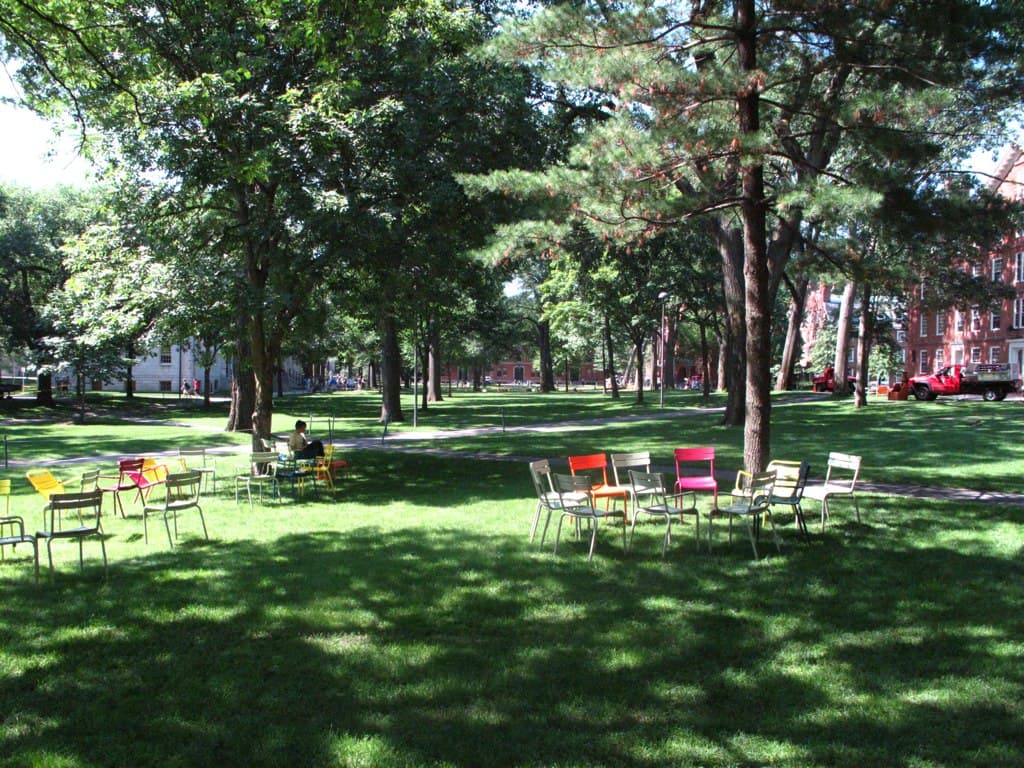
Walk through the Johnston Gate at Harvard Square, under the iron arch that reads "Enter to grow in wisdom," and you step out of the city and into a different century. Harvard Yard opens before you: a broad, tree-shaded lawn ringed by red-brick dormitories, white-granite halls, and iron gates, with students crossing on diagonal paths and visitors clustered around a bronze statue in front of University Hall. It is the oldest part of the oldest university in the United States, and it is the single most visited college campus in the country — a place that has been, at various times, a Puritan training ground, a Revolutionary War barracks, a parade ground, and the stage for nearly four centuries of commencements.
Harvard College was founded in 1636 by a vote of the Great and General Court of the Massachusetts Bay Colony — the first institution of higher learning in what would become the United States. Its purpose was plainly stated and urgently felt: the young colony needed ministers and magistrates, educated men to lead its churches and its government. The first classes met in a single frame house, and the college's first president, Henry Dunster, presided over a student body of fewer than a dozen. The college was first called simply the "New College." It became Harvard College in 1639, renamed for its first great benefactor, the young Charlestown minister John Harvard, who died of tuberculosis in 1638 at the age of thirty and left the college half his estate and his library of some 400 books. That bequest — money and books, from a man who had lived in the colony barely a year — was enough to put the college's name on the map permanently.
The Yard itself grew around that first college building, and its oldest surviving structures still define it. The western third of the Yard, known as the Old Yard, is where the history is densest: Massachusetts Hall, Harvard Hall, and University Hall stand in a row along its eastern edge, facing the Johnston Gate and Harvard Square beyond. Freshman dormitories cluster around the Old Yard — Wigglesworth, Weld, Grays, Matthews, Hollis, Stoughton, Holworthy, and the rest — so the Yard is not a museum but a living place, where first-year students still sleep in buildings older than the republic.
Massachusetts Hall and the fire that nearly erased the library
Massachusetts Hall, completed in 1720, is the oldest surviving building on Harvard's campus and the second-oldest academic building in the United States. It is a plain, handsome Georgian brick building, four stories tall, with a gambrel roof and a restrained dignity that set the pattern for the Yard's architecture for the next century. It has served, over three hundred years, as a dormitory, a barracks, and the seat of the university's administration — the offices of the President of Harvard University are still housed there. During the Revolutionary War, when Harvard's students were dispersed and the college's buildings were pressed into military service, Massachusetts Hall housed Continental Army soldiers; George Washington's troops were quartered in the Yard's buildings in 1775 and 1776, and the college itself briefly relocated to Concord while the army used Cambridge as its headquarters.
The building across the Old Yard from Massachusetts Hall tells the Yard's most dramatic story. The original Harvard Hall, built between 1672 and 1677, housed the college library — including the books John Harvard had donated. On the night of January 24, 1764, that building burned to the ground. Nearly the entire library was destroyed, including all but one of John Harvard's own books. The one survivor, John Downame's "The Christian Warfare Against the Devil, World, and Flesh," had been checked out by a student and was sitting in his room that night — a fluke of overdue borrowing that saved the only remaining volume of the founder's bequest. The current Harvard Hall, rebuilt in 1766 on the same site, now houses classrooms, and its restrained Georgian facade matches its neighbor across the lawn. The fire is the reason the Yard's oldest buildings are what they are: the college rebuilt, in brick, and never looked back.
University Hall and the white granite break
If Massachusetts Hall and Harvard Hall set the Yard's red-brick Georgian pattern, University Hall broke it — deliberately. Built between 1813 and 1815 to a design by Charles Bulfinch, class of 1781 and the first American-born professional architect, University Hall is a white Chelmsford granite building that stands at the center of the Old Yard's eastern side, its long facades facing the lawn and the Johnston Gate. Bulfinch's design was a statement: the college was no longer a colonial schoolhouse but a university with classical ambitions, and granite, not brick, would announce it. The building cost $65,000, of which $53,000 was paid by the Commonwealth of Massachusetts — a public investment in an institution that was already becoming a civic monument.
University Hall's history is written into its rooms. Its first floor held the College Commons, the dining hall, until 1849; its upper floors held the library, the scientific apparatus, and the chapel. A massive portico with stone pillars was added to the western facade soon after completion and removed in 1842, leaving the clean, symmetrical granite front you see today. The building was designated a National Historic Landmark in 1970 for its architectural significance. And it is the backdrop for the Yard's most photographed object: between its twin west staircases stands the bronze statue of John Harvard, moved here in 1924 from its original site near Memorial Hall so that it would face the Johnston Gate and greet every visitor entering the Yard.
The statue of three lies
The John Harvard statue is, by some measures, the most photographed statue in the United States — and almost everything its inscription says is wrong, which is precisely why tour guides love it. The statue is an 1884 bronze by Daniel Chester French, the sculptor who would later carve the seated Abraham Lincoln for the Lincoln Memorial in Washington. French had a problem: no portrait or likeness of John Harvard survives. So he modeled the figure on a Harvard student collaterally descended from an early Harvard president, Sherman Hoar, giving the statue a handsome young face that is almost certainly not John Harvard's. That is lie number one.
Lie number two is carved into the plinth itself: "JOHN HARVARD — FOUNDER — 1638." John Harvard did not found the college. The college was founded by the Massachusetts Bay Colony's vote in 1636, two years before Harvard's death and a year before he even arrived in the colony. He was its first great benefactor, not its founder — a distinction Harvard itself now states plainly, though the inscription remains. And lie number three is the date: the college was founded in 1636, not 1638, the year of Harvard's death. Tour guides recite the "three lies" for every group that gathers at the statue, and the tradition has become as much a part of the Yard as the statue itself.
There is one more tradition, newer and more visible: the toe of John Harvard's left shoe gleams bright gold against the darkly weathered bronze. Sometime in the 1990s, tour guides began telling visitors that rubbing the toe was a student tradition — it was not — and millions of visitors have done it anyway, polishing the bronze with their hands. Harvard seniors, by contrast, observe a real tradition: as they process to graduation exercises on Commencement Day, they remove their caps as they pass the statue. The statue appeared on the cover of Life magazine in 1941 and on a United States postage stamp in 1986, and it remains the Yard's centerpiece — the place where every visit begins, and where every photograph ends up.
Gates, lawns, and the Tercentenary Theatre
Harvard Yard is enclosed by a fence and a ring of gates, and the gates are worth a walk in themselves. The Johnston Gate, at the western end of the Old Yard facing Peabody Street and Harvard Square, is the grand entrance: a brick and iron gate built in 1889, through which the Yard opens to the Square. The Dexter Gate, the Class of 1890 gate on the south side, carries the inscription every Harvard visitor remembers: "Enter to grow in wisdom" on one side, and on the reverse, "Depart to serve better thy country and thy kind." Other gates commemorate classes, donors, and alumni, each with its own tablet and design, and walking the fence line is a quiet way to read the Yard's history in stone and iron.
Inside the fence, the Yard divides into the Old Yard in the west and the newer, larger expanse to the east, where the Tercentenary Theatre stretches between Widener Library and Memorial Church. The Theatre is not a building but an open-air lawn, named for Harvard's 300th anniversary in 1936, and it is where Commencement exercises are held each spring — thousands of chairs set out on the grass, graduates processing past the statue, and the Yard at its most ceremonial. Widener Library, at the Theatre's eastern end, is Harvard's flagship library: a great neoclassical building completed in 1915 with a bequest from Eleanor Elkins Widener in memory of her son Harry, Harvard class of 1907, who died on the Titanic in 1912. Its broad steps are the Yard's favorite meeting place, and its reading room holds one of the great book collections in the world, including a Gutenberg Bible. Memorial Church, facing the Theatre from the north, is the university's church, built in 1932 as a memorial to Harvard men and women who died in World War I; its white spire is one of the Yard's landmarks.
Elsewhere in the Yard, smaller sights reward the patient walker: Holden Chapel, nestled among the freshman dormitories, home of the Holden Choirs; Phillips Brooks House, dedicated to student service; the Harvard Bixi, a Chinese stele on a tortoise pedestal near Widener Library, a gift from Harvard alumni in China; and the freshman dormitories themselves, whose courtyards and stairwells have housed everyone from John Adams and John Quincy Adams to Theodore Roosevelt, Franklin Roosevelt, John F. Kennedy, and Barack Obama — eight United States presidents in all, along with the writers, scientists, and justices who studied in these same rooms.
The Yard as a public place
For all its history, Harvard Yard works best as a place to simply walk. It is free to enter and open to the public, and the best way to see it is the way students see it: on foot, slowly, with no agenda beyond looking. Start at the Johnston Gate, cross the Old Yard past Massachusetts Hall and Harvard Hall, and stop at the John Harvard statue — rub the toe if you must, but know the story behind it. Continue east past University Hall's granite facade, through the Tercentenary Theatre to Widener Library's steps, and sit for a while: the steps are the Yard's living room, and watching students come and go is the best free show in Cambridge. Then loop north to Memorial Church and Memorial Hall, the great High Victorian Gothic building just beyond the Yard's northern edge, built between 1870 and 1877 to honor Harvard alumni who died defending the Union in the Civil War.
Come in different seasons if you can. In autumn the Yard's elms and maples turn, and the red brick glows against the leaves. In winter, snow softens the lawns and the Yard empties to a hush. In spring, Commencement transforms the Theatre into a sea of chairs and gowns. And in summer, the Yard belongs to visitors and summer students, quieter and greener than at any other time of year. Pair the visit with Harvard Square itself — its bookstores, cafes, and street performers, the Harvard Coop, and the walk along Massachusetts Avenue to the Charles River — and with the rest of Cambridge, from the MIT campus across town to the house museums of Old Cambridge.
Harvard Yard's achievement is not that it is old, though it is the oldest college yard in America. It is that it is still doing, every day, what it was built to do: housing students, staging ceremonies, and welcoming strangers through its gates. The college that began in a single frame house in 1636 now enrolls students from every state and more than a hundred countries, but its heart is still this lawn, these brick dormitories, and this bronze statue with its three lies. Enter to grow in wisdom, the gate says. The Yard, nearly four centuries on, is still keeping that promise — one visitor, one student, one photograph at a time.
Key Facts
- Harvard College was founded in 1636 by vote of the Great and General Court of the Massachusetts Bay Colony — the first institution of higher learning in the United States.
- The college was renamed Harvard College in 1639 for John Harvard (1607–1638), a Charlestown minister who left it half his estate and his library of about 400 books upon his death.
- Massachusetts Hall (1720) is the oldest surviving building on Harvard's campus and the second-oldest academic building in the United States; it now houses the offices of the President of Harvard University.
- The original Harvard Hall burned on January 24, 1764, destroying nearly the entire college library; all but one of John Harvard's books were lost. The current Harvard Hall was rebuilt in 1766.
- University Hall (1813–1815), designed by Charles Bulfinch in white Chelmsford granite, cost $65,000, of which $53,000 was paid by the Commonwealth of Massachusetts; it was designated a National Historic Landmark in 1970.
- The John Harvard statue is an 1884 bronze by Daniel Chester French, unveiled October 15, 1884, and moved in 1924 from near Memorial Hall to its current site in front of University Hall.
- The statue's inscription — "JOHN HARVARD, FOUNDER, 1638" — contains the famous "three lies": the face is not John Harvard's (no likeness survives), he was a benefactor rather than the founder, and the college was founded in 1636, not 1638.
- During the Revolutionary War, Harvard's buildings housed Continental Army soldiers while the college briefly relocated to Concord.
- Widener Library, completed in 1915, was funded by Eleanor Elkins Widener in memory of her son Harry (class of 1907), who died on the Titanic in 1912; it houses a Gutenberg Bible.
- Memorial Hall, immediately north of Harvard Yard, was built 1870–1877 to honor Harvard alumni who died defending the Union in the Civil War.
- The Dexter Gate (Class of 1890) reads "Enter to grow in wisdom" on one side and "Depart to serve better thy country and thy kind" on the reverse.
- Eight United States presidents studied at Harvard, from John Adams to Barack Obama.
Visitor Details
Address: Harvard Yard, Cambridge, MA 02138 — enter through the Johnston Gate at Harvard Square, at the intersection of Massachusetts Avenue and Peabody Street
Transit: Harvard station (Red Line) in Harvard Square, steps from the Johnston Gate; multiple MBTA bus routes serve Harvard Square
Hours/Admission: Harvard Yard is generally open to the public to walk during the day, and there is no admission fee to enter the Yard itself. Access to individual buildings (libraries, dormitories, Memorial Church) is restricted or varies, and Yard access can occasionally be limited for university events — check Harvard's official visitor information before your visit rather than relying on a fixed schedule.
Best timing: Weekday mornings for the quietest Yard, or late afternoon when the light rakes across the Old Yard's brick facades. Spring Commencement season fills the Tercentenary Theatre with chairs and ceremony; autumn brings the Yard's best foliage. Start at the Johnston Gate, visit the John Harvard statue, then walk east through the Tercentenary Theatre to Widener Library's steps, and finish with a loop past Memorial Church and the Yard's gates.
Location Photography