The room where America began to act as one
Independence Hall gets the crowds, and the Liberty Bell gets the lines. But the first great act of American unity happened a few hundred feet away, in a smaller, quieter building set back from Chestnut Street behind a brick wall and a garden. Carpenters' Hall is where the First Continental Congress met in the autumn of 1774 — where delegates from twelve of the thirteen colonies, meeting as a single body for the first time, agreed to act together against British policy, signed the Continental Association, and set the colonies on the road to revolution.
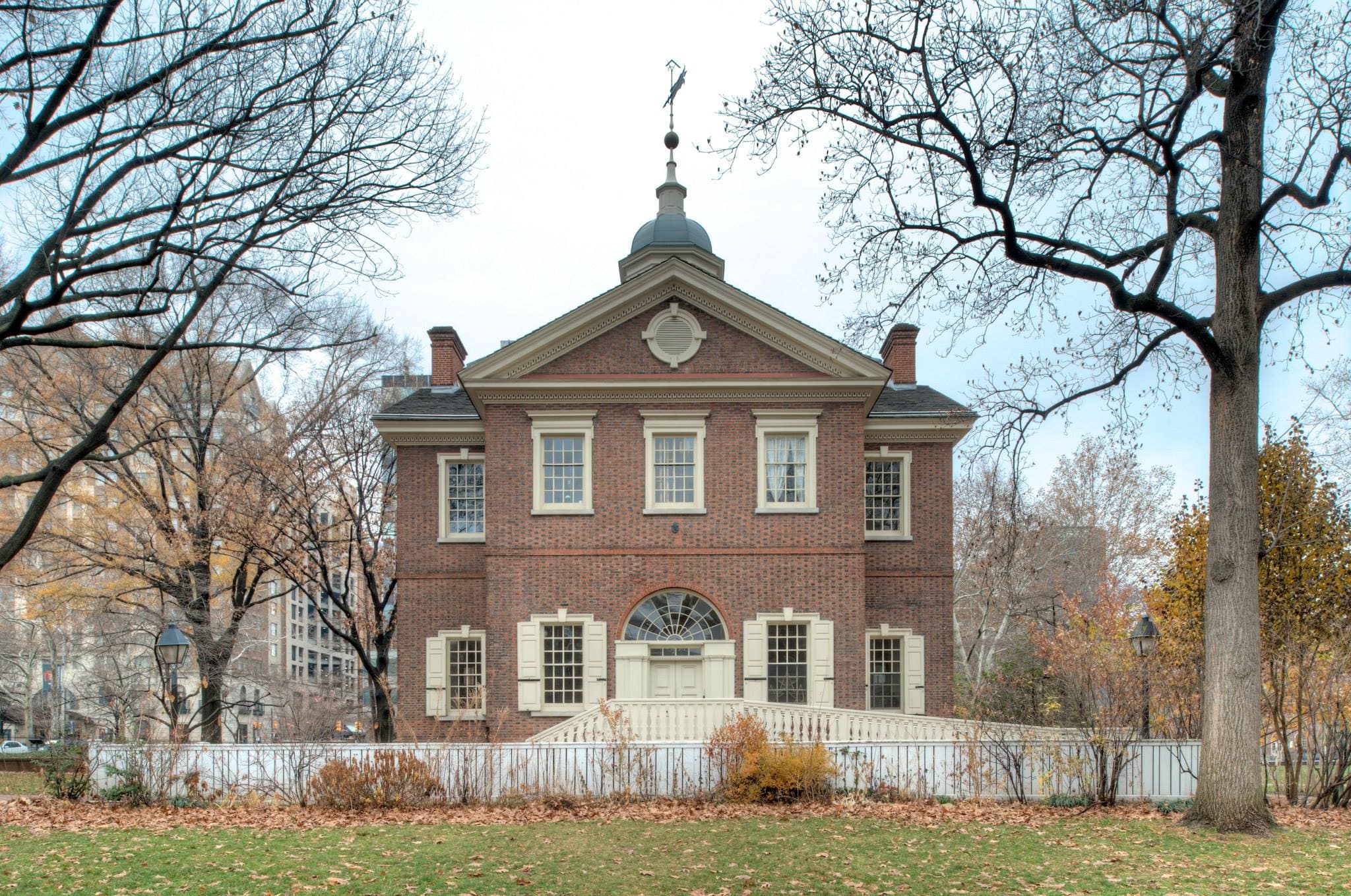
The building is easy to miss, and that is part of its charm. You reach it through Carpenters' Court, a narrow passage off Chestnut Street between Third and Fourth Streets, and step into a garden courtyard where the two-story brick hall stands on its own, framed by trees and old brick walls. There is no grand staircase, no tower, no marble. What there is, instead, is a room that has barely changed since the men who would become revolutionaries sat in it — and the knowledge that the building still belongs to the people who built it.
Carpenters' Hall was built by the Carpenters' Company of the City and County of Philadelphia, a guild of master builders founded in 1724 and still in existence today, making it the oldest extant craft guild in the United States. The Company bought the land in 1768, construction began in 1770, and the hall was substantially complete by 1774 — in time to host the most important meeting yet held in the colonies. The guild held its first meeting in the building on January 21, 1771, and it has owned the hall ever since. That unbroken ownership is remarkable: unlike most historic sites, Carpenters' Hall was never sold, never demolished, never rebuilt as a replica. The building you walk into is the building the delegates walked into.
The First Continental Congress, 1774
The Congress that met at Carpenters' Hall from September 5 to October 26, 1774, was called in response to the Intolerable Acts — the series of punitive laws Parliament passed after the Boston Tea Party, which closed the port of Boston and stripped Massachusetts of self-government. Twelve colonies sent delegates; Georgia, still dependent on British military protection against Spanish Florida and Native nations, did not. Among the fifty-six men who gathered were George Washington and Patrick Henry of Virginia, John Adams and Samuel Adams of Massachusetts, and John Jay of New York.
The delegates chose Carpenters' Hall deliberately. The Pennsylvania State House — today's Independence Hall — was available, but it was the seat of the colonial government, and the Congress wanted a meeting place that belonged to no government. A guild hall, owned by working craftsmen, suited a gathering that claimed to speak for the people of the colonies rather than for any crown-appointed assembly. The choice was itself a statement.
Over seven weeks, the Congress debated, petitioned, and ultimately acted. Its great achievement was the Continental Association, signed on October 20, 1774: an agreement by all twelve colonies to boycott British goods, to stop exporting goods to Britain, and to enforce the boycott through local committees. It was the first time the colonies had bound themselves to a common economic policy, and it created the machinery — the committees of inspection in every town and county — that would soon become the machinery of revolution. The Congress also resolved to ban further importation of enslaved people and to discontinue the slave trade within the colonies, an early, if incomplete, step against slavery. And it agreed to meet again the following spring if Britain did not relent. Britain did not relent, and the Second Continental Congress met in 1775 at the State House, where it would raise an army, appoint Washington its commander, and, in July 1776, adopt the Declaration of Independence.
Standing in the main hall today, you can see the room much as the delegates saw it: a long, well-proportioned chamber with tall windows, its woodwork and proportions intact. Exhibits in the hall explain the Congress and display artifacts of the period, and the room's quiet scale makes the history feel close in a way the grander State House, with its crowds and ceremony, sometimes does not.
The birthplace of Pennsylvania
Carpenters' Hall's second great moment came in June 1776, and it belongs to Pennsylvania alone. Meeting in the hall, the Pennsylvania Provincial Conference declared the province's independence from the British Empire and established the Commonwealth of Pennsylvania. The Conference mobilized the Pennsylvania militia for the war, and it set in motion the Provincial Convention that met from July 15 to September 28, 1776, and framed the Pennsylvania Constitution of 1776 — one of the most democratic constitutions of the revolutionary era.
In 1982, the Pennsylvania General Assembly formally recognized Carpenters' Hall as the official birthplace of the Commonwealth of Pennsylvania. The designation is fitting: the Commonwealth was not born in the State House, where the Declaration was signed, but here, in the carpenters' guild hall, where Pennsylvanians decided for themselves to break with the Crown.
The hall's later history is a catalog of the young republic's institutions. During the Revolutionary War it served as a hospital for British and American troops alike, and from September 1777 to June 1778 it stood in British-occupied Philadelphia. After the war, it housed meetings of Benjamin Franklin's Library Company of Philadelphia — the lending library Franklin founded in 1731 — and of the American Philosophical Society. The First and Second Banks of the United States both held meetings here, and the Bank of Pennsylvania kept offices in the building; in 1798 the hall was the scene of the famous Bank of Pennsylvania heist, one of the first great bank robberies in American history. From 1802 to 1819, with a brief interruption in 1811, the building served as Philadelphia's federal Custom House. Few buildings in America have held so many chapters of the national story under one roof.
Georgian architecture, built by the men who knew how
The hall is a fine example of Georgian architecture, designed by Robert Smith, a Scottish-born master builder and member of the Carpenters' Company. Smith drew on two traditions: the town halls of Scotland, where he was born, and the classical villas of Palladio in Italy, whose proportions and symmetry shaped Georgian design across the British Atlantic world. The result is a two-story brick building of calm, balanced proportions — Flemish-bond brickwork, tall arched windows, a hipped roof, and a restrained classical doorway — built by the very craftsmen whose guild commissioned it.
That is the detail that makes Carpenters' Hall different from the grander buildings around it. Independence Hall was built by the colonial government; the hall was built by working men, for their own use, to the highest standard their craft allowed. The Carpenters' Company was not a social club but a professional body: it set standards for building practice, published a book of architectural rules and prices, and trained the master builders who raised colonial Philadelphia. When you look at the hall's brickwork and joinery, you are looking at a guild's advertisement for its own skill — and at the standard to which Philadelphia's builders held themselves.
The building was designated a National Historic Landmark in 1970, and it sits within Independence National Historical Park, the federal park that preserves the historic core of Old City. But the hall is not a federal building: it remains privately owned by the Carpenters' Company, which opens it to the public and maintains it as a museum. About 120,000 visitors a year pass through its rooms.
The garden, the exhibits, and the walk
A visit to Carpenters' Hall is best taken slowly, as part of the Old City walking route. The garden courtyard is itself worth a pause: a quiet, brick-walled green space in the middle of a busy downtown, with benches and plantings that make it one of the most peaceful spots in the historic district. It is the kind of place Philadelphians slip into for a moment of shade, and it sets the tone for the hall itself — smaller, quieter, and more intimate than its famous neighbors.
Inside, the main hall and the exhibits tell the story of the First Continental Congress and the building's many lives: the guild that built it, the Congress of 1774, the Pennsylvania Conference of 1776, the banks, the library, and the Custom House. Docents and interpretive panels fill in the details, and the room's furnishings evoke the period without pretending to be an exact reconstruction of a single day. Allow time to read the panels; the hall rewards attention more than spectacle.
Then step back out and walk the route the delegates themselves walked. Independence Hall and the Liberty Bell Center are a few minutes away, on the same Chestnut Street corridor; the Second Bank of the United States portrait gallery, Franklin Court, and Elfreth's Alley are all within easy walking distance. Carpenters' Hall is the natural first stop on that route, because it is where the story starts: before the Declaration, before the Constitution, before the republic, there was a room full of delegates from twelve colonies, agreeing — for the first time — to act as one people. Start there, and everything that follows in Old City makes more sense.
Carpenters' Hall Gallery


Key Facts
- Carpenters' Hall, at 320 Chestnut Street in Philadelphia's Old City, stands in a garden courtyard reached through Carpenters' Court, within Independence National Historical Park.
- The hall was built by the Carpenters' Company of the City and County of Philadelphia, founded in 1724 and the oldest extant craft guild in the United States; the Company bought the land in 1768, construction began in 1770, and the hall was substantially complete by 1774. The guild held its first meeting in the building on January 21, 1771, and still owns it today.
- The hall was designed by Robert Smith, a Scottish-born master builder and Company member, in the Georgian style, drawing on Scottish town halls and the villas of Palladio; it is a two-story brick building with Flemish-bond brickwork and tall arched windows.
- The First Continental Congress met at Carpenters' Hall from September 5 to October 26, 1774, with delegates from twelve colonies; it signed the Continental Association on October 20, 1774, agreeing to a joint boycott of British goods, and resolved to ban further importation of enslaved people and discontinue the slave trade within the colonies.
- In June 1776, the Pennsylvania Provincial Conference met at the hall and declared the province's independence from the British Empire, establishing the Commonwealth of Pennsylvania; it mobilized the Pennsylvania militia and set up the Provincial Convention that framed the Pennsylvania Constitution of 1776. In 1982 the Pennsylvania General Assembly recognized Carpenters' Hall as the official birthplace of the Commonwealth of Pennsylvania.
- During the Revolutionary War the hall served as a hospital for British and American troops and stood in British-occupied Philadelphia from September 1777 to June 1778.
- Later occupants and users included Benjamin Franklin's Library Company of Philadelphia, the American Philosophical Society, the First and Second Banks of the United States, and the Bank of Pennsylvania (scene of the 1798 Bank of Pennsylvania heist); the federal Custom House occupied the building from 1802 to 1819, with a brief interruption in early 1811.
- The building was designated a National Historic Landmark on April 15, 1970, and receives about 120,000 visitors per year.
- The hall remains privately owned by the Carpenters' Company and is open to the public as a museum; Independence Hall, the Liberty Bell Center, Franklin Court, and Elfreth's Alley are all within easy walking distance.
Visitor Details
Address: Carpenters' Hall, 320 Chestnut Street, Philadelphia, PA 19106 (Old City / Independence National Historical Park area; enter through Carpenters' Court off Chestnut Street, between Third and Fourth Streets).
Transit: The hall sits in the heart of Old City, walkable from the 5th Street/Independence Hall station (Market-Frankford Line) and from SEPTA bus routes along Market and Chestnut Streets; Independence Hall and the Liberty Bell Center are a few minutes' walk away.
Hours/Admission: Hours and admission arrangements change from time to time — check the official source at carpentershall.org and the National Park Service's Independence National Historical Park pages before visiting to confirm current hours and any admission details. Allow about 45 minutes to an hour for the hall and its garden, as part of a longer Old City walking route.
Best timing: Visit in the morning for the quietest rooms, and pair the hall with Independence Hall and the Liberty Bell the same day — Carpenters' Hall first, since it is where the story of united colonial action begins. The garden courtyard is a peaceful resting spot between stops.