A patrol you walk beside
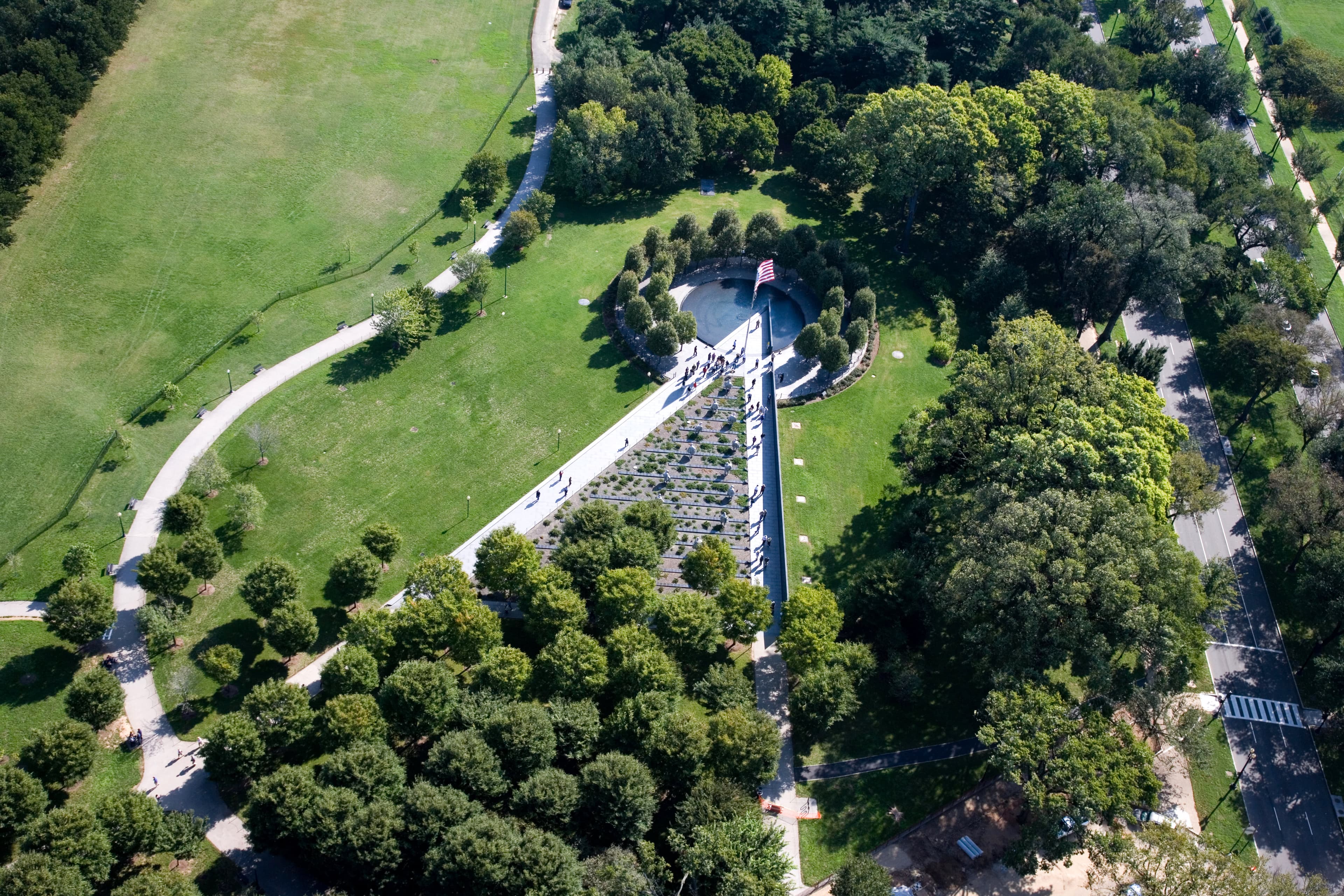
The first thing to understand about the Korean War Veterans Memorial is that you do not stand before it. You walk into it. Most of Washington's memorials keep you at a respectful distance — you look up at Lincoln, you stand at the edge of the World War II Memorial's plaza — but here, on a 2.2-acre triangle of ground in West Potomac Park, southeast of the Lincoln Memorial and just south of the Reflecting Pool, the memorial surrounds you. Nineteen stainless steel figures, each between seven feet three inches and seven feet six inches tall and weighing nearly a thousand pounds, are spread across a field of juniper bushes and strips of granite, walking in patrol formation toward an American flag at the point of the triangle. They wear ponchos over their combat gear, as if caught in a Korean rain. They are alert, weary, and larger than life, and because they are spaced apart rather than grouped on a pedestal, you move among them the way a visitor moves through a landscape, not past a monument.
That is the memorial's genius, and it is deliberate. The sculptor, Frank Gaylord of Barre, Vermont, himself a World War II veteran, called the group "The Column." The figures represent a platoon on patrol drawn from all four branches of the armed forces: fourteen from the Army, three from the Marine Corps, one Navy Corpsman, and one Air Force Forward Air Observer. They are also, pointedly, a cross-section of the America that fought in Korea — men of different races and ethnic backgrounds, in a war that was the first in American history in which U.S. combat units were not racially segregated. The juniper bushes around their feet and the granite strips beneath them suggest the rugged Korean terrain, and the windblown ponchos recall the brutal weather — the bitter winters and driving rains — that the troops endured.
The war they commemorate is often called the "Forgotten War," and the nickname is part of the story. The Korean War began on June 25, 1950, when North Korean forces crossed the 38th parallel into South Korea, and it ended with an armistice on July 27, 1953 — an armistice, not a peace treaty, which is why the two Koreas remain technically at war today. More than 5.7 million Americans served during the conflict, alongside forces from 21 other United Nations nations, and more than 36,000 Americans died. Yet when the veterans came home, the country was preoccupied with postwar prosperity and then with Vietnam, and the war slipped from public memory. The memorial, authorized by Congress in 1986 after decades of advocacy by veterans, was in part an answer to that forgetting: a place built, forty years late, so that the war would have a physical home in the nation's capital.
A long road to dedication
Getting the memorial built took nearly as long as the forgetting it corrected. Congress authorized the memorial in 1986, and the design and construction were managed by the Korean War Veterans Memorial Advisory Board and the American Battle Monuments Commission. The original design competition was won by a team of four architects and landscape architects from Pennsylvania State University, but that team withdrew as it became clear that the reviewing agencies — including the Commission of Fine Arts — wanted substantial changes. A federal court case over the design changes was filed and lost by the winning team. The eventual design was developed by Cooper-Lecky Architects of Washington, D.C., who oversaw a collaboration among several designers: Gaylord for the statues, and Louis Nelson Associates of New York for the Mural Wall.
President George H. W. Bush conducted the groundbreaking on June 14, 1992, Flag Day. Construction involved the Faith Construction Company, the Emma Kollie Company, the Cold Spring Granite Company, the Tallix Art Foundry, and the Baltimore District of the U.S. Army Corps of Engineers. The memorial was dedicated on July 27, 1995 — the 42nd anniversary of the armistice — by President Bill Clinton and Kim Young Sam, the president of South Korea, to the men and women who served during the conflict. Management was turned over to the National Park Service, under its National Mall and Memorial Parks group, and, as with all National Park Service historic areas, the memorial was listed on the National Register of Historic Places on the day of its dedication.
The Mural Wall: 2,400 faces looking back
Walk along the south side of the Field of Service and you meet the memorial's second great element: the Mural Wall. It is 164 feet long, eight inches thick, and made of more than 100 tons of highly polished "Academy Black" granite from California, arranged in 41 panels. Sandblasted into its surface are more than 2,400 photographic images, drawn from the National Archives, of the land, sea, and air troops who supported those who fought — doctors, nurses, truck drivers, mechanics, chaplains, supply clerks, and many others. The muralist, Louis Nelson, enhanced the photographs by computer to give them uniform lighting and size, and arranged them to rise and fall in harmony with the layout of the statues. The etched figures are deliberately without insignia or name tapes, so that they represent all who served rather than any individual.
The wall does two things at once, and both reward a slow walk. First, its polished surface is a mirror: it reflects the 19 statues standing before it, so that the patrol appears to number 38 — a reference to the 38th parallel that divided North and South Korea, and to the 38 months the war lasted. Second, seen from a distance, the arrangement of the etched images resolves into the rugged mountain ranges of Korea. Stand close and you see individual faces; step back and you see a landscape. It is one of the most quietly ingenious effects on the National Mall, and it is worth taking the time to experience both ways: up close, face to face with the etched photographs, and from twenty paces back, watching the patrol double in the granite.
Along the north side of the statues runs the United Nations Wall, a low granite curb listing the 22 member states of the United Nations that, as part of the United Nations Command, contributed troops or medical support to the defense of South Korea. It is easy to walk past this wall without stopping, but it is worth reading: it is the memorial's reminder that this was not only an American war, but a coalition war, fought under a United Nations flag.
The Pool of Remembrance and "Freedom Is Not Free"
At the apex of the triangle, where the patrol's path ends, the memorial opens into a circle: the Pool of Remembrance. It is a shallow pool, 30 feet in diameter, lined with black granite and encircled by a grove of linden trees with benches, the trees shaped to create a barrel effect that lets sunlight reflect on the water. Granite curbs around the pool are engraved with the numbers of the war's cost, for both American and United Nations forces: the dead, the wounded, the missing in action, and those held as prisoners of war. The figures engraved for the United States — 54,246 dead, 103,284 wounded, 7,140 captured, 8,177 missing — are sobering to read in stone, in a quiet circle, after walking among the statues.
Nearby, a plaque carries the memorial's most quoted inscription: "Our nation honors her sons and daughters who answered the call to defend a country they never knew and a people they never met." And on a granite wall at the pool, inlaid in silver letters ten inches high, is the memorial's motto: "Freedom Is Not Free." Three bushes of the Rose of Sharon, South Korea's national flower, grow on the south side of the memorial — a small, living tribute from the country the patrol was walking to defend.
The newest part of the memorial is also at the pool. In July 2022, on the 69th anniversary of the armistice, the Wall of Remembrance was unveiled: a series of long black granite slabs encircling the pool area, engraved with the names of the Americans and the South Koreans who died while serving under U.S. command — more than 43,000 names in all, listed by branch and rank. The wall was funded largely by the South Korean government and was the result of years of lobbying by the Korean War Veterans Memorial Foundation. Visitors should know that the wall has not been without controversy: a 2023 investigation found hundreds of spelling errors, names of service members who died in circumstances unrelated to the war, and roughly 500 omitted names, and South Korea's Ministry of Patriots and Veterans Affairs announced in January 2023 that it intended to verify and correct the list. The errors do not diminish the wall's purpose, but they are part of its story, and they are a reminder that even monuments are works in progress.
The stamp that went to court
The memorial has one more story that first-time visitors rarely hear, and it is worth knowing because it explains something you may notice about photographs of the place. In 2002, a retired Marine named John Alli was paid $1,500 for the use of one of his photographs of the memorial on a snowy day — a haunting image of the statues in winter — for a 37-cent U.S. postage stamp, which went on to sell more than $17 million worth of stamps. Sculptor Frank Gaylord, who had retained the intellectual property rights to his statues, sued the Postal Service, arguing that he had not signed those rights away when the memorial was erected. After years of litigation, the U.S. Court of Federal Claims awarded Gaylord $684,844.94 in damages, including interest, in September 2013. The case is a footnote to the memorial's history, but it is a telling one: it is why many of the most famous photographs of these statues — including Alli's snow photograph — circulated for years under unusual copyright restrictions, and why the memorial's imagery carries a legal history all its own.
How to visit, and when to come
The memorial sits at 10 Daniel French Drive SW, in West Potomac Park on the National Mall, southeast of the Lincoln Memorial and just south of the Reflecting Pool, across from the Vietnam Veterans Memorial. The nearest Metro stations are Foggy Bottom–GWU and Smithsonian, both served by the Blue, Orange, and Silver lines, and the memorial is an easy walk from either, as well as from the Lincoln Memorial itself. It is also, like the rest of the Mall, entirely walkable from the World War II Memorial to the east and the Tidal Basin to the south, so it pairs naturally with a longer Mall walk.
The memorial is outdoors and, per the National Park Service, open 24 hours a day, every day of the year, and admission is free. Park rangers are on hand to answer questions from 9:30 a.m. to 10 p.m. daily, except on December 25, and the Park Service offers programs at the memorial — check nps.gov/kowa before visiting for current program times, since schedules change. No ticket, reservation, or fee is involved, and no fixed tour time is stated in this article, since none was verified against the official source in this run.
If you can choose your hour, come at dusk or after dark. The statues are lit at night, and the effect is the one visitors remember most: the steel figures glowing against the dark, their reflections doubled in the black granite wall, the pool still and quiet under the linden trees. The memorial is powerful in daylight, when you can study the etched faces on the Mural Wall and read the names on the Wall of Remembrance. But at night, walking alone among the patrol, you understand why veterans and their families call this the most moving memorial on the Mall. Give it at least thirty minutes — longer if you read the walls — and walk the full triangle: enter with the patrol, follow the Mural Wall, read the United Nations curb, and finish at the Pool of Remembrance, where the numbers and the motto wait at the end of the walk. Then cross to the Lincoln Memorial, or stand at the Reflecting Pool and look back. The patrol will still be walking, as it always is, toward a flag at the point of the triangle, in a war the country once forgot and this place refuses to let go.
Gallery


Key Facts
- The Korean War Veterans Memorial is in West Potomac Park on the National Mall, southeast of the Lincoln Memorial and just south of the Reflecting Pool, at 10 Daniel French Drive SW, Washington, DC. Its coordinates are 38.8878, -77.0476.
- The memorial honors the Americans — and the United Nations partners — who served in the Korean War, which began June 25, 1950, when North Korean forces crossed the 38th parallel into South Korea, and ended with an armistice on July 27, 1953. More than 5.7 million Americans served; more than 36,000 died.
- Congress authorized the memorial in 1986 (Public Law 99-572); design and construction were managed by the Korean War Veterans Memorial Advisory Board and the American Battle Monuments Commission. The original design competition was won by a team from Pennsylvania State University, which later withdrew; the final design was developed by Cooper-Lecky Architects.
- Groundbreaking took place on June 14, 1992, conducted by President George H. W. Bush. The memorial was dedicated on July 27, 1995, the 42nd anniversary of the armistice, by President Bill Clinton and South Korean President Kim Young Sam. It was listed on the National Register of Historic Places on the day of its dedication and is managed by the National Park Service.
- The memorial's central group, "The Column," is 19 stainless steel statues by sculptor Frank Gaylord, each 7 feet 3 inches to 7 feet 6 inches tall and weighing nearly 1,000 pounds: 14 Army soldiers, 3 Marines, 1 Navy Corpsman, and 1 Air Force Forward Air Observer, dispersed among juniper bushes and granite strips in a triangular Field of Service.
- The Mural Wall, designed by Louis Nelson, is 164 feet long, 8 inches thick, made of more than 100 tons of polished "Academy Black" granite from California in 41 panels, sandblasted with more than 2,400 photographic images from the National Archives of the troops who supported the ground forces. Its reflective surface doubles the 19 statues to an apparent 38, for the 38th parallel and the 38 months of the war.
- The United Nations Wall, a low granite curb on the north side of the statues, lists the 22 United Nations member states that contributed troops or medical support to the defense of South Korea.
- The Pool of Remembrance is a shallow, 30-foot-diameter pool lined with black granite, encircled by linden trees and benches, with engraved casualty figures for American and United Nations forces (United States: 54,246 dead, 103,284 wounded, 7,140 captured, 8,177 missing) and a nearby plaque inscribed: "Our nation honors her sons and daughters who answered the call to defend a country they never knew and a people they never met."
- A granite wall at the pool bears the motto "Freedom Is Not Free" inlaid in silver letters; three Rose of Sharon bushes, South Korea's national flower, grow on the south side of the memorial.
- The Wall of Remembrance, unveiled July 27, 2022, the 69th anniversary of the armistice, is a series of black granite slabs encircling the pool area engraved with the names of more than 43,000 Americans and South Koreans who died while serving under U.S. command; a 2023 investigation found hundreds of errors in the list, and South Korea's Ministry of Patriots and Veterans Affairs announced in January 2023 that it intended to verify and correct it.
- The memorial's imagery was at the center of a copyright case: a snow photograph of the statues by retired Marine John Alli was used on a 37-cent U.S. postage stamp in 2003, and sculptor Frank Gaylord, who had retained his intellectual property rights, was awarded $684,844.94 in damages, including interest, by the U.S. Court of Federal Claims in September 2013.
- The memorial is the second national war memorial erected on the National Mall, after the Vietnam Veterans Memorial, which stands across the Reflecting Pool.
Visitor Details
Address: Korean War Veterans Memorial, 10 Daniel French Drive SW, Washington, DC (West Potomac Park, on the National Mall, southeast of the Lincoln Memorial and just south of the Reflecting Pool).
Transit: Foggy Bottom–GWU and Smithsonian Metro stations (Blue, Orange, and Silver lines), each a walk from the memorial; the memorial is also walkable from the Lincoln Memorial, the Vietnam Veterans Memorial, and the World War II Memorial.
Hours/Admission: The memorial is outdoors and, per the National Park Service, open 24 hours a day, every day of the year, and admission is free. Park rangers are on hand to answer questions from 9:30 a.m. to 10 p.m. daily, except on December 25. Programs and ranger talks change from time to time — check the official source at nps.gov/kowa before visiting for current program times. No fixed tour time is stated in this article, since none was verified against the official source in this run.
Best timing: Come at dusk or after dark if you can — the statues are lit at night and their reflections double in the Mural Wall — and allow at least thirty minutes to walk the full triangle: the patrol, the Mural Wall, the United Nations curb, and the Pool of Remembrance. Pair the visit with the Lincoln Memorial and the Vietnam Veterans Memorial across the Reflecting Pool.