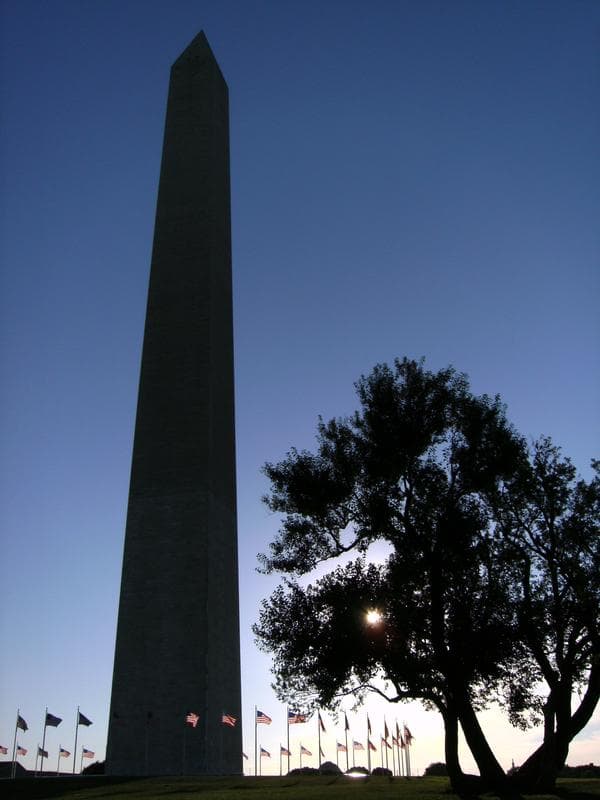
The Tallest Stone Structure on Earth
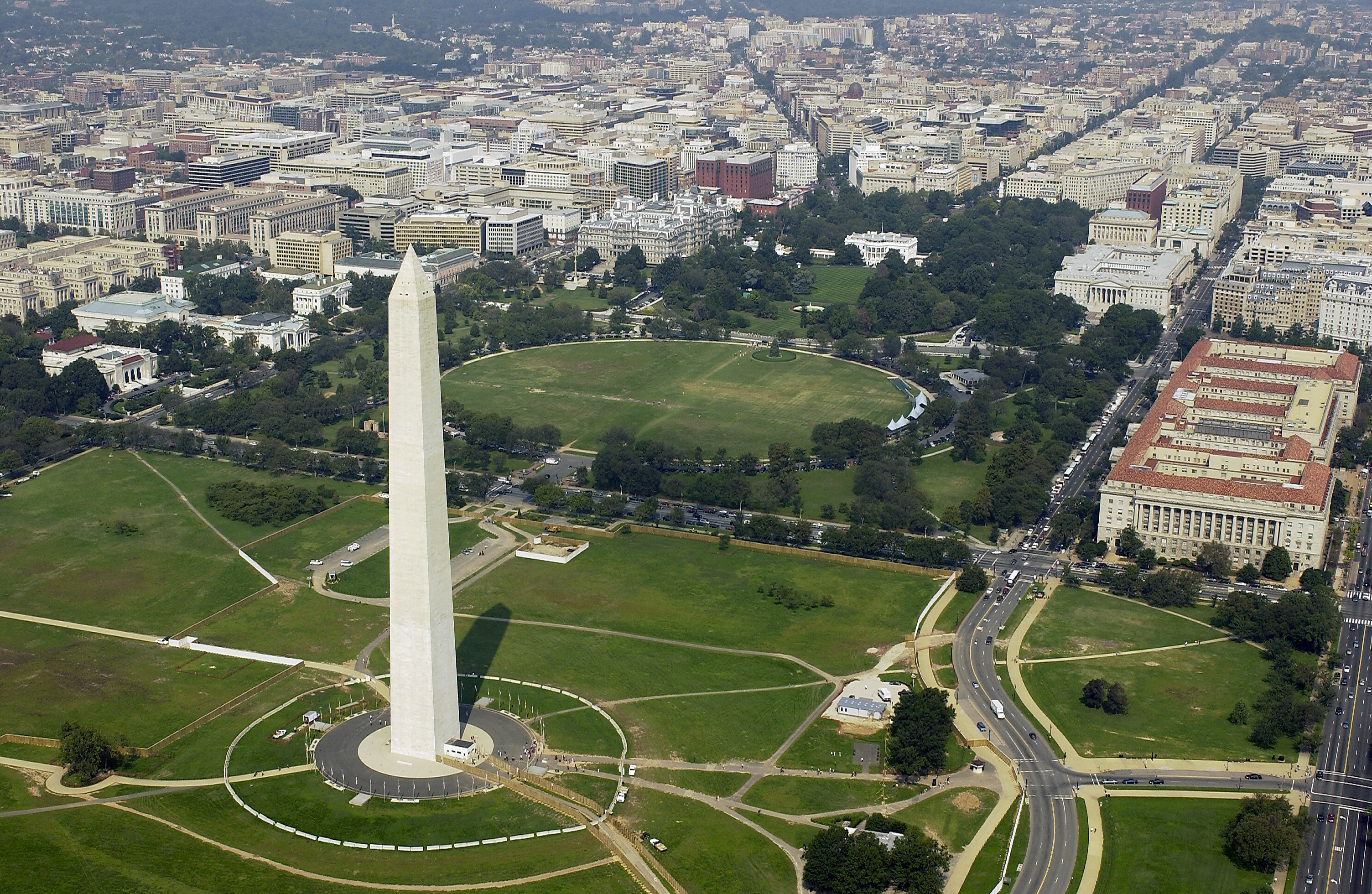
Every postcard of Washington has one thing in the middle: a white finger of stone rising 555 feet 5-1/8 inches (169.046 meters) over the Mall. The Washington Monument is the world's tallest predominantly stone structure and the world's tallest obelisk — a record it has held for more than 140 years. From 1884 to 1889, when the Eiffel Tower rose over Paris, it was also the tallest man-made structure on the planet. To this day, the District's Height of Buildings Act of 1910 keeps the city's rooftops far below it, so the monument remains the uncontested crown of the Washington skyline.
The 1910 law that bears its spirit — the Height of Buildings Act — limits new construction in much of the District to roughly 130 to 160 feet, a ceiling that keeps the monument the city's fixed point of reference. From across the Potomac in Arlington, from the rooftops of Georgetown, from the highways sweeping in from Virginia and Maryland, the obelisk is the first landmark that orients you and the last one you lose. It is not merely the center of the Mall; it is the center of the city's mental map, a compass needle in stone that every Washingtonian reads without thinking.
The dream of a grand monument to George Washington is older than the capital itself. In 1783 the Continental Congress voted to honor the victorious general with an equestrian statue; when Pierre L'Enfant laid out the federal city, he reserved a site at the very crossing of the great axes — where the east-west Mall axis meets the north-south line from the President's House. Marshy, unstable soil near that exact intersection forced the builders to shift the site a few hundred feet off-axis, which is why the monument sits just south of the Mall's true centerline. The location was chosen for posterity; geology had the final word.
The Washington National Monument Society, a private civic group founded in 1833, ran a design competition in 1836 and chose architect Robert Mills's proposal: a colossal obelisk ringed at its base by an elaborate classical colonnade with statues of the founders. The colonnade never happened — the money didn't — but the obelisk did, more or less as Mills drew it. The cornerstone was laid on July 4, 1848, in a ceremony attended by a reported 20,000 people.
The Two-Tone Shaft: A Halt That History Painted Onto the Stone
Look closely at the shaft and you will notice something the builders never intended: the marble changes color about 150 feet up, from a warm off-white below to a slightly different, cooler tone above. The monument wears its history on its skin. Construction, funded by slow private subscriptions, ground to a halt in the 1850s with the shaft only about 152 feet tall. A bizarre political scandal helped stop it — the anti-Catholic Know-Nothing party, which briefly seized control of the Monument Society, was outraged by a donated stone from the Pope; the block was stolen and reportedly thrown into the Potomac. Funds dried up, the Civil War intervened, and the stump stood abandoned for more than two decades, a half-built monument to a stalled nation.
Work resumed in 1876 after Congress authorized the U.S. Army Corps of Engineers to take over, with Lieutenant Colonel Thomas Lincoln Casey in charge. Casey's engineers strengthened the foundation, abandoned the unbuilt colonnade, and continued the shaft using marble from a different quarry — hence the two-tone effect that survives today. The capstone was set on December 6, 1884, topped with a nine-inch pyramid of cast aluminum inscribed "Laus Deo" — Praise be to God. Aluminum was then a precious metal, rarer than silver, an appropriately extravagant finish for the tallest structure on Earth. The monument was dedicated on February 21, 1885, and opened to the public on October 9, 1888.
Inside: Nearly 200 Stones From Around the World
The interior of the obelisk is its own museum. As the shaft rose, states, cities, foreign governments, and fraternal and military societies donated carved memorial stones that were set into the inner walls. Today nearly two hundred of these blocks line the stairwell and the elevator shaft — marble from Vermont, granite from New Hampshire, petrified wood from Arizona, jade from Alaska, and stones sent from Wales, Switzerland, Brazil, and beyond, each one a tribute to the first president in the donor's own voice. The grand staircase — 897 steps — is closed to the public, but the modern glass-sided elevator lets riders glimpse the memorial stones on the west face as they ascend.
Shaken: The 2011 Earthquake and the Rebuilding
On August 23, 2011, a magnitude 5.8 earthquake centered near Mineral, Virginia, shook the capital. The monument's slender shaft swayed; mortar cracked, stones chipped, and cracks opened near the very top. Engineers closed the obelisk indefinitely, and rope-access "difficult access" teams rappelled down its face to map every crack by hand. The repair cost $15 million, split between the federal government and philanthropist David Rubenstein — the same donor who later helped repair other Mall landmarks. For two and a half years the monument wore a scaffold scrim printed with the image of the shaft itself, lit dramatically at night, a work-in-progress that became its own attraction. It reopened to the public on May 12, 2014. A later closure, from September 2019 to August 2020, modernized the elevator and added new security screening facilities at the base.
The View From 500 Feet
The payoff for the ascent is the observation deck at the 500-foot level, ringed with small windows that frame the capital like a four-way panorama: the Capitol dome rising over the Mall to the east; the Lincoln Memorial and the Reflecting Pool stretching west; the Jefferson Memorial and the Tidal Basin to the south; the White House grounds and the northern city to the north. On a clear day the view carries to the far reaches of the metro area. The elevator ride itself takes about a minute, and the windows are deliberately small — a concession to the structure's 19th-century bones. Because demand is high, admission to the interior is managed with timed tickets distributed through the National Park Service; check the official NPS site before your visit for current hours and availability.
The Center of It All
The monument's genius is placement. It stands at the hinge of the monumental core — between the Capitol and the Lincoln Memorial (both covered in their own articles here), north of the Tidal Basin and the Jefferson Memorial, south of the White House. The fifty state flags ringing its base complete the civic symbolism: a first president honored at the center of a union he helped create. The grounds around it — a 14.6-acre lawn that has hosted presidential inaugurations' overflow crowds, civil-rights marches, music festivals, and countless impromptu picnics — are as much a part of the monument's story as the shaft itself. This is the rare landmark that works at every distance: from the Tidal Basin it is a white exclamation point over the cherry trees; from the steps of the Capitol it is the closing punctuation of the Mall's great vista; and from its own base, craning your neck straight up, it simply refuses to fit in your field of vision.
Whether you see it at dawn when the shaft catches the first light, or at night when it glows against the sky, it is the one sight in Washington you cannot miss — and, at 555 feet, the one sight that makes sure you can't.
Key Facts
Height: 555 feet 5-1/8 inches (169.046 m) — the world's tallest stone structure and the world's tallest obelisk
Tallest man-made structure in the world from 1884 (completion of the capstone) until 1889 (the Eiffel Tower)
Architect: Robert Mills, selected in the 1836 design competition of the Washington National Monument Society
Built in two phases: 1848–1854 (to ~152 feet), then 1876–1884 under Lt. Col. Thomas Lincoln Casey, U.S. Army Corps of Engineers
The visible two-tone marble is a direct result of the decades-long construction halt and the change of quarry
Capstone (December 6, 1884) topped with a nine-inch pyramid of cast aluminum — then a precious metal — inscribed "Laus Deo"
Interior holds nearly 200 memorial stones donated by states, cities, societies, and foreign countries; the 897-step staircase is closed to the public
Damaged by the August 23, 2011 Virginia earthquake; repaired and reopened May 12, 2014
Observation deck sits at the 500-foot level with views in all four directions
Managed by the National Park Service as part of the National Mall and Memorial Parks
Visitor Details
Address: 2 15th St NW, Washington, DC 20024
Transit: Metro Smithsonian station (Blue/Orange/Silver lines), a short walk south across the Mall
Hours/Admission: Timed tickets are required to enter the monument and ride the elevator to the observation deck — tickets are distributed through the National Park Service. Check the official NPS site before your visit for current hours, ticket releases, and availability. The surrounding grounds are open daily as part of the National Mall.
Best timing: Early morning for the shortest lines and soft light; sunset and night views from the grounds are spectacular, and the shaft is floodlit after dark.
Location Photography