A Figure at the End of P Street
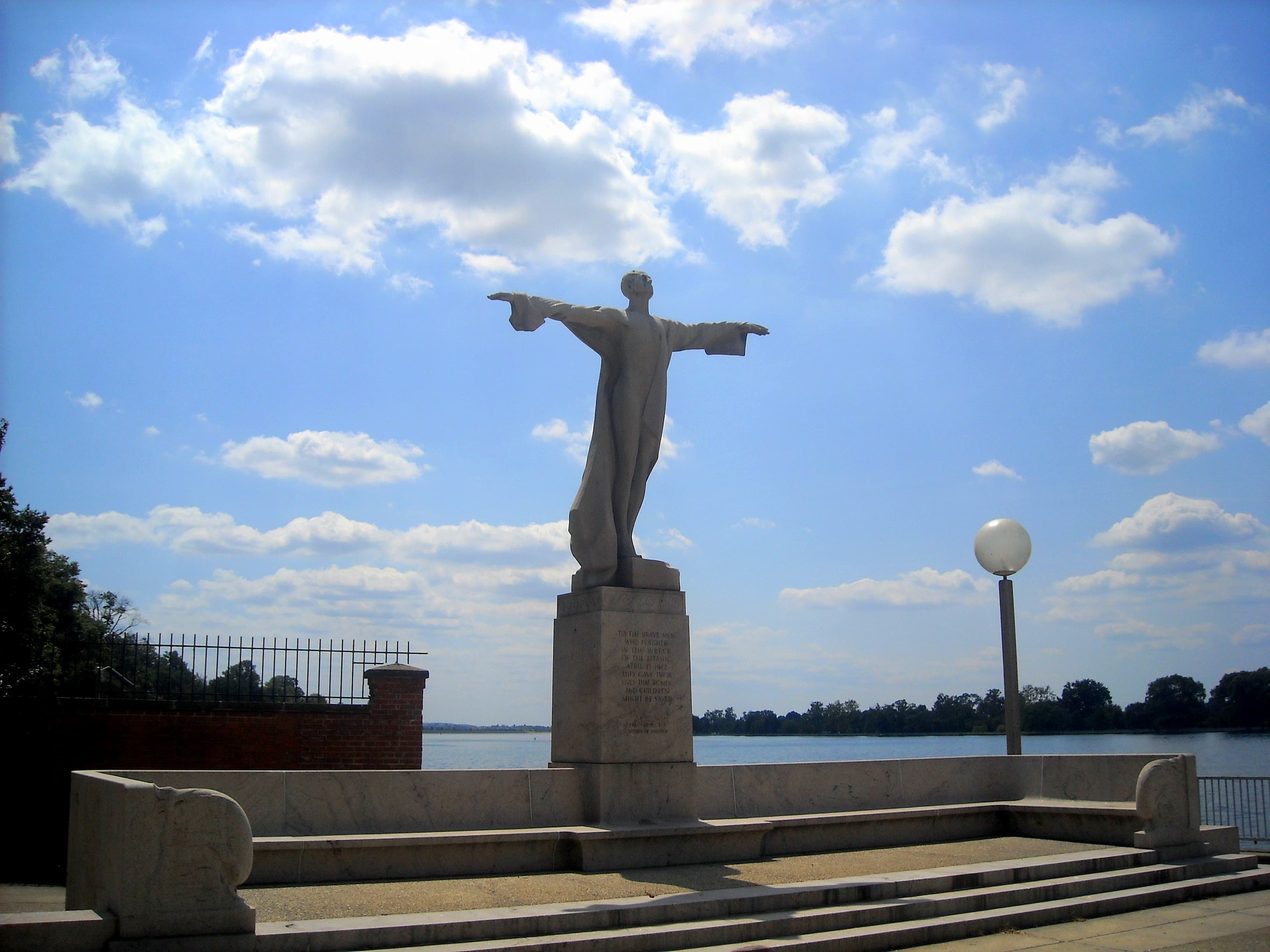
The Southwest Waterfront has been rebuilt around glass condominiums and the Wharf's restaurant piers, but walk south past the development, down the Washington Channel promenade to where P Street gives out, and the city suddenly goes quiet. There, on a raised platform at the water's edge in Southwest Waterfront Park, stands a partly draped male figure in pink granite, arms stretched wide in the shape of a cross, eyes closed, face lifted to the sky. Three granite steps lead up to a long exedra — a curved stone bench-wall designed by Henry Bacon — whose ends are carved with dolphins diving over stylized waves. In Roman tradition, dolphins were psychopomps, escorts of souls to the afterlife; in Christian art they stood for salvation. Both meanings are doing work here.
The inscription on the front of the pedestal explains the figure: "TO THE BRAVE MEN WHO PERISHED IN THE WRECK OF THE TITANIC, APRIL 15 1912. THEY GAVE THEIR LIVES THAT WOMEN AND CHILDREN MIGHT BE SAVED. ERECTED BY THE WOMEN OF AMERICA." The back carries a second, more democratic roll of honor — "TO THE YOUNG AND THE OLD, THE RICH AND THE POOR, THE IGNORANT AND THE LEARNED, ALL WHO GAVE THEIR LIVES NOBLY TO SAVE WOMEN AND CHILDREN." This is the Women's Titanic Memorial, one of only a handful of prominent outdoor sculptures in Washington designed by a woman, and one of the most moving pieces of public art in the city precisely because almost nobody finds it by accident.
Ten Days After: A Dollar at a Time
The RMS Titanic sank on April 15, 1912, after striking an iceberg; of the 2,223 people aboard, only 706 survived, and around seventy percent of the dead were men who had been told the lifeboats were for women and children first. Ten days later, on April 25, 1912, a group of prominent Washington women formed the Committee of One Hundred — soon the Women's Titanic Memorial Association — to honor that sacrifice in stone. Their fundraising rule was the point of the whole enterprise: no one could give more than one dollar, so that the memorial would belong to as many women as possible rather than to a few rich patrons.
First Lady Helen Herron Taft gave the first dollar. The National Park Service's account preserves the most touching one: Mary Glynn, a steerage passenger who had survived the sinking, contributed the first American dollar she had ever earned. The committee mailed some 10,000 letters to women's clubs, unions, and societies across the country; the Friends of Titanic Memorial Park count more than 25,000 contributors in all. By January 1914 the women had raised about $43,000, and the federal government covered the remainder of the cost. Congress formally authorized the memorial on a Potomac-side site on March 3, 1917 — by which time the statue itself was already finished and waiting.
Whitney, Bacon, and a Figure of Self-Sacrifice
The design competition was open only to women artists, and in 1914 it was won by Gertrude Vanderbilt Whitney — sculptor, heiress, and patron who would go on to found the Whitney Museum of American Art. The committee had pictured a great marble arch; Whitney persuaded them toward something more human. Her figure — which she described as bearing an expression of "sublime sacrifice" — was her first major commission, and it remains one of her most notable works. Carver John Horrigan cut it in Quincy, Massachusetts, from a single piece of pink granite furnished from Westerly, Rhode Island, with the Piccirilli Brothers also credited as sculptors. Henry Bacon, the architect of the Lincoln Memorial, designed the pedestal and the dolphin-crowned exedra that gives the memorial its embrace.
Whitney completed the figure in 1916, but bureaucracy moved slower than art. Site approvals, a new river wall, and agency sign-offs consumed years, and the finished statue spent more than a decade displayed in a New York gallery before it was finally installed at its first home in 1930, at the foot of New Hampshire Avenue along Rock Creek and Potomac Parkway, facing the Potomac. On May 26, 1931, Helen Taft — now a former first lady — unveiled it before President Herbert Hoover, First Lady Lou Henry Hoover, and members of the cabinet. Whitney, ill, could not attend; Secretary of State Henry L. Stimson told the crowd that the outstretched arms recalled Christ's sacrifice. That same year, Whitney opened her museum in New York — two monuments to her ambitions unveiled in a single season.
Exile for the Kennedy Center, and a Second Waterfront
The memorial's first site nearly destroyed it twice over. In 1936, Potomac floodwaters rose around the statue. Then, in 1966, it was dismantled and carted into storage at Fort Washington, Maryland, because its ground was needed for the rising John F. Kennedy Center for the Performing Arts. For two years Washington's Titanic memorial sat in a warehouse, one of the stranger exiles in the city's monumental history.
In 1968 it was re-erected — without ceremony, without a second dedication — at its present site in Washington Channel Park near 4th and P Streets SW, beside Fort Lesley J. McNair and across the Washington Channel from East Potomac Park. The National Register nomination, written when the memorial was finally listed in 2007 (it joined the D.C. Inventory of Historic Sites the same year), is candid that the new siting was less grand than the old. But the Southwest site has grown on the city. The water here is the working channel rather than the open river, the neighbors are houseboats and rowers rather than memorials row, and the figure's solitude feels earned — a monument to men who died far from any shore, keeping its vigil on a quiet one.
The memorial also acquired a ritual. Since 1978, a group now known as the Men's Titanic Society has gathered here in black tie in the small hours of each April 15 — the anniversary of the sinking — to lay a wreath, raise a champagne toast, and read the inscriptions aloud: "To those brave men." What began with local newsmen has become one of Washington's most faithful pieces of living folklore, performed annually at a monument most Washingtonians have never seen.
Key Facts
- Honors the men who died on RMS Titanic (April 15, 1912) so women and children could take the lifeboats; of 2,223 aboard, 706 survived (National Park Service).
- Funded by the Women's Titanic Memorial Association (organized April 25, 1912) with donations capped at $1 per woman; First Lady Helen Taft gave the first dollar, and more than 25,000 women contributed; about $43,000 raised by January 1914, with the federal government covering the rest.
- Designed by Gertrude Vanderbilt Whitney, winner of a 1914 competition open only to women artists — her first major commission; carved by John Horrigan (with the Piccirilli Brothers) from a single piece of pink granite; exedra by Lincoln Memorial architect Henry Bacon.
- Completed in 1916 but not installed until 1930 at New Hampshire Avenue and Rock Creek and Potomac Parkway; dedicated May 26, 1931, unveiled by Helen Taft before President Hoover; Whitney was too ill to attend.
- Removed in 1966 for construction of the Kennedy Center, stored two years at Fort Washington, and re-erected without ceremony in 1968 at its present Washington Channel Park site near 4th and P Streets SW.
- Added to the D.C. Inventory of Historic Sites and the National Register of Historic Places in 2007; since 1978 the Men's Titanic Society has held a black-tie midnight commemoration here each April 15.
Visitor Details
Address: Washington Channel Park (Southwest Waterfront Park), near 4th and P Streets SW, Washington, DC 20024 — at the south end of the Washington Channel promenade, beside Fort Lesley J. McNair.
Transit: Waterfront station (Green line) is about three blocks northeast; from the station, walk southwest on 4th Street to P Street and continue west to the channel. The Wharf's restaurants and piers are a short walk north.
Hours/Admission: An outdoor public monument in a public park — freely accessible at any hour, with no admission charge, tickets, or reservation of any kind.
Best timing: Early morning or the golden hour before sunset, when the channel is calm and the promenade is nearly empty. On the night of April 14–15, the Men's Titanic Society holds its annual black-tie commemoration at the memorial.
Titanic Memorial — Context Photography