A Greek Temple in a Meadow
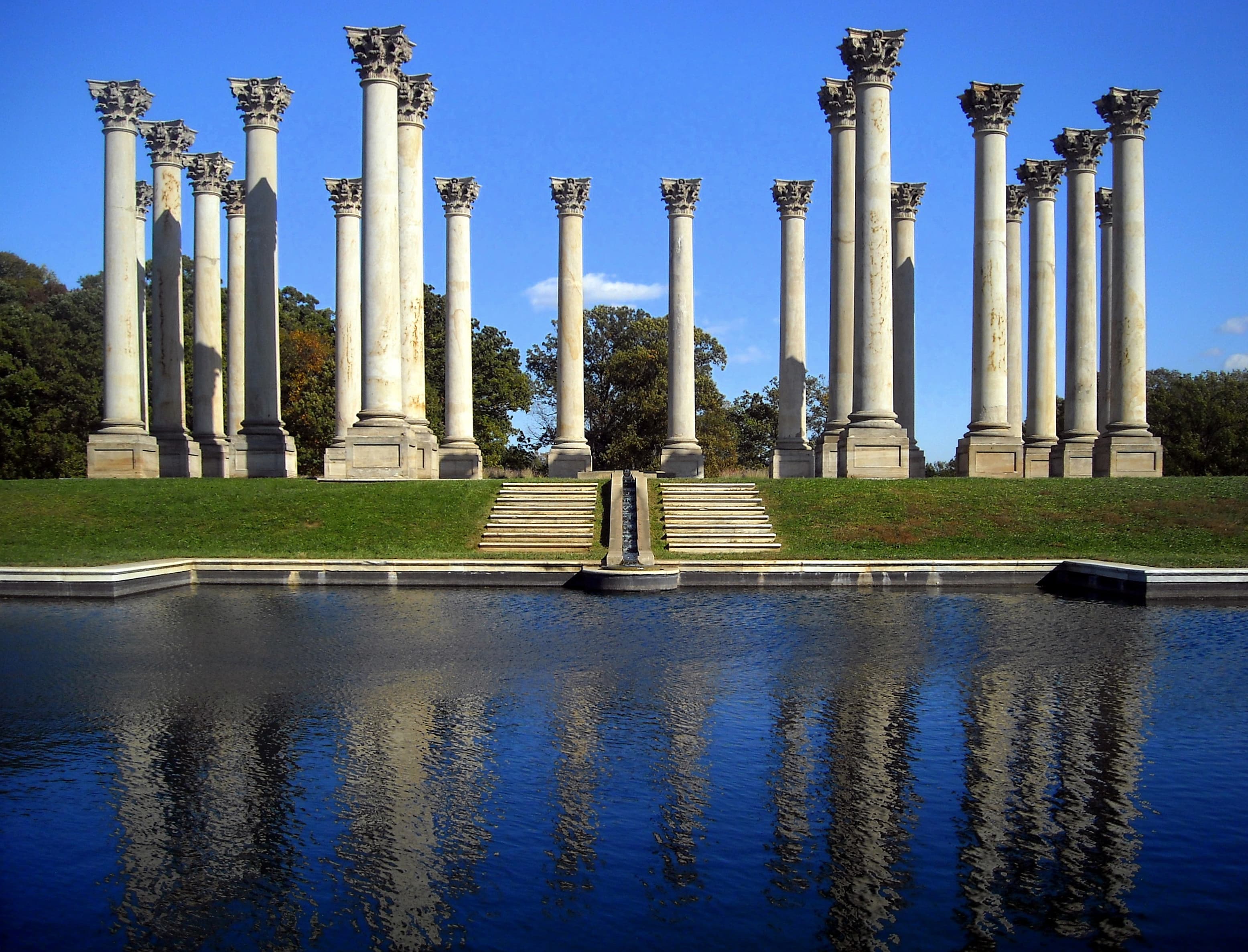
The first sight of the National Capitol Columns is genuinely strange. You cross the U.S. National Arboretum's Ellipse Meadow — more than twenty acres of open grass on a hilltop in Northeast Washington — and there, arranged in a stately rectangle on a raised stone platform, stand twenty-two Corinthian columns with their carved capitals intact, supporting no roof, no pediment, nothing at all. A long, narrow reflecting pool runs out in front of them, doubling the colonnade in still water. Visitors consistently reach for the same comparison: it looks like the ruin of a classical temple, something closer to Persepolis than to anything Americans build. The columns are not a copy and not a folly. From 1828 to 1958, they were the east portico of the United States Capitol.
The Arboretum is a 446-acre research arboretum run by the U.S. Department of Agriculture, established by Congress in 1927, and the columns are its best-known sight — an officially sanctioned monument this time, with paths, plantings, and a designed landscape, in deliberate contrast to the other debris of the same demolition, the Capitol Stones, which spent the same decades stacked anonymously in Rock Creek Park.
Quarried, Barged, and Set on the East Portico
The columns began as sandstone quarried near Aquia Creek in Virginia, the same soft, warm-toned stone used across the early Capitol. They were transported to Washington by barge, and old identification marks from the quarry are still visible on some of the stones today. In 1828 they went up as the east portico of the Capitol — the ceremonial front of the building, completed decades before the cast-iron dome that now defines it existed. For 130 years this colonnade was the backdrop of public life at the Capitol: presidents were inaugurated on the east front from Andrew Jackson's era onward, and the columns appear in the photographs and engravings of the nineteenth-century building as naturally as the dome does now.
What doomed them was proportion. When the present dome was completed in 1866 — finished, famously, during the Civil War — it was far larger than the modest dome the 1828 design had anticipated. To viewers, the big iron dome appeared inadequately supported by the portico beneath it, a visual illusion that bothered architects for nearly a century. The fix, when it finally came, was drastic: in 1958 the Capitol's east front was extended 33.5 feet outward and rebuilt in marble, and the original sandstone columns were taken down.
Storage, a Benefactor, and Russell Page
The columns' second life took thirty years to arrange. They went into storage — the same limbo that swallowed the rest of the east front's stone — and might easily have stayed there. In the 1980s, Arboretum benefactor Ethel Garrett took up the cause of giving them a permanent home. Her friend Russell Page, one of the twentieth century's great landscape designers, visited the Arboretum in September 1984, only months before his death, and judged that the east side of the Ellipse Meadow was the right stage: the columns would be in scale with the twenty-plus acres of open meadow around them.
The installation honors the columns' first life rather than disguising it. The columns stand on a foundation built from stones of the steps that originally stood on the east side of the Capitol — the portico's own steps, reunited with its columns. The reflecting pool is fed by a small rivulet of water that runs down a channel in those steps, so the platform carries sound and movement as well as reflections. The columns were moved from storage to the Arboretum beginning in 1988 and the monument was dedicated in 1990.
The Arboretum Around Them
The setting does half the work. The National Arboretum occupies 446 acres in Northeast Washington, about 2.2 miles northeast of the Capitol, and it is a working federal research station as much as a public garden — established by an act of Congress in 1927 after a campaign by USDA botanist Frederick Vernon Coville, and operated today by the Agricultural Research Service. Its nine and a half miles of roadways connect azalea hillsides, a national herb garden, conifer and dogwood collections, and the National Bonsai & Penjing Museum. Against all that cultivated greenery, the Ellipse Meadow is deliberately empty: Page's design leaves the colonnade alone on its hill, so your eye goes to the stone and the sky. The U.S. Capitol's own official history notes that the ensemble — columns, steps, and reflecting pool — reminds some visitors of the ruins of Persepolis. It is the rare Washington monument that gains its power from subtraction: a portico with the building removed.
The Details to Look For
Stand close and the columns stop being an abstraction. One column's capital — the carved crown of acanthus leaves that normally sits twenty-some feet overhead — has been placed separately in the meadow at ground level, so visitors can study the stone carver's work face to face. On portions of the stone you can see the many layers of paint applied across the decades the column stood at the Capitol, when the sandstone front was painted white. Quarry identification marks survive on some stones, exactly as the official Arboretum account describes.
There is one more comparison worth making while you stand there. The east front of the Capitol today is the 1958 marble duplicate — handsome, white, and convincing at a distance. The columns in this meadow are the thing itself: the actual sandstone portico of 1828, at full scale, close enough to touch, with its tooling, paint layers, and quarry marks exposed. It is the only place where the Capitol's original east front still exists as architecture rather than as a picture in a history book.
Then do the arithmetic of the colonnade: twenty-two columns stand in the meadow, but the portico had twenty-four. The two missing columns are not lost — they are broken. Both are cracked in half, with no base or capital, and they rest on their sides at the summit of Mount Hamilton inside the Arboretum's Azalea Collection. Finding them is the natural second act of a columns visit: the intact monument on the hill, and its casualties lying in the azaleas a short drive away within the same grounds.
Key Facts
- 22 Corinthian sandstone columns, part of the U.S. Capitol from 1828 to 1958 as its east portico; quarried near Aquia Creek, Virginia, and barged to Washington. Quarry marks remain visible on some stones.
- Removed in 1958 when the Capitol's east front was extended (33.5 ft) and rebuilt in marble, correcting the visual imbalance created when the oversized cast-iron dome was completed in 1866.
- Rescued in the 1980s by Arboretum benefactor Ethel Garrett; landscape designer Russell Page selected the Ellipse Meadow site in September 1984. Columns moved starting in 1988; dedicated in 1990.
- The columns stand on a foundation of stones from the Capitol's original east steps; a reflecting pool fed by a rivulet running down a channel in the steps mirrors the colonnade across the 20-acre (8.1 ha) Ellipse Meadow.
- One column's capital sits separately in the meadow for close inspection — acanthus-leaf carving and layers of Capitol-era paint visible.
- Only 22 of 24 columns stand here: the two damaged ones, cracked in half without base or capital, rest in the Azalea Collection on Mount Hamilton, inside the same Arboretum.
Visitor Details
Address: U.S. National Arboretum, 3501 New York Avenue NE, Washington, DC 20002 (main entrance; a second entrance is at 24th and R Streets NE). The columns are in the Ellipse Meadow, a short walk/drive inside the grounds.
Transit: The Arboretum has no Metro station at its gates; most visitors drive (free parking on site) or combine a bus/cab from Stadium-Armory or other nearby stations. Check the Arboretum's official site for current directions and entrance hours.
Hours/Admission: The Arboretum grounds are open daily from 8 am to 5 pm, closed December 25; admission is free. (Per the U.S. National Arboretum's official visitor information — confirm on usna.usda.gov before a special trip, as federal facility hours can change.)
Best timing: Weekday mornings for an empty meadow and still water in the reflecting pool. Late April–May pairs the columns with the Azalea Collection in bloom — the right moment to also hunt down the two broken columns on Mount Hamilton.
National Capitol Columns — Context Photography