A Cart Path Cut Between Two Properties
Elfreth's Alley was never planned; it was negotiated. Between 1702 and 1704, two Front Street landowners, Arthur Wells and John Gilbert, agreed to open a passage between their properties so carts could reach the Delaware River docks without winding through the young city's streets. Wells gave five feet of land on the south side, Gilbert ten feet on the north, and the resulting lane — about fifteen feet wide, running one block from North Front Street to North 2nd Street — became a working shortcut that houses gradually filled in around. Because Wells died soon after the alley was laid out, it was first called Gilbert's Alley, then Preston's Alley, for Paul Preston, who had married into Gilbert's family. Only around 1750 did it take the name it still carries, for Jeremiah Elfreth, a blacksmith who lived on Second Street just north of the alley and, through two of his marriages, had acquired land at its western end. The street he lent his name to is now a National Historic Landmark District, designated in 1960, and is generally counted the oldest continuously inhabited residential street in the United States.
A Working Street of Tradespeople
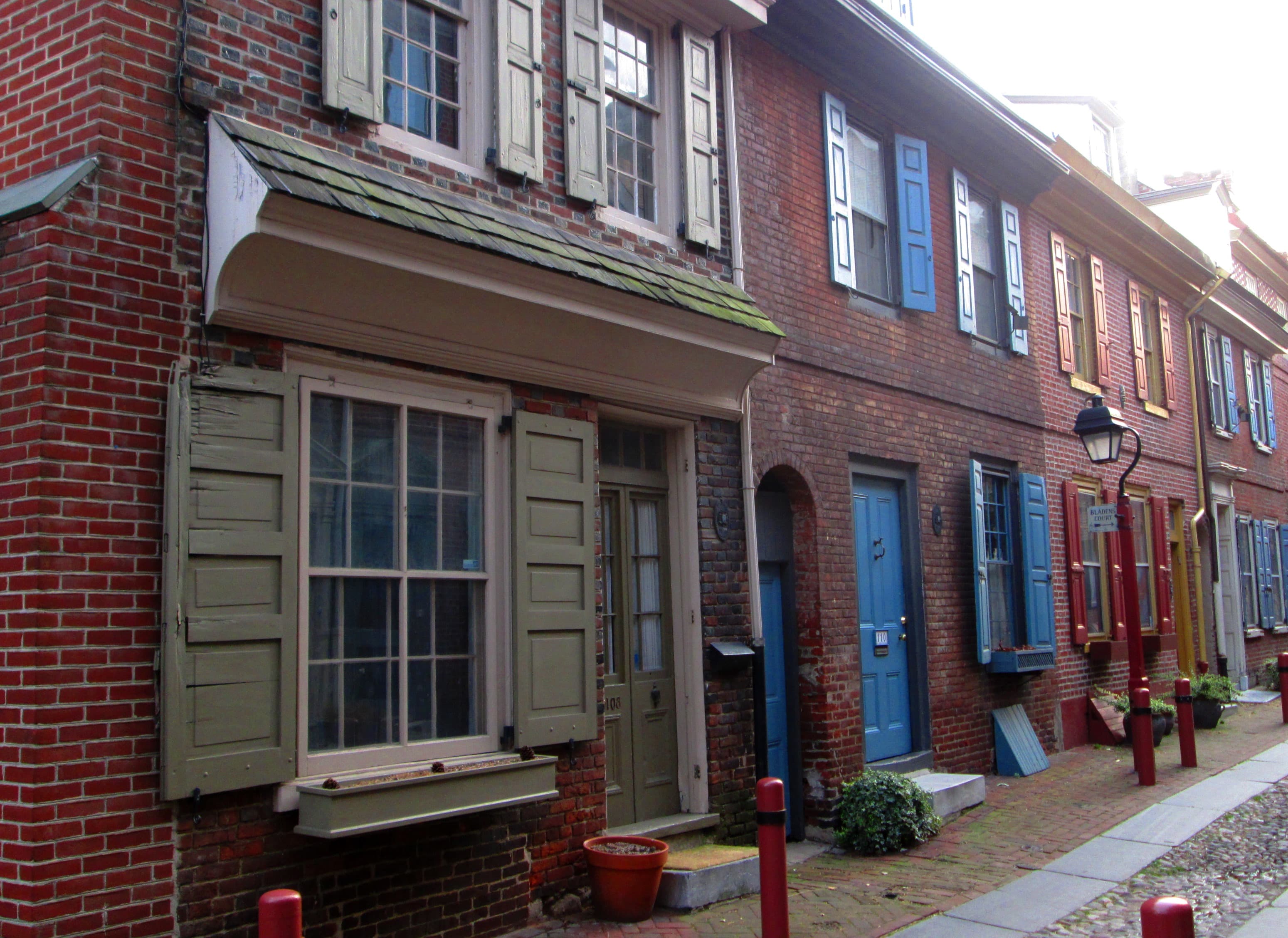
The 32 houses that line the alley today were built between the 1720s and 1836, in the Georgian and Federal styles, over a cobblestone bed. They were never mansions. The alley's residents were tradespeople and their families — shipwrights, silver and pewter smiths, glassblowers, furniture builders — and in the port economy of colonial Philadelphia, home and workshop were the same address, with business conducted on the first floor and the family living above it. Many of the houses are "trinities," a form so characteristic of this city that historians call them uniquely Philadelphian: three rooms stacked one to a floor, served by a winding stair. The households were not all headed by men, either. During the 1770s, one-third of the alley's households were headed by women. Read as a whole, the block is a rare surviving piece of 18th-century working-class housing stock — the kind of street that usually got demolished first — and preservationists like to set it against the grand, carefully kept mansion houses of Society Hill a few blocks south. Elfreth's Alley is the other Philadelphia: smaller, plainer, and occupied without interruption.
The Museum Houses at 124–126
Two adjoining houses near the middle of the block, Nos. 124 and 126, are open to the public as the Elfreth's Alley Museum. The houses preserve the 18th-century home of a pair of dressmakers, restored to its Colonial-era appearance, and the interpretation stays deliberately at street level: guides walk visitors through how the house was lived and worked in, then use it as a base for telling the stories of the other houses on the alley and the people who filled them across three centuries. It is a small museum by design — the rooms are the artifact — and it makes the essential point of the whole street better than any panel text could. These homes were considered ordinary, even modest, in their day; what is extraordinary is simply that they are all still here, and that most of them are still private homes. Of the 32 houses, only the museum pair opens its doors regularly, which is why the alley's two annual open-house traditions, described below, draw the crowds they do.
Industry Moves In, and the Street Nearly Disappears
The 19th century changed the alley without quite erasing it. In 1868 a stove factory took a place in a row of residential houses — an early sign of the industrial waterfront closing in — and factories eventually surrounded the block. The tradespeople who had worked at home gave way to factory workers who worked elsewhere and crowded in: successive waves of immigrants moved onto the street, and by 1900 the neighborhood was overwhelmingly Irish. The little houses, built for one family and a workshop, were subdivided and packed. By the early 20th century the alley was aging, unfashionable, and surrounded by industry — exactly the kind of block mid-century Philadelphia was demolishing without a second thought. It survived the era of urban renewal not by accident but because its residents organized, twice over: first to restore it, and then, in the late 1950s, to defend it against demolition for the construction of Interstate 95, which was cutting a trench along the waterfront a few blocks east.
The Association That Saved It
The Elfreth's Alley Association was founded in 1934 to preserve the alley's historic structures and interpret its history, and it has been the street's advocate ever since. Beyond the I-95 fight, the Association lobbied the city to restore the street's very name: for years, as part of a street-name simplification program, the alley had been officially designated the 100 block of Cherry Street. The campaign worked, the name came back, and the landmark designations followed. The Association still runs the museum at 124–126 and the alley's calendar of events, and it remains a working residents' organization as much as a preservation society — because the thing being preserved is not a monument but a neighborhood. That dual role shapes everything about visiting: the flower boxes, shutters, and flags are not set dressing, the doors that stay closed are closed because people live behind them, and the street asks to be walked the way you would walk any residential block — attentively, and a little quietly.
Still a Street, First of All
Today the alley is one of Philadelphia's most visited small places, and its two signature events bookend the year. For more than seventy years, Fête Day in early June has celebrated the alley's diverse ethnic heritage, with residents opening their private homes to the public alongside historical reenactments and festivities. Each December, Deck the Alley offers a self-guided tour of thirteen private homes dressed for the holidays, with caroling. Between those weekends, the rhythm is residential: mail delivered over 300-year-old cobblestones, neighbors coming and going through doors that opened before the United States existed. That continuity is the real exhibit. Other American streets are older as pavement; what Elfreth's Alley claims — and what three centuries of residents, dressmakers, immigrants, and preservationists have jointly maintained — is older as a home address.
Key Facts
• Opened 1702–1704 by Front Street landowners Arthur Wells and John Gilbert (5 ft and 10 ft of land respectively); called Gilbert's Alley, then Preston's Alley, before taking Jeremiah Elfreth's name around 1750.
• 32 houses built between the 1720s and 1836 in Georgian and Federal styles; many are Philadelphia "trinity" houses — three rooms, one to a floor.
• An 18th-century street of tradespeople — shipwrights, smiths, glassblowers, furniture builders; in the 1770s one-third of households were headed by women.
• Elfreth's Alley Association founded 1934; saved the street from I-95 demolition in the late 1950s and won back its name from "the 100 block of Cherry Street"; designated a National Historic Landmark District in 1960.
Visitor Details
Address: 126 Elfreth's Alley, Philadelphia, PA 19106 (the alley runs between N. Front and N. 2nd Streets in Old City, parallel to Arch and Quarry Streets)
Transit: Old City location, a short walk from Independence Hall and the rest of the historic district.
Hours/Admission: The alley itself is a public street and can be walked at any time. The Elfreth's Alley Museum (Nos. 124–126) is seasonal, open April to mid-November on Fridays, Saturdays, and Sundays, 12 pm to 4 pm (per the museum's official site): admission $3 per person, $2 for children 7–12, free for children under 7; a $3 audio tour of the alley is available on demand. Confirm current hours on the museum website before visiting, especially outside the season.
Best timing: Go on a museum day (Friday–Sunday in season) to see inside Nos. 124–126; for the rare chance to enter the private houses, plan around Fête Day in early June or Deck the Alley in early December. The other 30 houses are private residences — photograph from the street and keep doorways and windows respected.
Location Photography