Thirty years of granite

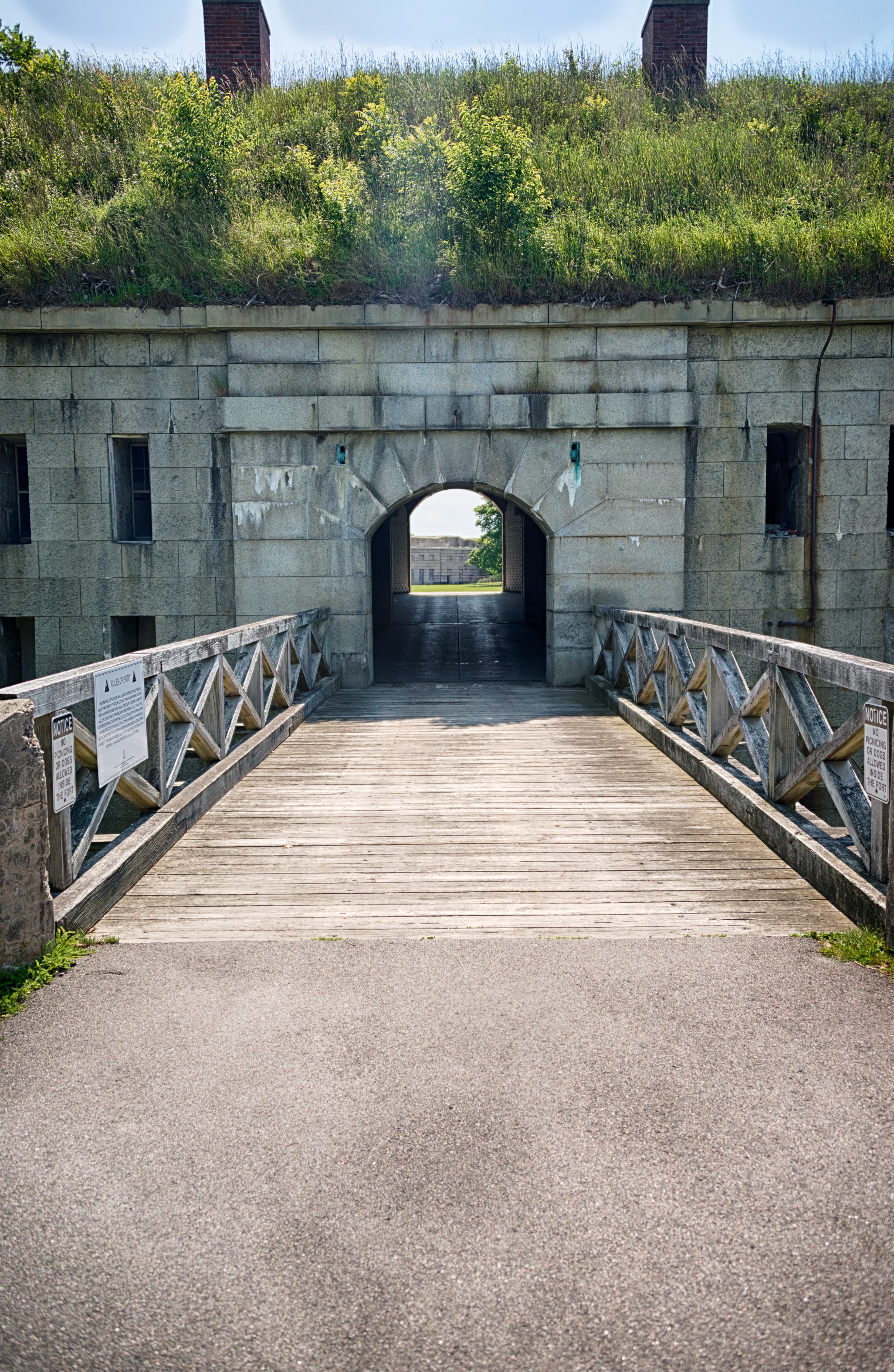
The Army started building Fort Warren in 1833 and did not finish until 1861, weeks after the Civil War began. The engineer in charge for most of those three decades was Colonel Sylvanus Thayer, the longtime superintendent of West Point, working to the Pentagon-shaped template of America's Third System of coastal forts. The walls are hand-cut granite, much of it quarried at Quincy and Cape Ann, laid up in bastions lettered A through E around a vast parade ground. A half-moon demilune battery guards the north sally port — a rare feature in American forts. The fort was named for Dr. Joseph Warren, the Revolutionary leader killed at Bunker Hill. There is a particular irony to the place: by the time the last courses were laid, rifled artillery had already made masonry forts like this one obsolete. Fort Warren never fired a shot at an enemy warship. Its guns — 15-inch and 10-inch Rodman smoothbores during the war, later Endicott-era disappearing rifles in concrete batteries — were aimed at threats that never came. The fort's real career turned out to be something its designers never drew on a plan.
A prison with a reputation for mercy
In late 1861 the War Department needed somewhere escape-proof to hold high-value Confederate captives, and an island seven miles offshore answered the description. Fort Warren became a prison for captured Confederate officers and sailors, Maryland elected officials deemed disloyal, and Northern political prisoners. The commandant from 1861 to 1864, Colonel Justin Dimick, ran the camp with a conspicuous decency that the prisoners themselves acknowledged: when his son, Lieutenant Justin E. Dimick, left for active service, Confederate officers pressed a letter into his hands asking that he be well treated if captured. (The younger Dimick was mortally wounded at Chancellorsville in May 1863.) The numbers are striking. Of more than 1,000 Confederates held at the fort, 13 died — a mortality rate lower than that of any other Civil War prison camp, Union or Confederate. The roster of inmates reads like a Confederate who's who: Vice President Alexander H. Stephens, who kept a diary during his confinement; Postmaster General John Henninger Reagan; James M. Mason and John Slidell, the diplomats seized in the Trent affair; and generals Richard S. Ewell, Isaac R. Trimble, John Gregg, Adam "Stovepipe" Johnson, Simon Bolivar Buckner Sr., and Lloyd Tilghman. On August 19, 1863, six prisoners tried to escape; two were caught on the island, two were caught sailing for Canada, and two were believed drowned.
The song that left the island
Fort Warren gave American music one of its most enduring melodies. The Second Battalion of Infantry arrived on Georges Island on April 29, 1861, as the fort's first garrison, and to pass the time the men sang — including a marching song about the abolitionist John Brown set to an old Methodist camp-meeting tune. "The John Brown Song" was written during their time at the fort, according to the National Park Service, and it was performed at a flag-raising there on May 12, 1861. Men of the Webster Regiment, the 12th Massachusetts Infantry, carried it south to the Army of the Potomac, where Julia Ward Howe heard it and, at a minister's suggestion, wrote new words. The result was "The Battle Hymn of the Republic." A tune hummed by bored soldiers on a harbor island became the anthem of the Union cause.
The Lady in Black
Every old fort needs a ghost, and Fort Warren has Boston's most famous one. The legend, popularized by the local historian Edward Rowe Snow in his 1946 book The Romance of Boston Bay, tells of Mrs. Andrew Lanier — called Melanie in some versions — the wife of a Confederate prisoner. She cut her hair, dressed as a Union soldier, and rowed from Hull to Georges Island with a pistol and a pickaxe to break her husband out. Discovered near the boat, she drew the pistol; in the struggle it went off and killed her husband. Condemned to hang, her last request was to die in women's clothing, and the garrison could only find black robes to dress her in. It is a legend, not a documented event — no contemporary record confirms it, and the details shift with the telling. But soldiers stationed at the fort reported the apparition for generations: a woman in black on the ramparts, footprints in snow that begin and end nowhere, the smell of old perfume in the tunnels. Snow, who campaigned to preserve the fort, has his own memorial on the island.
A fort that kept serving
The Army kept finding uses for the place. In the 1890s the fort was rebuilt for modern breech-loading rifles under the Endicott program — five concrete batteries named Adams, Bartlett, Lowell, Plunkett, and Stevenson. It served as headquarters of the Coast Defenses of Boston in World War I and as the control center for the harbor's south mine field in World War II, garrisoned by the 241st Coast Artillery of the Massachusetts National Guard. The guns were scrapped in 1942–44 as newer 16-inch batteries took over, and the fort was decommissioned in 1947. Massachusetts took ownership in 1958 through the Metropolitan District Commission, restored it, and reopened it to the public in 1961. It was designated a National Historic Landmark in 1970 and became the centerpiece of the Boston Harbor Islands National Recreation Area when that park was established in 1996. One difficult piece of its history was addressed in 2017, when the state's only Confederate memorial — a headstone for the 13 prisoners who died here, installed by the United Daughters of the Confederacy in 1963 — was removed and placed in the Massachusetts State Archives. Today the fort is administered by the Massachusetts Department of Conservation and Recreation, its casemates, parade ground, and 15-inch Rodman cannon open to anyone willing to take the boat. Start at the small museum in the old mine storehouse by the dock, then walk through the sally port into the fort's cool, echoing interior.
Key Facts
- Pentagonal Third System granite fort built 1833–1861 under engineer Sylvanus Thayer; named for Revolutionary hero Dr. Joseph Warren.
- Civil War prison for Confederate officers and officials, including Vice President Alexander H. Stephens; just 13 deaths among 1,000+ prisoners.
- "John Brown's Body" was written and first performed here in 1861 before becoming "The Battle Hymn of the Republic."
- Decommissioned 1947; National Historic Landmark (1970); centerpiece of Boston Harbor Islands National Recreation Area (1996).
Location Photography