A Medieval Cloister at the End of West Dixie Highway
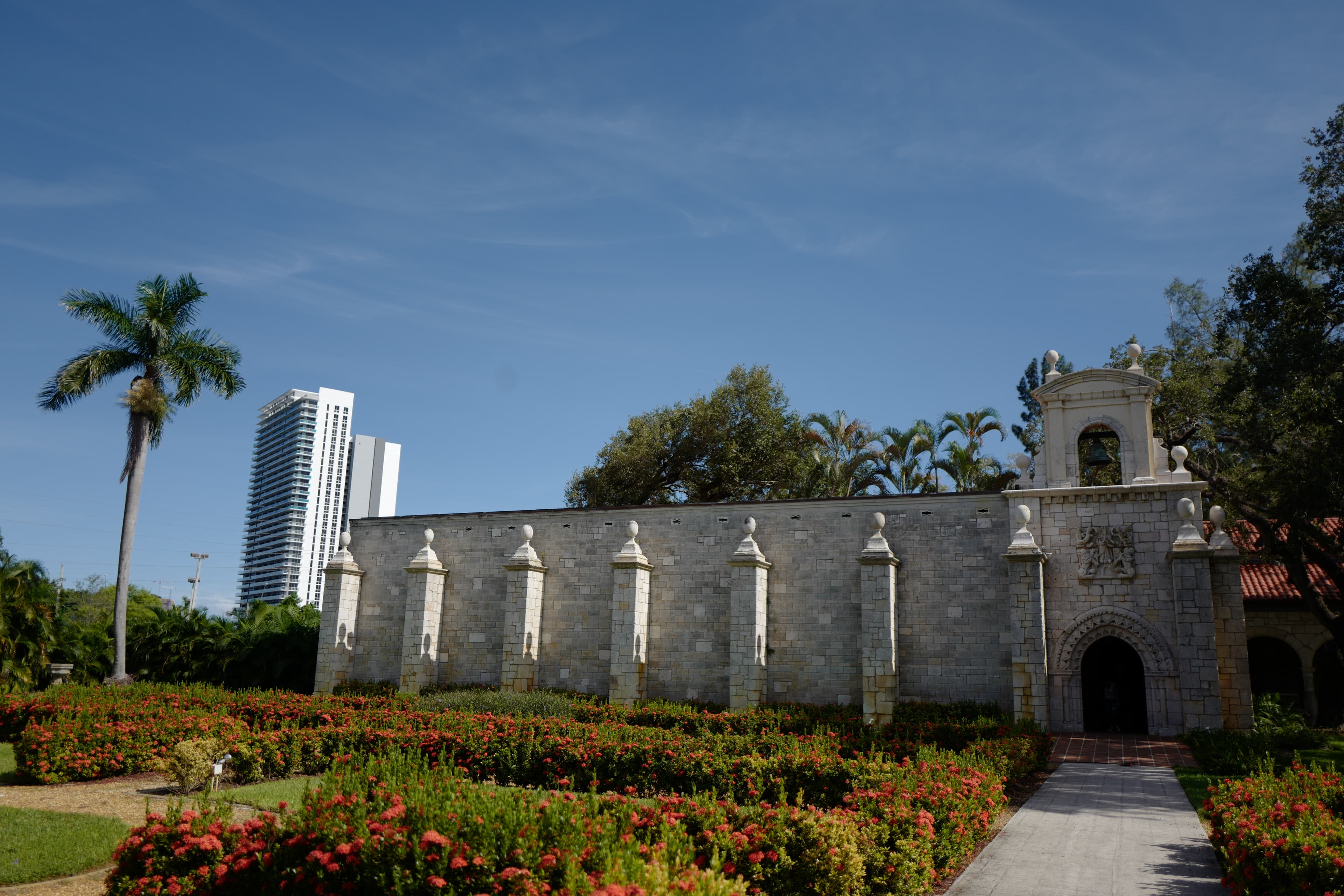
Drive north on West Dixie Highway in North Miami Beach, past the strip malls and body shops, and a stone wall appears on your left at number 16711. Behind it, in gardens of palms and live oaks, stands a Romanesque cloister — rounded arches, carved capitals, a courtyard open to the sky — that was already old when Columbus sailed. The Ancient Spanish Monastery, formally the Church of St. Bernard de Clairvaux, is routinely described as one of the oldest buildings in the Western Hemisphere, and the claim rests on a simple fact: the stones themselves are medieval. They were cut, laid, and prayed over in the province of Segovia, Spain, beginning in 1133. What stands in Florida is the cloister, the chapter house, and the refectory of that monastery — not a reproduction, but the original fabric, dismantled in the 1920s, shipped to the United States, and reassembled here in the 1950s. The abbey church itself never left Spain; it still stands in Sacramenia. What crossed the ocean was the monks' working heart of the complex, and its journey is stranger than any fiction a docent would dare invent.
Seven Centuries in Sacramenia
The monastery was founded by Alfonso VII of Castile and León and built between 1133 and 1141 in the Cistercian Romanesque style, on a high plateau near the Sierra de Guadarrama, about two miles from the village of Sacramenia. It was first named for Our Lady, Queen of the Angels — Santa María la Real — and later renamed to honor Bernard of Clairvaux after his canonization. The Cistercians were an austere order, and the architecture shows it: thick walls built with defensive strength, plain rounded arches, and a cloister walk arranged for a life of prayer, labor, and silence. French Cistercian monks settled the house, and royal privileges from Alfonso VII and his grandson Alfonso VIII protected its flocks, roads, and revenues. The community endured for almost 700 years — through fires, including one in 1641 that destroyed parts of the complex and forced rebuilding — until the end came not from war but from paperwork. In the 1830s, under Isabella II, Spain's Ecclesiastical Confiscations of Mendizábal seized church property across the country. The monastery was closed around 1836–1840, sold off, and put to work as a granary and a stable. It sat in agricultural limbo for nearly a century, weathering in the Castilian sun, until an American newspaper king came shopping.
Hearst Buys a Monastery
In 1925, William Randolph Hearst — then at the height of his collecting mania, furnishing his castle at San Simeon, California with the spoils of Europe — bought the cloister and its outbuildings, in defiance of Spanish government restrictions on exporting its patrimony. His crews dismantled the structures piece by piece. Every stone was numbered, and the pieces were packed in wooden crates lined with hay: 11,000 crates in all, a medieval building converted into the world's most ambitious flat-pack. The plan was to re-erect it in California. It never got there. As the crates passed through the United States, word arrived of an outbreak of hoof-and-mouth disease in Segovia, and the shipment was quarantined. Officials opened the crates and burned the hay packing to stop the disease from spreading — a sensible precaution with catastrophic consequences for the paperwork. When the crates were repacked, their contents went back in the wrong order, and much of the numbering system that told builders which stone went where was lost. Hearst, sliding into the financial difficulties that would consume his empire, could not proceed with the rebuilding. The monastery, scrambled and silent, went into a warehouse in Brooklyn. It stayed there for 26 years.
The Biggest Jigsaw Puzzle in History
Hearst died in 1951. In 1952, two businessmen, Raymond Moss and William Edgemon, bought the crates and brought them to Florida, where they set about reassembling the monastery on the site of a small plant nursery north of Miami — a tourist attraction in the making. Reassembly took 19 months and cost almost 1.5 million dollars, and Time magazine dubbed the project "the biggest jigsaw puzzle in history." Given the destroyed numbering, the description was not much of an exaggeration: masons worked from the logic of the architecture itself, reading the stones to work out where each belonged. Not everything in the finished building is from Sacramenia. Moss and Edgemon added decorative pieces from other Spanish buildings, most visibly the large round carved-stone coat of arms in the cloister, which came from the monastery of San Francisco de Cuéllar and belonged to the House of Alburquerque. And when the work was done, some of the original stones were simply left over — medieval pieces that fit nowhere in the reconstruction, a quiet admission that the puzzle was solved by judgment as much as by plan. In 1972 the reassembled monastery was added to the National Register of Historic Places.
From Tourist Attraction to Working Parish
The monastery's third life began in 1964, when Bishop Henry I. Louttit purchased the property for the Episcopal Diocese of South Florida. When financial difficulties later forced the dioceses to sell, Colonel Robert Pentland Jr. bought the cloisters and gave them to the Episcopal parish of St. Bernard de Clairvaux — which is why a Cistercian cloister from Castile is today an active Florida parish church, hosting services in English and Spanish, weddings in its chapel and gardens, and a steady stream of visitors who come for the stillness as much as the story. That double identity is the place's real character. It is a museum piece that never stopped being a church; the cloister walk built for monks processing in silence now frames quinceañeras and wedding photographs, and the gardens — palms against 900-year-old stone — make the transplant visible in every direction. Miami is a city that demolishes its past on a short cycle. Its oldest building survived precisely because it was never really Miami's to begin with: it was Spain's, then Hearst's, then a warehouse's, and only by accident and stubbornness did it become North Miami Beach's.
Key Facts
- Built 1133–1141 in Sacramenia, Segovia, Spain; founded by Alfonso VII; originally Santa María la Real, renamed for St. Bernard de Clairvaux; home to Cistercian monks for almost 700 years.
- Seized in the 1830s during Spain's Ecclesiastical Confiscations of Mendizábal and used as a granary and stable; the abbey church remains in Sacramenia — the cloister, chapter house, and refectory are what came to Florida.
- William Randolph Hearst bought the cloister and outbuildings in 1925 and had them dismantled into 11,000 hay-lined crates for shipment to the US, intending to rebuild at San Simeon.
- A hoof-and-mouth disease quarantine scrambled the crates and destroyed the numbering system; Hearst's finances collapsed and the stones sat in a Brooklyn warehouse for 26 years.
- Raymond Moss and William Edgemon bought the crates in 1952; reassembly in North Miami Beach took 19 months and cost almost $1.5 million; some stones were never used. Added to the National Register of Historic Places in 1972; purchased for the Episcopal Diocese of South Florida in 1964 and later given to the parish of St. Bernard de Clairvaux.
Visitor Details
Address: 16711 West Dixie Highway, North Miami Beach, FL 33160
Transit: No rail station serves the site directly; it sits on West Dixie Highway in North Miami Beach and is reached by car or Miami-Dade Transit bus routes along the Dixie Highway / Biscayne Boulevard corridor. Parking is on site.
Hours/Admission: Per the official site, the monastery is always closed on Mondays and Tuesdays, and its listed visiting hours are generally Wednesday–Saturday 10 am–4 pm and Sunday 2 pm–5 pm — but the grounds, offices, and gift shop are frequently closed for church activities and private events, so check the updated schedule on spanishmonastery.com before you go. Admission is charged; current fees are posted on the official site.
Best timing: Go on a weekday morning when the cloister is quiet and the light rakes across the courtyard. Allow about an hour. Remember it is a working parish: dress and behave as you would in a church, and expect possible closures for weddings on Saturdays.
Location Photography