The Original Hall of Fame
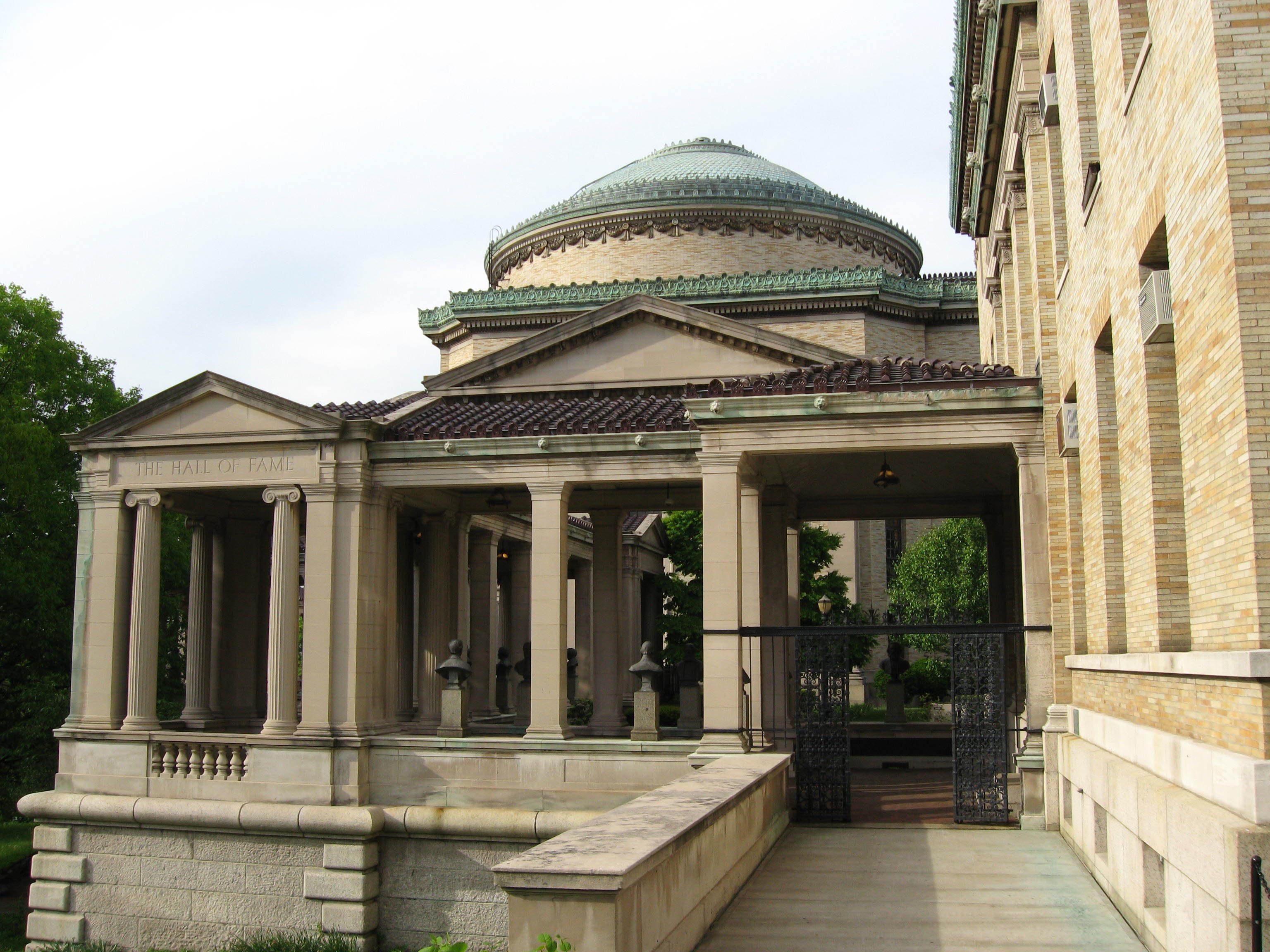
Long before Cooperstown, there was the Bronx. In 1900, New York University chancellor Henry Mitchell MacCracken — inspired by the Ruhmeshalle, Munich's hall of fame — proposed turning an eyesore into a pantheon: the long retaining wall holding up the university's new Gould Memorial Library could become an open-air gallery honoring great Americans. Philanthropist Helen Gould, who had already funded the library, put up $100,000 for the colonnade. Stanford White of McKim, Mead & White designed a 630-foot semicircular walkway in the Beaux-Arts classical style, and the Hall of Fame for Great Americans was dedicated on May 30, 1901 — the first hall of fame in the United States.
The structure itself solved an architectural problem: the colonnade conceals the tall retaining wall that holds up the library terrace, turning a structural necessity into the main event. For decades it worked exactly as intended. Up to 50,000 visitors a year climbed to University Heights; newspapers covered the election of new honorees the way they would later cover sports drafts. The hall even entered the language — in The Wizard of Oz (1939), the Munchkins sing to Dorothy that she will "be a bust in the hall of fame," and audiences of the day knew exactly which hall they meant. To be enshrined here, in bronze, was to be certified as American greatness — the country arguing with itself, every five years, about who deserved to last.
How to Get In: Dead 25 Years, Voted by 100
The rules were designed to keep the honor serious. Anyone could suggest a name, but election required a majority vote from a board of about 100 electors — writers, historians, and public figures from every state, with NYU officials barred from serving — followed by approval from the university senate. The nominee had to be a native-born or naturalized American citizen who had made a major contribution to the nation's economic, political, or cultural life, and had to have been dead for at least ten years — later raised to twenty-five, so only reputations with staying power qualified.
The first election, in 1900, chose 29 names, including George Washington, Abraham Lincoln, and Benjamin Franklin. At first only the native-born were eligible; in 1915 the rules opened to naturalized citizens. Honorees were grouped into fifteen categories — authors at one end of the colonnade, inventors at the other — and each received a bronze bust on a pedestal, with a plaque giving the name, dates, and a quotation. The first busts went up in 1907, and most were sculpted between 1922 and 1930.
The Bronze Roll Call
Walk the colonnade today and the names come at you in waves: Edgar Allan Poe, Ralph Waldo Emerson, Nathaniel Hawthorne, Harriet Beecher Stowe, Mark Twain among the authors; Alexander Graham Bell, Thomas Edison, Samuel Morse, and Eli Whitney among the inventors; Susan B. Anthony, Booker T. Washington, John James Audubon. The busts were executed by distinguished American sculptors, including Daniel Chester French of Lincoln Memorial fame and Frederick MacMonnies, who carved the reliefs on the Washington Square Arch. The great wave of sculpting came between 1922 and 1930, when most of the elected honorees finally got their bronze; from 1930 to 1970, new busts were typically installed soon after each election. Each plaque pairs the name and dates with a quotation chosen to distill the honoree's claim on posterity — Bell's on invention as the product of many minds, Whitney's on the cotton gin.
Some entries mark turning points. Booker T. Washington, elected in 1945, was the first Black American honored. The most recent bust installed honors Franklin D. Roosevelt. And four elected honorees never got their bronze at all — Louis Brandeis, Clara Barton, Luther Burbank, and Andrew Carnegie were left as plaques only, because the money to sculpt them never materialized.
Decline and the Empty Niches
The Hall's long fade began when NYU, financially strained, sold its Bronx campus to the City University of New York in 1973; the grounds became Bronx Community College. Funding for new busts evaporated, the bronze began to corrode, and the elections stopped — the last were held in 1976. Sports halls of fame had captured the public imagination, and the original was left to the pigeons and the architecture students.
Then, in August 2017, after the white-supremacist rally in Charlottesville, BCC removed the busts of Confederate generals Robert E. Lee and Stonewall Jackson, leaving two more niches empty. Of 102 elected honorees, 96 busts now stand in the colonnade. The campus itself earned a distinction in 2012, when it was designated a National Historic Landmark district — the first community college campus in the country so honored. Restoration efforts in the 1980s and 1990s, funded by New York State, repaired the roof and conserved the bronze; the work was finished in 1997 and won a preservation award, a brief moment when the city remembered what it had.
The Colonnade Itself
Even with the roll call thinned, White's architecture carries the visit. The loggia runs 630 feet — the original 500-foot semicircular sweep plus a 130-foot annex added later — its walkway 10 feet 3 inches wide, flanked by four-foot parapets of Massachusetts granite and columns of Indiana limestone. Below the western edge, Sedgwick Avenue runs 40 to 60 feet beneath the terrace, so the colonnade reads as a hilltop temple from the street. The ceiling is Guastavino tile; the sloped roof above is red Spanish tile. The bronze entrance gates, designed by Samuel Yellin, carry inscriptions: "Enter with Joy that those within have lived" over the north gate, "Take counsel here of Beauty, Wisdom, Power" over the south. Eight pedestals bear the hall's verse — "By wealth of thought, or else by mighty deed, they served mankind in noble character" — and at the center of the curve stands the Gould Memorial Library, its dome inscribed "LIBRARY OF NEW YORK UNIVERSITY MDCCCIC." It is a Beaux-Arts composition of genuine grandeur, sitting quietly on a community college campus, waiting for the crowds that stopped coming half a century ago.
Key Facts
- Dedicated May 30, 1901, on NYU's University Heights campus (now Bronx Community College); designed by Stanford White; funded by Helen Gould's $100,000 gift; the first hall of fame in the United States.
- A 630-foot Beaux-Arts colonnade curving around the Gould Memorial Library, with Guastavino-tiled ceiling, Indiana limestone columns, and bronze gates by Samuel Yellin.
- 102 Americans elected across fifteen categories; 96 bronze busts in place — four never sculpted for lack of funds, and the Lee and Jackson busts removed in 2017.
- NYU sold the campus to CUNY in 1973; the last elections were held in 1976; the campus was designated a National Historic Landmark district in 2012.
Location Photography


Visitor Details
Address: Bronx Community College, 2155 University Ave (enter at W 181st St & University Ave), Bronx, NY 10453
Transit: 4 train to 183rd St, then walk west uphill on 183rd St to Hall of Fame Terrace (about 10–15 minutes).
Hours/Admission: Free; no tickets required. Public hours are generally reported as weekdays 9am–5pm (some sources say daily 10am–5pm), but campus gate access can vary — check bcc.cuny.edu before visiting.
Best timing: Weekday mornings are quietest; spring and fall give the best light along the colonnade. Allow an hour to read the plaques.