Uniting Independent Cities
When construction began in 1869, Brooklyn and New York were two completely separate municipal cities. Conceived by German immigrant engineer John A. Roebling, the bridge took 14 grueling years to finish. After John died of tetanus following a site accident, his son Washington Roebling took over as chief engineer, and Washington’s wife Emily Warren Roebling directed daily operations on-site when Washington became incapacitated by caisson decompression sickness.
Gothic Towers and Pneumatic Caissons
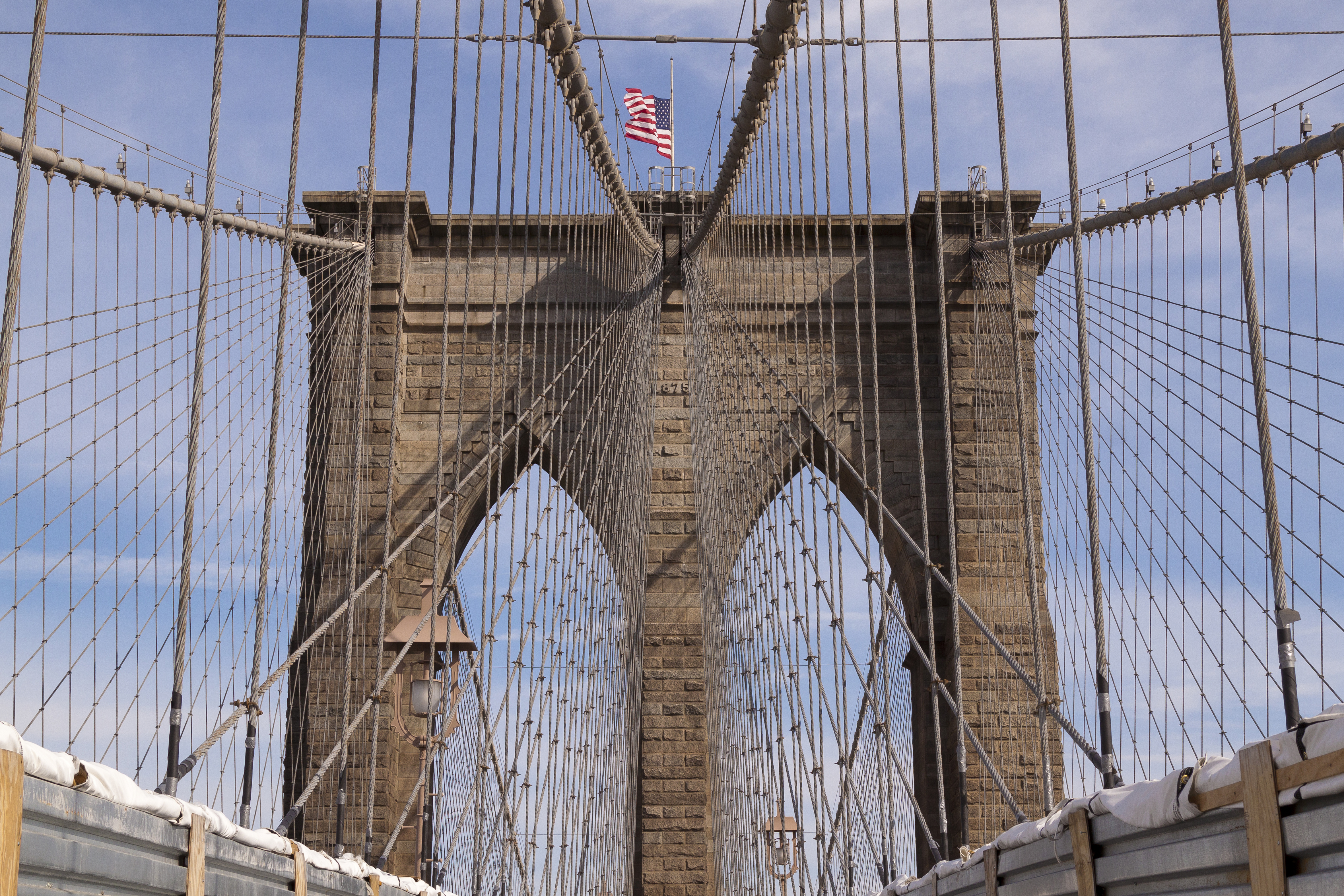
The bridge’s dual Gothic arch towers were constructed from Maine granite and Rosendale cement. Workers excavated the riverbed inside massive wooden caissons pressurized with compressed air to keep water out, descending dozens of feet beneath the waterline.
A German rope-maker's dream
The bridge began in the mind of a man who never saw a stone laid. John Augustus Roebling was born in 1806 in Mühlhausen, Prussia, trained as an engineer, and emigrated to Pennsylvania in 1831, where he started America's first wire-rope factory. Wire rope made him: he spanned Niagara Falls with a suspension bridge in 1855, then the Ohio River at Cincinnati in 1867 — at 1,057 feet, the longest suspension span in the world. He spent a decade lobbying for a bridge across the East River, the first fixed crossing between the independent cities of New York and Brooklyn — what he called the greatest bridge ever built — and won approval in 1867. He died before construction began. On June 28, 1869, surveying the tower site at the Fulton Ferry slip, Roebling's foot was crushed between the dock and an arriving ferry. Surgeons amputated his toes; he refused further treatment, dosing the wound with his beloved "water therapy," and tetanus set in. He died on July 22, 1869, at his son's house in Brooklyn Heights. The chief engineer's job fell to his son Washington, a Rensselaer graduate and Union Army engineering officer — and, crucially, to Washington's wife Emily, who had spent the couple's 1867 European tour studying caisson engineering with him and would spend the next decade studying higher mathematics and the catenary curves of suspension cables. The bridge was formally the New York and Brooklyn Bridge, and its twin towers rose 276 feet above the East River.
Working in the caissons
Construction began on January 2, 1870, with the foundations — and the foundations nearly killed everyone. To reach bedrock, the Roeblings used pneumatic caissons: giant airtight wooden chambers, open at the bottom, sunk through the riverbed while compressed air kept the water out. Workers — "sandhogs," many of them immigrants earning about $2 a day — entered through iron airlocks and dug with picks and dynamite, descending 44 feet on the Brooklyn side and 78 feet on the Manhattan side. What nobody understood was what the pressurized air did to the human body. Men who rose to the surface too quickly suffered nitrogen bubbling out of their blood — joint pain, paralysis, death. They called it caisson disease; we call it the bends. More than a hundred workers were stricken; roughly two dozen died, alongside others killed by falls and falling debris. Inside the caissons, temperatures reached around 80 degrees; one engineer described the conditions as Dante's Inferno brought to life. The design was a hybrid — part suspension bridge, part cable-stayed. Washington spent more time in the caissons than almost anyone. In 1872, after a long day below, he rose too fast and collapsed; he spent the rest of the project — eleven more years — largely bedridden in Brooklyn Heights, his hearing and sight damaged, watching the towers rise through a telescope and relaying orders through Emily. She ran the site: hiring, purchasing, engineering decisions, in daily communication with her husband. When the bridge company's trustees tried to replace Washington in 1882, Emily lobbied them herself — and won, by a vote of 10 to 7. Then there was the wire. The four main cables were spun in place starting in 1876, each from thousands of steel wires supplied by contractor J. Lloyd Haigh. In 1877 the wire was found to be defective — Haigh had been substituting inferior stock. Tearing the cables down was unthinkable, so Washington did the engineer's math: he kept the completed work and ordered extra wires added to each cable. The bridge ended up stronger than designed — a fortunate fraud.
Opening day
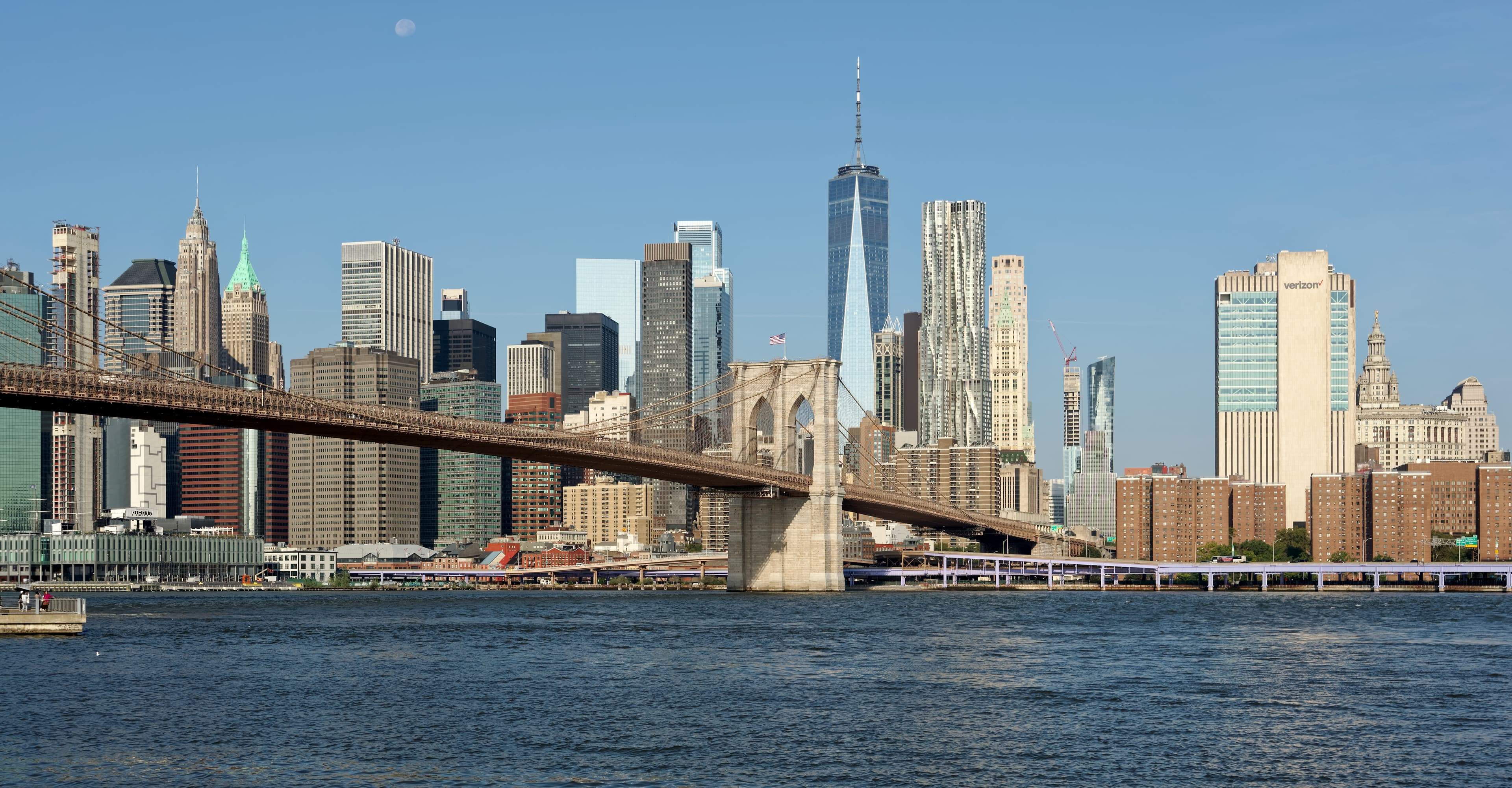
Fourteen years after it began, the bridge opened on May 24, 1883, and New York threw itself a party. Emily Roebling was given the honor of the first crossing: she rode across in an open carriage with a live rooster in her lap, a symbol of victory, while the bridge workers stopped to cheer and tip their hats. Behind her came the official procession — President Chester A. Arthur and New York's Mayor Franklin Edson riding from the Manhattan side, met at the Brooklyn tower by Mayor Seth Low — twenty-four carriages of dignitaries, military escorts, and bands. More than 150,000 people crossed on foot that day; shops closed, bells rang, and that night fireworks burst over the towers. The project had cost $15.5 million and fourteen years. At 1,595.5 feet, the main span was the longest suspension span on earth, and the twin Gothic towers were the tallest structures in the Western Hemisphere. The celebration nearly ended in tragedy a week later. On May 30, a woman tripped on the stairs to the promenade; another screamed; the crowd surged and panicked, convinced the bridge was collapsing. Twelve people were crushed to death in the stampede. The disaster shook public confidence — until P. T. Barnum, who had offered his elephants for the opening and been refused, got his second chance. On May 17, 1884, he marched 21 elephants, 7 camels, and 10 dromedaries across the bridge, the seven-ton African elephant Jumbo bringing up the rear. The Times wrote it looked "as if Noah's Ark were emptying itself over on Long Island." Nobody doubted the bridge after that.
The vaults that paid for the bridge
There is a second Brooklyn Bridge most walkers never see: the one underneath. To anchor the cables, Roebling designed massive stone anchorages on both shores, and inside the Brooklyn-side anchorage he drew eight chambers with fifty-foot cathedral ceilings — he had hoped to rent them as shops. The shops never came, but the chambers found a better tenant: wine. The vaults were dark, dry, and cool year-round — ideal conditions for even the most delicate vintage Bordeaux, Burgundy, or Champagne — and Roebling's successors rented them to liquor merchants to help pay down the bridge's $15 million cost. The vaults were built into the approaches themselves — beneath the ramps leading up to the anchorages, inside the arched granite and limestone that span the intervening streets. Rackey's Wine Company worked the Brooklyn side; Luyties & Co. the Manhattan side. In 1901 the Luyties Brothers paid $5,000 for a vault on the Manhattan side, at 204 Williams Street; A. Smith & Company paid $500 a year for one on the Brooklyn side from 1901 to 1909. One vault's wall, seen by a reporter in 1978, still bore the fading toast: "Who loveth not wine, women and song, he remaineth a fool his whole life long." The wine men decorated like they owned the place — the walls were stenciled with French street names and painted with vines and grape leaves, a buried Bordeaux. After Prohibition, Anthony Oechs & Company moved into the Manhattan vaults in 1934 and did a brisk business. The vaults' afterlife kept going: from 1983 to 2001 the arts group Creative Time staged installations in the Brooklyn anchorage's cathedral spaces — fashion shows and sound works under the fifty-foot vaults. Today the anchorages are closed to the public — but the bridge above them carries on, six lanes and a promenade, on cables spun by hand in the 1870s.
Key Facts
- Opened on May 24, 1883; Emily Warren Roebling was the first person to cross.
- It was the longest suspension bridge in the world upon completion, with a main span of 1,595.5 feet.
- The dedicated elevated pedestrian promenade offers uninterrupted views of Lower Manhattan and NY Harbor.
Hero photo: Jakub Hałun, CC BY 4.0, via Wikimedia Commons.
Location Photography


Gallery photos: Andrew Choy (CC BY-SA 2.0), Suiseiseki (CC BY-SA 3.0), NormanB (CC BY-SA 3.0), Dietmar Rabich (CC BY-SA 4.0), Currier and Ives (Public domain) via Wikimedia Commons.