El Farito at the End of the Island
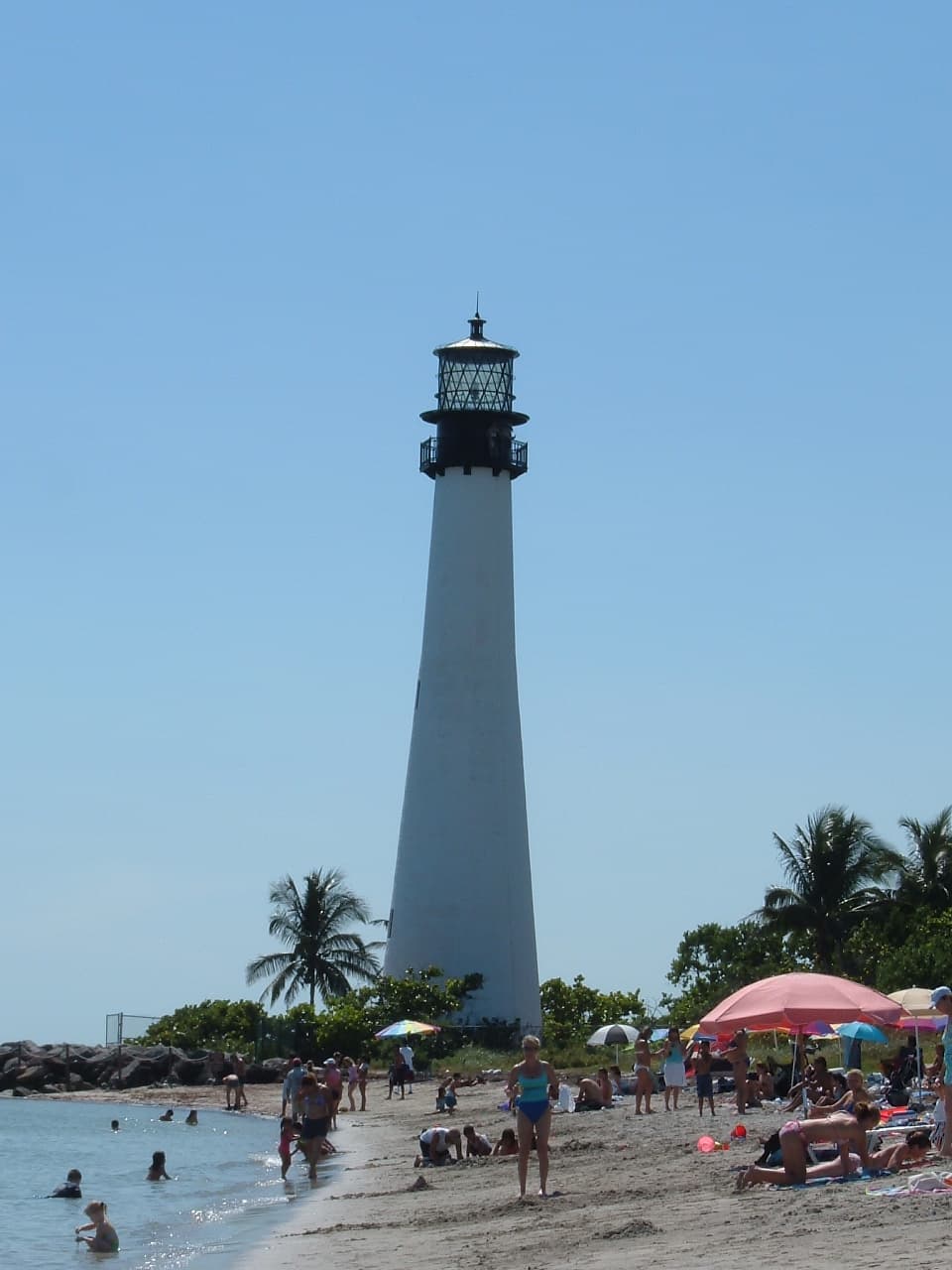
Drive the Rickenbacker Causeway to Key Biscayne, past the marinas and village, and the road ends inside Bill Baggs Cape Florida State Park. A short walk through sea grapes brings you to a whitewashed brick tower, 95 feet tall, capped with a black lantern room, yards from a wide Atlantic beach. This is the Cape Florida Lighthouse — "el farito," the little lighthouse, to Spanish-speaking Miamians. First completed in 1825, when Miami did not exist, it warned ships off the Florida Reef and guided them into the Florida Channel, the deepest natural channel into Biscayne Bay. The tower you climb today is substantially the rebuilt light of 1846, raised in 1855 — and Florida State Parks calls it the oldest standing structure in Miami-Dade County. Few lighthouses pack so much into one acre: an escape route to freedom, a famous siege, a yacht club, and a Gilded Age land fight.
A Light Built Over an Escape Route
Ponce de León named this headland the "Cape of Florida" during the first Spanish expedition to Florida in 1513. Three centuries later, the cape had a secret. When Spain ceded Florida to the United States in 1819–1821, many Black Floridians — free under Spanish rule, or escaped from slavery — feared what American rule would mean, and Cape Florida became a rendezvous where fugitive slaves and Black Seminoles waited for Bahamian sloops or paddled dugout canoes for the British Bahamas, where slavery was restricted. Historians call this movement the Saltwater Railroad. In the early 1820s an estimated 300 Black Seminoles reached Andros Island this way; one traveler in 1820 reported 60 "Indians," 60 "runaway slaves," and 27 Bahamian boats preparing to leave the cape. The lighthouse, begun in 1825, ended the cape's usefulness as a clandestine port — its beam swept the beach the escapees needed dark. The light was built to save lives and ships, and its glare closed this avenue of escape. In September 2004, Cape Florida was designated a National Underground Railroad Network to Freedom Site, and a marker at the lighthouse tells that story.
Burned Out: The Attack of July 23, 1836
The first tower was 65 feet of brick, contracted to have solid walls five feet thick at the base, though the contractor quietly built them hollow instead. Its first keeper, Captain John Dubose, served more than a decade. A hurricane in 1835 flooded the island under three feet of water; then the Second Seminole War began. In January 1836, after the massacre of the Cooley family on the New River, mainland settlers fled across the bay to the lighthouse before removing to Key West, and a Navy party under Lt. George M. Bache fortified the tower, boarding its ground-floor windows and reinforcing the door. On July 18, Dubose sailed to Key West to visit his evacuated family, leaving assistant keeper John W. B. Thompson in charge, aided by Aaron Carter, an African American man. Five days later, on July 23, 1836, Seminole attackers rushed the station. Thompson and Carter barely won the race to the door — Thompson felt rifle balls pass through his clothes and hat, and the attackers grabbed the door as he turned the key. The two men fired from the upper windows all afternoon. After dark the raiders set fire to the door and boarded window; rifle balls had pierced the lamp-oil tanks below, 225 gallons caught, and the tower became a chimney. Driven onto the two-foot-wide platform outside the lantern, clothes burning and both wounded, Thompson hurled a keg of gunpowder down the shaft hoping for a quick death; it exploded, briefly damped the fire, and did not kill him. Carter died beside him. The Navy schooner Motto, which had heard the explosion twelve miles away, found Thompson alive the next day — three rifle balls in each foot, the stairway burned away — and sailors hauled a line up to lower him. The light stayed dark from 1836 to 1846.
Rebuilt, Raised, Retired, and Sold for $400
Congress funded a rebuild in 1846: the contractor, working for $7,995, reused brick from the ruined tower alongside new brick shipped from Massachusetts, and the light was re-lit in April 1847 with 17 Argand lamps, under keeper Reason Duke — whose daughter had married the first keeper's son. In 1855 the tower was raised to its present 95 feet and fitted with a second-order Fresnel lens, installed under Lt. Col. George Meade, later the Union commander at Gettysburg; the heightened light was re-lit in March 1856. Confederate sympathizers smashed the lamp and lens in 1861; the light was repaired in 1866. But even raised and brightened, the tower could not adequately mark the offshore reef, and in 1878 the new screw-pile lighthouse at Fowey Rocks, seven miles southeast, replaced it. The dark tower's afterlife was pure Florida. From 1888 to 1893 the Treasury leased it to the Biscayne Bay Yacht Club for a total of one dollar — the southernmost yacht club in the United States, boosters claimed, and the tallest in the world. In 1898 it served briefly as US Signal Station Number Four, watching for the Spanish fleet. Waters Davis, whose family held the surrounding land under an old Spanish land-grant claim, bought the abandoned lighthouse from the Treasury for $400 in 1903, then sold his holdings in 1913 to James Deering of Vizcaya — who discovered Congress and two executive orders had supposedly reserved the cape for the lighthouse and the military. After legal wrangling, Congress and President Woodrow Wilson recognized his ownership. Deering's engineers found the beach had eroded a quarter-mile in ninety years and the foundations were only four feet deep; they underpinned the tower with a concrete foundation in a steel casing — work that let it ride out the eyewall of the 1926 Miami hurricane.
Bill Baggs, the Coast Guard, and a Centennial Relighting
The cape's rescue came in 1966, when Florida bought the southern third of Key Biscayne and created a state park named for Bill Baggs, editor of the Miami News, who had campaigned to protect the land from development. The state restored the tower and, around 1969–70, built replicas of the keeper's cottage and kitchen as a museum. The lighthouse joined the National Register in 1970. In 1978 — a century after it went dark — the Coast Guard returned an automated light to the tower; it was decommissioned again in 1990, and the tower survived Hurricane Andrew in 1992. A 1995–96 restoration with the Dade County Historical Society fitted new optics, and the light was relit in July 1996 for Miami's centennial. It is now owned and operated by the Florida Department of Environmental Protection — its beam once again sweeping the beach it first lit in 1825.
Climbing the 109 Steps
The lighthouse opens only on guided tours, and that constraint is part of the pleasure: a ranger or volunteer unlocks the door, tells the Thompson story in the cool brick stairwell, and leads the group up the 109 spiral steps to the gallery. The view explains the geography of this journal's Miami chapter. North runs the beach toward Miami Beach; east is open Atlantic over the reef; west, across Biscayne Bay, stands the downtown skyline; and south, in the shallows a mile off the cape, are the stilt houses of Stiltsville, a village that refused to come ashore. Below spreads the park — a mile and a quarter of natural beach often ranked among America's best, mangrove wetlands, and No Name Harbor. Go early, climb first, then spend the rest of the visit at ground level: the keeper's cottage museum, the Network to Freedom marker, and the beach where the Saltwater Railroad launched in the dark.
Key Facts
- First completed in 1825 as a 65-foot brick tower; first keeper was Captain John Dubose. The rebuilt tower, completed in 1846 and raised to 95 feet in 1855 with a second-order Fresnel lens, is described by Florida State Parks as the oldest standing structure in Miami-Dade County.
- On July 23, 1836, during the Second Seminole War, assistant keeper John W. B. Thompson and Aaron Carter were besieged in the tower; 225 gallons of lamp oil ignited, Carter died, and Thompson — wounded in both feet — was rescued by the US Navy schooner Motto. The light remained out until 1846.
- Before and around its construction, Cape Florida was a Saltwater Railroad departure point where fugitive slaves and Black Seminoles sailed for the Bahamas; the site was designated a National Underground Railroad Network to Freedom Site in September 2004.
- Decommissioned in 1878 in favor of Fowey Rocks Light; later a Biscayne Bay Yacht Club headquarters (1888–1893), a Spanish–American War signal station (1898), and a private possession — bought by Waters Davis from the US Treasury for $400 in 1903 and sold to James Deering in 1913.
- Added to the National Register of Historic Places on September 29, 1970 (reference no. 70000180). The Coast Guard reactivated the light in 1978 and decommissioned it in 1990; it was restored in 1995–96 and relit for the Miami Centennial in July 1996.
- The climb is 109 steps to a gallery about 95 feet up, with views of the Atlantic, Biscayne Bay, the Miami skyline, and Stiltsville to the south.
Visitor Details
Address: Bill Baggs Cape Florida State Park, 1200 S. Crandon Blvd., Key Biscayne, FL 33149
Transit: No rail or direct bus serves the park entrance; most visitors drive or cycle over the Rickenbacker Causeway from Miami (toll applies) to the end of Crandon Boulevard. Parking is on site inside the park, and the park is a popular destination for cyclists from the mainland.
Hours/Admission: Per floridastateparks.org, the park is open 8 AM to sunset, 365 days a year, and charges $8 per vehicle — check the official site for the full current fee schedule. Per park materials, guided tours of the lighthouse and keeper's cottage museum run at 10 AM and 1 PM, Thursday through Monday, and the lighthouse is open only during tours; confirm tour times on floridastateparks.org before you go, and note the climb is 109 steps with a minimum height requirement for children.
Best timing: Take the 10 AM tour before the beach crowds and the heat, then stay for the beach, the bay-side trails, and sunset over Biscayne Bay from the seawall near No Name Harbor. Weekdays are far quieter than weekends, and parking can fill on holidays.
Location Photography