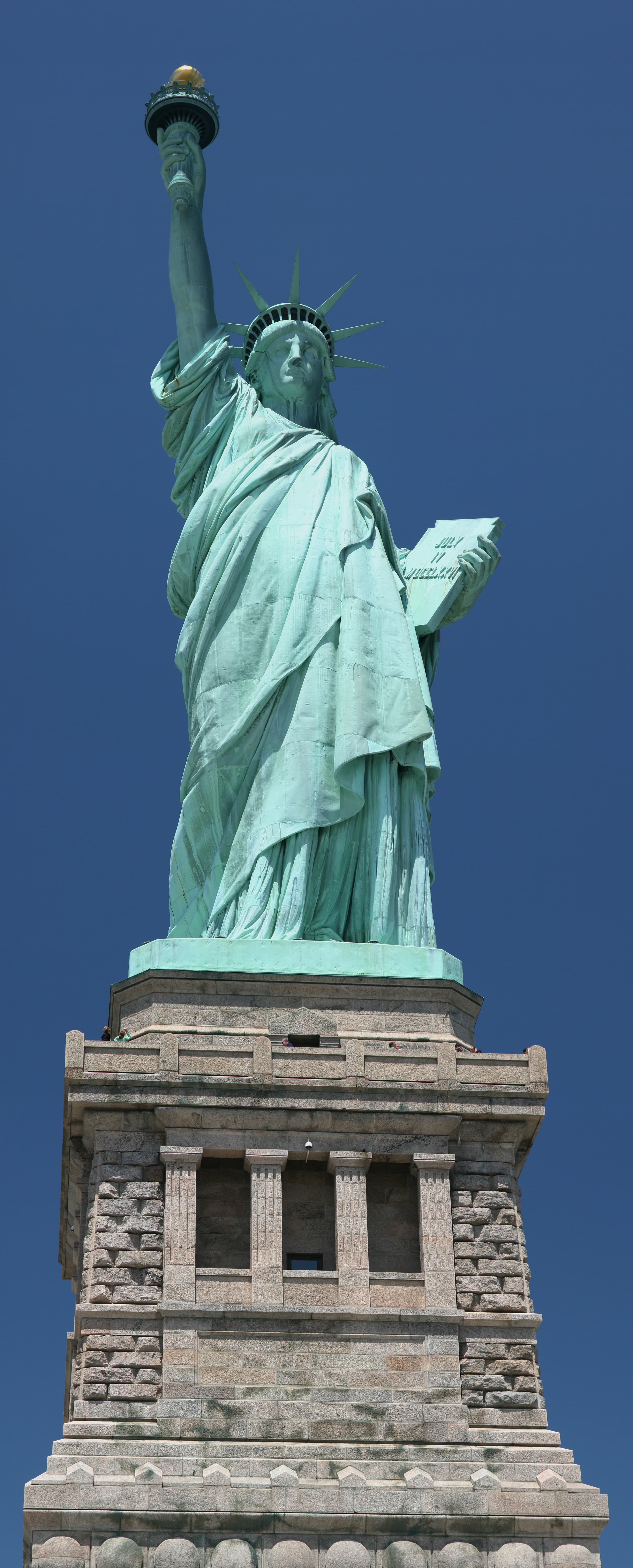
A Colossus First Proposed for the Suez Canal
The idea began at a dinner table. In 1865 the French historian Édouard René de Laboulaye, a devoted admirer of the United States, proposed that France present the Americans with a monument to liberty for their approaching centennial — a gift from one republic to another, paid for by the French people. Among those who took up the idea was a young Alsatian sculptor, Frédéric Auguste Bartholdi. Before America, though, Bartholdi tried to sell the colossus to Egypt. In the late 1860s he pitched the Khedive Isma'il a lighthouse for the northern entrance of the Suez Canal at Port Said: a giant robed Egyptian peasant woman, "Egypt Carrying the Light to Asia," holding a torch aloft. The Khedive and canal builder Ferdinand de Lesseps declined, citing the cost, and a plain lighthouse went up instead. Bartholdi carried the concept home in his sketchbook. In 1871 he crossed the Atlantic with letters of introduction, and by his own account chose the site the moment his ship entered New York Harbor: Bedloe's Island, the small island in the harbor's mouth that every arriving ship would have to pass. Liberty, he decided, should greet the world at the door.
Built in Paris, Piece by Piece
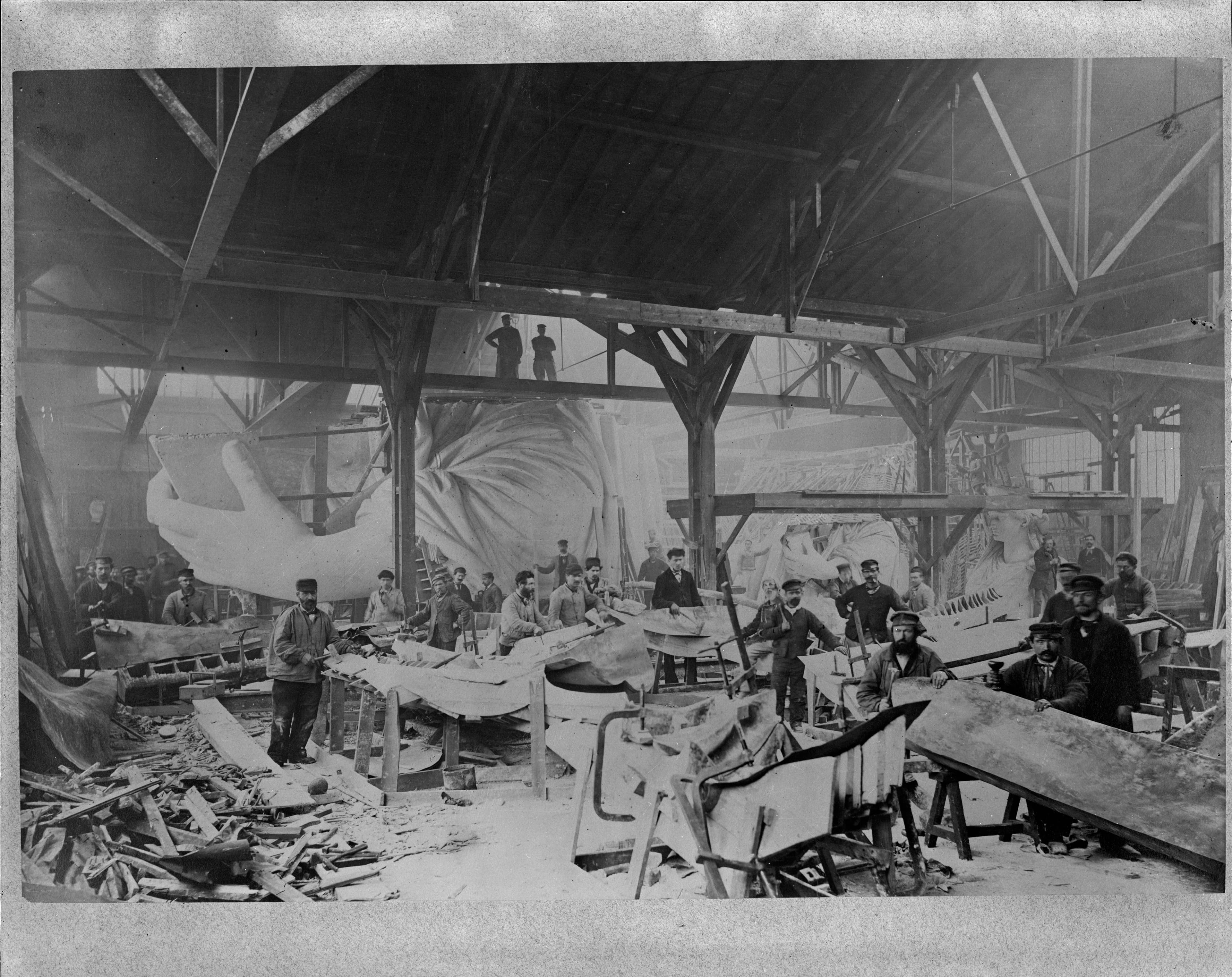
The Franco-American Union, formed in 1875, split the bill: France would pay for the statue, America for the pedestal. Bartholdi modeled Liberty as Libertas, the Roman goddess of freedom, in a Paris workshop, and craftsmen hammered thin copper sheets into her form over full-size wooden molds — the repoussé method that let a 151-foot statue weigh no more than her skin could bear. The skeleton was the harder problem, and it belonged to Gustave Eiffel and his structural engineer Maurice Koechlin, years before the Eiffel Tower: a central iron pylon with a secondary frame of flat iron bars, flexible enough that the copper skin could shift in harbor winds without tearing, and insulated against the galvanic corrosion that copper against iron would otherwise cause. Pieces went on tour to raise money — the head was shown in Paris, and the torch-bearing arm stood at the Centennial Exposition in Philadelphia in 1876 and then in Madison Square Park until 1882, where New Yorkers paid to climb up and look out from the flame. The completed statue was formally presented to the American ambassador in Paris on July 4, 1884. Then she was unbolted: 350 pieces packed into 214 crates, loaded aboard the French steamer Isère, which reached New York on June 17, 1885. On Bedloe's Island, workmen reassembled her over the following months, rivet by rivet, around Eiffel's tower.
The Pedestal a Newspaper's Readers Paid For
The American half of the bargain nearly failed. Architect Richard Morris Hunt designed a granite pedestal to rise inside Fort Wood, the disused star-shaped coastal fort built on the island between 1807 and 1811, its eleven points still framing the base today. Benefit concerts, auctions, and prize fights raised money in dribbles; Congress refused an appropriation of $100,000, and by early 1885 the pedestal fund was exhausted with the masonry partway up and the finished statue waiting in crates. Enter Joseph Pulitzer, publisher of the New York World. In March 1885 he announced a drive to raise $100,000 and pledged to print the name of every contributor, no matter how small the gift. The World ran the campaign daily, publishing donors' letters — schoolchildren's pennies, a kindergarten class's sixty cents, money collected in saloons and offices. Five months later, on August 11, 1885, the paper announced $102,000 raised from 120,000 donors, with 80 percent of the total given in sums of less than a dollar. The pedestal was finished in April 1886. The statue France built stands, quite literally, on small change.
The Poem That Rewrote Her Meaning
In 1883, while the pedestal fund was staging an auction of art and manuscripts, organizers asked the poet Emma Lazarus for an original work. Lazarus, then volunteering with Jewish refugees fleeing pogroms in eastern Europe, produced a sonnet, "The New Colossus," that deliberately answered the ancient Colossus of Rhodes: not a conqueror astride a harbor, but a "Mother of Exiles" whose torch implied welcome — "Give me your tired, your poor, / Your huddled masses yearning to breathe free." The poem was read at the auction, printed in the catalogue, and then largely forgotten, as Lazarus herself nearly was after her early death. In 1903 her friend Georgiana Schuyler succeeded in having the sonnet cast on a bronze plaque and mounted inside the pedestal. The timing remade the statue. Ellis Island, in plain sight across the water, was then processing the greatest migration in American history, and for the millions who passed Liberty on their way in, Lazarus's words — not the Franco-American centennial — described what the statue was for. France gave America a monument to an idea; immigration, and a poem, gave her a second job as the greeter of strangers.
October 28, 1886 — and the Working Life After
Dedication day was wet. Rain and fog hung over the harbor on October 28, 1886, as a parade wound from Madison Square — where the arm had stood for six years — down Broadway past the World Building, and out to the island. President Grover Cleveland accepted the statue for the United States; Bartholdi, stationed in the crown, pulled the cord that dropped the French tricolor from Liberty's face. Women had been barred from the island ceremony, and New York suffragists chartered a boat, circled as close as they could, and protested the exclusion of women from a celebration of liberty in female form. Then the statue went to work. For her first sixteen years she doubled as an official aid to navigation, administered by the Lighthouse Board, her torch lit by electric floodlights — among the first statues in America so illuminated. The bright copper skin, the color of a new penny at unveiling, weathered over three decades into the green patina now inseparable from her image. The torch balcony, once open to climbers, has been closed since 1916, when the Black Tom explosion — a German sabotage attack on a Jersey City munitions depot — showered the statue with shrapnel and damaged the arm. Administration passed to the War Department and, in 1933, to the National Park Service.
The Original Torch, in a Museum of Her Own
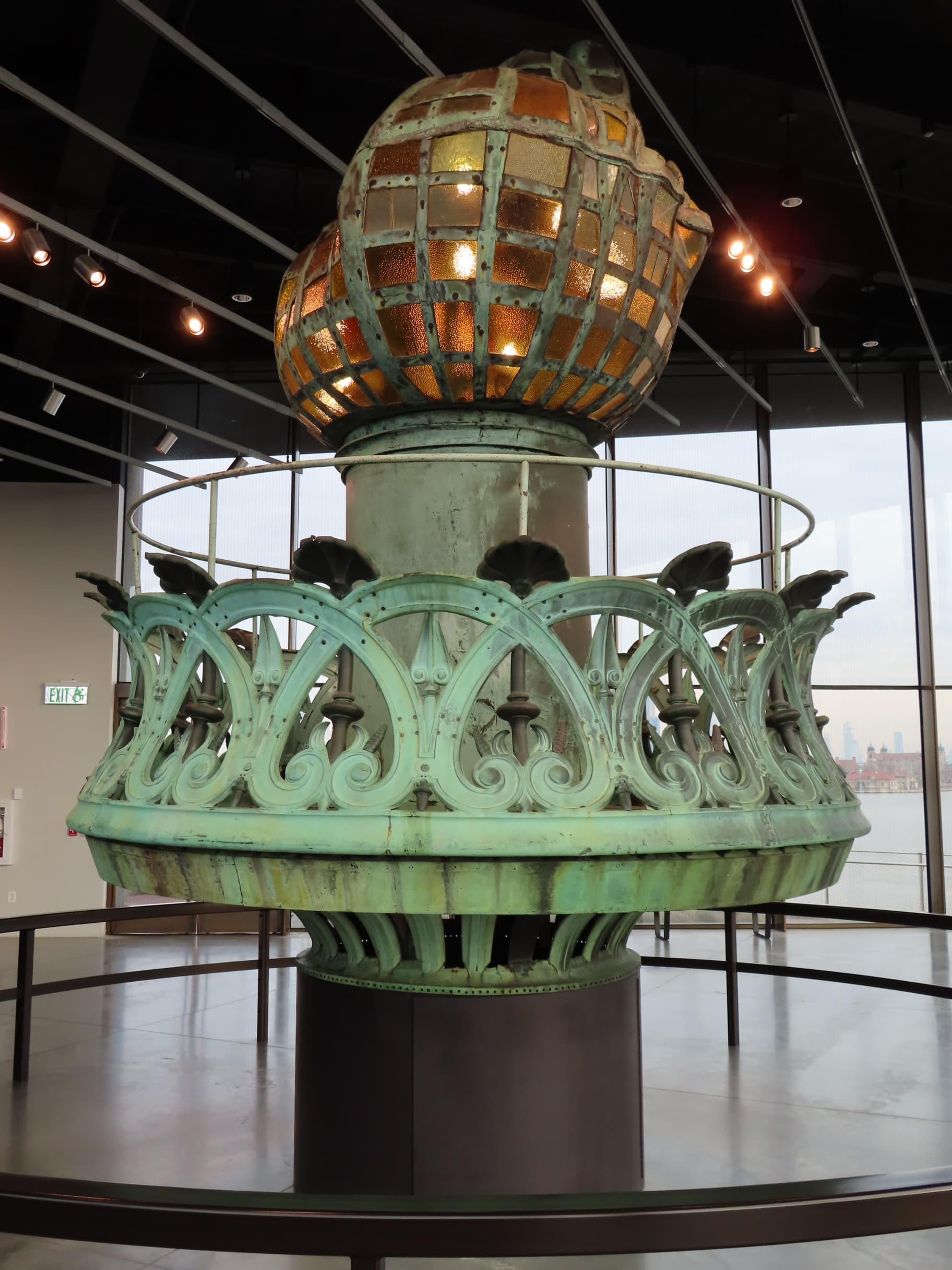
By her centennial, a century of harbor weather had corroded the armature and leaked into the skin, and she closed for a full restoration. When she reopened for her hundredth birthday in 1986, the most delicate decision had been made above her head: the original torch, badly damaged and repeatedly altered over the years, was removed and replaced by a faithful copy whose flame is covered in 24-karat gold leaf, lit at night by floodlights beneath it. The 1886 torch survived — displayed for years at the pedestal's entrance — and in 2019 it took its place as the centerpiece of the Statue of Liberty Museum, opened on Liberty Island on May 16 of that year, where visitors can stand beside the flame Liberty actually carried for her first century. It is the fitting end to her story of parts and reassemblies: the statue that arrived in crates now keeps her most traveled piece indoors, out of the weather, while her double keeps watch over the harbor. Liberty Island today is all hers — museum, grounds, and the old star fort under her feet — and the climb still exists for those who plan for it: 162 steps from the statue's feet to the crown, and the same view Bartholdi promised the incoming ships.
Key Facts
- Dedicated October 28, 1886, a gift from the people of France for the American centennial: designed by Frédéric Auguste Bartholdi, with the iron framework engineered by Gustave Eiffel and Maurice Koechlin.
- The statue stands 305 feet (93 m) from ground to torch; the copper figure alone is 151 feet tall, its flexible iron armature designed to let the skin move in harbor winds.
- Built in Paris, formally presented on July 4, 1884, then disassembled into 350 pieces in 214 crates and shipped aboard the French steamer Isère, arriving in New York on June 17, 1885.
- The pedestal, designed by Richard Morris Hunt, stands inside Fort Wood (built 1807–1811); it was completed after Joseph Pulitzer's New York World raised $102,000 from 120,000 donors — 80 percent giving less than a dollar.
- Emma Lazarus wrote "The New Colossus" in 1883 for a pedestal fundraiser; a bronze plaque of the sonnet was installed inside the pedestal in 1903.
- The original torch was replaced in the 1984–86 centennial restoration (the new flame is covered in 24-karat gold); the original is now the centerpiece of the Statue of Liberty Museum, opened May 16, 2019.
Visitor Details
Address: Liberty Island, New York, NY 10004 — reachable only by ferry; the island grounds, museum, and pedestal are administered by the National Park Service as the Statue of Liberty National Monument.
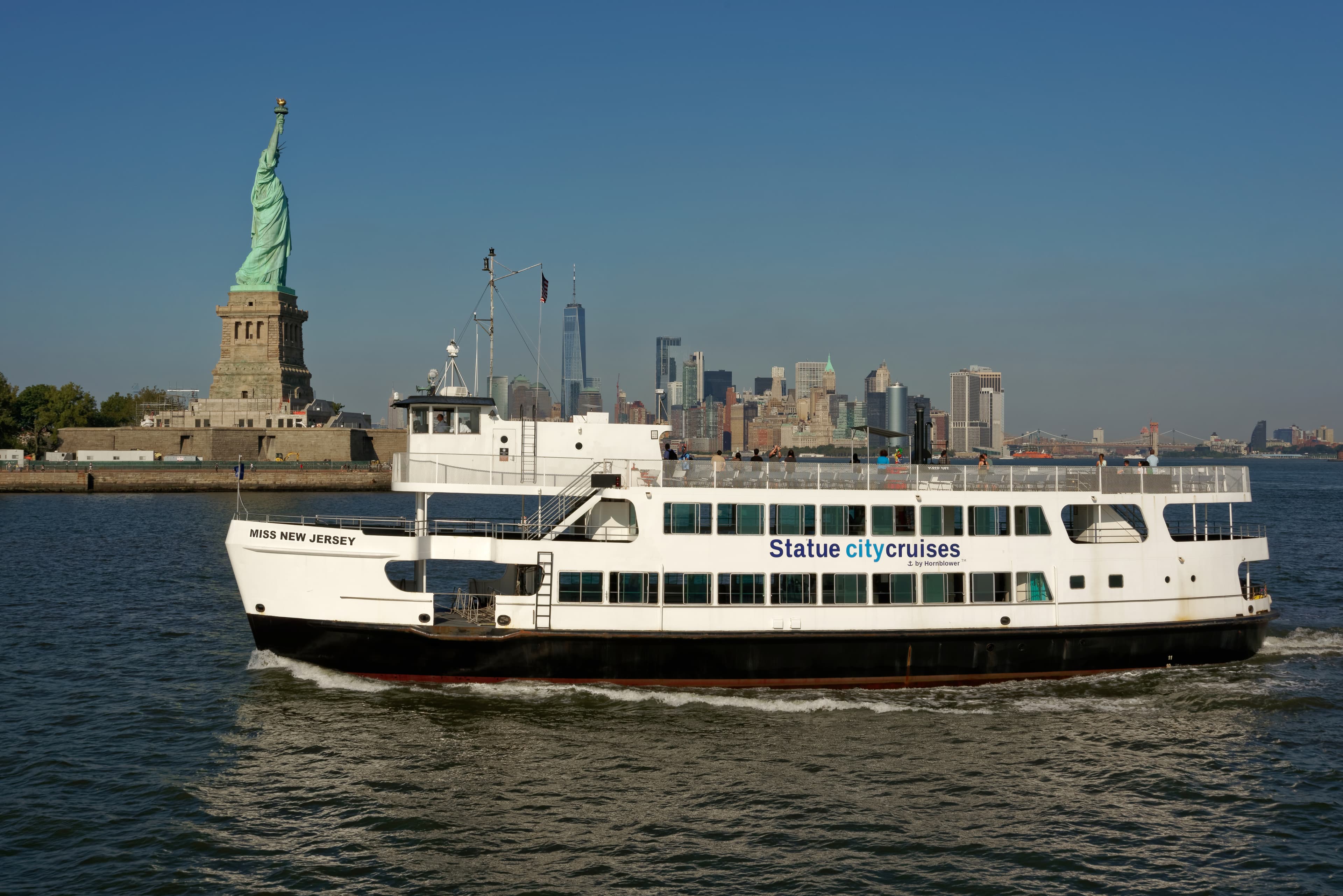
Transit: Statue City Cruises is the only authorized ferry operator (per the National Park Service), sailing from The Battery in Lower Manhattan and from Liberty State Park in New Jersey; all ferry tickets include both Liberty Island and Ellis Island and entry to both museums. The Battery is a short walk from the Bowling Green (4/5) and South Ferry (1) subway stations. Airport-style security screening is required before boarding, and lines build at peak times.
Hours/Admission: Ferries run daily on a seasonal schedule — buy tickets in advance through Statue City Cruises, as the National Park Service strongly recommends; same-day tickets can sell out in season. General admission covers the grounds and museums only. Entering the pedestal or the crown requires a separate advance reservation, and crown tickets are very limited: the crown climb is 162 steps from the statue's feet with no elevator. Check current sailing times, ticket options, and prices on the official Statue City Cruises / NPS pages before going, as prices and schedules change.
Best timing: Take the first ferry of the day — the statue faces east, so morning light is on her front, the grounds are emptiest, and you can continue to Ellis Island before the midday crowds. Weekdays outside summer are calmest; reserve pedestal and crown tickets as far ahead as availability allows.