A Temple on Reclaimed River Mud
The Lincoln Memorial stands where, in Lincoln's lifetime, there was no land at all — only the muddy flats of the Potomac River. The site at the western end of the National Mall was created by dredging and landfill in the 1880s and 1890s, and when Congress finally authorized a memorial in 1911, nearly half a century after Lincoln's assassination, critics complained the ground was a swamp unworthy of the man. Architect Henry Bacon argued the opposite: a memorial at the end of the Mall's great axis, facing the Washington Monument and the Capitol across two miles of green, would anchor the whole composition of the capital. He won. Because the ground was made land, the temple rests on concrete piers sunk as deep as 65 feet to reach bedrock.
Ground was broken in 1914, and the memorial was dedicated on May 30, 1922, before some 35,000 people, with President Warren G. Harding presiding and Lincoln's 78-year-old son, Robert Todd Lincoln, in attendance. The ceremony also carried a stain that later history would answer on the very same steps: Robert R. Moton, the president of Tuskegee Institute and the dedication's principal Black speaker, was required to sit in a segregated section apart from the main audience.
Thirty-Six Columns for Thirty-Six States
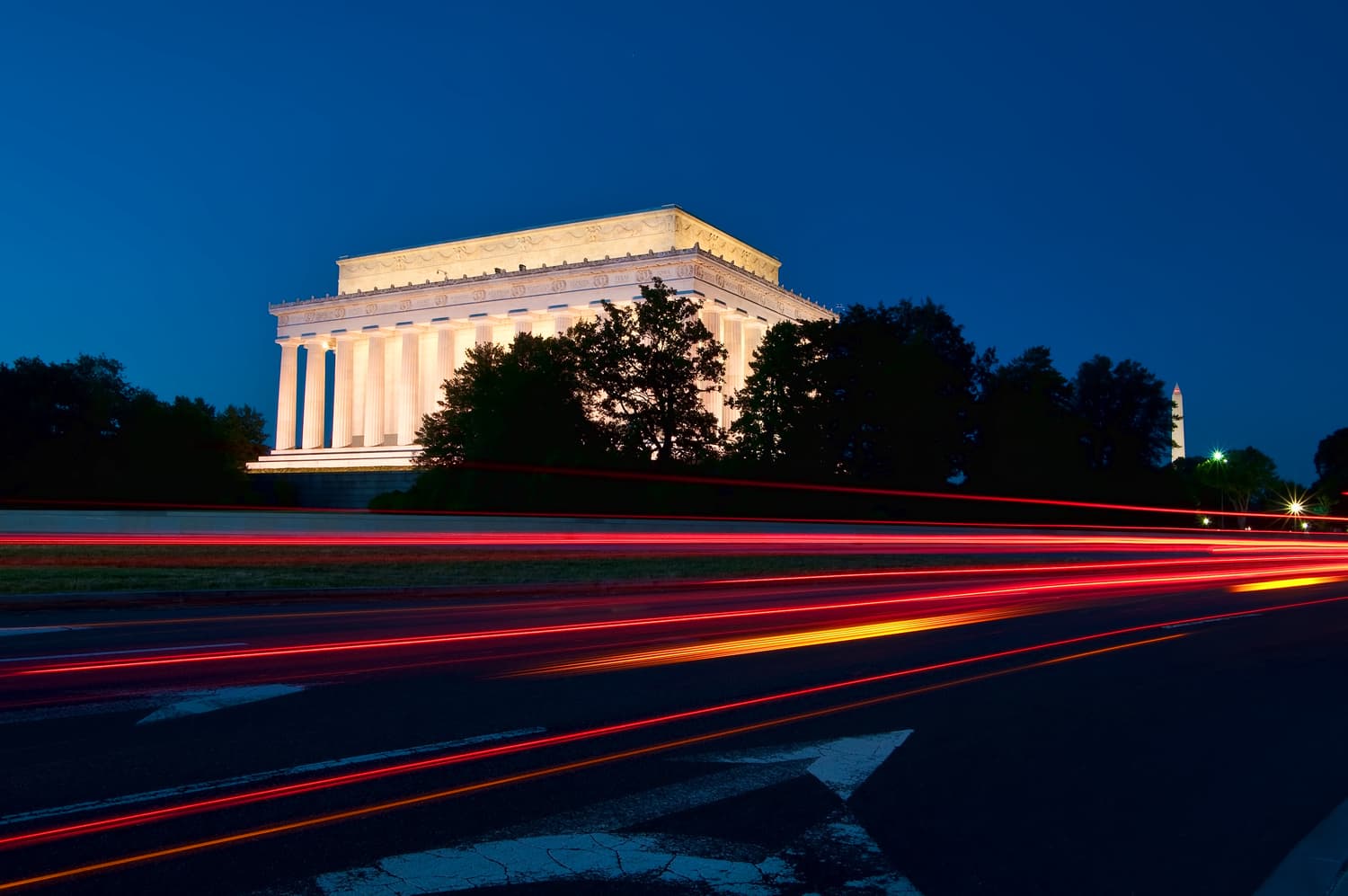
Bacon modeled his temple on the Parthenon, reasoning that the man who saved democracy deserved the architecture of the civilization that invented it. The building is Greek Doric, built of white Colorado marble, roughly 190 feet long, 119 feet wide, and 99 feet high. Its colonnade has 36 fluted columns — one for each state in the Union at the time of Lincoln's death — and the names of those 36 states are carved in the frieze above them. Higher still, on the attic walls, are the names of the 48 states that existed when the memorial was dedicated in 1922, added after Alaska and Hawaii joined the Union only by plaques at the terrace. Two massive tripods flank the great staircase, and the whole temple rises on a stepped granite terrace above the Reflecting Pool, so that from the Mall the building seems to float at the end of its own mirror. Visitors love to count the granite steps and test the folklore that their number echoes "four score and seven years ago"; the Park Service treats any match as a happy accident rather than a design.
The Seated Lincoln
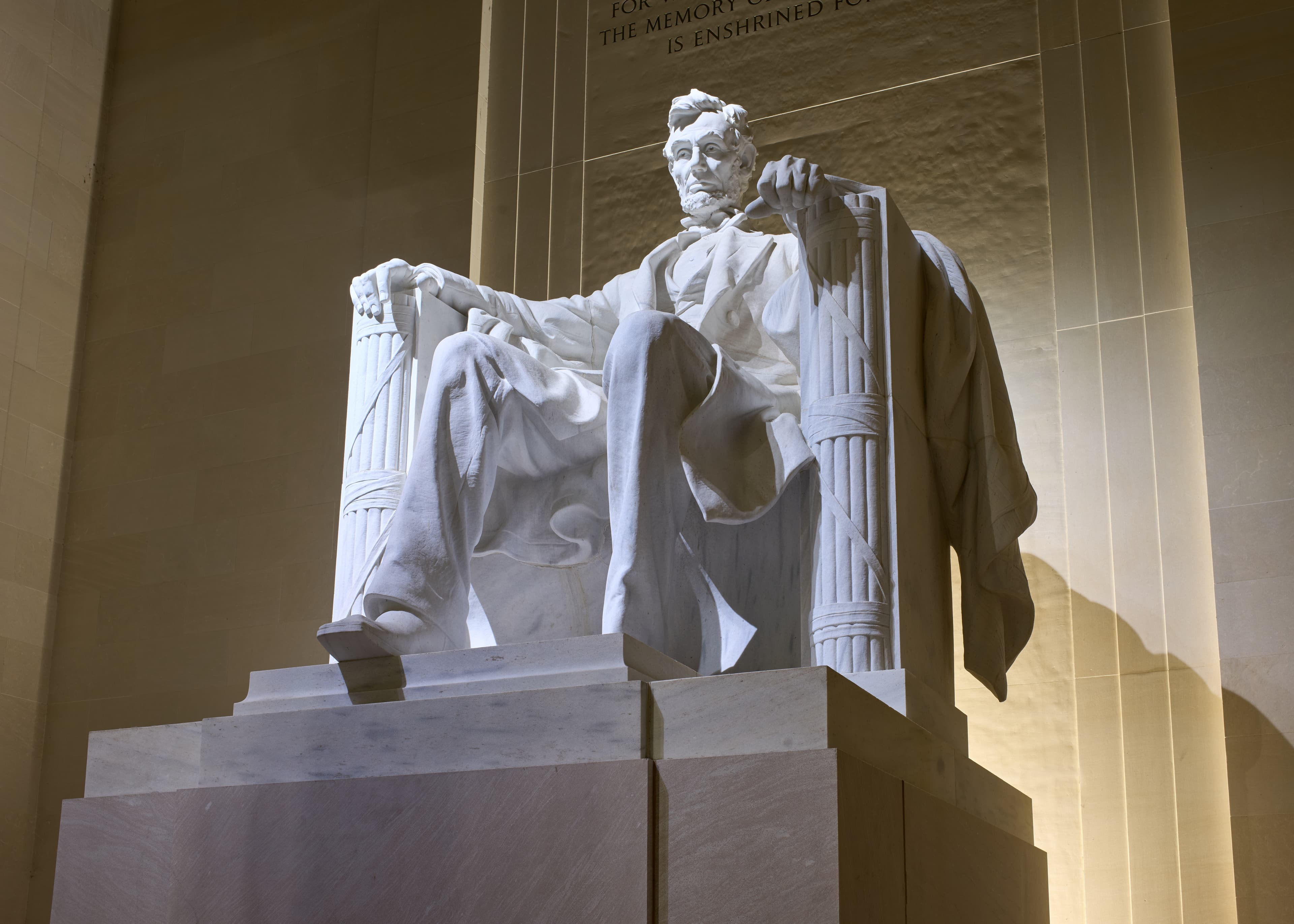
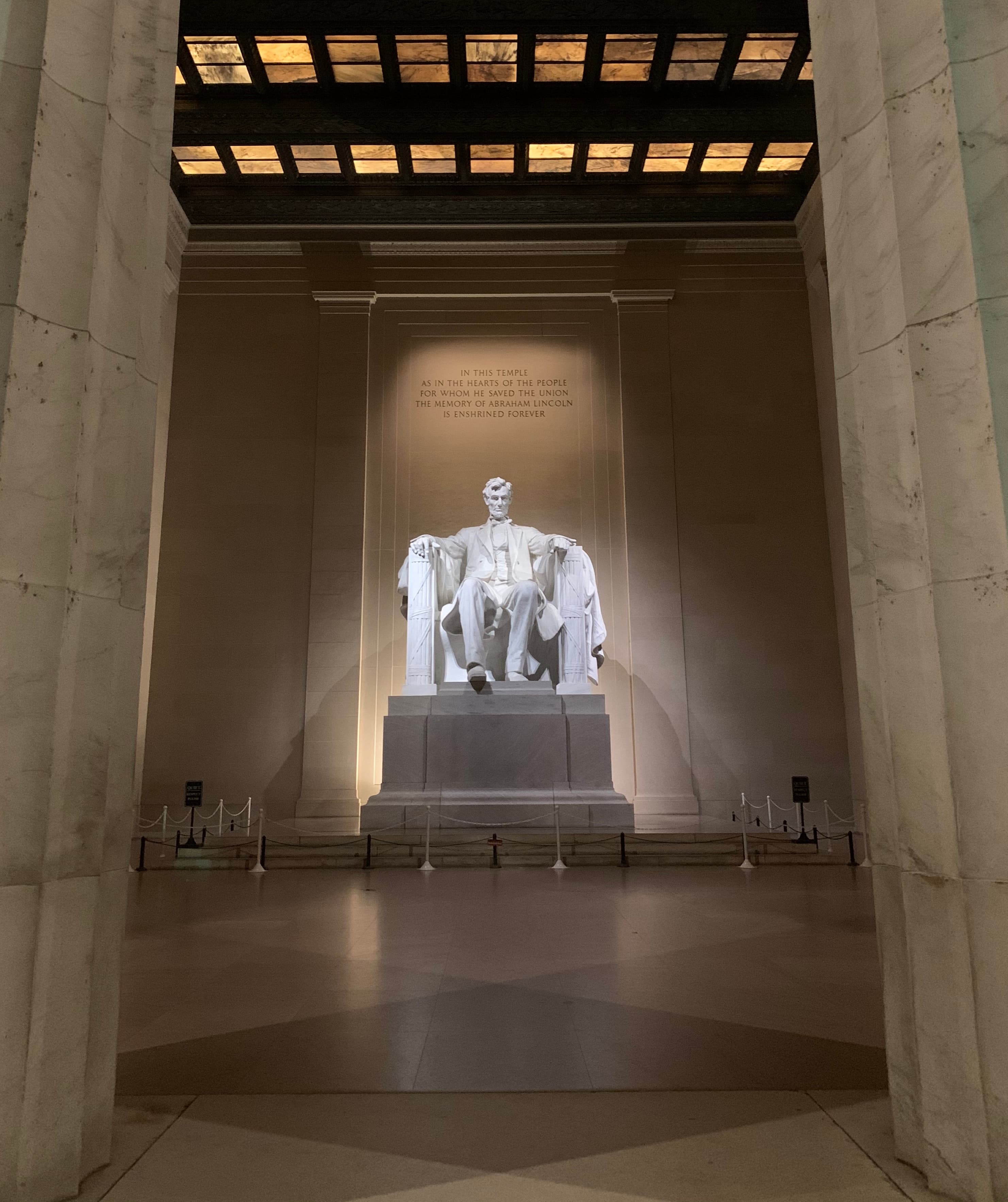
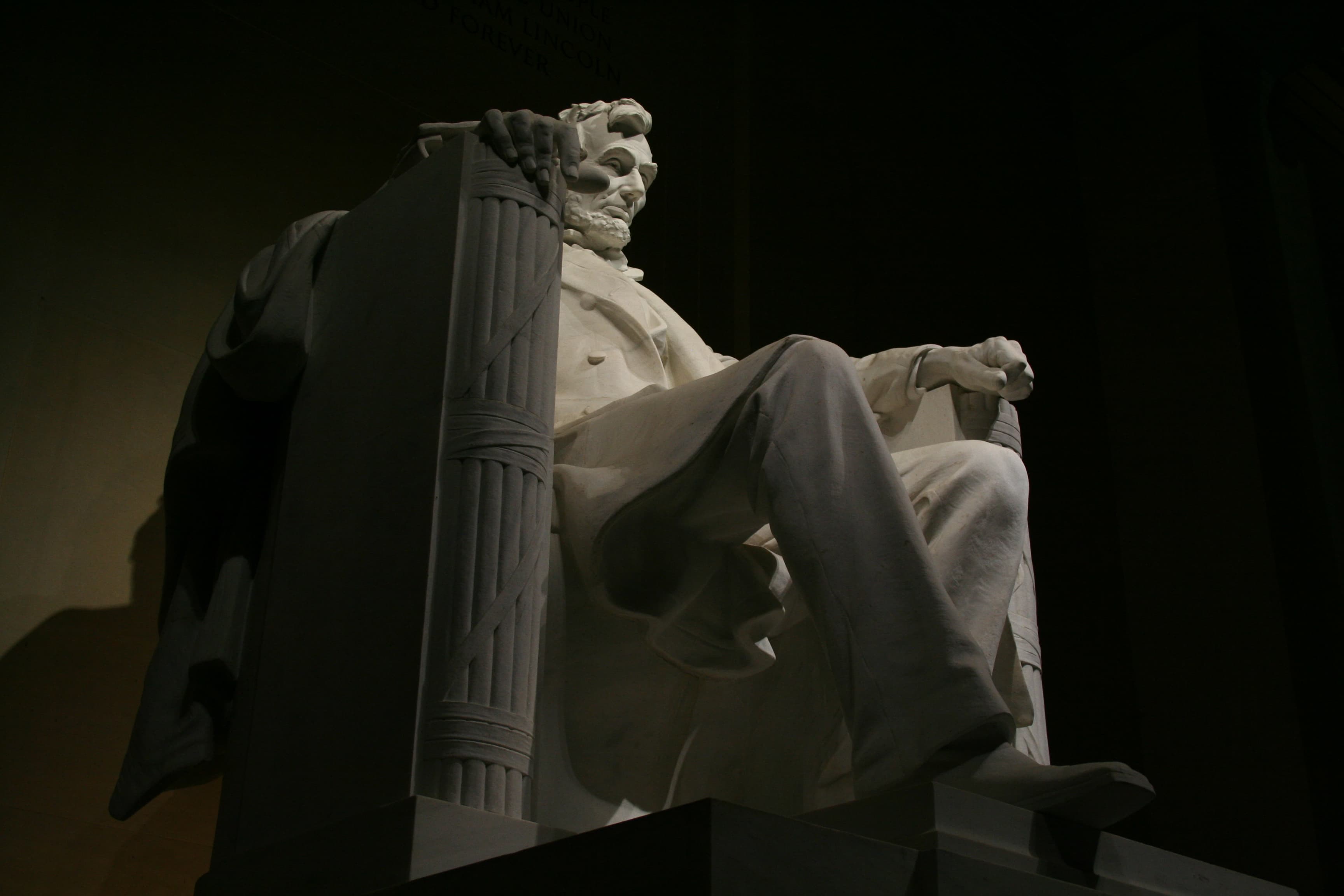
Inside, alone in the central chamber, sits Daniel Chester French's statue — 19 feet tall from foot to crown, carved from 28 blocks of white Georgia marble by the Piccirilli brothers, the Italian-born stonecutters of the Bronx who executed much of America's monumental sculpture. If Lincoln stood up, he would be 28 feet tall; the statue weighs about 175 tons. It was installed in 1919–1920, and French adjusted the design after seeing it in place, even arranging the lighting so the face would read gravely rather than harshly from below. The figure had also grown in the making. French's early studies imagined a far smaller statue; as Bacon's chamber rose, both men agreed the room demanded a giant, and the seated figure was enlarged stage by stage until it filled the temple's scale without crowding it. French worked from the 1860 Volk life mask and the wartime photographs, and he insisted on the tension visitors still feel: this is not Lincoln triumphant but Lincoln burdened, a man caught mid-decision in the middle of a war. Lincoln sits in a great curule chair whose arms rest on fasces, the Roman bundles of rods symbolizing the Union he preserved. One hand is clenched, the other open and relaxed — generations of visitors have read tension and resolve, war and peace, into the contrast. Above the statue, cut into the wall, runs the memorial's dedication, written by Royal Cortissoz: "In this temple, as in the hearts of the people for whom he saved the Union, the memory of Abraham Lincoln is enshrined forever."
Two Speeches Carved in Stone
The side chambers hold the words. On the south wall is the Gettysburg Address, 272 words that redefined the nation in November 1863. On the north wall is the Second Inaugural Address of March 1865 — "With malice toward none, with charity for all" — delivered weeks before Lincoln's death. Above each speech hangs a mural by Jules Guerin, painted on canvas with pigments mixed in kerosene so the damp marble air would not destroy them: one shows an angel of truth freeing an enslaved person, the other figures of unity and fraternity. The carving holds one famous flaw. In the Second Inaugural, an engraver cut an "E" where the word "FUTURE" should begin with an "F"; the error was filled in with stone dust and mortar, but a sharp eye in the right light can still find the ghost of the extra letter — perhaps the most appropriate misprint in American public art, a reminder that the temple was made by human hands.
Marian Anderson to Martin Luther King
The memorial's second life began on Easter Sunday, April 9, 1939. Denied Constitution Hall by the Daughters of the American Revolution because she was Black, the contralto Marian Anderson sang instead from the Lincoln Memorial's steps before 75,000 people, in a concert arranged with the support of Eleanor Roosevelt and introduced by Interior Secretary Harold Ickes. Radio carried it to millions. The steps had become the nation's stage for unfinished business. Twenty-four years later, on August 28, 1963, the March on Washington for Jobs and Freedom filled the Mall from the memorial to the Washington Monument, and Martin Luther King Jr., standing on the memorial's steps, delivered "I Have a Dream" to some 250,000 people. The most famous passage was not in his prepared text: partway through, gospel singer Mahalia Jackson, seated behind him, called out, "Tell them about the dream, Martin!" — and King set his pages aside and improvised the closing the country has memorized since. In 2003, the exact spot where King stood was marked with an inscription cut into the granite landing, eighteen steps from the top. Stand on it, face the Mall as he did, and the geography of the speech — the monument, the Capitol dome beyond — explains itself.
The Memorial Today
The Lincoln Memorial is open 24 hours a day, every day of the year, and admission is free; National Park Service rangers staff it during the day. Beneath the chamber runs a cavernous undercroft of soaring concrete vaults, built to carry the temple on its piers, which the Park Service has been developing into exhibition space. Most visitors climb the steps, circle the statue, read a wall of text, and step out onto the terrace for the defining view of Washington: the Reflecting Pool, the Washington Monument, and the Capitol in a single line — the view printed on the back of the five-dollar bill, with the statue itself on the penny. Come at sunrise and you may share the steps only with runners; come at night and the chamber glows, the marble lit from within, the crowds gone, and the old man's gaze travels unbroken down the dark Mall toward the Capitol he saved a government to fill.
Key Facts
- Dedicated May 30, 1922; designed by architect Henry Bacon as a Greek Doric temple of white Colorado marble, with 36 columns for the 36 states of the Union at Lincoln's death.
- The statue by Daniel Chester French is 19 feet tall seated (28 feet if standing), carved from 28 blocks of Georgia white marble by the Piccirilli brothers and weighing about 175 tons.
- The Gettysburg Address is carved on the south interior wall and the Second Inaugural Address on the north, each beneath a mural by Jules Guerin; a corrected engraver's error (an "E" for the "F" in "FUTURE") is still faintly visible in the Second Inaugural.
- Built 1914–1922 on land reclaimed from the Potomac River flats; the structure rests on concrete piers sunk up to 65 feet.
- Marian Anderson sang from its steps on Easter Sunday 1939 before 75,000 people after being barred from Constitution Hall; Martin Luther King Jr. delivered "I Have a Dream" from the steps on August 28, 1963 — the spot is now marked by an inscription on the landing.
- Administered by the National Park Service; open 24 hours a day year-round, free of charge.
Visitor Details
Address: 2 Lincoln Memorial Circle NW, Washington, DC 20002 — at the western end of the National Mall, across the Arlington Memorial Bridge from Arlington National Cemetery.
Transit: Foggy Bottom–GWU station (Blue/Orange/Silver lines) is about a 10-minute walk; the DC Circulator's National Mall route also stops nearby. There is no parking at the memorial itself.
Hours/Admission: Open 24 hours a day, 365 days a year; admission is free. National Park Service rangers are on site during daytime hours for questions and programs (per the National Park Service).
Best timing: Sunrise for near-empty steps and the sun rising behind the Capitol down the Mall axis; after dark for the illuminated chamber. Pair it with the Vietnam Veterans Memorial and Korean War Veterans Memorial, a few minutes' walk north and south, and allow time simply to sit on the steps where King stood.