The vestibule of the city
Every great capital has a room it uses to receive the world, and Washington's is a train station. Step off a Northeast Regional train at Union Station, walk up through the concourse, and the building does something no other arrival in the city quite manages: it slows you down. The Main Hall opens overhead — a barrel-vaulted ceiling 96 feet above a marble floor, gilded and coffered, ringed by plaster Roman legionnaires — and then the great arched windows throw daylight across it, and for a moment the business of catching a train gives way to the business of looking up. That pause is the whole point of the building. It was designed, quite deliberately, to make arrival in Washington feel like an occasion.
Union Station sits at 50 Massachusetts Avenue NE, at the foot of Capitol Hill, where Massachusetts, Delaware, and Louisiana Avenues meet in Columbus Circle. It is the southern terminus of the Northeast Corridor, the busiest passenger rail line in the nation, running north through Baltimore, Philadelphia, New York, and Boston. It is also, all at once, an Amtrak terminal, a MARC and VRE commuter hub, a Washington Metro Red Line station, an intercity bus depot, and a shopping and dining concourse — a working piece of infrastructure wearing the clothes of a monument. More than six million Amtrak passengers used it in fiscal year 2025 alone, and in its busiest era, during World War II, as many as 200,000 people passed through it in a single day.
That double life — monument and machine — is what makes it worth a visit even if you never board a train. Come for the architecture, stay for the trains, and leave understanding something about how Washington wanted to present itself to the country at the start of the twentieth century: not as a government office park, but as a Rome on the Potomac, with a gateway to match.
A station Congress itself authorized
Before Union Station, Washington's railroads were a mess, and the mess was visible from the Capitol. Each major railroad ran its own terminal: the Baltimore and Ohio out of New Jersey Avenue Station, and the Pennsylvania, Chesapeake and Ohio, and Southern railways out of the Baltimore and Potomac station at 6th Street and what is now Constitution Avenue, right on the edge of the National Mall. Tracks cut across the Mall itself, and grade crossings snarled the streets. When the Pennsylvania and the Baltimore and Ohio announced in 1901 that they would build one union station together, the city had two reasons to celebrate: the railroads would finally leave the Mall, and Washington would finally have a station grand enough for a capital.
The project was guided by Daniel Burnham, the Chicago architect behind the 1893 World's Columbian Exposition, acting as a member of the Senate Park Commission — the body behind the McMillan Plan that reshaped the Mall and the monumental core. In September 1901 Burnham wrote to the Commission's chairman, Senator James McMillan, that "the station and its surroundings should be treated in a monumental manner, as they will become the vestibule of the city of Washington, and as they will be in close proximity to the Capitol itself." After two years of negotiation, Congress passed the act authorizing the station, signed into law by President Theodore Roosevelt on February 28, 1903 — the only railroad station in the nation specifically authorized by Congress. The Washington Terminal Company, jointly owned by the railroads, built it to a standard the act set in plain language: "monumental in character," at a cost of at least $4 million. The main building alone eventually cost more than $5.9 million, and the whole program of grades, approaches, bridges, tunnels, yards, and shops cost more than $16 million.
The design work fell principally to William Pierce Anderson of Burnham's firm, D.H. Burnham & Company. Building it reshaped the neighborhood around it. More than 100 houses were demolished, erasing a poor, flood-prone district known as Swampoodle; Tiber Creek was put into a tunnel; Delaware Avenue disappeared beneath the tracks between Massachusetts and Florida Avenues. The first Baltimore and Ohio train to arrive with passengers, the Pittsburgh Express, pulled in at 6:50 a.m. on October 27, 1907; the first Pennsylvania train followed three weeks later, on November 17. The main building itself was completed in 1908.
The Main Hall: Rome in Washington
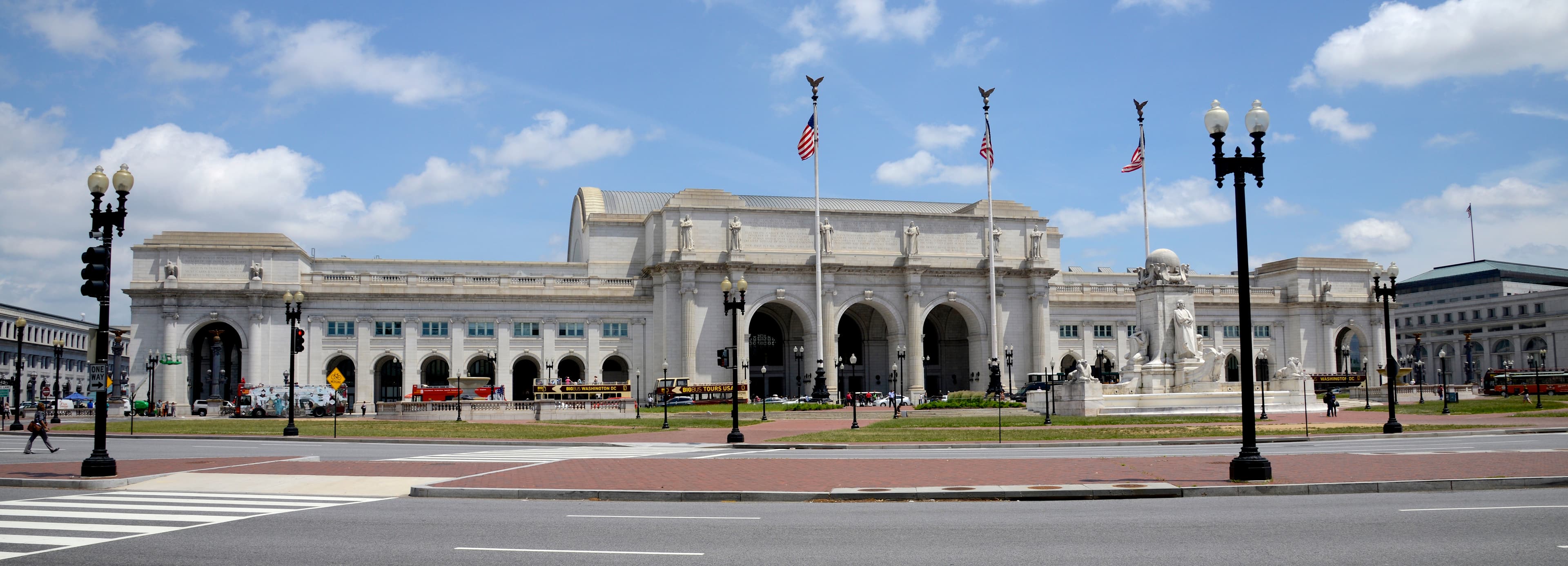
Burnham borrowed openly from Rome, and the borrowing is the building's signature. The three great entrance arches on the facade take their cue from the Arch of Constantine, and the Main Hall inside is modeled on the Baths of Diocletian — a vast waiting room, 219 feet long and 120 feet wide, under a barrel-vaulted, coffered ceiling 96 feet high, finished in gold leaf. The facade stretches more than 600 feet along Massachusetts Avenue, faced in white Vermont granite over a steel frame, and it reads, from Columbus Circle, exactly as Burnham intended: as the front door of the capital, with the dome of the Capitol itself visible just beyond.
Look closely and the hall is a civic lesson in sculpture. Above the main cornice of the central block stand six colossal statues by Louis Saint-Gaudens titled "The Progress of Railroading" — Fire, Electricity, Freedom, Imagination, Agriculture, and Mechanics — the confident iconography of the American Renaissance, the era's belief that industry and art advanced together. Inside, Saint-Gaudens also made the thirty-six Roman legionnaires that ring the Main Hall's upper cornice, plaster figures made to read as carved stone, each holding a shield bearing the American eagle. The inscriptions, the marble, the gold leaf, the sheer height of the vault — all of it was meant to tell a traveler, on arrival, that this city took itself seriously, and that the republic's business was conducted on a grand scale.
The hall was not just a waiting room. It held an opulent Presidential Suite, also called the State Reception Suite, with its own entrance, where presidents, State Department officials, and congressional leaders could receive distinguished visitors arriving by rail. President William Howard Taft was its first presidential user, in 1909. The suite had a second, practical purpose: it was meant to protect the president during his travels, after the 1881 assassination of President James A. Garfield in the old Baltimore and Potomac station — the very station Union Station replaced.
Columbus Circle and the fountain out front
Burnham designed the station's forecourt as carefully as the building. The semicircular Union Station Plaza — now Columbus Circle — stretches 940 feet across the facade, paved in the same Vermont white granite, with three 110-foot ornamental flagstaffs standing before the central pavilion. Its centerpiece is the Columbus Fountain, sculpted by Lorado Taft and dedicated on June 8, 1912, in a three-day celebration that drew tens of thousands of people, including President William Howard Taft.
The fountain is a Beaux-Arts monument in its own right: a semicircular double basin in marble, with a 45-foot shaft crowned by a globe supported by four eagles, a 15-foot statue of Christopher Columbus standing on a ship's prow at its base, allegorical figures of the Old World and the New World flanking the shaft, and two couchant lions guarding the ends. It was not part of the station's original design — Congress authorized a Columbus memorial in 1907, and a national competition chose Taft's design — but it completed Burnham's composition, giving the station a ceremonial forecourt on the axis to the Capitol. Stand at the fountain and look back at the facade, then turn and look up Massachusetts Avenue toward the Capitol dome, and you are standing on the sightline Burnham designed: station, plaza, and Capitol in a single monumental sequence. Note for visitors: Columbus Plaza has undergone periodic renovation closures in recent years, so check ahead if you want to walk the plaza itself rather than view it from the station steps.
War, presidents, and a runaway train
Union Station's history reads like a condensed history of twentieth-century America, because the nation's business kept passing through it. During World War II it was at its busiest, with up to 200,000 passengers in a single day, and the old Presidential Suite did wartime duty: converted in December 1941 into a USO canteen, it served 6.5 million military service members before closing in May 1946, then reopened in 1951 as a permanent USO lounge dedicated by President Harry Truman as a "home away from home" for traveling service members.
Its most famous single day, though, was a disaster that somehow was not. On the morning of January 15, 1953, the Pennsylvania Railroad's Federal, the overnight train from Boston, ran away on its approach: the engineer found he had only engine brakes, a switchman telephoned a warning, and the GG1 electric locomotive No. 4876 hit the bumper block on track 16 at about 35 miles per hour, jumped the platform, destroyed the stationmaster's office and a newsstand, and headed for the wall of the Main Hall. The terminal floor, never designed to carry a 475,000-pound locomotive, gave way, and the engine dropped into the basement — into about the center of what is now the food court. Remarkably, no one was killed; passengers in the rear cars thought they had only had a rough stop. The locomotive was hauled away in pieces and repaired, and the hole was temporarily planked over and hidden from view because President Dwight D. Eisenhower's inauguration was imminent. The accident later inspired the finale of the 1976 film Silver Streak.
Decline, the Pit, and the 1988 rebirth
Like the railroads themselves, the station fell hard in the second half of the century. As air travel and highways drew passengers away, the building decayed. In 1967 the chairman of the Civil Service Commission proposed turning it into a visitor center for the Bicentennial, and the Main Hall was gutted to hold a recessed theater pit for a slide-show presentation — officially the PAVE (Primary Audio-Visual Experience), sarcastically known as "the Pit." The National Visitor Center opened on Independence Day 1976, never drew the crowds hoped for, and the Park Service closed its theaters and laid off most of its staff in October 1978. Meanwhile Amtrak passengers were banished to a cramped replacement station behind the concourse, under a parking garage, which a New Yorker editor described as "a bad small town bus terminal" — a 1,900-foot walk from the front door to the tracks, and the visitor center's most common question was, "Where are the trains?"
The end came in February 1981, when a leaking roof sent ceiling plaster crashing down in the eastern wing and the Park Service declared the whole structure unsafe and sealed it. Congress responded with the Union Station Redevelopment Act, signed by President Ronald Reagan on December 29, 1981, directing the Department of Transportation to restore the station as a rail terminal first and a commercial complex second. The restoration cost about $160 million, refitted the Main Hall floor in marble, turned the Pit into a new basement level, and restored the decorative plaster, skylights, and stonework. The station reopened in its present form on September 29, 1988 — a festival marketplace as well as a terminal, with shops and restaurants along the concourse and Main Hall, a new Amtrak terminal behind the original concourse (its passenger concourse renamed in 1994 for W. Graham Claytor Jr., Amtrak's president from 1982 to 1993), and the food court set beneath the old train-shed arches, their track numbers still visible overhead.
The earthquake and the gilded ceiling
The Main Hall you see today is, in part, a product of an earthquake. On August 23, 2011, a magnitude 5.8 earthquake shook the Washington region and cracked the Main Hall's century-old plaster ceiling, last restored in the 1980s. Scaffolding went up in 2012, and over nearly three years, bay by bay, crews repaired the plaster, repainted, and re-gilded the coffered ceiling — replacing more than 120,000 sheets of 23-karat gold leaf, with help from a $350,000 grant from American Express and the National Trust for Historic Preservation — and installed a new steel support system above the ceiling so it could better withstand a future quake, along with improved ventilation and maintenance access. A rolling scaffold let the public keep passing through below while the work went on overhead. The completed ceiling was unveiled in late spring 2016, and with the Center Café and its planters removed from the middle of the hall at the same time, the Main Hall stood unobstructed, as Burnham designed it, for the first time in almost fifty years. When you look up now, the gold you see is real, and it is there because the building was shaken and then painstakingly put right.
The working station today
Union Station is not a museum with trains attached; it is a station that happens to be beautiful, and its present is as busy as its past. Amtrak runs the Northeast Corridor and long-distance trains from here — Acela, Northeast Regional, Vermonter, Cardinal, Crescent, Palmetto, and others — and it is the southern terminus of the corridor and Amtrak's second-busiest station. MARC's Penn, Camden, and Brunswick Lines and VRE's Fredericksburg and Manassas Lines make it the commuter hub for Maryland and Virginia, with free cross-honoring between MARC and VRE for pass holders since August 2024. Below the headhouse, the Washington Metro's Red Line stops at Union Station, and intercity and local buses use the mezzanine-level bus stands. The station carries 18 platforms and 22 tracks, and in August 2025 a former lower-level storage track, Track 22, reopened as a platform track for Amtrak and VRE use.
The building's ownership has changed hands in the same years. Amtrak began condemnation proceedings in April 2022, citing poor maintenance and lack of capital investment; a federal judge ruled in April 2024 that Amtrak could seize the commercial space, and Amtrak took control of the station in late July 2024, agreeing in February 2025 to pay $505 million for the leasehold. Its Second Century Plan, whose final environmental impact statement the Federal Railroad Administration completed in March 2024, aims over the next twenty years to triple passenger capacity and double train capacity, modernizing and expanding the station facilities, and it accommodates Burnham Place, a planned three-million-square-foot mixed-use development over the rail yard that would connect the station to the growing NoMa and H Street Corridor neighborhoods. In August 2025 the federal government announced it would negotiate to resume direct management of the station's non-railroad areas. In short: the station you visit today is mid-transformation, and the grand old headhouse is the anchor for a much larger project.
How to visit well, and why it endures
Union Station rewards the simplest possible visit: arrive, look up, and walk slowly. Enter from Columbus Circle through the great arches and cross the Main Hall, pausing under the vault to find the legionnaires along the cornice and the six Progress of Railroading statues above the facade outside. Walk the East and West Halls, with their skylit, coffered ceilings and marble columns, then follow the concourse back toward the Claytor Concourse and the gates, where the working station takes over from the monument — the departure boards, the lines for the Northeast Regional, the commuters who cross this floor twice a day without ever looking up, which is the building's real compliment. The food court below keeps the old train-shed arches and track numbers, a quiet joke for rail fans: you eat lunch where the trains used to stand.
Pairing the station with its neighborhood is easy, and the pairing is the point. The Capitol is five blocks south, an easy walk down Delaware Avenue or First Street; the National Postal Museum sits just west of the station in the old City Post Office building, and the Thurgood Marshall Federal Judiciary Building stands to the east. To the north and east, NoMa and the H Street Corridor — the neighborhoods the station once cut off with its tracks and yards — are now its growth frontier, connected by the Metropolitan Branch Trail, which meets the station. Come in the morning, when the light comes through the Main Hall's great windows and the commuter rush gives the hall its working hum, or in the evening, when the facade is lit and the plaza glows. Either way, give yourself an hour, not ten minutes: the building repays the slower pace.
Union Station endures because it was built for a purpose larger than any single era's trains, and because each era has, eventually, chosen to save it rather than replace it. It survived the decline of passenger rail, a misguided turn as a visitor center, a ceiling collapse, and an earthquake, and each rescue left it closer to Burnham's original idea: a monumental gateway, open to everyone, standing between the railroad yard and the Capitol. Walk through the Main Hall, stand under the gilded vault, and step out onto Columbus Circle with the Capitol ahead of you, and you will have made the arrival the building was designed for — the vestibule of the city, doing its job, more than a century on.
Key Facts
- Union Station is located at 50 Massachusetts Avenue NE, Washington, DC 20002, at Columbus Circle, at the foot of Capitol Hill; coordinates 38.8977, -77.0064.
- The station was authorized by an act of Congress signed by President Theodore Roosevelt on February 28, 1903 — the only railroad station in the nation specifically authorized by Congress — and built by the Washington Terminal Company to be "monumental in character" at a cost of at least $4 million; the main building alone eventually cost more than $5.9 million.
- The station was designed under the guidance of Daniel Burnham, principally by William Pierce Anderson of D.H. Burnham & Company, as part of the Senate Park (McMillan) Commission's plan for the monumental core; Burnham called it "the vestibule of the city of Washington."
- The first Baltimore and Ohio train arrived with passengers on October 27, 1907 (the Pittsburgh Express, 6:50 a.m.); the first Pennsylvania Railroad train arrived November 17, 1907; the main building was completed in 1908.
- The facade stretches more than 600 feet along Massachusetts Avenue, faced in white Vermont granite, with three entrance arches modeled on Rome's Arch of Constantine; the Main Hall, modeled on the Baths of Diocletian, measures 219 feet by 120 feet with a barrel-vaulted, coffered ceiling 96 feet high, finished in gold leaf.
- The sculptural program is by Louis Saint-Gaudens: six colossal statues above the facade titled "The Progress of Railroading" (Fire, Electricity, Freedom, Imagination, Agriculture, Mechanics) and thirty-six Roman legionnaire figures ringing the Main Hall's upper cornice.
- The Columbus Fountain in Columbus Circle, sculpted by Lorado Taft, was dedicated June 8, 1912: a marble double-basin fountain with a 45-foot shaft crowned by a globe on four eagles, a 15-foot statue of Columbus on a ship's prow, Old World and New World figures, two couchant lions, and three 110-foot flagstaffs in the plaza.
- The Presidential (State Reception) Suite, first used by President William Howard Taft in 1909, became a USO canteen in December 1941 that served 6.5 million service members during World War II; it reopened in 1951 as a USO lounge dedicated by President Harry Truman.
- At its World War II peak, as many as 200,000 passengers passed through the station in a single day.
- On January 15, 1953, the Pennsylvania Railroad's Federal ran away into the station; GG1 locomotive No. 4876 hit the bumper block at about 35 miles per hour and fell through the terminal floor into the basement; no one was killed, and the accident inspired the finale of the 1976 film Silver Streak.
- The station was converted into a National Visitor Center for the Bicentennial, opening July 4, 1976, with a recessed slide-show theater in the Main Hall known as "the Pit"; it was declared unsafe and sealed on February 23, 1981, after ceiling plaster collapsed.
- The Union Station Redevelopment Act was signed December 29, 1981; a roughly $160 million restoration followed, and the station reopened in its present form on September 29, 1988, with the Pit replaced by a basement level and the food court set beneath the old train-shed arches.
- A magnitude 5.8 earthquake on August 23, 2011, cracked the Main Hall ceiling; restoration from 2012 replaced more than 120,000 sheets of 23-karat gold leaf and added a new steel ceiling support system, and the completed ceiling was unveiled in late spring 2016.
- The station is Amtrak's second-busiest station and the southern terminus of the Northeast Corridor; it serves Amtrak, MARC (Penn, Camden, Brunswick Lines), VRE (Fredericksburg, Manassas Lines), Washington Metro Red Line, and intercity and local buses; it has 18 platforms and 22 tracks, and Amtrak alone carried 6,010,221 passengers through it in fiscal year 2025.
- The station was designated on the National Register of Historic Places on March 24, 1969 (reference number 69000302).
- Amtrak took control of the station in late July 2024 and agreed in February 2025 to pay $505 million for the leasehold; its Second Century Plan aims over twenty years to triple passenger capacity and double train capacity, and in August 2025 the former storage Track 22 reopened as a platform track and the federal government announced it would negotiate direct management of the station's non-railroad areas.
Visitor Details
Address: Union Station, 50 Massachusetts Avenue NE, Washington, DC 20002 (Columbus Circle, at the foot of Capitol Hill, between the Capitol Hill and NoMa neighborhoods).
Transit: Union Station Metro station (Red Line) is inside the complex; Amtrak, MARC, and VRE trains use the main terminal; intercity and local buses use the mezzanine-level bus stands; the Metropolitan Branch Trail connects at the station. The U.S. Capitol is about five blocks south, and the National Postal Museum is immediately west of the station.
Hours/Admission: Union Station is a working transit terminal open to the public, and its shops, restaurants, and services keep their own schedules — check the official source at unionstationdc.com and Amtrak schedules before visiting to confirm current hours, service alerts, and any temporary closures (Columbus Plaza in particular has had periodic renovation closures). No admission fee applies to entering the station halls.
Best timing: Arrive in the morning, when light comes through the Main Hall windows and the commuter rush gives the hall its working hum, or in the evening when the facade is lit. Allow about an hour: cross the Main Hall slowly, walk the East and West Halls, follow the concourse to the gates, and step out to Columbus Circle for the facade-and-Capitol sightline. Pair the visit with the National Postal Museum next door and a walk toward the Capitol.
Location Photography