Gridlock, 1893
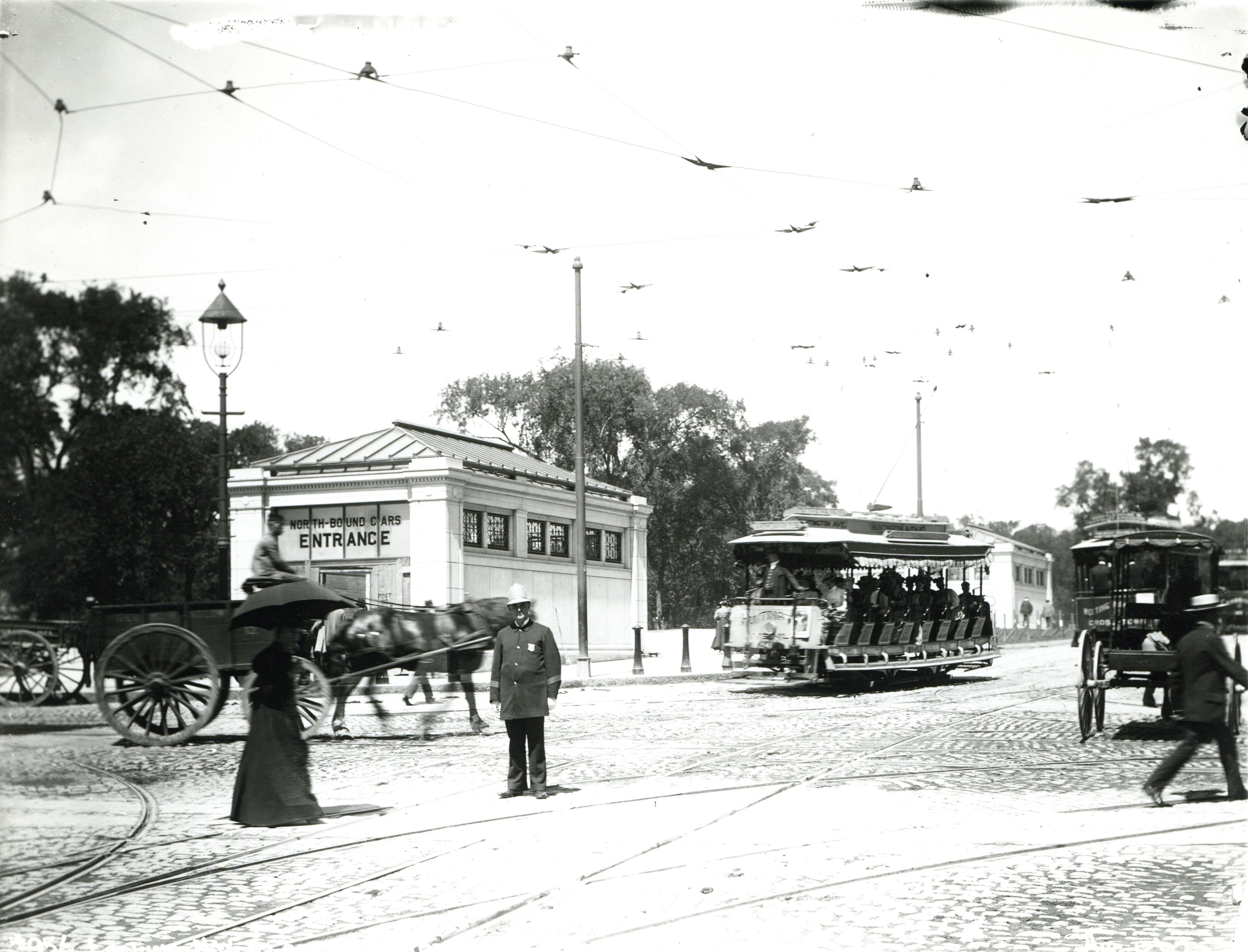
Before Boston had a subway, downtown had a standstill. By the 1890s, electric streetcars ran nose to tail along Tremont, Washington, and the narrow lanes between them, trapped behind horse-drawn wagons and each other. The German guidebook author Karl Baedeker wrote in 1893 that "the extraordinary congestion of the main business streets of Boston makes the electric tramway somewhat of an absurdity in the centre of the city." Locals joked it was faster to climb out of a trolley and walk across the roofs of the parked cars to your destination. The Great Blizzard of 1888, which buried the region and froze transportation solid, sharpened the argument that the surface streets could no longer carry the city. In June 1891, the state created the Boston Transit Commission to study the problem and propose a fix. Officials weighed routing trolleys through alleys, lifting them onto elevated viaducts, or putting them underground. For the core of the city, where the standstills were worst, the commission chose a subway — a method with only a handful of precedents anywhere in the world.
Digging Under the Common
Construction began at the Public Garden on March 28, 1895, under chief engineer Howard A. Carson, and the work was cut-and-cover: streets torn open, tunnels built, streets restored. It was not a gentle project. On March 4, 1897, illuminating gas that had been leaking for weeks from an underground main into the cavity between the station roof and the street above ignited when a horse-drawn trolley passed over the intersection of Tremont and Boylston Streets; six people were killed and at least sixty seriously injured, though the future Boylston station itself survived. The stations were designed with rectangular stone headhouses by architect Edmund M. Wheelwright — granite entrance kiosks with copper roofs that critics promptly called "resembling mausoleums" and "pretentiously monumental." The criticism was sharp enough that it influenced the design of later Boston stations, which got deliberately more modest entrances. But the headhouses at Park Street survive in use today, covered by the tunnel's National Historic Landmark designation.
September 1, 1897: The First Run
On the morning of September 1, 1897, the Tremont Street Subway opened for public travel between the Public Garden and Park Street, and America had its first subway. The first revenue car was streetcar No. 1752, driven by veteran motorman Jimmy Reed — an ordinary streetcar that simply dove underground and kept going, which was the whole point: this was not a new rail technology but the city's existing trolleys, freed from the street. Thousands of Bostonians gathered to watch the cars emerge. Even the New York Times took notice, remarking, in what reads now as a backhanded compliment, that "that so conservative an American town should happen to be the pioneer in adopting this is viewed as remarkable." Boston had beaten New York by seven years; the subway is the oldest tunnel in North America still in service and, by one reckoning, the third-oldest in the world still operating on electric traction, after lines in London (1890) and Budapest (1896). Park Street and Boylston opened together that morning and remain open today, making them the oldest subway stations in the United States. A few weeks later the Pleasant Street portal opened at the corner of Tremont and Pleasant, and the following year the tunnel extended north through Scollay Square and Adams Square to Haymarket.
The Tunnel Grows and Shrinks
The original subway was never meant to be what it became. It was built to relieve surface congestion, not as true rapid transit — its five closely spaced stations (Boylston, Park Street, Scollay Square, Adams Square, Haymarket) were spaced for trolleys, and the short-lived Beach Pneumatic Transit in New York is the only American predecessor. Yet the tunnel kept absorbing history. From 1901 to 1908, heavy elevated trains — the future Orange Line — ran through the subway's outer tracks alongside the trolleys, until they moved to their own Washington Street Tunnel. In 1912 the Cambridge–Dorchester line (today's Red Line) dug a lower level at Park Street, turning the station into the system's main transfer hub. In 1914 the Public Garden portal closed when the subway was extended west under Boylston Street to Kenmore; the Pleasant Street incline, which had carried streetcars south to Egleston and City Point in South Boston, ended service in 1962, and its portal is now buried beneath Elliot Norton Park at Tremont and Charles Streets — the dead-ended tunnel survives below. The northern stations fared worse: during the construction of Government Center and the new City Hall in 1963, Scollay Square station was rebuilt and Adams Square station closed; a surviving 150-foot section of the abandoned northbound tunnel was later renovated as records storage. The surviving spine — Boylston to Park Street to Government Center — became the core of today's MBTA Green Line. The subway was designated a National Historic Landmark in 1964, added to the National Register of Historic Places in 1966, and named a National Historic Civil Engineering Landmark in 1978.
What to Look For Today
Stand on the Green Line platform at Boylston, the least-modified of the two original stations, and you are standing in an 1897 room: the curve of the tunnel, the original tile and arches, and the same platform configuration it has had for more than a century. Two vintage streetcars — PCC car 3295 and Type 5 car 5734 — are typically on display on a disused outer track by the inbound platform. At Park Street, walk the Common-side plaza and find the two granite kiosks with copper roofs, Wheelwright's much-criticized headhouses, still marking the entrances, plus the later pavilions added in the 1995 remodeling. In what is now an exit at Park Street, a bronze plaque records the facts in the Commission's own words: the subway was authorized by the legislatures of 1893 and 1894, built by the Boston Transit Commission under chief engineer Howard Adams Carson, begun at the Public Garden on March 28, 1895, and "opened to this point for public travel 1 September 1897." Then ride any Green Line train — B, C, D, or E — between Boylston and Park Street, and you are riding the country's first subway tunnel, on trolleys, exactly as Boston intended.
Key Facts
- Opened September 1, 1897: the first subway in the United States and the oldest subway tunnel in North America still in use.
- Built under chief engineer Howard A. Carson to get streetcar lines off traffic-clogged downtown streets — not as true rapid transit; the Great Blizzard of 1888 helped force the decision.
- First two stations, Park Street and Boylston, opened together on opening day and remain the oldest subway stations in the U.S.; the tunnel was extended to Haymarket in 1898.
- The surviving portions form the central spine of today's MBTA Green Line; designated a National Historic Landmark (1964) and a National Historic Civil Engineering Landmark (1978).
Location Photography


Visitor Details
Address: Park Street station, Tremont Street at Park Street, Boston, MA (east edge of Boston Common)
Transit: MBTA Green Line (B, C, D, E branches) and Red Line; Park Street is the main Green/Red transfer station.
Hours/Admission: This is a working transit station — ride with a regular MBTA fare. Check the official MBTA site before visiting for current fares, hours, and any service alerts.
Best timing: Ride the Green Line between Boylston and Park Street outside rush hour to see the tunnel without the crush. Linger at Boylston for the original 1897 tile and arches; at Park Street, step up to the Common-side plaza to read the bronze plaque and see Wheelwright's granite headhouses.