Two Centuries on Wallabout Bay
The story starts with a curve in the East River. Wallabout Bay — a broad, sheltered bend of the river in northwest Brooklyn — had been recognized as a natural harbor since Dutch times, and it carried a grim Revolutionary history: during the British occupation, prison ships moored off the bay held thousands of American captives, as many as 11,500 of whom died, most infamously aboard the Jersey. When President John Adams moved in the final days of his presidency to authorize the young nation's first naval shipyards, Brooklyn was an obvious choice. The Navy Yard was established in 1801, one of the first five.
The Yard grew with the republic. In 1806 the Commandant's House — Quarters A — was completed; it remains the oldest building associated with the Yard and a National Historic Landmark. In 1837 the Yard launched the Fulton II, the first U.S. steam warship assigned to sea duty, a sign of the technological shift the shipyard would ride for a century and a half. Between 1841 and 1851 the Yard built Dry Dock 1, a granite-lined graving dock that still holds ships today — making it one of the oldest working dry docks in the country.
For its first sixty years the Yard built wooden ships. Then came iron, and the Yard's most famous early product: in 1862 it fitted out the USS Monitor, the ironclad turret ship that fought the CSS Virginia to a draw at Hampton Roads and changed naval warfare in a single afternoon.
The Can-Do Shipyard
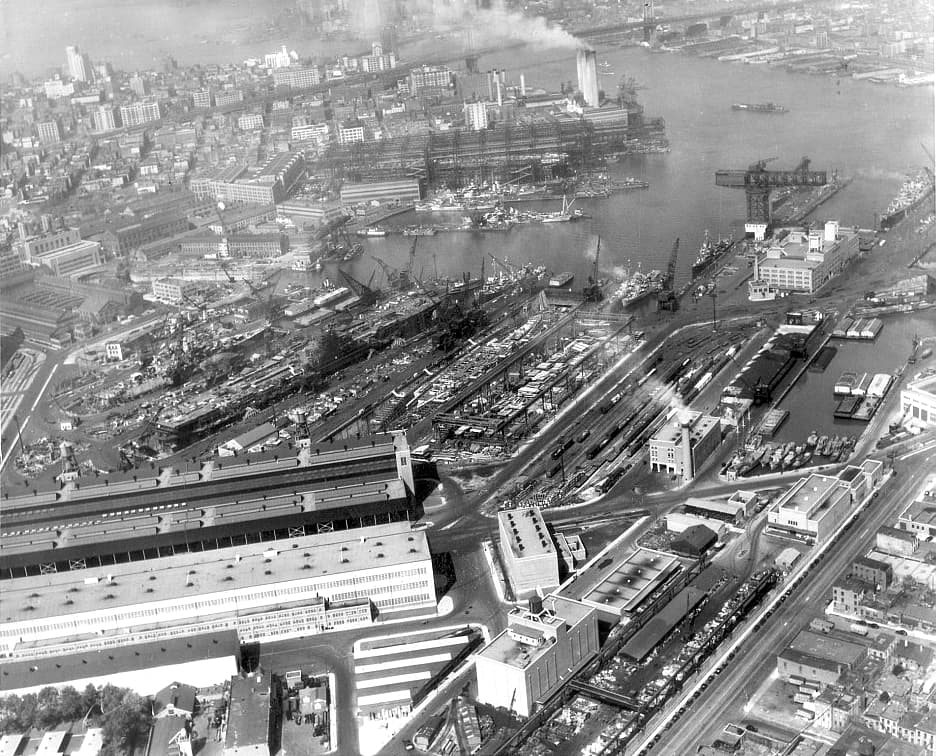
No period defined the Yard like World War II. At its peak the Brooklyn Navy Yard employed roughly 70,000 men and women working around the clock in shifts — the largest naval construction facility in the United States and, at the time, the largest single employer in New York State. They built battleships and aircraft carriers, repaired more than 5,000 ships, and converted hundreds more. The effort earned the Yard its enduring nickname: the Can-Do Shipyard.
The ships that slid down its ways read like a syllabus of American naval history. The USS Arizona, sunk at Pearl Harbor on December 7, 1941, was built here a generation earlier. So was the USS Missouri, launched in 1944 — and on September 2, 1945, the instrument of Japan's surrender was signed on the Missouri's decks in Tokyo Bay, ending the war on a ship built in Brooklyn. The Yard also constructed the carriers Bennington, Bon Homme Richard, Kearsarge, and Franklin D. Roosevelt, and the battleships North Carolina and Iowa.
At its wartime maximum the Yard sprawled across more than 350 acres of waterfront. Then the war ended, the work thinned, and the Navy's calculus changed.
The Gates Close
By 1965, fewer than 7,000 men and women still worked at the shipyard — roughly a tenth of the wartime peak. The reasons were structural, not sentimental: warship designs had grown so large that new hulls could barely be built in a yard hemmed in by the city, and the tallest ships could no longer pass beneath the Brooklyn and Williamsburg Bridges. In 1966, Secretary of Defense Robert McNamara folded the Yard into a nationwide round of base closures. On June 25, 1966, the decommissioning ceremony lowered the flag over the Yard for the last time, and the clang of steel went silent.
New York City purchased the site the following year, and in 1971 it reopened as an industrial park. The decades that followed were lean ones — much of the Yard sat underused as manufacturing hollowed out across the city. The dry docks kept working when they could, but the grand era of shipbuilding was plainly over, and for a long stretch the Yard's future was an open question.
A Working Yard Again
What happened next is one of New York's better second acts. Instead of being carved into condos or left to rot, the Yard stayed industrial. The city-owned site — about 300 acres along the East River — is now managed as a center of urban manufacturing and innovation, home to more than 450 businesses employing over 11,000 people in manufacturing, technology, and skilled crafts.
The naval past is not decoration here; it is infrastructure still in use. Dry Dock 1, completed in 1851, is still a working dry dock for ship repair — you can stand at its edge and watch hulls being worked on, 180 years after it was dug. The Civil War-era machine shops still machine. Building 77, a World War II-era manufacturing building, has been renovated into a food manufacturing hub. The Yard's own museum and visitor center sits at BLDG 92, a free exhibition in a former Marine Commandant's residence, in a LEED Platinum-certified building.
Even the quieter corners have been reclaimed. The Naval Cemetery Landscape, a former naval burial ground, is now a native-plant ecological park designed for bird habitat — a green pause inside the industrial grid.
How to See It
The Yard is a working industrial site, not an open campus, so the smart way in is through its official programs. BLDG 92, the visitor and exhibition center, tells the Yard's past, present, and future through artifacts, oral histories, and a permanent exhibition — and it's free. Turnstile Tours, which has run the Yard's official tours since 2008, offers a two-hour "Past, Present & Future" walking tour on Saturdays, departing from Building 77, visiting the museum, historic buildings, and a working dry dock. Advance ticket purchase is required — check turnstiletours.com for the current schedule and prices.
Getting there is half the pleasure: the NYC Ferry's Astoria Route stops at the Brooklyn Navy Yard dock, so you can approach the way ships always have, across the water. Once inside, expect contrasts you won't find anywhere else in the city — a 19th-century dry dock beside a rooftop farm, a battleship-era machine shop beside a modern fabrication studio. The Can-Do Shipyard never really stopped; it just changed what it makes.
Key Facts
- Established 1801 as one of the first five U.S. naval shipyards, authorized under President John Adams; operated continuously until decommissioned in 1966.
- Built the USS Monitor (1862), USS Arizona (launched 1915), and USS Missouri (launched 1944); Japan's WWII surrender was signed aboard the Missouri.
- WWII peak: roughly 70,000 workers — the largest naval construction facility in the U.S., nicknamed the "Can-Do Shipyard."
- Today: ~300 acres, 450–500+ businesses, 11,000+ jobs in manufacturing and tech; Dry Dock 1 (1851) still used for ship repair.
Location Photography


Visitor Details
Address: 63 Flushing Ave, Brooklyn, NY
Transit: NYC Ferry Astoria Route to the Brooklyn Navy Yard stop; MTA buses along Flushing Ave (B57/B69 corridors) and nearby subway at York St (F) or Atlantic Ave-Barclays (multiple lines) with a bus connection.
Hours/Admission: BLDG 92 exhibition is free; guided tours via Turnstile Tours (Saturdays, 2-hour walking tour from Building 77), advance tickets required. Check brooklynnavyyard.org and turnstiletours.com before visiting, as schedules and prices change.
Best timing: Saturday afternoons for the guided walking tour; arrive by ferry for the full waterfront approach.