Built Because the Water Was Killing People
The Fairmount Water Works exists because of fear. In the 1790s, a series of yellow fever epidemics tore through Philadelphia, and the medical thinking of the day blamed unclean water and the rotting matter in the streets. The city council appointed a Watering Committee, and its first answer was Benjamin Henry Latrobe's Centre Square waterworks, accepted in 1799: two steam engines working in series, pumping Schuylkill River water into wooden tanks that together held just 57,000 gallons, from which it ran by gravity through wooden mains. It was a pioneering system and a fragile one. If either engine failed, the water supply to the entire city stopped, and the storage was hopelessly small for a growing port. The committee went looking for something bigger and more reliable, and chose John Davis and Frederick Graff — Latrobe's apprentice and successor as chief engineer — to design a new waterworks at Fairmount, the rocky bluff on the east bank of the Schuylkill, then about a mile from the built-up town. What Graff designed there would run, in one form or another, for almost two hundred years.
A Greek Temple Full of Steam Engines
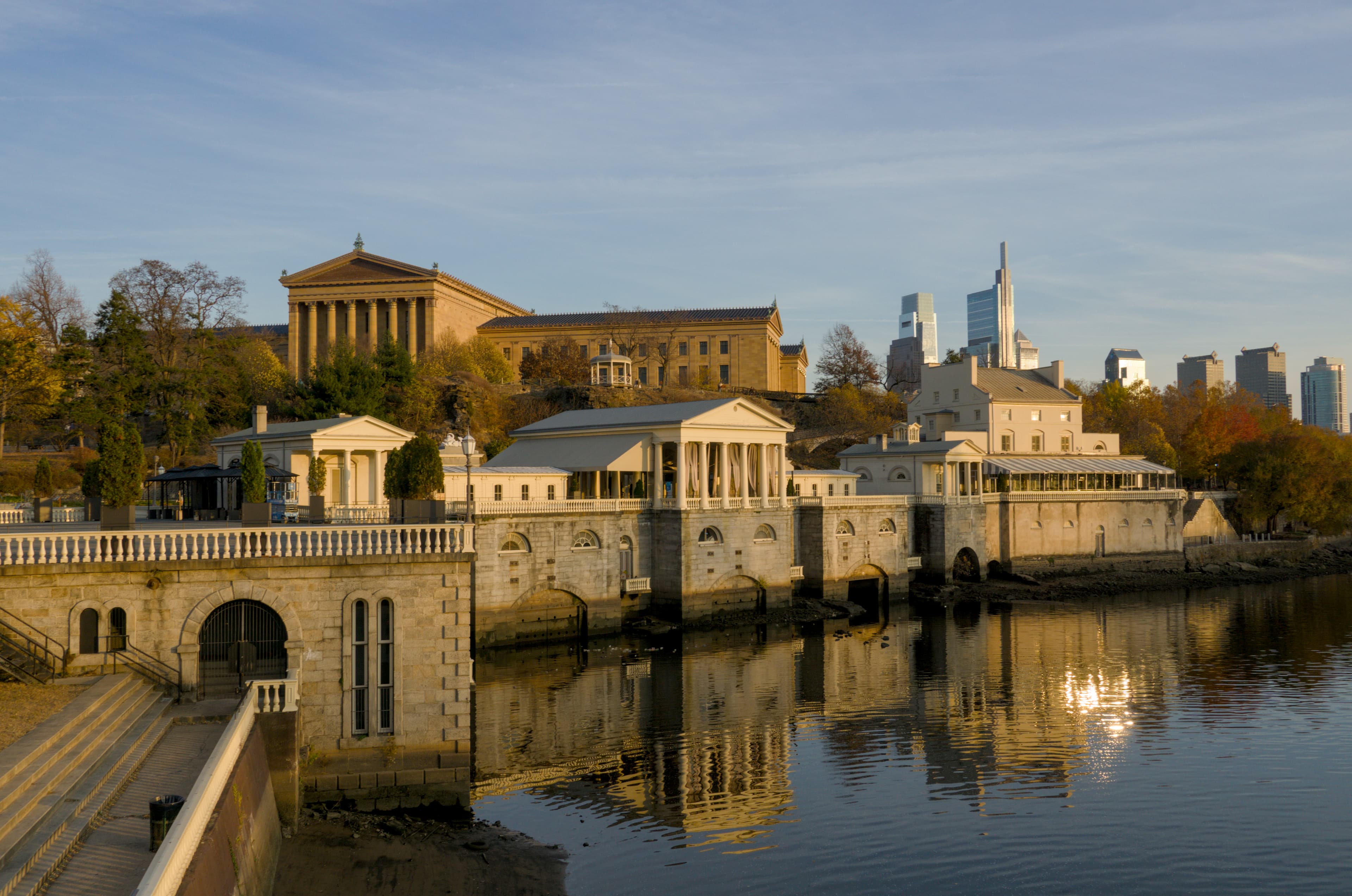
Construction ran from 1812 to 1815. The engine house held two steam engines that lifted river water into an earthen reservoir of about three million gallons atop Faire Mount — the hill where the Philadelphia Museum of Art stands today — from which the city's supply flowed downhill by gravity. The machinery was advanced, but what made Fairmount famous was its manners. Graff disguised an industrial plant as a piece of classical scenery: colonnaded mill houses, temple-fronted pavilions, balustraded terraces stepping down to the river. The industrial nature of the place was deliberately hidden behind a Classical Revival exterior, and visitors consistently refused to believe they were looking at a pumping station. The politics were as considered as the architecture. Philadelphia was the first large American city to supply water as a municipal public service: if you did not want a pipe run into your house, you could still draw water free of charge at a public hydrant. Fairmount was infrastructure built as a civic argument — that clean water was not a commodity to be sold back to citizens but a duty the city owed them, delivered beautifully enough to make the point stick.
The Dam That Let the River Pump the City's Water
Steam was powerful but expensive, and Graff's masterstroke was to make the Schuylkill do the lifting itself. Between 1819 and 1821, workers built Fairmount Dam — a timber-crib dam roughly 1,600 feet long, angled diagonally across the river — to divert water into a mill race and forebay along the bank. In 1822, three great water wheels in the mill house began turning, and the steam engines were retired: Fairmount became the first water supply in the United States driven by water wheels. The dam did two other jobs at once. The Schuylkill is tidal near its mouth, and the dam kept brackish Delaware River water from creeping up to the intakes; above it, the backed-up river formed the Fairmount Pool, a calm five-mile reach that is still the rowing water of Boathouse Row. After Graff's death in 1847, his son Frederic Graff Jr. kept the works current: a brick Italianate standpipe tower rose in 1852 to feed a new reservoir, and Jonval turbines — more efficient and hidden underwater — progressively replaced the wheels, housed in a New Mill House built beside the old one and in the renovated Old Mill House itself; the last wheels were gone by about 1872. The present dam, rebuilt in 1928 on the original cribs, still spills in the same place.
The Most Fashionable Machine in America
Almost immediately, the Water Works became a sight to see — one of the most popular tourist attractions in early nineteenth-century America. Graff laid out landscaped grounds along the bank, the South Garden, with shaded walks, summer houses, terraces, and fountains; riverboats ran fashionable excursions up the Schuylkill from it, and its image was reproduced in virtually every medium of the day, down to transfer prints on earthenware and porcelain. Fanny Trollope, visiting in the early 1830s, called it a lovely scene and noted that Philadelphians resorted there in such numbers that several evening stages ran out to Fair Mount for their accommodation. Charles Dickens, no easy grader of American institutions, praised its pleasant design and public usefulness. The grounds around the works were landscaped into what the National Park Service nomination calls the nucleus of one of the first parks in America — not a town common or square, but scenery composed around a public work, with garden walks and summer houses where Philadelphians flocked in good weather. The pleasure grounds had a serious afterlife: in the 1850s the city began buying land upriver, starting with estates like Lemon Hill, specifically to keep the water supply clean. Those protective purchases grew into Fairmount Park, today one of the largest urban park systems in the country — a park that exists, at root, because a waterworks needed its river defended.
Aquarium, Ruin, Rebirth
By the early 1900s the river Fairmount depended on had been fouled by the industry along its banks, and the crowded site had no room for the modern filtration plants the city now needed. New pumping stations with sand filtration beds took over the supply, and the Fairmount Water Works was decommissioned in 1909. The mill houses found a second career in 1911 as the Philadelphia Aquarium — one of the first aquariums in the United States, drawing millions of visitors until it closed in 1962 — followed by an indoor swimming pool that lasted into the early 1970s. Then came the hard decades: vacancy, deterioration, and fire. The hilltop reservoir was drained and filled in the 1920s, Graff Jr.'s standpipe tower was demolished, and the Philadelphia Museum of Art rose on the reservoir's ground — the city's temple of art succeeding its temple of water on the same hill. Rescue arrived in the landmark year of 1976, when the works were listed on the National Register and designated a National Historic Landmark; engineering landmark designations followed from the civil engineers in 1976 and the mechanical engineers in 1977. Over the next three decades the complex was carefully restored, a project completed in 2008. Since 2003 the buildings have housed the Fairmount Water Works Interpretive Center, the Philadelphia Water Department's environmental education center, where the old engine house spaces now hold exhibits on the watershed, a freshwater mussel hatchery, and the machinery's descendants. The temple of clean water is back at its original job: explaining the river to the city that drinks from it.
Key Facts
• Designed by Frederick Graff and built 1812–1815 on the east bank of the Schuylkill; Philadelphia's second municipal waterworks, pumping river water up to a roughly 3-million-gallon reservoir atop Faire Mount, where the Philadelphia Museum of Art now stands.
• Fairmount Dam (1819–1821, about 1,600 feet long) diverted the river to a mill race so that, from 1822, water wheels replaced steam engines — the first water supply in the United States driven by water wheels; the dam also blocked brackish tidal water and created the five-mile Fairmount Pool used by Boathouse Row.
• Its Classical Revival mill houses and landscaped South Garden made it one of the most visited attractions in early 19th-century America; the protective land purchases begun around it in the 1850s grew into Fairmount Park.
• Operated as a waterworks until 1909, then housed the Philadelphia Aquarium (1911–1962) and an indoor pool; designated a National Historic Landmark in 1976, with civil (1976) and mechanical (1977) engineering landmark honors.
• Restored over three decades, completed in 2008; since 2003 it has been the Fairmount Water Works Interpretive Center, run by the Philadelphia Water Department.
Visitor Details
Address: 640 Waterworks Drive (lower level), Philadelphia, PA 19130 — on the east bank of the Schuylkill at the Fairmount Dam, just below and behind the Philadelphia Museum of Art.
Transit: SEPTA bus routes 38 and 32 stop nearby (per the official site), and the seasonal Philly PHLASH serves the Art Museum area at Stop 11; the site also sits directly on the Schuylkill River Trail, an easy walk from the Benjamin Franklin Parkway via Kelly Drive or Martin Luther King Jr. Drive, with Boathouse Row a few minutes north along the river. Free two-hour parking is available along Water Works Drive.
Hours/Admission: Interpretive Center open Wednesday–Saturday, 10 am to 5 pm; general admission is free, donations welcome (per fairmountwaterworks.org, checked before writing — confirm current hours before visiting, as schedules change). Note: the center currently reports no elevator access, following flood damage from Hurricane Ida. The grounds, terraces, and dam views are public parkland and can be walked when the center is closed.
Best timing: Late afternoon, when low sun lights the mill houses' river facade and the dam — the classic view is from the Martin Luther King Jr. Drive side of the river. Pair the center with a walk north past Boathouse Row toward evening, when the boathouses are lit, and allow time for the Art Museum steps above.
Location Photography