A Cornerstone in a Swampy New Capital
George Washington never slept in the White House — the one president who didn't. He chose its site on Pennsylvania Avenue in the new federal city, oversaw its design competition, and died before it was finished. The winning architect was James Hoban, an Irish immigrant who drew on Leinster House in Dublin, then as now a seat of government, for the plan: a dignified three-story stone house with a temple front, scaled to a republic rather than a palace. The cornerstone was laid on October 13, 1792, and the walls rose in Aquia Creek sandstone, much of it quarried and dressed by labor that included enslaved workers hired out to the building commissioners — a fact the historical record, after long neglect, now states plainly. John and Abigail Adams moved in on November 1, 1800, into a house still unfinished: plaster wet, staircases incomplete, and Abigail famously hanging the family laundry in the grand, empty East Room because there was nowhere else to dry it.
Fire: August 24, 1814
Fourteen years later the house met its catastrophe. During the War of 1812, after defeating American forces at Bladensburg, British troops entered Washington on August 24, 1814, and set fire to the public buildings. President James Madison had fled; his wife Dolley, waiting until the last safe moment, directed that Gilbert Stuart's full-length portrait of George Washington be saved, and members of the household staff cut it from its frame and carried it out before the soldiers arrived. The British ate the dinner laid out in the dining room, then burned the house. By morning the interior was ash and only the sandstone walls stood — and even they were scarred; scorch marks from 1814 can still be found on some of the original exterior stones. Hoban himself supervised the rebuilding, and James Monroe moved into the restored house in 1817. The building had in fact been whitewashed early in its life to protect the porous stone from freeze damage, and it was called the "White House" informally for decades — but the name only became official in 1901, when Theodore Roosevelt put it on the presidential stationery.
Growing the House: Porticoes, Wings, and a New West Front
The house Adams knew would be unrecognizable in its conveniences within a generation. Monroe added the curved South Portico in 1824; Andrew Jackson added the columned North Portico in 1829, creating the famous front door on Pennsylvania Avenue. Running water arrived in the 1830s, gas lighting in 1848, and a succession of greenhouses sprawled where the West Wing now stands. The decisive change came in 1902, when Theodore Roosevelt hired McKim, Mead & White to strip away the Victorian clutter, restore the state rooms, and build a separate executive office building — the West Wing — so the house could be a residence again. William Howard Taft made its office oval in 1909; Franklin Roosevelt moved the Oval Office to its present corner in 1934, positioned so he could move between work and residence with dignity. An East Wing followed in 1942, and Harry Truman added the now-beloved — then loudly criticized — balcony off the second-floor Yellow Oval Room in 1948.
The House Comes Down: The Truman Reconstruction
Truman's balcony turned out to be the last addition the old timbers could quietly bear. By 1948 engineers found ceiling beams sagging and splitting; in 1949, a leg of Margaret Truman's piano broke through the floor of her second-floor sitting room into the family dining room below. The verdict was total: the house was structurally failing and had to come apart. From late 1949 to 1952, workmen dismantled the mansion from the inside out — furnishings to storage, paneling and stonework catalogued and numbered, the famous exterior walls taken down stone by numbered stone — excavated two new basement levels beneath the empty shell, poured a modern steel and concrete structure, and reassembled the original facade around it. Truman waited out the work at Blair House, the official guest residence across Pennsylvania Avenue, where in November 1950 two Puerto Rican nationalists tried to assassinate him on its steps, killing White House Police Officer Leslie Coffelt. The family returned to the rebuilt house in March 1952; a decade later, Jacqueline Kennedy's restoration and her televised tour of the rooms introduced tens of millions of Americans to the house they had paid to rebuild.
What the Public Can Actually See
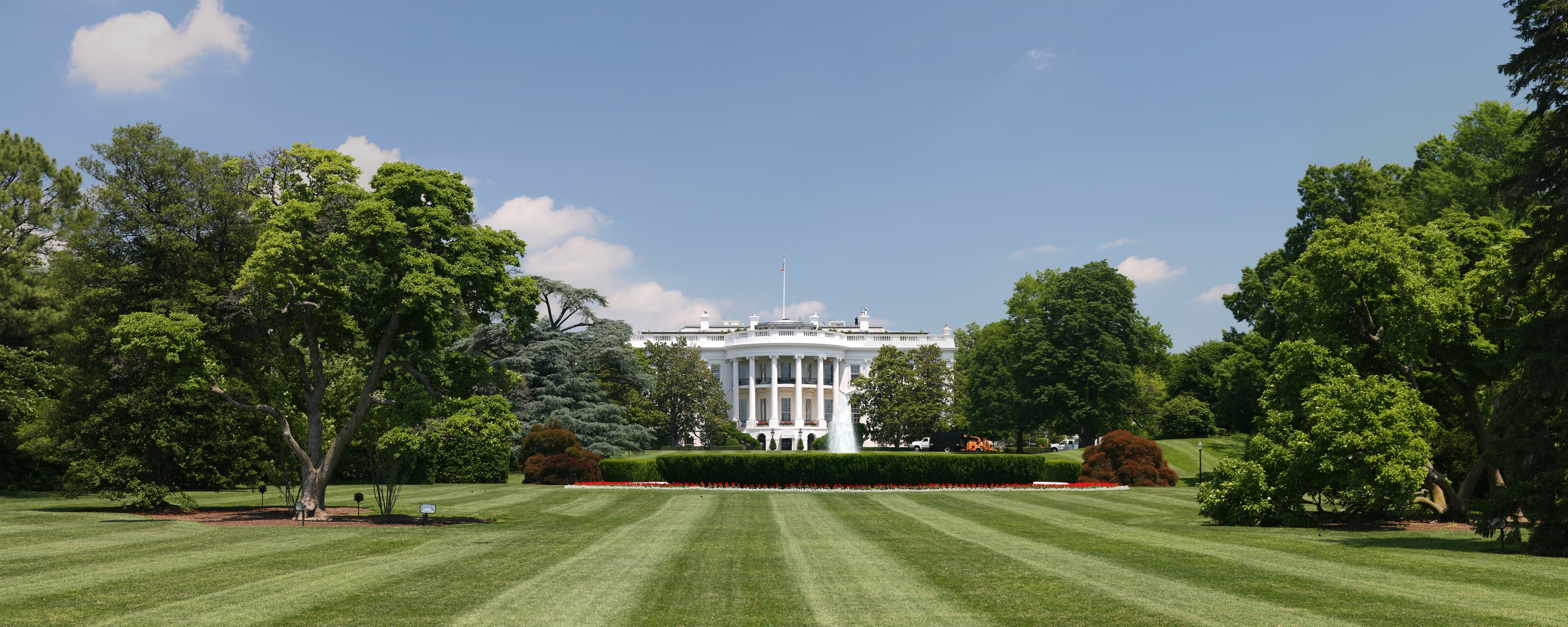
Be clear-eyed about access: there is no queue, no ticket window, and no walking up. Interior tours are free but must be arranged well in advance — U.S. citizens request them through their member of Congress (per whitehouse.gov, requests may be submitted from 7 to 90 days ahead; foreign visitors apply through their embassy in Washington), and tours are confirmed or denied only about two weeks out, subject to cancellation on short notice when the house has work to do. Those who get in take a self-guided route through the State Floor's public rooms — the Entrance Hall and Cross Hall, the Green, Blue, and Red Rooms, and the State Dining Room — with Secret Service officers posted along the way to answer questions; the West Wing and the Oval Office are not on the tour. Everyone else gets the exterior, which is genuinely worth the trip: the North Front from the fence on Pennsylvania Avenue at Lafayette Square (closed to vehicles since 1995 and now a pedestrian plaza), and the South Front across the Ellipse, the postcard view over the South Lawn. The free White House Visitor Center, run by the National Park Service at 1450 Pennsylvania Avenue NW, fills in the interiors with exhibits and a film for those without a tour slot — and it is the one part of the White House story you can simply walk into off the street.
A Working Symbol
The numbers sketch the strangeness of the place: 132 rooms, 35 bathrooms, six levels, about 55,000 square feet, set in 18 acres of President's Park in the middle of a capital city. It is simultaneously the most public building in America and a private family apartment; its state rooms host dinners for monarchs while, two floors up, a president's family lives something like an ordinary life. The grounds carry their own calendar — the Easter Egg Roll on the South Lawn, held since 1878; the pardoned Thanksgiving turkey; state arrival ceremonies on the South Lawn; Christmas trees and menorah lightings. The grounds earn their keep in public, too. The Rose Garden along the West Wing colonnade — planted under Ellen Wilson in 1913 and redesigned by Rachel "Bunny" Mellon for John F. Kennedy in 1961 — serves as the presidency's outdoor stage for welcomes, signings, and announcements, balanced on the east side by the Jacqueline Kennedy Garden; neither garden is on the public tour route. That is the house's essential arrangement in miniature: the rooms and gardens America knows best are the ones it sees on screens, from a distance, or not at all. Twice destroyed or dismantled, rebuilt once by its own original architect and once by an army of cataloguers, the house at 1600 Pennsylvania Avenue keeps its odd double identity intact: a working office of state that happens also to be the nation's front parlor — and its most guarded front door.
Key Facts
- Designed by Irish-born architect James Hoban and built 1792–1800 of Aquia Creek sandstone; first occupied by President John Adams in November 1800. George Washington, who chose the site, is the only president never to have lived there.
- Burned by British troops on August 24, 1814, during the War of 1812; only the exterior walls survived (1814 scorch marks remain visible on original stones). Dolley Madison directed the rescue of Gilbert Stuart's portrait of George Washington before the fire.
- Rebuilt under Hoban by 1817; the South Portico was added in 1824 and the North Portico in 1829; Theodore Roosevelt made "White House" the official name in 1901 and built the West Wing in 1902 (Oval Office added 1909, moved to its present position in 1934).
- Completely dismantled and rebuilt in the Truman reconstruction of 1949–52: the interior was gutted and the exterior stones numbered, removed, and reassembled over a new steel-and-concrete frame with two added basement levels.
- The mansion contains 132 rooms and 35 bathrooms across six levels (about 55,000 square feet) on 18 acres of President's Park.
- Interior tours are free but available only by advance request — U.S. citizens apply through their member of Congress (7–90 days ahead, per whitehouse.gov); foreign nationals apply through their embassy. There is no walk-up entry.
Visitor Details
Address: 1600 Pennsylvania Avenue NW, Washington, DC 20500. The interior is open only on approved tours; the exterior is viewed from Lafayette Square (north, on Pennsylvania Avenue) and the Ellipse (south).
Transit: McPherson Square and Farragut West stations (Blue/Orange/Silver lines) and Metro Center are all a short walk away. Pennsylvania Avenue in front of the White House has been closed to vehicles since 1995 and is a pedestrian plaza.
Hours/Admission: No walk-up entry to the house at any time. Public tours are free and self-guided, generally offered Tuesday–Thursday 7:30–11:30 am and Friday–Saturday 7:30 am–1:30 pm, excluding federal holidays — but only to visitors whose advance request through their member of Congress (7–90 days ahead, per whitehouse.gov) has been approved, and schedules change or tours cancel on short official notice. Foreign visitors request through their embassy in Washington. The White House Visitor Center (1450 Pennsylvania Avenue NW), run by the National Park Service, is free and open to walk-ins; check nps.gov for its current hours. Expect airport-style screening on tours, and note that bags are not permitted inside.
Best timing: For exteriors, early morning at the Lafayette Square fence for the quietest North Front view, and golden hour from the Ellipse or the Washington Monument grounds for the South Front. For a tour, submit the congressional request as early in the 90-day window as you can — approvals come roughly two weeks before the date and popular seasons fill fast.
Location Photography