
A plan drawn in 1791, finished in pieces
The National Mall begins with a plan. In 1791, Pierre Charles L'Enfant, the French-born engineer commissioned to design the new federal capital, drew a grand, mile-long public promenade running west from the Capitol — a "Grand Avenue" of gardens, monuments, and public buildings, flanked by the city's great institutions. L'Enfant's plan was visionary and, for a century, largely unrealized: the Mall's ground was, for decades, a jumble of railroad tracks, gardens, grazing land, and scattered buildings, crossed by streets and cluttered with sheds.
The Mall we walk today is the product of a second plan: the McMillan Plan of 1901–1902, drawn up by the Senate Park Commission under Senator James McMillan, which revived L'Enfant's vision and gave it its modern form — a long, open, tree-lined expanse, with the Washington Monument at its center, the Capitol anchoring the east, and, eventually, the Lincoln Memorial anchoring the west. The plan cleared the railroads, unified the grounds, and set the rules that still govern the Mall: low, horizontal museum buildings along its flanks, open lawn at its center, and monuments at its nodes. The result is not a park in the ordinary sense. It is a designed landscape with a civic job to do: to give the nation's capital a public room large enough for its history.
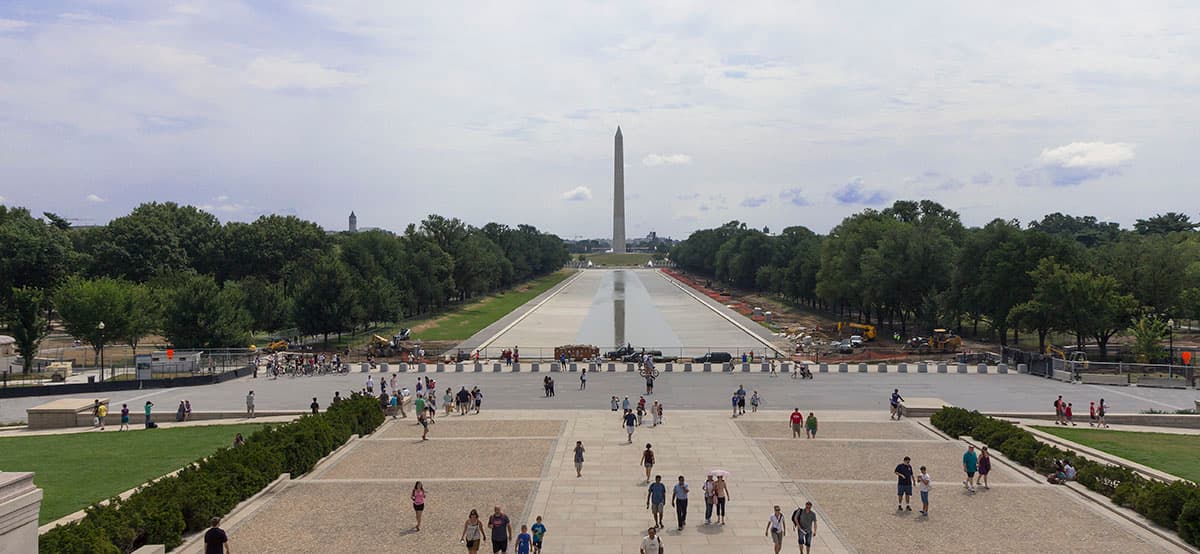
That history is written into the ground in layers. The Mall's east end is the Capitol, seat of Congress, on its hill. Its center is the Washington Monument, the 555-foot obelisk to the first president, completed in 1884 after decades of interrupted construction — its two-tone masonry, where construction stopped and resumed, is still visible, a record of the nation's interrupted nineteenth century. Its west end is the Lincoln Memorial, completed in 1922, a Greek temple in marble holding Daniel Chester French's seated Lincoln and the words of the Gettysburg Address and the Second Inaugural carved into its walls. Between them runs the Reflecting Pool, a long, still basin that doubles the Monument and the Memorial in its surface, and the long lawns and elm-lined paths where millions walk each year.
The museums along the flanks
The Mall's flanks are, in themselves, one of the great museum districts on earth. On the north and south sides of the lawn stand the Smithsonian museums — most of them free, all of them part of the same public trust — and the National Gallery of Art. A visitor could spend a week here and not exhaust them, and the Mall's design makes that possible: the museums open directly onto the lawn, so a walk between monuments becomes, naturally, a walk between museums.
The great Smithsonian anchors, east to west, include the National Air and Space Museum, the National Museum of the American Indian, the National Museum of African American History and Culture, the National Museum of American History, and the National Museum of Natural History, along with the Smithsonian Castle — the Institution's red sandstone headquarters, built in the 1850s, which serves as its visitor center — and the Freer and Sackler galleries of Asian art and the Hirshhorn Museum of sculpture. The National Gallery of Art, with its West Building of European and American art and its East Building of modern art, stands on the north side, and the National Archives, just off the Mall to the north, holds the Declaration of Independence, the Constitution, and the Bill of Rights.
This article does not try to replace the articles on each of those institutions — several already have their own stories on this site — but it treats the Mall as what it is: the frame that holds them. The Smithsonian museums are free, and that freeness is a deliberate American choice, written into the Smithsonian's founding bequest from James Smithson, an English scientist who never visited America but left his fortune "for the increase and diffusion of knowledge among men." The Mall is where that bequest becomes a landscape.
The memorials, and what the Mall is for
Beyond the museums, the Mall's memorials give it its emotional weight. South of the Reflecting Pool, along the Tidal Basin, stand the memorials to the twentieth century's wars and presidents — the World War II Memorial, the Vietnam Veterans Memorial, the Korean War Veterans Memorial, the Franklin Delano Roosevelt Memorial, the Martin Luther King Jr. Memorial, and the Jefferson Memorial — each with its own article on this site, each with its own way of remembering. The Mall holds them all in a single landscape, and walking from one to the next, across the lawn and around the basin, is a lesson in how America has chosen, at different moments, to remember its dead and its leaders.
But the Mall is not only a memorial ground. It is also, and just as essentially, a stage. The March on Washington for Jobs and Freedom in 1963, when Martin Luther King Jr. delivered his "I Have a Dream" speech from the steps of the Lincoln Memorial; the anti-war demonstrations of the 1960s and 1970s; the Million Man March of 1995; the Women's March of 2017; the annual Fourth of July celebration, the Smithsonian Folklife Festival each summer, the National Cherry Blossom Festival each spring around the Tidal Basin — the Mall has hosted them all, because it is the one place in America designed to hold a crowd large enough to be the nation talking to itself. A lawn that can hold a million people is not an accident. It is the point.
That dual role — memorial and stage, solemn and celebratory — is what makes the Mall unlike any other public space. On a quiet weekday morning, it is a place of almost monastic calm: joggers, school groups, a few visitors reading the inscriptions at the Lincoln Memorial. On a festival weekend, it is a fairground. On a day of protest, it is a forum. The landscape absorbs all three without changing its form, which is the genius of the McMillan Plan: open ground, strong axes, and monuments that hold their dignity at any scale of crowd.
How to walk it
The Mall runs roughly two miles from the Capitol (at its east end) to the Lincoln Memorial (at its west end), with the Washington Monument near its center. The classic walk is east to west, downhill in spirit if not in grade: start at the Capitol, walk the lawn past the Smithsonian museums, pause at the Washington Monument, continue to the World War II Memorial and the Reflecting Pool, and finish at the Lincoln Memorial, climbing its steps for the view back down the Mall — the view L'Enfant imagined, with the Monument and the Capitol aligned in the distance. That walk, without museum stops, takes about an hour at a stroll; with museum stops, it takes a day, or several.
No fixed admission price is stated in this article, since none is needed: the Mall itself is open public ground, and the Smithsonian museums and the memorials are free to enter. No fixed hour is stated either, since none was verified against an official source in this run: the grounds are open around the clock as public space in practice, while individual museums and the Washington Monument keep their own hours and, for the Monument, a timed-ticket system — so check the official National Park Service and Smithsonian pages before visiting for current museum hours, Monument ticket details, and any closures or construction, including work around the Reflecting Pool.
Practical advice: wear walking shoes, bring water, and use the museums as shade and rest stops — they are spaced along the lawn precisely for that purpose, and their cafes and restrooms make a long walk manageable. The Metro serves the Mall from several directions (Smithsonian, Federal Triangle, Archives, and L'Enfant Plaza stations are the closest, depending on where you start), and the Mall is flat and largely accessible, with paved paths throughout. In summer, start early or late in the day; in spring, time a visit with the cherry blossoms around the Tidal Basin; in winter, the Mall's emptiness has its own stark beauty, and the museums are warm.
Key Facts
- The National Mall is the two-mile ceremonial landscape in Washington, DC, running from the U.S. Capitol in the east to the Lincoln Memorial in the west, with the Washington Monument near its center.
- Pierre Charles L'Enfant drew the original plan in 1791, with a grand public promenade west from the Capitol; the McMillan Plan of 1901–1902 revived and completed that vision in its modern form.
- The Washington Monument, a 555-foot obelisk to George Washington, was completed in 1884; its two-tone masonry records the interruption in its construction.
- The Lincoln Memorial, completed in 1922, holds Daniel Chester French's seated Lincoln and the texts of the Gettysburg Address and the Second Inaugural Address.
- The Reflecting Pool runs between the World War II Memorial and the Lincoln Memorial, mirroring the Monument and the Memorial.
- Smithsonian museums along the Mall — including Air and Space, American Indian, African American History and Culture, American History, and Natural History — are free, as is the National Gallery of Art; the Smithsonian Castle, built in the 1850s, is the Institution's visitor center.
- The Mall has hosted the March on Washington (1963), the Million Man March (1995), the Women's March (2017), the annual Smithsonian Folklife Festival, and the Fourth of July celebration.
- Memorials around the Mall and Tidal Basin include the World War II, Vietnam Veterans, Korean War Veterans, Franklin Delano Roosevelt, Martin Luther King Jr., and Jefferson Memorials.
- Coordinates (Mall center, near the Washington Monument): 38.8895, -77.0353.
Visitor Details
Address: National Mall, Washington, DC — between the U.S. Capitol and the Lincoln Memorial, roughly 3rd Street to 17th Street NW.
Transit: Metro — Smithsonian (Blue/Orange/Silver), Federal Triangle (Blue/Orange/Silver), Archives (Green/Yellow), and L'Enfant Plaza (Blue/Orange/Silver/Green/Yellow) stations serve different points along the Mall.
Hours/Admission: The Mall grounds are open public space and the Smithsonian museums and memorials are free to enter. No fixed museum hour is stated here, since none was verified against an official source in this run — check the official National Park Service and Smithsonian pages for current museum hours, Washington Monument timed tickets, and construction notices.
Best timing: Walk east to west from the Capitol to the Lincoln Memorial (about an hour without museum stops); use museums as shade and rest stops; start early or late in summer; visit in spring for the Tidal Basin cherry blossoms.
Photographs of the National Mall