A memorial you walk through, not around
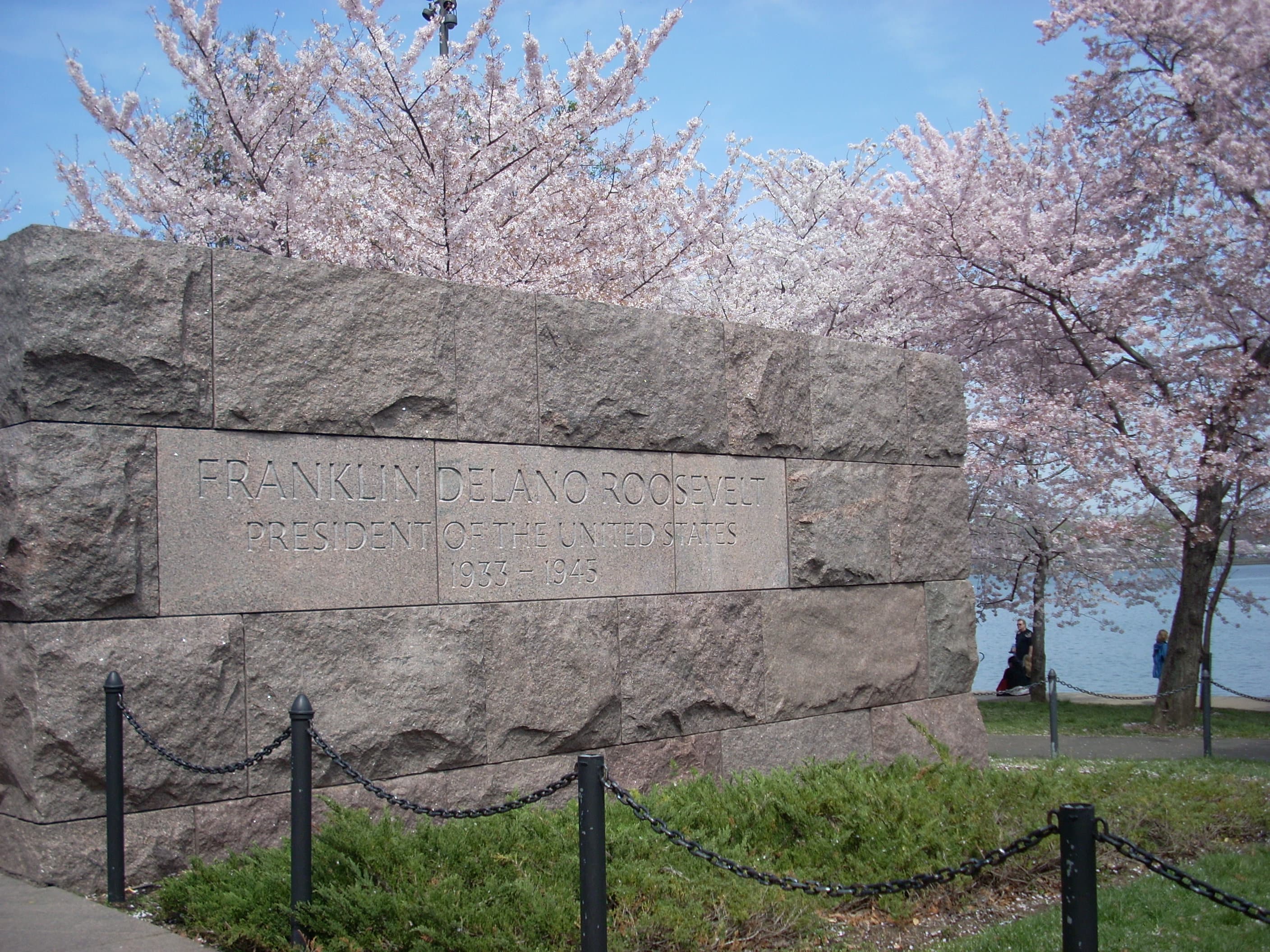
Most of Washington's great memorials ask you to look up. The Franklin Delano Roosevelt Memorial asks you to walk in. There is no towering column, no domed temple, no single statue on a high pedestal. Instead, along the southwest shore of the Tidal Basin in West Potomac Park, between the Jefferson Memorial and the Martin Luther King Jr. Memorial, the memorial unfolds as a sequence of four outdoor rooms built of reddish South Dakota granite, shaded by trees, and animated by running water. You enter at one end and emerge at the other having walked, in order, through the twelve years of Franklin D. Roosevelt's presidency — from the depths of the Great Depression, through the New Deal and the Second World War, to the stillness that follows his death in 1945.
That modesty is deliberate, and it is the memorial's great strength. Roosevelt was the only president elected four times, and the only one to lead the country through both a worldwide economic collapse and a world war. A conventional monument — a figure on a plinth — could honor the man but not the era. Landscape architect Lawrence Halprin, who won the design competition in 1974, chose instead to tell the story in space: walls carved with Roosevelt's own words, bronze figures caught in the moments of ordinary American life his presidency touched, and water that changes character from room to room, growing larger and more complex as the crises of his presidency grow. It is, for a first-time visitor, the most contemplative stop on the Tidal Basin — quieter than the Lincoln Memorial's crowds, more intimate than the Jefferson Memorial's marble hall, and the one that most rewards slowing down and reading the walls.
The memorial was dedicated on May 2, 1997, by President Bill Clinton, more than four decades after Congress first established a commission to honor Roosevelt. It covers 7.5 acres, it is administered by the National Park Service as part of National Mall and Memorial Parks, and it was listed on the National Register of Historic Places on the day of its dedication. Construction had begun on September 16, 1991, after a design history almost as long and contentious as the presidency it honors.
Forty years to build a memorial
Roosevelt himself had asked for almost nothing. In September 1941, he told his friend Supreme Court Justice Felix Frankfurter that if any memorial were ever erected to him, he would like it to be a block about the size of his desk, placed in the green plot in front of the National Archives Building, plain and without ornamentation, carved simply "In Memory of Franklin Delano Roosevelt 1882–1945." His associates fulfilled that wish: a modest white marble block was dedicated on April 12, 1965, the twentieth anniversary of his death, on the lawn in front of the National Archives at Ninth Street and Pennsylvania Avenue NW. It still stands there today.
The grand memorial on the Tidal Basin took a far longer road. Congress established the Franklin Delano Roosevelt Memorial Commission in 1955. An architectural competition announced in 1959 drew more than 600 entries; the winning design of eight enormous concrete stelae was rejected by the Commission of Fine Arts. A second attempt, by Marcel Breuer — a pinwheel of tall stone triangles with hidden speakers broadcasting Roosevelt's speeches — was rejected as well, in terms the Commission did not soften. The project stalled for years, and a rose garden with a statue was proposed as a stopgap. Only in 1974 did Halprin's landscape design win the competition, and even then Congress did not appropriate construction funds for more than twenty years. The memorial that finally opened in 1997 was the capstone of Halprin's distinguished career, and he had a personal stake in it: he carried fond memories of Roosevelt from his own youth, and he understood the difficulty of honoring a president whose legacy was not a single event but an era.
The prologue, and the president in a wheelchair
Visitors today first meet the memorial's newest element: the Prologue Room, added in 2001. Near the entrance stands a bronze statue of Roosevelt seated in a wheelchair, by sculptor Robert Graham, dedicated on January 10, 2001. It exists because the original memorial, for all its care, drew a pointed criticism: it did not plainly show the disability that shaped Roosevelt's life. Roosevelt had contracted polio in 1921, at the age of 39, and for the rest of his public life he took great care that the public rarely saw him in a wheelchair — his appearances were choreographed, his leg braces and the arm of an aide hidden, because in his era disability carried a stigma of weakness he could not afford as a leader. The memorial's original seated statue, by Neil Estern, showed him in a chair with a cloak obscuring it, as the public knew him; casters added to the back of the chair were the sculptor's quiet nod to the truth.
Disability advocates, led by the National Organization on Disability, argued that the full story deserved to be told in the open, and raised the private funds for the wheelchair statue. It now greets visitors at the entrance, and it changes the way the whole memorial reads: this is a memorial about a man who refused to let disability stop him, and about a country that learned, in part through him, to see ability differently. The prologue room's statue is a good place to begin, because it frames the question the four rooms that follow will answer: what did this man, and this country, actually do?
Room One: the Depression, in bronze and stone
The first room covers Roosevelt's first term, 1933 to 1937, and it opens on the country he inherited: a nation in the grip of the Great Depression, with millions out of work and breadlines on city streets. The room's most famous sculpture is George Segal's Depression Bread Line, five life-sized bronze men standing shoulder to shoulder, heads bowed beneath worn hats and coats, waiting for food. Segal's figures are rough-textured and downcast, and they are deliberately unheroic: they are not symbols of triumph but of endurance, and they set the memorial's tone. This is a memorial that does not flinch from hardship, because Roosevelt's presidency cannot be understood without it.
Beside the breadline, a companion Segal group shows a man listening to a radio — the fireside chat, the medium through which Roosevelt spoke directly to Americans in their living rooms, explaining banking, relief, and recovery in plain language and rebuilding a measure of trust between the public and its government. A relief panel illustrates Roosevelt's inauguration on March 4, 1933, and the room's water feature is a single large drop: the crash of the economy that brought the country to its knees. The granite walls carry Roosevelt's words, including the line from his first inaugural address that has outlived every other sentence of his presidency: that the only thing we have to fear is fear itself. Read the walls slowly; the memorial's quotations are its narrative voice, and they were chosen to carry the argument of each room.
Room Two: the New Deal at work
The second room, covering the second term from 1937 to 1941, turns from crisis to response. Here the water changes: stair-stepped falls recall the Tennessee Valley Authority's dam-building projects, the great public works program that brought electricity, flood control, and jobs to one of the country's poorest regions. Relief sculptures show the human face of the New Deal era — a rural couple standing before the land they worked, figures from the programs that put Americans back to work building roads, schools, parks, and post offices. The room also carries the memorial's most-quoted passage on freedom: the Four Freedoms, from Roosevelt's 1941 State of the Union address — freedom of speech, freedom of worship, freedom from want, and freedom from fear — carved into a granite wall. It is a fitting centerpiece for a memorial that treats the New Deal not as a set of programs but as a statement about what government owes its people, and it is the wall visitors photograph most.
Room Three: war, and Fala
The third room is the war room, covering 1941 to 1945, and its water is deliberately chaotic — falls crashing at varying angles over scattered boulders, the sound louder, the mood darker. Here stands the memorial's most beloved sculpture: Neil Estern's larger-than-life bronze of Roosevelt seated in a naval cape, wrists crossed, with his Scottish terrier Fala at his feet. Fala, given to Roosevelt in 1940, was his near-constant companion until the president's death, and a celebrity in his own right after Roosevelt defended him in a famous 1944 campaign speech against Republican claims about the cost of retrieving the dog from the Aleutian Islands. Visitors pose beside Fala more than beside any other figure in the memorial, and children pat the bronze dog's head until it shines. It is a small, warm, human moment in the middle of a room about the largest war in history, and it is exactly why the memorial works: it never lets the sweep of history crowd out the person at its center.
The third room's walls carry the harder quotations of the war years, including Roosevelt's words on the regimentation of free peoples, and the room's scale grows grander, as if the memorial itself were bracing for the weight of what it must carry. From here, the path leads to the final room, and the water changes one last time.
Room Four: the still pool, and Eleanor
The fourth room covers the final months of Roosevelt's fourth term and his death on April 12, 1945, a few months into that term. Its water is a still pool for reflection, set below a low-relief panel showing his funeral procession down Pennsylvania Avenue. After the noise and turbulence of the war room, the quiet is startling, and it is the memorial's most moving effect: you arrive at stillness the way the country did, suddenly, and you stand in it.
Here also stands the memorial's other great figure: the bronze statue of First Lady Eleanor Roosevelt, by Neil Estern, standing before the emblem of the United Nations. Eleanor Roosevelt is the only First Lady depicted in a presidential memorial, and the statue honors her postwar work as a United States delegate to the United Nations, where she chaired the commission that drafted the Universal Declaration of Human Rights, adopted in 1948. She had transformed the role of First Lady during her husband's presidency — traveling the country, reporting back on conditions in mines, mills, and relief lines, and advocating for civil rights, women's rights, and the poor — and after his death she became, in President Harry Truman's phrase, the First Lady of the World. Her statue, thoughtful and plain-coated, is a reminder that the memorial honors not only a presidency but a partnership, and that the story it tells did not end in 1945.
A wide array combining the earlier waterfalls closes the sequence — a retrospective of the presidency, gathering the single drop, the stair-steps, the chaos, and the stillness into one final water feature. It is Halprin's way of saying that the twelve years, for all their upheaval, form a single story.
How to visit well
Allow at least an hour, and ideally more; the memorial rewards unhurried reading. Walk the rooms in order, from the entrance to the still pool, and read the quotations on the walls — they are the memorial's text, and skipping them is like visiting a library and looking only at the binding. Pause at the breadline, at Fala, and at Eleanor Roosevelt; these are the three figures visitors remember, and each repays a close look. The memorial is fully outdoors, so weather matters, and it is at its most beautiful in spring, when the Tidal Basin's cherry trees are in bloom along the Cherry Tree Walk, and in the early morning or late afternoon, when the light rakes across the red granite and the crowds thin.
The memorial sits between the Jefferson Memorial and the Martin Luther King Jr. Memorial along the Tidal Basin, and it pairs naturally with either: the walk from the Lincoln Memorial, past the Korean War Veterans Memorial and the Martin Luther King Jr. Memorial, around the Tidal Basin to the FDR Memorial and on to the Jefferson Memorial, is one of the great walks in Washington, and the FDR Memorial is its quiet heart. Hours and any visitor-service details change from time to time — check the official National Park Service source at nps.gov before visiting to confirm current hours and conditions. The memorial is open-air and free to enter as a public memorial landscape; confirm any current details on the official source rather than relying on a guidebook's date.
What stays with you after a visit is not a single image but a sequence: the bowed heads of the breadline, the voice on the radio, the stair-stepped water of the dams, the chaos of war, the dog at the president's feet, the still pool, and Eleanor Roosevelt standing before the emblem of the world body she helped to build. Roosevelt asked for a block the size of his desk. The country gave him seven and a half acres of granite and water — and, in Halprin's design, something rarer than a monument: a place to walk through history, and to feel its weight, room by room.
Location Photography


Key Facts
- The Franklin Delano Roosevelt Memorial is a presidential memorial in Washington, D.C., dedicated to Franklin D. Roosevelt, the 32nd president of the United States (in office 1933–1945), the only president elected four times.
- It is located on the southwest side of the Tidal Basin along the Cherry Tree Walk in West Potomac Park, between the Jefferson Memorial and the Martin Luther King Jr. Memorial, and is administered by the National Park Service as part of National Mall and Memorial Parks.
- The memorial covers 7.5 acres and was dedicated on May 2, 1997, by President Bill Clinton; construction began September 16, 1991; it was listed on the National Register of Historic Places on the day of its dedication.
- Landscape architect Lawrence Halprin won the design competition in 1974; Congress had established the Franklin Delano Roosevelt Memorial Commission in 1955, and two earlier designs (Pederson and Tilney's stelae, then Marcel Breuer's stone triangles) were rejected by the Commission of Fine Arts.
- The memorial consists of a prologue room plus four outdoor rooms, one for each of Roosevelt's four terms: Room One (first term, 1933–1937) covers the Great Depression; Room Two (second term, 1937–1941) covers the New Deal; Room Three (third term, 1941–1945) covers World War II; Room Four covers the end of the war and Roosevelt's death on April 12, 1945.
- The design is built of reddish South Dakota granite and animated by water, stone, and sculpture; each room contains a waterfall, growing larger and more complex from room to room. The five main water features symbolize: a single large drop (the economic crash), stair-stepped drops (the Tennessee Valley Authority dams), chaotic falls at varying angles (World War II), a still pool (Roosevelt's death), and a wide array combining the earlier falls (a retrospective of the presidency).
- Sculptures and works in the memorial are by Leonard Baskin, Neil Estern, Robert Graham, Thomas Hardy, and George Segal. Notable works: George Segal's Depression Bread Line (five bronze men in a breadline) and his Fireside Chat figure (a man listening to a radio); Neil Estern's seated Roosevelt with his Scottish terrier Fala; Neil Estern's statue of Eleanor Roosevelt before the United Nations emblem; and Robert Graham's wheelchair statue of Roosevelt in the Prologue Room, dedicated January 10, 2001, funded by the National Organization on Disability with private donations.
- The granite walls are carved with quotations from Roosevelt's speeches, including the Four Freedoms from his 1941 State of the Union address (freedom of speech, freedom of worship, freedom from want, freedom from fear) and the "only thing we have to fear is fear itself" line from his first inaugural address.
- Eleanor Roosevelt's statue makes this the only presidential memorial to depict a First Lady; it honors her work as a U.S. delegate to the United Nations, where she chaired the commission that drafted the Universal Declaration of Human Rights, adopted in 1948.
- Roosevelt himself asked in 1941 that any memorial to him be no larger than his desk and placed in front of the National Archives; the modest white marble block fulfilling that wish was dedicated April 12, 1965, on the lawn at Ninth Street and Pennsylvania Avenue NW, and still stands there.
- When the memorial first opened, visitors were briefly encouraged to wade in the fountains; the National Park Service prohibited entering the water within days, for safety and to protect the memorial.
- The memorial includes tactile reliefs with braille for blind visitors, part of a design intended to be accessible to people with various physical impairments.
Visitor Details
Address: The Franklin Delano Roosevelt Memorial, West Potomac Park, on the southwest side of the Tidal Basin along the Cherry Tree Walk, Washington, DC (between the Jefferson Memorial and the Martin Luther King Jr. Memorial; commonly listed at 1850 West Basin Drive SW, Washington, DC 20242).
Transit: The memorial is reached on foot along the Tidal Basin; the walk from the Lincoln Memorial past the Korean War Veterans Memorial and the Martin Luther King Jr. Memorial, around the Tidal Basin to the FDR Memorial and on to the Jefferson Memorial, is the natural approach. Confirm current transit and access details on the official National Park Service source before visiting.
Hours/Admission: Hours and visitor-service details change from time to time — check the official source at nps.gov (Franklin Delano Roosevelt Memorial) before visiting to confirm current hours and conditions. The memorial is an open-air public memorial landscape; no fixed fee or hours are stated here because they were not verified against the official source in this run.
Best timing: Allow at least an hour and walk the rooms in order, reading the wall quotations. Spring cherry-blossom season along the Tidal Basin is the most beautiful time; early morning or late afternoon brings thinner crowds and low light across the red granite. Pair the visit with the Martin Luther King Jr. Memorial and the Jefferson Memorial on the same Tidal Basin walk.