The temple of knowledge on Fifth Avenue
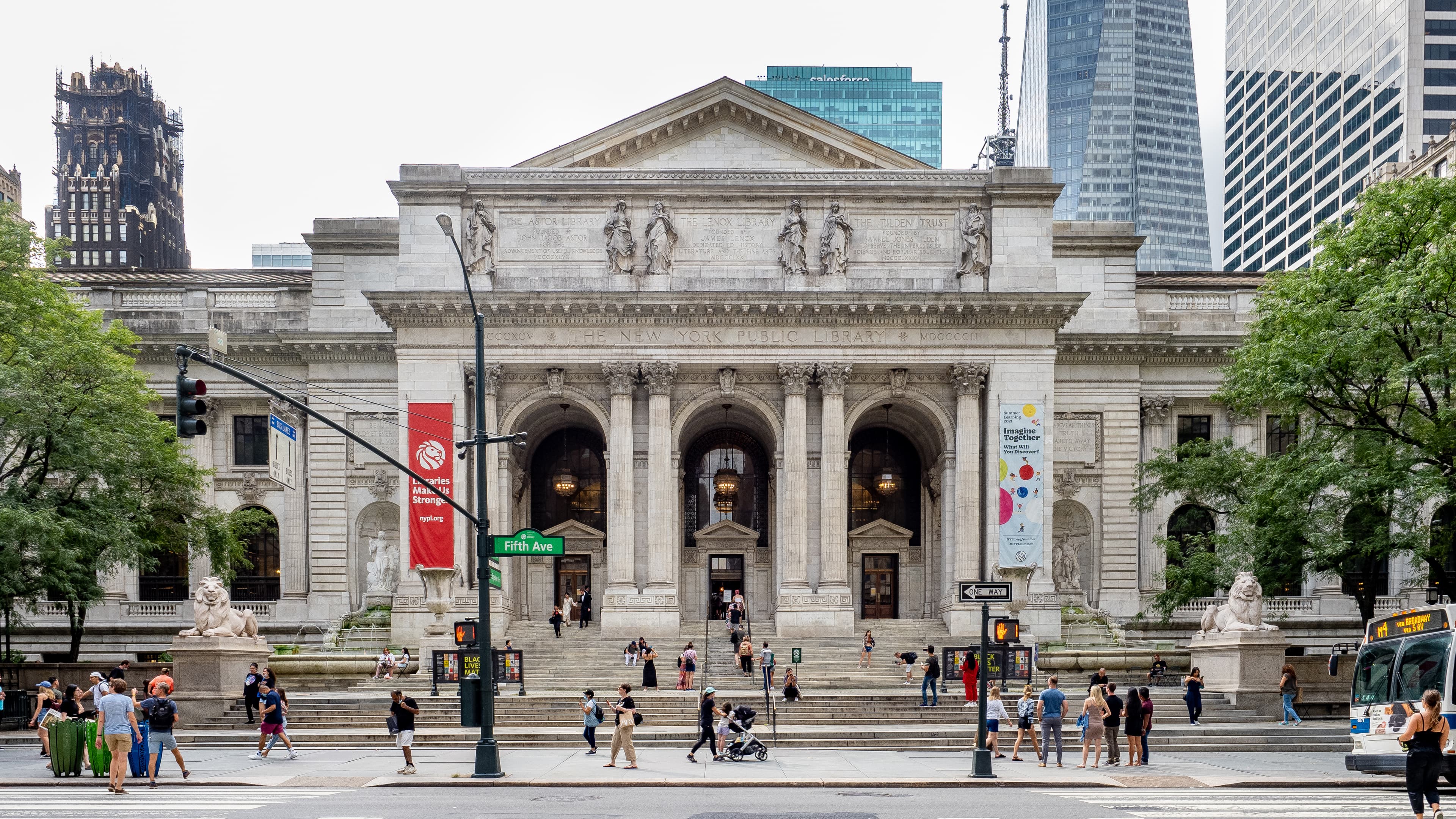
There are a handful of New York buildings a first-time visitor can recognize from a single photograph, and the Main Branch of the New York Public Library is one of them: the long white marble facade on Fifth Avenue at 42nd Street, the wide staircase, and the two stone lions keeping watch at the top of the steps. It is a library, and it is also a landmark in the fullest sense — a building New Yorkers use as a meeting point, a backdrop for photographs, and a symbol of the city itself. Its official name is the Stephen A. Schwarzman Building, after the businessman whose gift helped fund its renovation, but almost everyone still calls it the Main Branch, or simply the New York Public Library.
The building is a working research library, one of the four research libraries in the New York Public Library system, and it is open to the public. That combination — monumental architecture and everyday use — is what makes it worth visiting rather than merely photographing. Students fill the reading room's long oak tables, researchers request books from the stacks below, exhibitions in the ground-floor galleries draw crowds off Fifth Avenue, and free guided tours lead visitors through rooms that would be roped off in almost any other building of this grandeur. You do not need a library card to walk in, climb the stairs, and stand under the painted ceilings. You only need to be quiet in the reading room.
The building sits at the eastern edge of Bryant Park, the green lawn and tree-lined paths that fill the block between Fifth and Sixth Avenues, 40th and 42nd Streets. The pairing is deliberate and old: the library and the park were planned together as a civic center for Midtown, and the library's rear terrace looks out over the park's lawn. A visit to one naturally becomes a visit to the other, and on a fine day the steps, the terrace, and the park's chairs form a single public room.
Three libraries become one
The New York Public Library was formed on May 23, 1895, by the merger of three institutions: the Astor Library, founded with a bequest from John Jacob Astor; the Lenox Library, founded by James Lenox; and the Tilden Trust, established under the will of former governor Samuel J. Tilden. The Astor and Lenox collections were great private research collections, rich in books and manuscripts but limited in who could use them. The merger's promise was radical for its time: a free public research library, open to all New Yorkers, funded by a combination of private endowment and public money, with branch libraries across the boroughs.
The city offered the site — the block on Fifth Avenue between 40th and 42nd Streets, then occupied by the Croton Reservoir, the vast walled basin that had stored the city's drinking water since 1842. The reservoir was demolished, and its foundations were reused in part for the new building. The architects chosen by competition were John Merven Carrère and Thomas Hastings, the firm of Carrère and Hastings, who designed the building in the Beaux-Arts style then favored for American civic monuments: symmetrical, classical, and built to last. Construction began in 1902 and took nearly a decade. The building was dedicated on May 23, 1911 — exactly sixteen years after the library's founding — in a ceremony attended by President William Howard Taft, Governor John Alden Dix, and Mayor William Jay Gaynor. The cost was about $9 million, an enormous sum at the time, and the result was immediately hailed as one of the finest public buildings in America.
Marble, lions, and the Fifth Avenue facade
The building's material is its first statement. The exterior is Vermont marble, laid in blocks about three feet thick, and the facade on Fifth Avenue is a study in Beaux-Arts order: a raised terrace reached by a broad staircase, a central portico with six Corinthian columns, and a long, calm elevation stretching the full block between 40th and 42nd Streets. Sculptural groups crown the attic story, and bronze flagpole bases by Raffaele Menconi, cast at Tiffany Studios, flank the entrance. The building is not tall — it rises only a few stories above the terrace — but its horizontal sweep, set back from the avenue behind its steps, gives it a presence that taller neighbors cannot match.
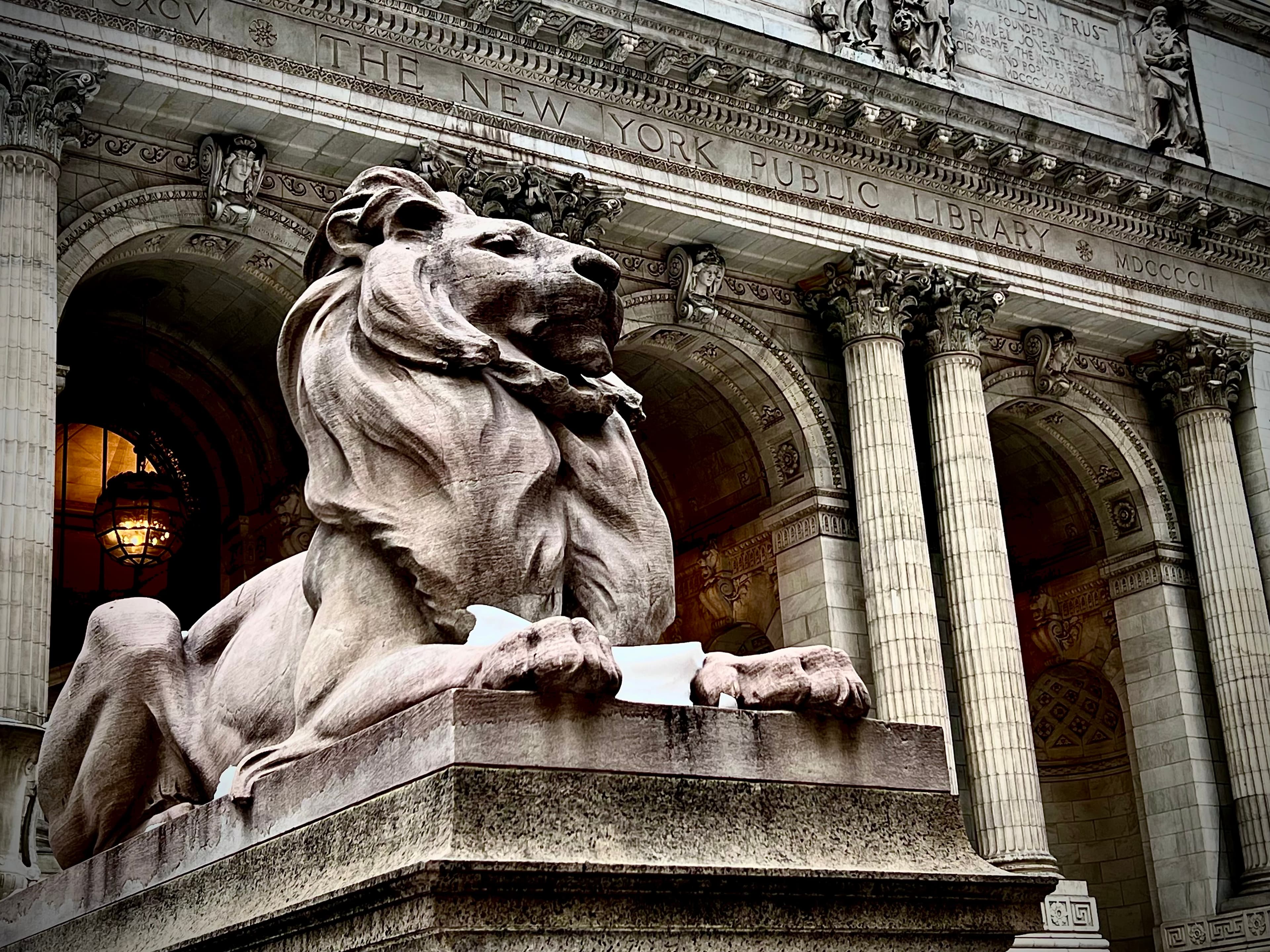
The lions are the facade's most famous feature, and they were part of the design from the start. Sculpted by Edward Clark Potter from pink Tennessee marble, each lion measures roughly six feet high and twelve feet long, and each weighs many tons. They were carved by the Piccirilli brothers, the Bronx-based family of stonecarvers whose work also appears on the Lincoln Memorial and other American monuments, and installed in 1911. Originally they were named Leo Astor and Leo Lenox, for the library's founders. In the 1930s, Mayor Fiorello La Guardia gave them the names by which the world knows them: Patience, on the south side of the steps, and Fortitude, on the north — the qualities, he said, that New Yorkers would need to get through the Great Depression. The names stuck, and the lions have been New York mascots ever since, wearing wreaths at the holidays, the occasional sports cap after a championship, and, on the library's 125th anniversary, holding oversized copies of books chosen by the library's librarians.
The lions are also the building's best orientation device. Meet at the lions, climb the steps between them, and you are at the front door. Photograph them from the sidewalk, and you have the classic Fifth Avenue shot; photograph the building from across the avenue at dusk, when the facade is lit, and you have the postcard.
Astor Hall and the grand stairs
Inside the front doors is Astor Hall, the building's first-floor lobby, named for the Astor family whose library helped found the institution. It is a barrel-vaulted marble hall, its walls inscribed with the names of major donors, its scale deliberately ceremonial: this is the threshold between the street and the library, and Carrère and Hastings designed it to slow visitors down. Two grand marble staircases rise from Astor Hall's north and south sides to the second floor, then continue to the third, in a processional route that is itself one of the building's great experiences. Bronze busts of Carrère and Hastings stand at the stair landings, a quiet tribute to the architects by the building they made.
Astor Hall also holds the building's practical heart for visitors: the information desk, where free guided tours of the building begin, and the entrance to the Gottesman Exhibition Hall, the ground-floor gallery that hosts the library's major exhibitions — displays drawn from its research collections, from rare books and manuscripts to maps, photographs, and ephemera. The exhibitions change, and they are one of the best reasons to return: the library's collections are so deep that a single exhibition can only show a fraction of them, and each new show opens another drawer.
From Astor Hall, the route upward is the route every first-time visitor should take: up the grand stairs, through the McGraw Rotunda, and into the reading rooms beyond. The building was designed as a sequence, and it still works that way.
The McGraw Rotunda: the story of the written word
At the top of the stairs, on the third floor, is the McGraw Rotunda, the building's central hall and the hinge between its public rooms. It is a barrel-vaulted space of marble and plaster, with passageways leading north and south and doorways to the great rooms on either side. Its decoration tells the building's story in paint: four large murals and two lunettes by Edward Laning, painted in the early 1940s as a Works Progress Administration project, depict the development of the written word — Moses with the Tablets of the Law, a medieval monk copying a manuscript, Gutenberg showing a proof of his Bible to the Elector of Mainz, and the Linotype machine and the modern press — while the ceiling mural shows Prometheus bringing fire to humanity. The rotunda is where tour groups gather, where visitors pause between rooms, and where the building's civic argument is made most plainly: that writing, printing, and reading are the technologies on which civilization runs.
The rotunda's doorways lead to the building's two great third-floor rooms. To the west is the Bill Blass Public Catalog Room, the library's former catalog hall, its ceiling carrying a section of James Wall Finn's 1911 mural of sky and cloud. To the east is the Edna Barnes Salomon Room, originally a picture gallery and now used for events, its walls hung with paintings. Between them, straight ahead, is the room everyone has come to see.
The Rose Main Reading Room
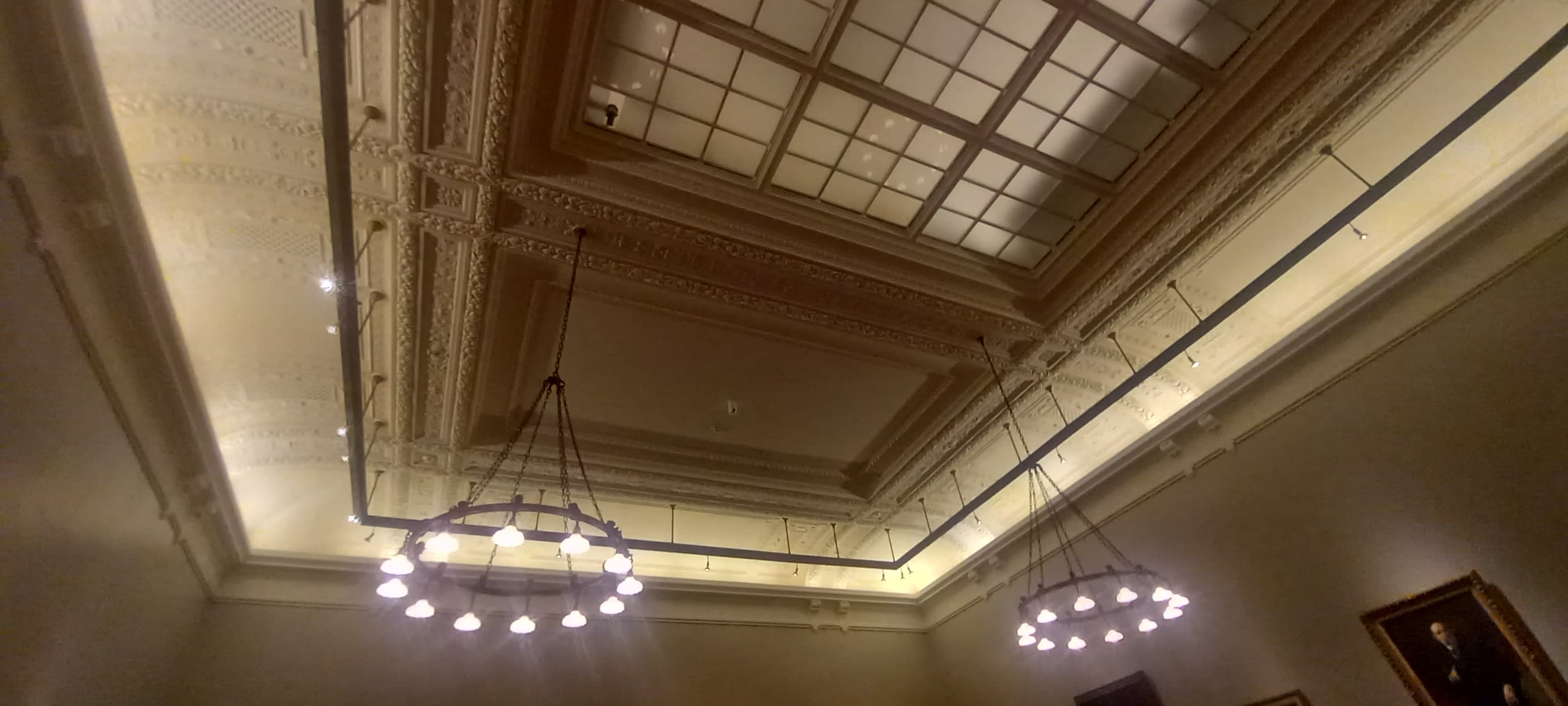
The Rose Main Reading Room — Room 315, its full name the Deborah, Jonathan F. P., Samuel Priest, and Adam R. Rose Main Reading Room — is one of the great public interiors in the world, and the single most impressive room in New York that anyone can walk into for free. It is 78 feet wide and 297 feet long, nearly the length of two city blocks, with a ceiling 51 feet high, painted with murals of sky and cloud by James Wall Finn and framed by ornate plasterwork in gold and copper leaf. Forty-two long oak tables, each seating up to sixteen readers, fill the floor — 624 seats in all — lit by brass reading lamps and by tall arched windows on both long sides. Books line the walls at floor level and along the balcony above, and the room hums, quietly, with the sound of people working.
The room was restored in the 1990s with a gift from Sandra Priest Rose and Frederick Phineas Rose, and reopened in November 1998 after a year and a half of work. In May 2014, an ornamental plaster rosette fell from the ceiling, and the room and the adjoining catalog room were closed for more than two years while the ceiling was inspected, repaired, and restored. They reopened on October 5, 2016, to considerable celebration, and the room has been in full use ever since. The restoration is part of the room's story now, and a reminder of how seriously the library takes its stewardship: a ceiling painted in 1911, repaired in 2016, still sheltering readers in the 2020s.
The rules of the room are simple and worth observing: it is a working reading room, not a museum gallery, so voices stay low, photographs are taken discreetly and without flash, and the long tables are for reading and writing. Sit for a while if you can. The room rewards stillness — the light changing through the tall windows, the scale of the ceiling, the simple fact of hundreds of strangers reading together in silence. It is the closest thing New York has to a secular cathedral, and it earns the comparison.
The collections below and the exhibitions above
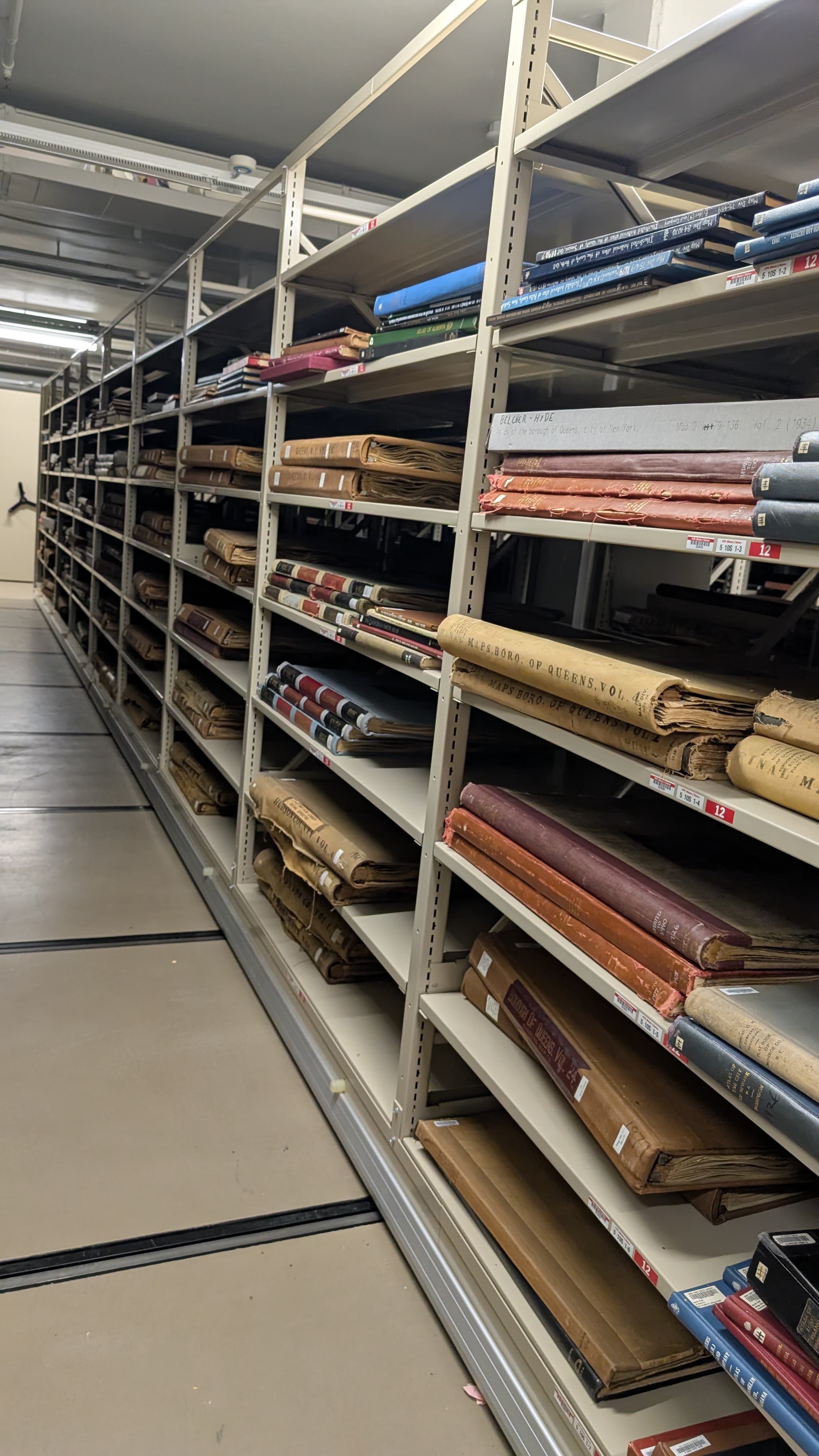
Beneath the reading room, in seven levels of stacks, sit the research collections that the building was built to hold: millions of books, manuscripts, maps, prints, and photographs, including the library's famed holdings in Americana, maps, prints, and rare books. The stacks were an engineering achievement in their own right when the building opened — a steel framework designed to carry the weight of books and to deliver them quickly to the reading room above, the system that the first director, John Shaw Billings, had sketched in his organizing plan for the building. Most of the stacks are closed to the public, but their presence is the point: the grand rooms upstairs exist because the collections downstairs do, and the library's exhibitions are the public window onto them.
The library's research divisions — among them the Manuscripts and Archives Division, the Map Division, the Wallach Division of Art, Prints and Photographs, and the Rare Book Division — are among the finest of their kind, and their material appears regularly in the Gottesman Exhibition Hall downstairs and in smaller displays throughout the building. Check what is on before you visit; a single exhibition of maps, or of a writer's papers, or of the library's treasures can anchor a whole visit, and the exhibitions are the easiest way for a casual visitor to grasp the depth of what the building holds.
The building has also entered popular culture in a way few libraries have. Its exterior and reading room have appeared in films and television for decades, most famously in the opening scenes of Ghostbusters (1984), in which the library's stacks and reading room set the film's supernatural premise in motion. The cameo is fitting: the building looks like the kind of place where extraordinary things might be shelved alongside the ordinary ones.
Bryant Park, and how to visit well
The library's back door opens onto Bryant Park, and the two belong together in any visit. The park fills the block directly behind the library, between Fifth and Sixth Avenues, and its lawn, gravel paths, and rows of movable green chairs are the city's most successful public living room. The park stands on the site of the old Croton Reservoir's distributing basin and, before that, a potter's field; it was renamed for the poet and newspaper editor William Cullen Bryant in 1884, and its present form — lawn, terraces, and the library's rear elevation as its backdrop — dates to its restoration in the early 1990s. Come out of the library's west side, take a chair on the lawn, and look back at the building's rear facade: it is quieter than the Fifth Avenue front, and in some lights more beautiful.
A good first visit takes about two hours. Start at the lions and climb the Fifth Avenue steps; cross Astor Hall and take the grand stairs to the third floor; pause in the McGraw Rotunda to look up at the Prometheus ceiling and the Laning murals; step into the Bill Blass Public Catalog Room, then into the Rose Main Reading Room, and sit for a while at the edge of the room rather than walking its full length. Come back downstairs for the Gottesman Exhibition Hall, then leave by the west side into Bryant Park, where the library's terrace and the park's lawn make a natural place to rest. If you want a guided tour, the library offers free tours of the building — check the official source before visiting for current times and meeting points, since schedules change.
More than a century after it opened, the Schwarzman Building endures because it still does the thing it was built to do. It is not a monument to reading; it is a place where reading happens, in a room nearly two blocks long, under a painted sky, between two marble lions, on the busiest avenue in the busiest city in America. Walk up the steps, past Patience and Fortitude, and into the quiet — and you will understand why New Yorkers treat this building not as a tourist sight but as their own.
Key Facts
- The Stephen A. Schwarzman Building, commonly called the Main Branch or the 42nd Street Library, is the flagship building of the New York Public Library, at 476 Fifth Avenue (Fifth Avenue at 42nd Street), Midtown Manhattan, at the eastern edge of Bryant Park.
- The New York Public Library was formed on May 23, 1895, by the merger of the Astor Library, the Lenox Library, and the Tilden Trust.
- The building was designed by Carrère and Hastings in the Beaux-Arts style, built on the site of the demolished Croton Reservoir, and dedicated on May 23, 1911; construction began in 1902 and cost about $9 million.
- The exterior is Vermont marble; the Fifth Avenue facade features a raised terrace, a broad staircase, and a central portico with Corinthian columns.
- The two marble lions flanking the entrance steps were sculpted by Edward Clark Potter from Tennessee marble, carved by the Piccirilli brothers, and installed in 1911; originally named Leo Astor and Leo Lenox, they were renamed Patience (south side) and Fortitude (north side) by Mayor Fiorello La Guardia in the 1930s.
- Astor Hall is the building's first-floor marble lobby; two grand marble staircases rise from it to the second and third floors.
- The McGraw Rotunda on the third floor features murals by Edward Laning, painted in the early 1940s as a Works Progress Administration project, depicting the development of the written word, with a ceiling mural of Prometheus bringing fire to humanity.
- The Rose Main Reading Room (Room 315) measures 78 feet wide by 297 feet long with a ceiling about 51 feet high; it holds 42 oak tables seating 624 readers, was restored with a gift from Sandra Priest Rose and Frederick Phineas Rose and reopened in November 1998, closed in May 2014 after a plaster rosette fell from the ceiling, and reopened on October 5, 2016.
- The Bill Blass Public Catalog Room adjoins the reading room to the west; the Edna Barnes Salomon Room lies to the east of the McGraw Rotunda.
- The building was designated a National Historic Landmark in 1965 and a New York City Landmark in 1967; its Astor Hall, stairs, and McGraw Rotunda became New York City's first Interior Landmark in 1974, and the Main Reading Room and Catalog Room were designated an Interior Landmark in 2017.
- The building is one of four research libraries in the New York Public Library system; its research collections are housed in stacks beneath the reading room, and its Gottesman Exhibition Hall hosts rotating exhibitions drawn from those collections.
- The building's exterior and reading room appear in popular culture, most famously in the opening scenes of Ghostbusters (1984).
Visitor Details
Address: The New York Public Library, Stephen A. Schwarzman Building, 476 Fifth Avenue, New York, NY 10018 (Fifth Avenue at 42nd Street, Midtown Manhattan, at the eastern edge of Bryant Park)
Transit: 42nd Street–Bryant Park station (B, D, F, and M trains) is at the building's doorstep on Sixth Avenue; 5th Avenue station (7 train) is one block east on 42nd Street; Grand Central Terminal is a short walk east on 42nd Street, and buses run along Fifth Avenue and 42nd Street.
Hours/Admission: Hours, admission arrangements for special exhibitions, and guided-tour times change from time to time — check the official source at nypl.org before visiting to confirm current hours, any exhibition ticketing, and tour schedules. The building's public spaces and reading room are normally open to visitors without a library card; the Rose Main Reading Room is a working reading room, so keep voices low and photography discreet and without flash.
Best timing: Arrive in the morning for the quietest reading room; allow about two hours for a first visit — lions and facade, Astor Hall, the grand stairs, the McGraw Rotunda, the Rose Main Reading Room, and the Gottesman Exhibition Hall — then finish with Bryant Park directly behind the building. Free guided tours of the building are offered; confirm current times on nypl.org before visiting.