The cathedral on the highest ground in Washington
There is a short list of Washington sights a first-time visitor names without thinking — the White House, the Lincoln Memorial, the Capitol, the Washington Monument — and Washington National Cathedral belongs on it, even though it sits away from the Mall, on a wooded hill in the city's Upper Northwest. It is the capital's great Gothic church: officially the Cathedral Church of Saint Peter and Saint Paul in the City and Episcopal Diocese of Washington, seat of both the Presiding Bishop of the Episcopal Church and the Bishop of the Episcopal Diocese of Washington, and a self-described house of prayer for all people.
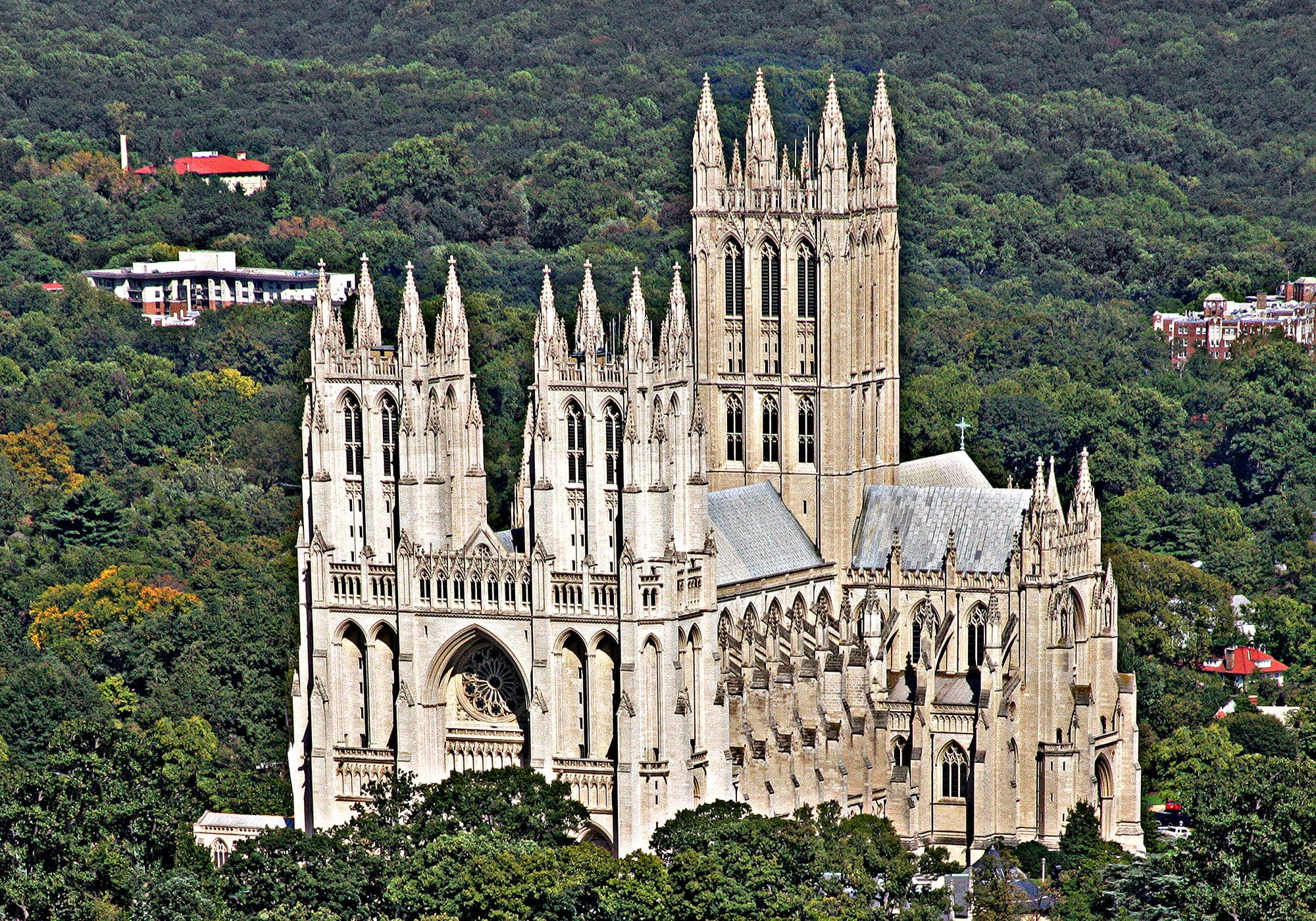
The building earns its place on that list twice over. It is, by size, the second-largest church building in the United States and the sixth-largest cathedral in the world, a limestone pile 518 feet long with a central tower rising 301 feet, seating some 4,000 people. And it is, by role, the place the nation goes when it needs a room big enough for grief and ceremony: state funerals, memorial services, inaugural prayer services, and the last sermon Martin Luther King Jr. ever preached, delivered here four days before his assassination.
What makes it unforgettable, though, is not its size but its strangeness. This is a medieval-style cathedral built in the twentieth century, by hand, stone on stone, over 83 years — and it wears its long construction like a personality. Its stained glass holds a fragment of rock from the Sea of Tranquility on the Moon. Its towers carry 112 gargoyles and grotesques, including devils, golfers, and, high on the northwest tower, Darth Vader. Its gardens are planted in medieval patterns. Stand in the nave and look up, and you are standing inside both a house of worship and a national attic, where every window, statue, and stone seems to be remembering something.
From L'Enfant's plan to Roosevelt's foundation stone
The idea of a great church for national purposes is older than the cathedral by more than a century. Pierre L'Enfant's 1792 plan for the federal city set aside a site for one, though that part of his plan was never built. The cathedral that exists today began in earnest in 1891, when a meeting was held to plan an Episcopal cathedral for Washington, and on January 6, 1893, Congress chartered the Protestant Episcopal Cathedral Foundation to establish it.
The site, chosen in 1896 by Henry Yates Satterlee, the first Episcopal bishop of Washington, is Mount Saint Alban, a wooded hill rising about 400 feet above the Potomac — the highest point in the city, on 57 acres at Massachusetts and Wisconsin Avenues. Satterlee wanted the cathedral above politics and commercialism, a reminder of the moral and spiritual values that should inform public life, and he wanted it in the Northwest, where he correctly expected the city to grow.
Satterlee chose the English Gothic Revival architect George Frederick Bodley to draw the master plan, closely modeled on the English Gothic style of the late fourteenth century, with Henry Vaughan as supervising architect. The foundation stone was laid on September 29, 1907 — the Feast of Saint Michael and All Angels — in a ceremony attended by President Theodore Roosevelt and a crowd of more than 20,000. The stone itself was symbolic in the way everything about this building would be: a small stone from the fields around the Church of the Nativity in Bethlehem, engraved with John 1:14, "The Word was made flesh and dwelt among us," set inside a much larger block of American granite.
Then came the long middle of the story. Bodley died in 1907, the year the stone was laid. Work stopped during World War I; Vaughan died in 1917. When construction resumed, the Boston firm of Frohman, Robb and Little — led by Philip Hubert Frohman, who had designed his first fully functional house at fourteen — carried Bodley's vision forward, enlarging the west facade and adding the carillon section of the central tower. The crypt chapels opened first: Bethlehem Chapel, directly above the foundation stone, began daily services on May 1, 1912, and has held them almost continuously ever since. The Gloria in Excelsis Tower was dedicated on May 7, 1964. Frohman died in 1972 with the final plans complete, and the building was finished according to them. On September 29, 1990 — exactly 83 years to the day after Roosevelt's ceremony — the final finial was set in place on the southwest tower in the presence of President George H. W. Bush.
A Gothic interior built for a nation
Step inside and the scale rearranges your sense of the building. The nave runs eight bays long, wide side aisles flanking it, a six-bay transept crossing it, and a five-bay chancel beyond — all of it vaulted stone, lit by more than two hundred stained-glass windows. The west rose window, dedicated in 1977 in the presence of President Jimmy Carter and Queen Elizabeth II, tells the story of Creation, which is also the iconographic program of the whole west facade: where a medieval cathedral would show the Last Judgment over its doors, this one shows the making of the world, its sculptural program designed by Frederick Hart.
The interior is full of the nation's memory, worked into a church's fabric. State seals are set into the marble floor of the narthex; state flags hang along the nave. Statues honor George Washington and Abraham Lincoln, Rosa Parks, Helen Keller, and Martin Luther King Jr. Windows commemorate the Lewis and Clark expedition and the raising of the flag at Iwo Jima. The great organ has more than ten thousand pipes, and the central tower holds a 53-bell carillon, each bell carved with a Bible verse. Look closely and you will find the building's deliberate imperfections, too: the architects introduced slight asymmetries — the main aisle tilting faintly off its axis where it meets the crossing — to counteract optical distortion and to give the vast stone interior a human, hand-built feel.
The most famous window is also the smallest story in the building. The Space Window, honoring humanity's landing on the Moon, holds at its center a fragment of lunar rock from the Sea of Tranquility, brought back by Apollo 11 and presented at the window's dedication service on July 21, 1974, the fifth anniversary of the mission. It is a piece of the Moon set into a church window, and it captures the cathedral's peculiar genius: a building that treats the whole American story, including its journey off the planet, as part of its decoration.
Below the main floor, the crypt tells the older half of the story. It is the oldest part of the cathedral, built in Norman and Romanesque styles deliberately older than the Gothic above, as if the new cathedral stood on the ruins of an earlier church. Its chapels include the Bethlehem Chapel, where the foundation stone lies buried beneath the altar and where the burial rites for President Woodrow Wilson were held in 1924 — Wilson remains the only president buried in Washington, and his memorial bay now stands on the cathedral's main level.
The stone menagerie: gargoyles, grotesques, and Darth Vader
Outside, the cathedral's most beloved feature is also its least solemn. The building carries 112 gargoyles and grotesques, carved figures that run from the traditional — dragons, devils, and grotesque faces — to the contemporary: golfers, a yuppie with a briefcase, caricatures of the famous and the humble. Gargoyles, strictly speaking, carry rainwater away from the walls through spouts; grotesques are purely decorative. The cathedral has both, and it offers tours devoted to them.
The most famous is the one most visitors never actually see. High on the northwest tower, between two pinnacles and above a closer, larger skull-shaped grotesque, sits a limestone carving of Darth Vader's helmet. It is technically a grotesque, not a gargoyle, and it got there through a children's competition: in the 1980s, during construction of the northwest tower, the cathedral and National Geographic World magazine asked children to design grotesques for the building. Christopher Rader of Nebraska, then a young teenager, submitted Darth Vader — reasoning, as he put it, that Vader was a lot like a demon and therefore a good choice — and his drawing took third place. Jay Hall Carpenter sculpted the head and Patrick J. Plunkett carved it in stone. Bring binoculars, and look from the northwest parking lot: the Dark Lord is small, high, and exactly where the cathedral says he is, a piece of pop culture set permanently into sacred architecture. The cathedral calls it one of its most popular attractions, and it is hard to argue.
A national stage: funerals, sermons, and services
The cathedral's role as a national house of prayer was not an afterthought; it was the point. It has hosted state funerals for Presidents Dwight D. Eisenhower, Ronald Reagan, Gerald Ford, and George H. W. Bush, and the national memorial service after the September 11, 2001 attacks. Martin Luther King Jr. preached his last Sunday sermon here, "Remaining Awake Through a Great Revolution," on March 31, 1968, four days before he was killed in Memphis. Inaugural prayer services and interfaith gatherings have filled the nave in the days around presidential inaugurations for generations.
That role also explains the building's odd, generous ecumenism. It is an Episcopal cathedral, and it holds daily Episcopal services, but its charter and its history made it a place where the country gathers across lines: the state flags and seals, the memorials to national events, the interfaith services through the year. It receives no direct federal funding — it is supported by private donations — yet it functions, in the words of its own mission, as a spiritual home for the nation. The crossing, where nave meets transept, holds an elevated wooden platform that serves as the stage for concerts and the resting place for coffins at state funerals: the same floor that hosts a choir on Independence Day has held the nation's dead.
The building has also kept a long argument with itself about its own past. In 2016, the cathedral voted to remove images of Confederate flags from stained-glass windows honoring Robert E. Lee and Stonewall Jackson, part of a wider reckoning with what a national house of prayer should commemorate. The windows' story is a reminder that this is a living building, not a monument frozen at completion — decorative and restorative work continues, including repairs to damage from the 2011 Virginia earthquake, which cracked pinnacles and finials across the towers.
Gardens, tower views, and the grounds
Do not leave without walking the grounds. The 57-acre close holds the Bishop's Garden, a medieval-style garden with a knot garden designed by Nellie B. Allen, set within landscape plans that Frederick Law Olmsted Jr. helped shape — a quiet, planted counterpoint to the stone mass above it, and one of the most peaceful corners in Upper Northwest Washington. The Peace Cross, a Celtic cross erected in 1898 as a memorial to the fallen of the Spanish-American War, still stands on the grounds, older than the cathedral itself.
Then go up. The Pilgrim Observation Gallery, high in the central tower, looks out over the capital from the city's highest ground — a view that makes the cathedral's siting suddenly obvious. On a clear day the Mall, the monuments, and the city's green ridges fall away below, and the building's claim to be a watchtower over Washington feels literal. It is the right ending to a visit: first the nave, where the nation is remembered, then the tower, where the city is seen whole.
How to visit well, and why it endures
Plan the visit around the building's two scales. Start in the nave and walk its full length, slowly, from the west doors to the chancel — the stained glass, the flags, the statues, and the Space Window reward a slow pace and a willingness to look up. Take a tour if one is offered: the gargoyles, the crypt chapels, and the tower gallery are all better with a guide pointing out what the naked eye misses, especially Darth Vader, who genuinely requires binoculars or a zoom lens. Then walk the Bishop's Garden and the grounds, which are the cathedral at its most human scale.
Allow at least two hours, and more if you take a tour or climb to the observation gallery. Remember that this is a working church: services, concerts, and special events shape what is open when, and parts of the building may be closed for a service or a funeral. More than 270,000 people visit each year, and the nave can be busy at midday; early in the day is quieter, and the light through the south windows is at its best in the afternoon.
More than a century after Roosevelt laid its foundation stone, the cathedral endures because it never settled for being one thing. It is a Gothic church built by modern hands, a national stage that is also a parish church, a medieval fantasy that contains a moon rock and a movie villain. It took 83 years to finish, and it shows: every generation that worked on it left something of itself in the stone. Walk the nave, find the Space Window, squint up at Darth Vader, and stand in the garden below the tower, and you will have seen Washington's great church the way it asks to be seen — not as a monument to a finished past, but as a building still doing the work it was chartered to do.
Key Facts
Washington National Cathedral is officially the Cathedral Church of Saint Peter and Saint Paul in the City and Episcopal Diocese of Washington, an Episcopal cathedral and the seat of both the Presiding Bishop of the Episcopal Church and the Bishop of the Episcopal Diocese of Washington.
The Protestant Episcopal Cathedral Foundation was chartered by Congress on January 6, 1893, to establish the cathedral; the site on Mount Saint Alban, the highest point in Washington, was selected in 1896.
The foundation stone was laid on September 29, 1907, in a ceremony attended by President Theodore Roosevelt and a crowd of more than 20,000; the cathedral was completed 83 years later, on September 29, 1990, in the presence of President George H. W. Bush.
The architects were George Frederick Bodley and Henry Vaughan, succeeded by the Boston firm of Frohman, Robb and Little under Philip Hubert Frohman; the design is Neo-Gothic, closely modeled on the English Gothic style of the late fourteenth century.
The cathedral is located at 3101 Wisconsin Avenue NW, Washington, DC 20016, at Massachusetts and Wisconsin Avenues in Upper Northwest Washington, on a 57-acre close.
The building is 518 feet long, seats about 4,000 people, and its central Gloria in Excelsis Tower rises 301 feet; it is the second-largest church building in the United States and the sixth-largest cathedral in the world.
The cathedral holds more than 200 stained-glass windows; the west rose window, dedicated in 1977 in the presence of President Jimmy Carter and Queen Elizabeth II, tells the story of Creation.
The Space Window honors the Moon landing and holds a fragment of lunar rock from the Sea of Tranquility, brought back by Apollo 11 and presented at the window's dedication on July 21, 1974.
The building carries 112 gargoyles and grotesques, including the Darth Vader grotesque high on the northwest tower: designed by Christopher Rader for a National Geographic World children's competition, sculpted by Jay Hall Carpenter, and carved by Patrick J. Plunkett.
The cathedral's great organ has more than ten thousand pipes, and its central tower holds a 53-bell carillon, each bell carved with a Bible verse.
The cathedral has hosted state funerals for Presidents Dwight D. Eisenhower, Ronald Reagan, Gerald Ford, and George H. W. Bush; Martin Luther King Jr. preached his last Sunday sermon here on March 31, 1968; Woodrow Wilson is buried here, the only president buried in Washington.
The crypt's Bethlehem Chapel, the oldest completed portion of the cathedral, began daily services on May 1, 1912, above the buried foundation stone; the Gloria in Excelsis Tower was dedicated on May 7, 1964.
The Bishop's Garden includes a knot garden designed by Nellie B. Allen, within landscape plans shaped by Frederick Law Olmsted Jr.; the Peace Cross on the grounds was erected in 1898.
The cathedral is listed on the National Register of Historic Places (designated May 3, 1974) and was ranked third on the American Institute of Architects' List of America's Favorite Architecture in 2007; more than 270,000 people visit each year.
Decorative and restorative work continues, including repairs to damage from the 2011 Virginia earthquake.
Visitor Details
Address: Washington National Cathedral, 3101 Wisconsin Avenue NW, Washington, DC 20016 (Cathedral Heights / Upper Northwest, at Massachusetts and Wisconsin Avenues NW)
Transit: Metrobus routes run along Wisconsin Avenue and Massachusetts Avenue to the cathedral's doorstep; the nearest Metro stations, Cleveland Park and Woodley Park on the Red Line, are each roughly a mile away, an uphill walk or a short bus ride. Several bus routes serve the Wisconsin Avenue corridor directly.
Hours/Admission: Hours, admission arrangements, and tour availability change from time to time, and parts of the building may close for services or special events — check the official source at cathedral.org before visiting to confirm current hours, admission, and tour schedules. Bring binoculars if you want to spot the Darth Vader grotesque.
Best timing: Arrive early in the day for the quietest nave; allow at least two hours, more with a tour or the tower observation gallery. Walk the full nave from the west doors, find the Space Window, take a gargoyle tour if one is offered, then finish in the Bishop's Garden and, if open, the Pilgrim Observation Gallery for the view over the capital.
Location Photography