A memorial on the line between two presidents
There is a sightline in Washington that tells a story all by itself. Stand at the Lincoln Memorial, where Martin Luther King Jr. delivered his "I Have a Dream" speech on August 28, 1963, and look southeast across the Tidal Basin: your eye travels to the Jefferson Memorial, and midway along the basin's northwest shore it lands on a great white figure, arms crossed, gazing out over the water. That figure is the Martin Luther King, Jr. Memorial, and its placement is deliberate. King is set on a direct line between the president who freed the enslaved and the president who wrote that all men are created equal — the two American promises his life's work held the country to.
The memorial is the newest of Washington's major memorials on the National Mall, and the first on or near the Mall dedicated to an African American. It covers four acres in West Potomac Park, at 1964 Independence Avenue SW — an address chosen for the year the Civil Rights Act became law. It is an outdoor memorial, open to the sky and to the water, and it is best understood as a single piece of sculpture you walk through rather than a building you enter. The whole visit takes less than an hour, but the design rewards slowness: the approach, the passage, and the wall of words are meant to be experienced in sequence.
King's memorial was more than two decades in the making. Congress authorized it in 1996, the Martin Luther King, Jr. National Memorial Project Foundation raised the funds, and the ROMA Design Group's design was selected in 2000. Construction began in 2009. The memorial opened to the public on August 22, 2011, and the dedication ceremony, originally planned for August 28, 2011 — the 48th anniversary of the March on Washington — was postponed by Hurricane Irene and held on October 16, 2011. President Barack Obama spoke at the dedication, making King the fourth private citizen, and the first African American, to be honored with a memorial on the National Mall.
Through the Mountain of Despair
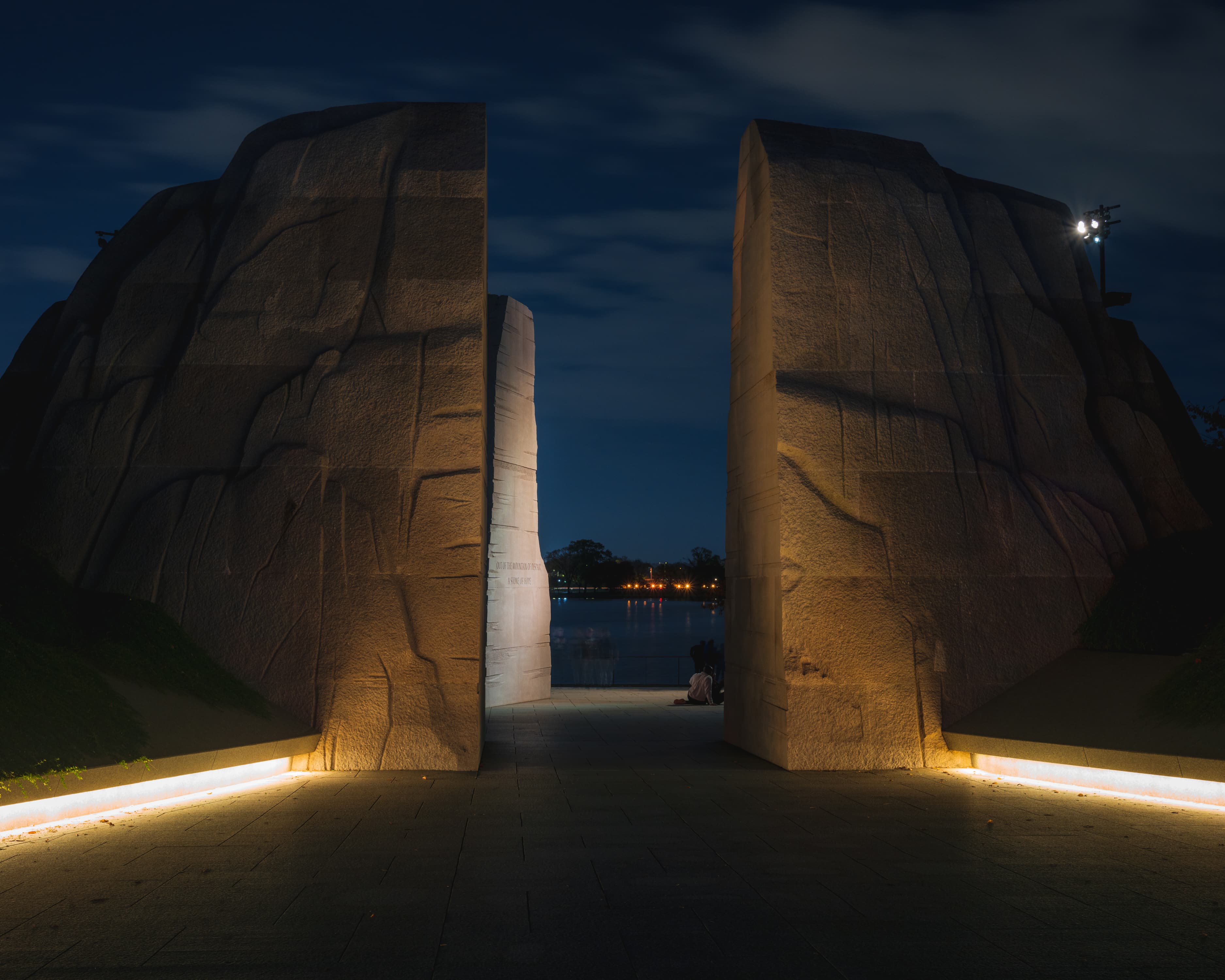
Every visit begins the same way, and the beginning is the point. You do not walk up to the statue from the open lawn. You approach through two massive blocks of granite, split apart, standing on either side of a narrow passage. This is the Mountain of Despair: two rough, unfinished-looking cliffs, their stone left deliberately coarse, as if the mountain has been torn open. The gap between them is the only way in, and walking through it is a physical act — you pass out of the ordinary park and into the memorial, through struggle, toward what waits on the other side.
The image comes from King's most famous speech, delivered from the steps of the Lincoln Memorial in 1963: "With this faith, we will be able to hew out of the mountain of despair a stone of hope." The memorial makes that metaphor literal. The mountain is split, and the stone hewn from it stands ahead of you in the plaza beyond. The sculptor, Chinese master sculptor Lei Yixin, carved the central figure in China from granite, then shipped it to Washington and finished it on site. The statue is 30 feet tall, showing King from the knees up, emerging from the stone with his arms crossed, looking out across the Tidal Basin toward the Jefferson Memorial. It is not a waving, triumphant figure, and it is not a portrait of a man at a podium. It is a man in thought, emerging — still partly of the rock, already fully himself.
Look closely at the stone itself. The figure's surface carries horizontal striations, lines cut into the granite that echo the grain of the rock it came from. Those marks became part of the memorial's later history: a quotation originally carved on the side of the statue, a heavily shortened paraphrase of a longer passage from King, drew criticism — including from the poet Maya Angelou — for making him sound arrogant, and in 2013 the words were removed and the stone reworked so the grooves matched. What remains is the figure, unadorned by that disputed text, and the story is worth knowing because it shows how seriously the memorial's stewards take getting King's words right. The words that matter here are the ones on the wall, quoted in full and in context.
The Stone of Hope
Step out of the mountain's passage and the plaza opens around you. The Stone of Hope stands at the center, and its scale is the first thing you feel: 30 feet of pale granite, far taller than any person, yet carved at a human scale in its details — the folds of the suit, the set of the jaw, the crossed arms. King looks not at you but past you, across the water, toward the Jefferson Memorial. The direction matters. He faces the author of the Declaration of Independence, as if still addressing the promise of equality to the nation that wrote it.
The figure's posture has been much discussed, and it rewards a moment of looking rather than a quick photograph. The arms are crossed, not raised; the expression is stern, not smiling. This is King the strategist and the preacher at once, a man who led a movement through jail cells, marches, and threats of death and who preached nonviolence as a discipline, not a sentiment. Children often run ahead to the base of the statue, and the contrast — small figures dwarfed by the granite — is part of the memorial's power. The statue is not on a high pedestal; it rises from the plaza at a height that lets you stand close and look up, the way you would look up at a person you admire.
Photograph the statue from the plaza, but also from the side, where the figure's emergence from the block of stone is most visible, and from the water's edge, where the Tidal Basin frames it. In spring, the cherry trees around the basin are in bloom, and the pale blossoms against the pale granite make one of Washington's most photographed scenes — the memorial was placed on the basin's shore in part so that the seasons would be part of it.
The Inscription Wall: fourteen quotations
Curving around the plaza is the memorial's other great element: the Inscription Wall, a 450-foot crescent of granite engraved with fourteen quotations from King's speeches, sermons, and writings, chosen by a panel of historians. The wall is organized around four themes that the panel identified in King's work — justice, democracy, hope, and love — and the quotations span his whole public life, from the Montgomery bus boycott to the final years of his ministry.
Walk the wall slowly, all the way around, and read the quotations in order. Some you will know by heart. "Darkness cannot drive out darkness; only light can do that. Hate cannot drive out hate; only love can do that," from Strength to Love in 1963, is here, as is the measure of a person in times of challenge and controversy. Others are less familiar and land harder for it: passages on the urgency of now, on the interconnectedness of all communities, on the long arc of justice. The wall is not a greatest-hits list; it is an argument, made in King's own sentences, that justice, democracy, hope, and love are not four separate causes but one work.
The wall is also the memorial's best place to linger. Visitors tend to read aloud to one another here, quietly, and the crescent shape gathers sound inward, so the plaza hums with half-heard sentences. If you are visiting with children, the wall is the teaching tool: pick one quotation, read it together, and ask what it means now. If you are visiting alone, pick the one that stops you and stand with it. The memorial's designers intended the wall to be read, not skimmed, and an unhurried circuit of it is the heart of the visit.
The bookstore, the basin, and the wider walk
Just outside the main plaza, the memorial includes a small bookstore, where visitors can buy books by and about King and learn more about the movement he led. It is worth a stop, especially if the wall has left you wanting the longer texts the quotations came from — the full "I Have a Dream" speech, the Letter from Birmingham Jail, the sermons collected in Strength to Love.
Then step back and take in the setting, because the Tidal Basin is half the memorial. The basin is a shallow, man-made inlet off the Potomac, ringed by a walking path and by cherry trees, and the memorial's plaza opens directly onto it. From the water's edge you can see the Jefferson Memorial across the basin to the southeast and, turning, the Washington Monument rising to the northeast. The memorial sits in West Potomac Park, within easy walking distance of the Franklin Delano Roosevelt Memorial, which lies just to the southeast along the basin's shore, and the Lincoln Memorial, a short walk to the northwest. That geography is the memorial's final argument: King belongs in this company, on this water, in this line of American memory.
In spring, the basin's cherry blossoms draw crowds, and the memorial is at its most beautiful — and its most crowded. In summer, the plaza is hot and bright, and the granite throws back the sun; bring water and a hat. In autumn, the trees around the basin turn, and the crowds thin. In winter, the memorial is stark and quiet, the pale stone against a gray sky, and the quotations read differently in the cold. There is no bad season, but there is a best time of day: early morning, before the tour groups arrive, or late afternoon, when the light softens across the water and the statue's shadow lengthens across the plaza.
How to visit well
A good first visit takes about forty-five minutes to an hour. Start at the entrance on Independence Avenue and walk deliberately through the Mountain of Despair — do not hurry the passage, since the design means you to feel it. Emerge into the plaza and spend time with the Stone of Hope, looking at the figure from the front and from the side. Then walk the full Inscription Wall, reading the fourteen quotations in order, and finish at the water's edge, looking across the basin to the Jefferson Memorial and back along the sightline toward the Lincoln Memorial. If you have more time, continue along the basin's path to the Franklin Delano Roosevelt Memorial, which tells a complementary story of American struggle and resolve, or walk northwest to the Lincoln Memorial and stand where King spoke.
The memorial is an outdoor National Park Service site with no ticketed entry. Check the official National Park Service source at nps.gov before visiting for current conditions, any temporary closures, and ranger program information, since arrangements change from time to time. The plaza and paths are paved and level; the site is open to the air, so dress for the weather and wear comfortable shoes for the basin walk. The nearest Metro stations are a walk away — Smithsonian on the Blue, Orange, and Silver lines and Foggy Bottom on the Blue, Orange, and Silver lines are the usual approaches — and buses run along Independence Avenue. Allow extra time in cherry blossom season, when the basin paths are at their busiest.
More than a decade after its dedication, the memorial has settled into the capital's landscape the way only the great memorials do: it is a place Washingtonians bring visitors, a place school groups read aloud, a place where a single line of a speech, carved in granite, still stops people mid-stride. Walk through the mountain, stand before the stone, and read the wall — and you will understand why this four-acre plot on the Tidal Basin has become one of the first places a first-time visitor should go.
Key Facts
- The Martin Luther King, Jr. Memorial is a national memorial in West Potomac Park, at 1964 Independence Avenue SW, Washington, DC, on the northwest shore of the Tidal Basin, on a sightline linking the Lincoln Memorial to the northwest and the Jefferson Memorial to the southeast.
- The memorial covers four acres and is administered by the National Park Service as part of the National Mall and Memorial Parks.
- The central sculpture is the Stone of Hope, a 30-foot granite statue of Martin Luther King Jr., carved by sculptor Lei Yixin, depicting King emerging from a block of stone with his arms crossed, looking across the Tidal Basin toward the Jefferson Memorial.
- The entrance passage is formed by two granite blocks known as the Mountain of Despair, split apart so visitors walk through the mountain to reach the statue.
- The design is inspired by a line from King's "I Have a Dream" speech, delivered from the steps of the Lincoln Memorial on August 28, 1963: "With this faith, we will be able to hew out of the mountain of despair a stone of hope."
- The Inscription Wall is a 450-foot crescent of granite engraved with fourteen quotations from King's speeches, sermons, and writings, selected by a panel of historians and organized around the themes of justice, democracy, hope, and love.
- The ROMA Design Group's design was selected in 2000; Congress authorized the memorial in 1996; construction began in 2009.
- The memorial opened to the public on August 22, 2011; the dedication ceremony, originally planned for August 28, 2011, the 48th anniversary of the March on Washington, was postponed by Hurricane Irene and held on October 16, 2011, with President Barack Obama speaking.
- A quotation originally carved on the side of the statue, a shortened paraphrase that drew criticism, was removed in 2013 and the stone reworked to match its striations.
- The memorial is the first on or near the National Mall dedicated to an African American, and King was the fourth private citizen so honored there.
- The Franklin Delano Roosevelt Memorial lies just southeast along the Tidal Basin shore; the Lincoln Memorial is a short walk northwest.
Photographs of the Memorial