The most famous address in music
There is a joke every New Yorker knows, and it is also the truest thing ever said about this building. A tourist stops a musician on 57th Street and asks, "How do you get to Carnegie Hall?" The answer: "Practice." The joke works because Carnegie Hall, at 881 Seventh Avenue between 56th and 57th Streets in Midtown Manhattan, is not just a concert hall. It is the finish line. For more than 130 years, reaching its stage has meant that a performer has arrived — in classical music, in jazz, in popular song, in comedy, in just about every form of live performance America has produced.
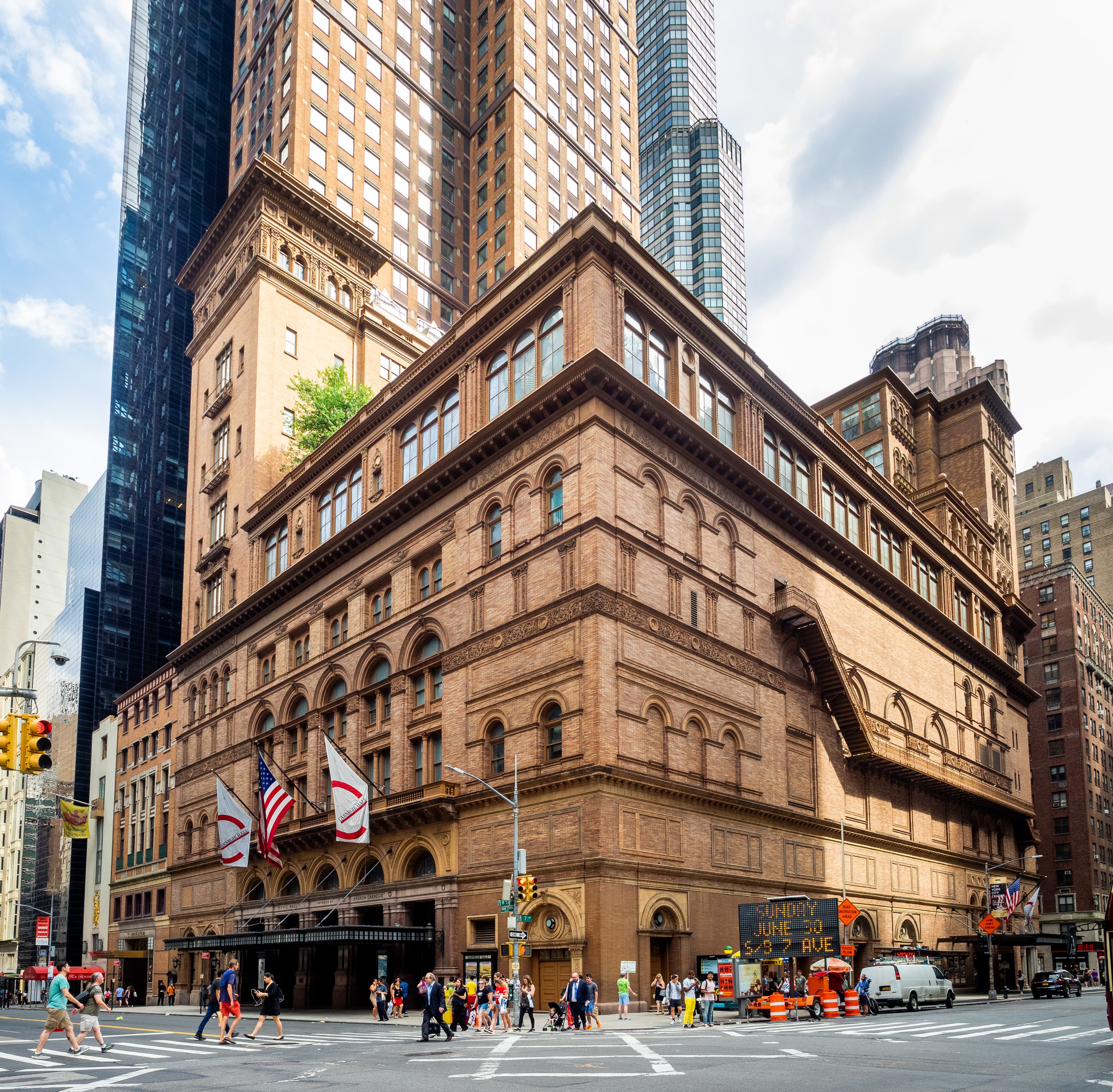
Stand on the corner of Seventh Avenue and 57th Street, two blocks south of Central Park, and the building itself tells you why it matters before a single note sounds. It is a great brick pile in the Renaissance Revival style, eight stories tall on its main block, faced in warm ochre Roman brick with terracotta and brownstone detail, its arched entrance arcade opening onto 57th Street. It does not glitter like a modern concert hall. It looks like what it is: a temple built in 1891, when New York was becoming the cultural capital of America, and built to last. The lobby, the auditorium, the five tiers of boxes and balconies in the main hall — all of it has the confidence of a building that never doubted music was worth a monument.
That confidence was earned almost immediately. On opening night, May 5, 1891, the hall — then called simply the Music Hall — presented a gala concert conducted in part by Pyotr Ilyich Tchaikovsky himself, who had sailed from Russia for the occasion. The New York Philharmonic made the hall its home the following year and stayed for seventy years, until 1962. In between, nearly every great name in music has stood on this stage: the conductors Mahler, Toscanini, and Bernstein; the pianists Horowitz, Rubinstein, and Van Cliburn; the singers Caruso, Callas, and Marian Anderson; and, in time, the popular artists who proved that the hall belonged to all of American music, not only to the classical tradition. No other stage in the world carries that whole history at once.
A steel magnate's gift to music
Carnegie Hall exists because of one of the great acts of philanthropy in American history — and because of one woman's persistence. In the late 1880s, Louise Whitfield Carnegie, the wife of the steel magnate Andrew Carnegie, was a singer and a music lover who wanted New York to have a concert hall worthy of its ambitions. Andrew Carnegie agreed to fund it. The architect was William Burnet Tuthill, a cellist as well as an architect, who designed the hall with the ear of a musician: the main auditorium's shape, its proportions, and its materials were all chosen for sound, and the result is an acoustic that performers and audiences have praised for more than a century. Musicians say the hall does something rare — it makes a single voice or instrument sound intimate, and a full orchestra sound immense, in the same room.
The hall opened as the Music Hall and soon took the name of its founder, Carnegie Hall. In its early decades it was the center of New York's musical life in a way that is hard to imagine now, when the city has so many venues. The Philharmonic played here. The great European orchestras and soloists made their American debuts here. And the building grew around its music: studios were added above the hall, rented to artists and musicians, so that for much of the twentieth century Carnegie Hall was not only a stage but a vertical village of working artists — painters, photographers, dancers, and musicians living and working over the most famous auditorium in America. The photographer Bill Cunningham, later famous for his New York Times street-fashion photographs, lived in one of those studios for decades.
The night jazz came to Carnegie Hall
If the hall's classical history is its foundation, the moment that made it an American institution — not just a classical one — came on January 16, 1938, when Benny Goodman brought his swing band to Carnegie Hall. Jazz had been played in dance halls and clubs; it had never been presented as concert music in America's grandest hall. Goodman's concert, with its famous jam-session finale of "Sing, Sing, Sing," was a triumph, and it changed what Carnegie Hall meant. After Goodman, the hall belonged to jazz too: Duke Ellington premiered his extended work Black, Brown and Beige here in 1943; Billie Holiday, Ella Fitzgerald, Louis Armstrong, and Miles Davis all played here; and the hall's stage became a place where the boundaries between classical, jazz, and popular music dissolved.
The popular-music history that followed is a roll call of the twentieth century. Judy Garland's concert here on April 23, 1961 — recorded live and released as Judy at Carnegie Hall — is widely considered one of the greatest live albums ever made, a comeback performance by a singer at the peak of her powers before an audience that would not let her leave the stage. The Beatles played here twice in one day, on February 12, 1964, days after their first Ed Sullivan Show appearance, in the first flush of Beatlemania. Bob Dylan, Simon and Garfunkel, Joni Mitchell, and generations of rock, folk, and comedy performers have followed. The hall presents about 250 performances each season, across classical, jazz, popular, and world music, and its programming still mixes the canon with the new — exactly as a living hall should.
Saved by a violinist
Carnegie Hall very nearly did not survive the twentieth century. By the late 1950s, with the Philharmonic preparing to move to the new Lincoln Center, the hall's owners planned to sell the building for demolition and replace it with an office tower. The rescue was led by the violinist Isaac Stern, who had played the hall since his youth and understood what its loss would mean. Stern organized a campaign of musicians, citizens, and politicians; in 1960 the City of New York purchased the building, and Carnegie Hall was saved. It was designated a National Historic Landmark and, in 1967, a New York City landmark. The main auditorium was renamed for Stern in 1997, in honor of the man who saved it — so the hall's full name for its great room is now the Isaac Stern Auditorium, on the Perelman Stage.
The building was extensively renovated in 1986, restoring the auditorium's white-and-gold interior, improving backstage facilities, and modernizing the hall without sacrificing its acoustic or its character. The Rose Museum, which opened in 1991, displays artifacts from the hall's history — programs, photographs, and memorabilia from more than a century of performances — and the Carnegie Hall Archives, established in 1986, preserve the programs and records of the hall's past. Walk the lobby before a concert and you are walking through a museum of American music that happens to still be a working hall.
Three halls in one building
A first-time visitor should know that "Carnegie Hall" is really three concert spaces in one complex, with 3,671 seats between them. The great room is the Isaac Stern Auditorium, seating about 2,790 across five levels — parquet, three tiers of boxes and balconies, and the balcony at the top. This is the hall of Tchaikovsky and Goodman and Garland, the room with the famous acoustic, and the room most people mean when they say "Carnegie Hall." There are no bad seats in the usual sense, but the experience differs by level: the parquet puts you close to the stage, the first tier boxes give a sense of occasion, and the upper balconies give a sweeping view of the whole room — and a reminder of how high and grand the space is.
Below ground, on the Seventh Avenue side, is Zankel Hall, a 599-seat space that presents more adventurous and contemporary programming — new music, world music, and intimate performances that suit a smaller room. On 57th Street is the Joan and Sanford I. Weill Recital Hall, a 268-seat room for recitals and chamber music, the kind of close, conversational performance that Carnegie Hall has always done alongside its grand occasions. A season at Carnegie Hall might take you into all three rooms, and each is worth knowing by name when you look at the program.
How to visit, and what to see around it
Carnegie Hall sits at 881 Seventh Avenue, at 57th Street, in Midtown Manhattan, two blocks south of Central Park. The nearest subway is the 57th Street–Seventh Avenue station (N, Q, R, W trains) at the hall's doorstep, and the 57th Street station (F train) on Sixth Avenue is a short walk east; buses run along Seventh Avenue and 57th Street. The building's 57th Street entrance, with its five-arched arcade, is the classic approach — come a little early, step inside, and look up at the lobby before you take your seat.
A visit can take several forms. The classic visit is a concert in the Stern Auditorium, and for a first-timer almost any program will do — the room itself is half the experience. Guided tours of the hall are also offered, and they are the best way to see the auditorium, the lobby, and the Rose Museum when there is no performance, and to hear the stories — Tchaikovsky's opening night, Goodman's jazz concert, the campaign to save the building — from guides who know them by heart. If you cannot get inside, the exterior alone rewards a stop: the brick facade, the arched entrance, and the bustle of Seventh Avenue and 57th Street around it are a Midtown experience in themselves.
Do not state a ticket price, a fee, or a tour time as fact from this article alone — programs, prices, and schedules change, and the hall's own site is the authority. Check carnegiehall.org before visiting for current performances, tour times, and ticket information, and book ahead for popular concerts, which sell out.
Pair Carnegie Hall with the rest of Midtown. Central Park is two blocks north, with its southern entrances at 59th Street. The Museum of Modern Art is a short walk east on 53rd Street. The shops and theaters of the Broadway corridor are a few blocks west and south, and the grand hotels and restaurants of Midtown surround the hall on every side. An afternoon at MoMA, a walk through the southern end of Central Park, and an evening at Carnegie Hall is one of the great New York days — and it is a day that ends, as so many great New York days have ended since 1891, in the most famous concert hall in the world.
More than 130 years after Tchaikovsky raised his baton on opening night, Carnegie Hall endures because it still does the thing it was built to do. It is not a monument to music; it is a place where music happens, night after night, before audiences that come from every borough and every country, in a room whose acoustic has never been bettered. Stand under the marquee on 57th Street, take your seat, and listen. You are sitting where the century's music was made — and where, if the joke holds, practice got somebody.
Key Facts
- Carnegie Hall is at 881 Seventh Avenue, between West 56th and 57th Streets, in Midtown Manhattan, two blocks south of Central Park.
- The hall opened on May 5, 1891, as the Music Hall, funded by industrialist and philanthropist Andrew Carnegie and designed by architect and cellist William Burnet Tuthill in the Renaissance Revival style; it soon took Carnegie's name.
- Opening night featured a gala concert conducted in part by Pyotr Ilyich Tchaikovsky, who traveled from Russia for the occasion.
- The New York Philharmonic made Carnegie Hall its home in 1892 and remained until 1962, when it moved to Lincoln Center.
- Benny Goodman's swing-band concert on January 16, 1938, brought jazz into Carnegie Hall as concert music; Duke Ellington premiered Black, Brown and Beige at the hall in 1943.
- Judy Garland's concert on April 23, 1961, released as Judy at Carnegie Hall, is widely considered one of the greatest live albums ever made; the Beatles played two shows at the hall on February 12, 1964.
- In the late 1950s the building was threatened with demolition and replacement by an office tower; violinist Isaac Stern led the campaign that saved it, and the City of New York purchased the building in 1960. It was designated a National Historic Landmark and, in 1967, a New York City landmark.
- The building was extensively renovated in 1986; the Rose Museum opened in 1991 and the Carnegie Hall Archives were established in 1986.
- Carnegie Hall contains three performance spaces with 3,671 seats in total: the Isaac Stern Auditorium (about 2,790 seats, five levels, renamed for Stern in 1997), Zankel Hall (599 seats, below ground on Seventh Avenue), and the Joan and Sanford I. Weill Recital Hall (268 seats, on 57th Street).
- The hall presents about 250 performances each season across classical, jazz, popular, and world music.
- Artist studios above the hall housed working artists and musicians for much of the twentieth century, including photographer Bill Cunningham.
- The old joke — "How do you get to Carnegie Hall? Practice." — is the hall's most famous piece of folklore.
Visitor Details
Address: Carnegie Hall, 881 Seventh Avenue, New York, NY 10019 (at West 57th Street, Midtown Manhattan).
Transit: 57th Street–Seventh Avenue station (N, Q, R, W trains) at the hall's doorstep; 57th Street station (F train) on Sixth Avenue, a short walk east; buses run along Seventh Avenue and 57th Street.
Hours/Admission: Programs, ticket prices, and tour times change from time to time — check the official source at carnegiehall.org before visiting for current performances, tour schedules, and ticket information, and book ahead for popular concerts, which sell out. No fixed ticket price, fee, or show time is stated in this article, since none was verified against the official source in this run.
Best timing: Come for an evening concert in the Stern Auditorium — any program will show off the room — or take a guided tour to see the auditorium, the lobby, and the Rose Museum. Pair the visit with Central Park (two blocks north) and the Museum of Modern Art (a short walk east on 53rd Street).
Carnegie Hall in Photographs