The most photographed street in Brooklyn
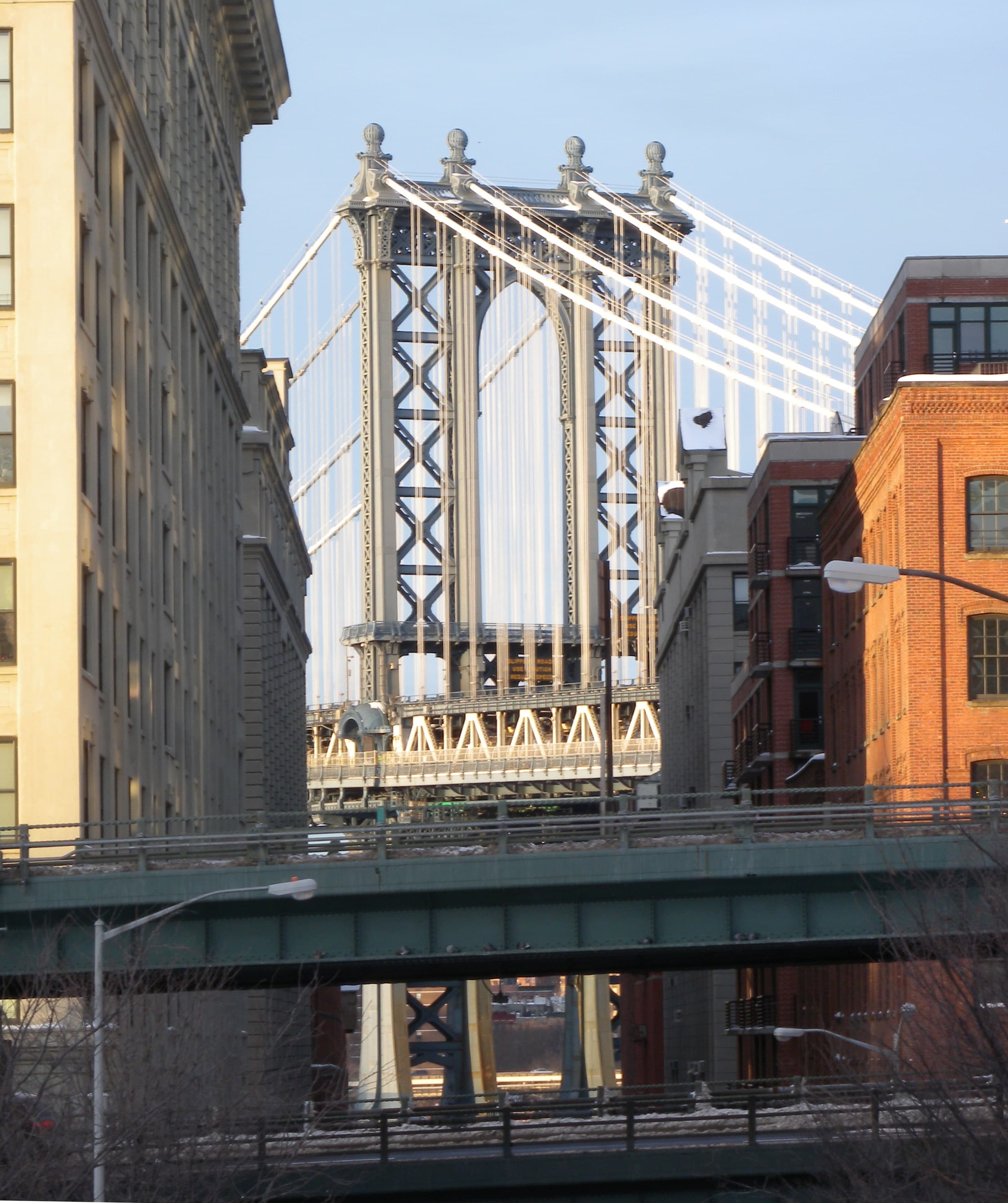
Stand at the corner of Washington Street and Water Street in Brooklyn, look north, and you will see the image that has become the postcard of the borough: the steel tower of the Manhattan Bridge rising between two red-brick warehouse buildings, its cables and cross-bracing framed by their facades, and — if you line it up just right — the Empire State Building sitting neatly in the arch of the bridge's Brooklyn tower, across the East River in Manhattan. It is a trick of perspective, and it is entirely real. The bridge was finished in 1909; the Empire State Building did not rise until 1931, yet the two align from this one spot as if they had been planned together. Visitors stand in the middle of Washington Street to take the photograph, and have done so since long before the age of the smartphone — the view was already famous as a film location when Sergio Leone shot scenes for Once Upon a Time in America here in the early 1980s, and it appears on the film's poster.
That one view explains DUMBO, but it does not contain it. DUMBO — Down Under the Manhattan Bridge Overpass — is a small neighborhood, roughly ten blocks, wedged between the Brooklyn Bridge to the west and the Manhattan Bridge to the east, with the East River at its northern edge. It is bounded by Brooklyn Bridge Park to the north, the Brooklyn Bridge to the west, Brooklyn Heights to the south, and Vinegar Hill to the east. Its streets are paved in Belgian blocks, its buildings are massive masonry warehouses and factories from the turn of the twentieth century, and overhead, the Manhattan Bridge rumbles like a living machine, carrying subway trains, cars, cyclists, and pedestrians across the river. It is at once a historic district, a working neighborhood, a technology hub, and an open-air film set — and it rewards a slow walk more than almost any other ten blocks in New York.
From ferry landing to factory floor
DUMBO began as a crossing point, not a neighborhood. Before either bridge existed, the Fulton Ferry connected this stretch of the Brooklyn waterfront to Manhattan, and the western part of the area was known as Fulton Landing. The land passed through early Dutch and English hands — the Rapelje family owned much of the waterfront by 1700, and in 1787 Comfort and Joshua Sands bought land here and planned a summer settlement they called Olympia, one of several names the area has carried. Through the eighteenth and nineteenth centuries it was generally considered part of Vinegar Hill, its neighbor to the east.
The industrial age made DUMBO. In the late nineteenth and early twentieth centuries, the waterfront filled with warehouses and factories that made machinery, paper boxes, spices, paint, coffee, sugar, and Brillo soap pads. The most famous of its industrialists was Robert Gair, a Scottish immigrant whose cardboard-box factory on Washington Street gave the area one of its long-running names, Gairville — and, according to local history, the cardboard box itself was invented in the Gair building, when a printing press accident creased a stack of paperboard and Gair saw a folding carton instead of a ruined run. The Gair building today houses the offices of the e-commerce company Etsy. Other firms whose names are still on the district's history include Arbuckle Brothers (coffee and sugar), J.W. Masury & Son and Benjamin Moore & Co. (paint), E.W. Bliss (machinery), and the Brillo Manufacturing Co., whose building at 200 Water Street has been converted to residences. The district includes some of the earliest large-scale reinforced concrete factory buildings in America.
The Jay Street Connecting Railroad served this waterfront from about 1904 until 1957, running from rail yards beneath the two bridges to buildings along the water, with a car float bridge on Bridge Street and a yard that could hold 120 cars. Its tracks were abandoned in 1959, but rails are still visible in DUMBO's streets — one of the small details that tells a visitor, without any plaque, what this place used to be. The two bridges that now define the neighborhood arrived in this same industrial era: the Brooklyn Bridge opened in 1883, and the Manhattan Bridge opened on December 31, 1909, its steel towers and sweeping cables designed by Leon Moisseiff, with an approach framed by a monumental stone arch and colonnade on the Manhattan side.
The name nobody wanted — and then everybody did
The acronym "DUMBO" arose in 1978, when new residents — artists and young homesteaders who had begun moving into the neighborhood's large, inexpensive loft spaces in the late 1970s — coined it in the belief that such an unattractive name would help deter developers. It did not deter anyone. The name stuck, the developers came anyway, and the joke curdled into a brand: the comedian Jerry Seinfeld later joked that New Yorkers added the "O" because nobody wanted to live in a neighborhood called "Dumb." The alternative expansion sometimes offered, "District Under the Manhattan Bridge Overpass," is a back-formation; the original is "Down Under the Manhattan Bridge Overpass."
The arc of the neighborhood after the artists arrived is the classic New York story, compressed into a few decades. As Manhattan property grew more expensive toward the end of the twentieth century, DUMBO gentrified — first as a haven for art galleries, then, under developer David Walentas and his company Two Trees Management, which bought a large number of the neighborhood's buildings in the late twentieth century, as an upscale residential and commercial community. The DUMBO Historic District, a historic industrial complex of 95 contributing buildings, was listed on the National Register of Historic Places in 2000, and on December 18, 2007, the New York City Landmarks Preservation Commission designated DUMBO as the city's 90th historic district. In the 2010s the neighborhood became known as the center of the "Brooklyn Tech Triangle," with one of the highest concentrations of technology firms of any New York neighborhood and the headquarters of Etsy and the home-furnishings company West Elm. The city completed a major rehabilitation of DUMBO's cobblestone streets, together with neighboring Vinegar Hill, in 2025, a project that uncovered several thousand artifacts from as far back as the eighteenth century.
Two bridges, one waterfront
DUMBO is the only New York neighborhood that lives between two of the world's most famous bridges, and the bridges are not scenery here — they are the roof, the walls, and the reason for the place. The Brooklyn Bridge, opened in 1883, anchors the western edge; its stone towers and web of cables are visible from almost every waterfront corner, and its pedestrian walkway connects to DUMBO by ramps and staircases. The Manhattan Bridge, opened in 1909, passes directly over the neighborhood; its Brooklyn-side tower stands at the foot of Washington Street, which is why the famous view exists at all. The Manhattan Bridge's pedestrian walkway, reached from Sands Street near Jay Street, is quieter than the Brooklyn Bridge walk and gives a different, grittier crossing — concrete, chain-link, and subway trains rattling past.
Below the bridges, the waterfront has been remade as Brooklyn Bridge Park, an 85-acre park designed by Michael Van Valkenburgh Associates that runs 1.3 miles along the East River from Atlantic Avenue in the south, under the Brooklyn Heights Promenade and past the Brooklyn Bridge, to Jay Street north of the Manhattan Bridge. The park's first section, Pier 1, opened in 2010, and the park was finished in December 2021. In DUMBO itself, the park includes the preexisting Empire–Fulton Ferry and Main Street sections, the historic Fulton Ferry Landing, and Pebble Beach, a small rocky shore beneath the Brooklyn Bridge that is one of the city's best free viewpoints. The Main Street section of the park holds The Cliffs at DUMBO, a 7,800-square-foot outdoor climbing gym described as the largest outdoor bouldering gym in North America.
Empire Stores, Jane's Carousel, and the Archway
Three landmarks anchor a DUMBO walk, and all three are acts of preservation rather than new construction. The first is Empire Stores, the long Civil War-era coffee warehouse on Water Street, whose renovation was completed in 2017. Converted to mixed-use retail and office space, it now holds West Elm's global flagship store, the watchmaker Shinola, and, since May 2019, Time Out Market, a food hall with more than twenty local vendors. Its rooftop and its courtyard — where the old warehouse's arched openings frame the Manhattan Bridge — are among the neighborhood's best public spaces, and the Brooklyn Historical Society opened a branch here in May 2017 with exhibits on DUMBO's maritime and industrial past.
The second is Jane's Carousel, the carved wooden 48-horse carousel built in 1922 by the Philadelphia Toboggan Company for Idora Park in Youngstown, Ohio. When Idora Park closed in 1984, Jane and David Walentas bought the intact carousel at auction and shipped it to Brooklyn; Jane Walentas oversaw a restoration that took more than twenty-five years. Since September 15, 2011, the carousel has operated in Brooklyn Bridge Park in a glass-and-steel pavilion designed by the French architect Jean Nouvel — a jewel box on the waterfront, with the Manhattan Bridge overhead and the East River behind it. It is a ticketed attraction, and it is also a piece of film history in its own right: it appears in the film Past Lives, and it was the first carousel ever listed on the National Register of Historic Places, in 1975, before being delisted in 1985.
The third is the DUMBO Archway, the great vaulted space beneath the Manhattan Bridge on Adams Street, which hosts art exhibitions, live music, film shoots, and watch parties — including for the World Cup — and, on Sundays in season, the Brooklyn Flea market, with dozens of vendors selling everything from secondhand goods to custom jewelry. The Archway is also a film location: the trailer for Joker (2019) features Joaquin Phoenix running through it. A few blocks away, on Water Street, stands Gleason's Gym, the oldest boxing gym in New York, where Muhammad Ali and Mike Tyson trained, and which has been in DUMBO since the 1980s. And on John Street, the Brooklyn Public Library's Adams Street branch, which opened in October 2021 in a converted factory, is the first new Brooklyn Public Library branch to open since 1983.
A neighborhood that photographs itself
DUMBO's fame as a photograph is now part of its identity. The New York Times has called it "the most Instagrammable neighborhood in America," and the Washington Street view is only the beginning: photographers work the cobblestones of Plymouth Street, the archways under the bridge, the waterfront at Pebble Beach, and the glass pavilion of Jane's Carousel at dusk. The neighborhood has been a film set for decades — Sergio Leone's Once Upon a Time in America (1984) used the Washington Street view, Bananarama's 1984 video for "Cruel Summer" was filmed largely in DUMBO, and the area has been parodied in Grand Theft Auto IV as "BOABO" (Beneath the Off-ramp of the Algonquin Bridge Overpass). That self-consciousness is part of the fun, but it is worth remembering that the photograph everyone takes is a photograph of a real working place: the bridge overhead carries four subway lines' worth of trains, the warehouses are offices and homes, and the cobblestones underfoot — Belgian blocks, restored at great expense in 2025 — are the original industrial street surface.
How to visit, and what to see around it
DUMBO is compact enough to see on foot in an hour, and rich enough to fill a day. Start at the Washington Street view — the corner of Washington and Water Streets — and expect company; the best time for the photograph is early morning, before the crowds gather in the middle of the street. Walk north to the waterfront at Main Street Park and Pebble Beach, then west along the Brooklyn Bridge Park promenade beneath the Brooklyn Bridge to Fulton Ferry Landing, where the River Café sits at the water's edge. Turn back east through Empire Stores, stop at Jane's Carousel, and finish under the Archway on Adams Street. The Brooklyn Bridge walkway is accessible from DUMBO, and the Manhattan Bridge walkway entrance is on Sands Street near Jay Street.
No fixed ticket price, fee, or opening hour is stated in this article, since none was verified against an official source in this run. Jane's Carousel is a ticketed attraction and the Brooklyn Flea market runs seasonally; check the official sources — Brooklyn Bridge Park, Jane's Carousel, and the Brooklyn Flea — before visiting for current hours, prices, and schedules. The neighborhood's shops, restaurants, and food hall set their own hours.
Pair DUMBO with the rest of the waterfront. The Brooklyn Bridge walk to Manhattan is the classic continuation, and Brooklyn Heights and its Promenade lie just south. Vinegar Hill, the quiet nineteenth-century neighborhood to the east, is a ten-minute walk and feels like a different century. And across the river, the Manhattan skyline — the reason the Washington Street photograph works — is the view DUMBO has always sold, from the days of the Fulton Ferry to the present. Stand on the cobblestones, look north through the bridge's arch, and you are standing where Brooklyn has always introduced itself to the world: between two bridges, under one great span of steel, at the edge of the East River.
Location Photography


Architectural & Historical Highlights
- DUMBO stands for “Down Under the Manhattan Bridge Overpass,” coined in 1978.
- Bounded by Brooklyn Bridge Park to the north, the Brooklyn Bridge to the west, Brooklyn Heights to the south, and Vinegar Hill to the east.
- Formerly known as Gairville, Rapailie, Olympia, and Walentasville; long considered part of Vinegar Hill.
- Fulton Ferry / Fulton Landing connected the Brooklyn waterfront to Manhattan before either bridge existed.
- The cardboard box is said to have been invented in Robert Gair's building, now home to Etsy.
- Jay Street Connecting Railroad ran circa 1904–1957; its tracks were abandoned in 1959 but are still visible in DUMBO's streets.
- Brooklyn Bridge opened in 1883; Manhattan Bridge opened December 31, 1909, designed by Leon Moisseiff.
- DUMBO Historic District listed on the National Register in 2000 (95 buildings); designated New York City's 90th historic district on December 18, 2007.
- Brooklyn Bridge Park: 85 acres, designed by Michael Van Valkenburgh Associates, 1.3 miles; Pier 1 opened 2010, park finished December 2021; includes Empire–Fulton Ferry, Main Street, Fulton Ferry Landing, and Pebble Beach.
- Empire Stores renovated in 2017; holds West Elm's global flagship store and, since May 2019, Time Out Market.
- Jane's Carousel built in 1922, bought in 1984, opened September 15, 2011, in a Jean Nouvel pavilion.
- DUMBO Archway hosts exhibitions, concerts, film shoots, and the seasonal Brooklyn Flea market.
- Gleason's Gym is the oldest boxing gym in New York; Muhammad Ali and Mike Tyson trained there.
- Cobblestone rehabilitation of DUMBO's streets, together with neighboring Vinegar Hill, completed in 2025.
- The Washington Street view appears in Once Upon a Time in America (1984).