First, where it actually is
Let us be precise about something that trips up many visitors: Arlington National Cemetery is not in Washington, DC. It stands across the Potomac River in Arlington, Virginia, on a hillside above the river, directly across from the Lincoln Memorial and the National Mall. It belongs to every Washington trip all the same. You can stand at the Lincoln Memorial, look west across Memorial Bridge, and see the cemetery's rolling green slope rising on the far bank, with Arlington House — the old Custis-Lee mansion — crowning the hill. The two places face each other across the water by design, and the view between them is one of the great sightlines in American public life: the memorial to the president who saved the Union, looking toward the burial ground created by the war that nearly destroyed it.
That geography matters because it explains the cemetery. Arlington was not chosen as a blank site on a map. It was a home, seized in war, and turned into a burial ground in a deliberate act — and the story of how that happened is the first thing a visitor should understand before walking among the headstones.
A house on a hill
The land was once the Arlington estate, built by George Washington Parke Custis, the grandson of Martha Washington and the adopted son of George Washington. Between 1803 and 1818, Custis built Arlington House, a Greek Revival mansion designed by the English architect George Hadfield, on a hill chosen for its commanding view of the new federal city across the river. Custis intended the house as a memorial to George Washington, and filled it with Washington relics. His daughter Mary Anna Randolph Custis married a young army officer named Robert E. Lee in 1831, and Arlington House became the Lees' home.
The house was also, like so much of antebellum Virginia, a place of enslaved labor. Enslaved men and women built much of the estate, worked its fields and gardens, and lived in quarters behind the mansion — quarters that survive today and are part of the site's interpretation. Any honest account of Arlington has to hold both truths at once: the house was a family home, and it was a plantation worked by enslaved people who had no choice in the matter. The National Park Service, which maintains Arlington House today, tells both stories, and a visitor who walks the grounds should spend time at the slave quarters as well as in the mansion's grand rooms.
When Virginia seceded and the Civil War began, Robert E. Lee resigned from the United States Army and took command of Virginia's forces, later of the Confederate Army of Northern Virginia. The Lee family left Arlington House in the spring of 1861, never to live there again. Union troops promptly occupied the heights across the river from Washington — the hill was too strategically important to leave undefended — and built forts around the estate. In 1863, the federal government established Freedmen's Village on part of the estate, a community where formerly enslaved people fleeing the Confederacy lived, worked, and built churches and schools; it lasted into the twentieth century and is an important, often overlooked chapter of the site.
The cemetery itself was born of war and, by most accounts, of deliberate intent. In 1864, with Washington's military hospitals overflowing and existing burial grounds filling, Quartermaster General Montgomery C. Meigs — a man who had served under Lee and felt his defection personally — ordered burials on the Arlington estate. The first military burial at Arlington was that of Private William Henry Christman of Pennsylvania, interred on May 13, 1864. Others followed quickly, including men who died in the brutal Overland Campaign battles of that spring. The estate was also seized for nonpayment of taxes in 1864, after the Lees could not pay in person, and sold at auction to the federal government. After the war, the Supreme Court ruled in 1882 that the seizure had been illegal; the estate was returned to Custis Lee, Robert E. Lee's eldest son, who in 1883 sold it back to the United States for $150,000. By then it was already, irreversibly, a national cemetery.
One of the cemetery's earliest monuments tells the story of the war's human cost in its starkest form. The Civil War Unknowns Monument, a granite vault near Arlington House, holds the remains of 2,111 Union soldiers whose names were never known, gathered from the battlefields around Washington. It was dedicated in 1866. The number is worth pausing on: more than two thousand men, buried together because no one could say who they were. That vault is the direct ancestor of everything Arlington would become — a place where the nation honors not only its famous dead but its unknown ones.
The Tomb of the Unknown Soldier
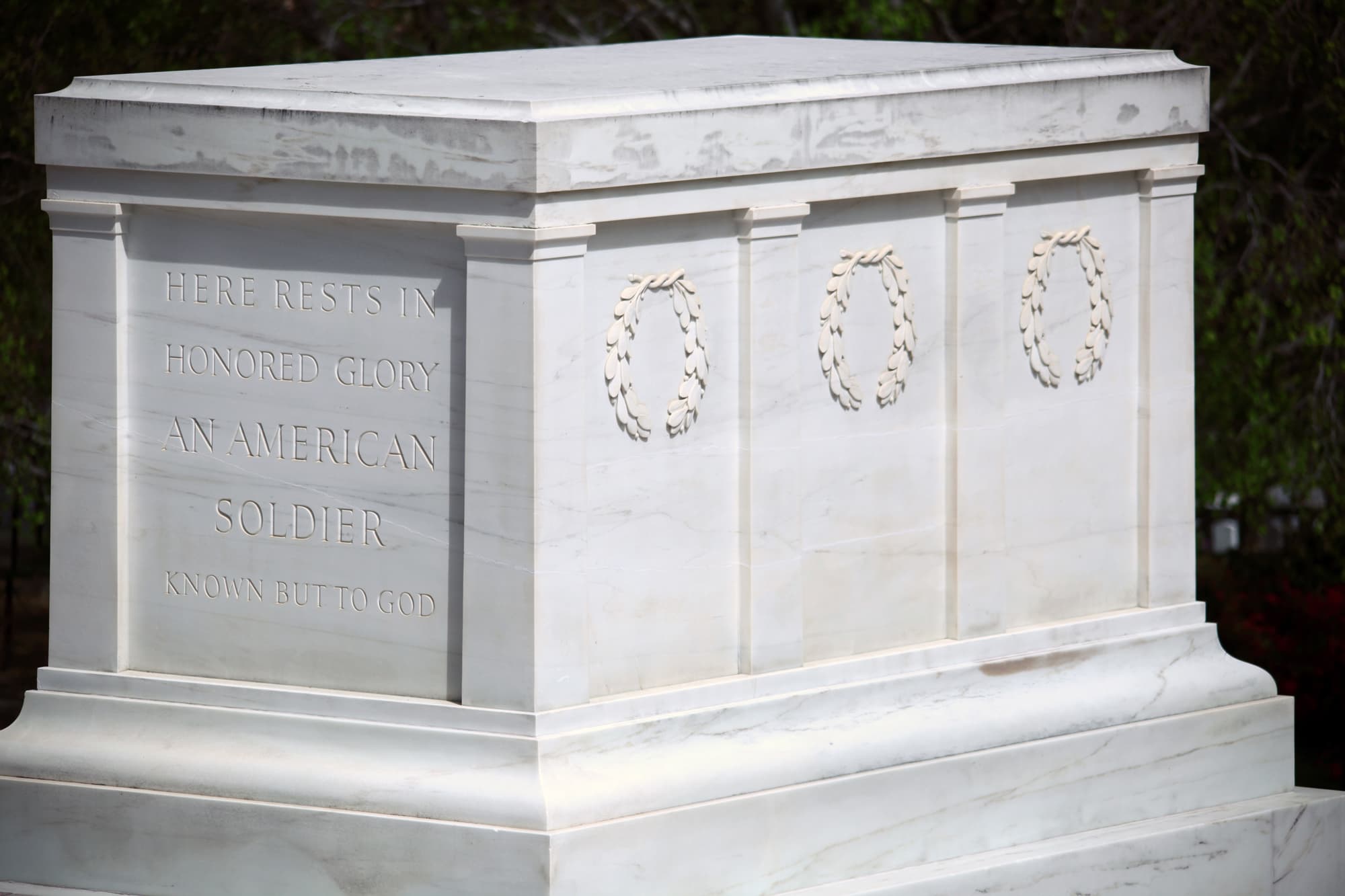
The heart of Arlington for most visitors is the Tomb of the Unknown Soldier, a white marble sarcophagus on a plaza at the top of the hill, in front of Memorial Amphitheater. It is, strictly speaking, the Tomb of the Unknowns: it holds the remains of unidentified American service members from World War I, World War II, and the Korean War. The World War I unknown was interred on November 11, 1921 — Armistice Day, three years to the day after the guns fell silent — in a ceremony attended by President Warren G. Harding and watched by a nation still grieving. The World War II and Korean War unknowns were added in 1958. A Vietnam War unknown was interred in 1984, but advances in DNA identification later identified those remains as First Lieutenant Michael Joseph Blassie, an Air Force pilot shot down in 1972; his remains were returned to his family in 1998, and the Vietnam crypt now stands empty, its inscription reading that it honors the missing of that war. The Tomb's famous inscription, carved on the sarcophagus, reads: "Here rests in honored glory an American soldier known but to God."
The Tomb has been guarded continuously, day and night, since 1937. The guards are soldiers of the 3rd U.S. Infantry Regiment, known as The Old Guard, the Army's oldest active-duty infantry unit, which also serves as the official ceremonial unit and escort to the president. To become a Tomb Guard is famously demanding: candidates train for months, memorize the histories of the cemetery and the Tomb, and must maintain exacting standards of bearing and uniform. Fewer than a small fraction of those who try earn the Tomb of the Unknown Soldier Identification Badge, one of the rarest badges in the Army, and it can be revoked for conduct unbecoming even after a guard leaves the post.
The Changing of the Guard is the ceremony visitors come to see, and it is worth describing in general terms because its power lies in its precision. The relief guard marches to the plaza, the guards exchange their rifles with a choreography that has been rehearsed to the step, and the new sentinel takes up the walk — twenty-one steps down the mat, a turn, twenty-one seconds facing the Tomb, twenty-one steps back — the number twenty-one echoing the twenty-one-gun salute, the highest military honor. The guard's rifle is carried on the shoulder away from the Tomb, a sign of respect, and the sentinel's gloves are kept damp so the rifle never slips. When the cemetery is crowded, the guards still do not rush; when it rains or snows, they still walk. The ceremony repeats through the day, and the cemetery asks visitors to stand in silence and respect during it — no talking, no flash photography, no crossing the rail. Check the official Arlington National Cemetery website before visiting for current ceremony times, which vary by season; this article deliberately does not state a fixed schedule, because schedules change and a wrong time here would send a visitor to an empty plaza.
What makes the Tomb moving is not the precision alone. It is what the precision is for. The men and women buried here are unknown, and that is the point: the nation is saying that a soldier whose name is lost is owed the same honor as a general whose name is in every textbook. Stand at the rail during a changing, listen to the click of heels on marble and the silence of the crowd, and that idea stops being abstract.
The Kennedy gravesite and the Eternal Flame
A short walk downhill from Arlington House, on the slope below the mansion, lies the gravesite of President John F. Kennedy — the most visited single grave in the cemetery, and one of the most visited graves in the world. Kennedy was assassinated in Dallas on November 22, 1963, and buried at Arlington on November 25, 1963, after a state funeral that much of the nation watched on television. At the funeral, Jacqueline Kennedy lit an eternal flame at the temporary gravesite, inspired in part by the flame at the Tomb of the French Unknown Soldier in Paris. The site was chosen on the hillside below Arlington House, a spot Kennedy himself had admired on a visit with his friend, the architect John Carl Warnecke, remarking on the view of Washington and saying he could stay there forever.
The permanent gravesite, designed by Warnecke, was consecrated and opened to the public on March 15, 1967. It is deliberately simple: a low granite wall, a circular walk, and a flat granite stone from which the Eternal Flame burns at the head of the President's grave. The flame is fed by natural gas, with an ignition system that relights it if wind or rain extinguishes it, so that it burns continuously. Jacqueline Kennedy Onassis is buried beside her husband, as are two of their children who died in infancy, and Robert F. Kennedy, assassinated in 1968, is buried a short distance away, his grave marked by a simple white cross and a low wall bearing quotations from his speeches. The other president buried at Arlington is William Howard Taft, the twenty-seventh president and later Chief Justice of the United States, who died in 1930.
The Kennedy site draws crowds, and crowds can make a grave feel like a tourist stop. Resist that feeling. The flame is small — a modest jet of fire in a granite disc — and the power of the place is in its modesty. People leave flowers, coins, and notes; many stand for a long time without speaking. The view from the gravesite, across the Potomac to the Lincoln Memorial and the Washington Monument, is the same view the President admired, and it is worth standing quietly to take in: the city he led, seen from the hill where he rests.
Memorial Amphitheater
Behind the Tomb stands Memorial Amphitheater, the great white marble bowl that hosts the nation's Memorial Day and Veterans Day observances. The original amphitheater at Arlington was a wooden structure built in 1874 for some of the first Memorial Day ceremonies, but it proved too small for the crowds. Congress authorized a permanent amphitheater in 1913; President Woodrow Wilson laid the cornerstone in 1915, and it was dedicated on May 15, 1920. The architect was Thomas Hastings of the firm Carrère and Hastings, and the marble came from Danby, Vermont. The amphitheater seats roughly five thousand people on low marble benches, arranged in an ellipse ringed by a double colonnade. Inscribed on the frieze above the colonnade are the names of battles from the American Revolution through the Spanish-American War; the stage is flanked by the names of generals and admirals from American history before World War I; and above the stage is a line from Lincoln's Gettysburg Address: "We here highly resolve that these dead shall not have died in vain."
Beneath the amphitheater's west side is the Memorial Display Room, open to the public, with exhibits about the Tomb and the unknown soldiers, including medals awarded to the unknowns and the flags that covered their caskets. A small chapel sits beneath the stage. Most visitors will see the amphitheater from the Tomb plaza, but it is worth walking around its colonnade: the scale of the place, and the quiet of its marble corridors, gives a sense of how the nation chose to build for remembrance — not a fortress, but an open-air hall, meant to be filled with citizens.
The amphitheater is also the site of the national Memorial Day observance, when the president traditionally lays a wreath at the Tomb and speaks in the amphitheater. Veterans Day has its own observance. These are not shows; they are ceremonies, and if your visit coincides with one, expect road closures, security, and crowds, and plan accordingly.
Arlington House, restored to a complicated history
Arlington House itself is open to visitors, maintained by the National Park Service, and it rewards a slow visit. The mansion's great portico, with its eight massive Doric columns, faces east toward Washington, and the view from the portico is one of the finest in the capital region: the Potomac, the Lincoln Memorial, the Washington Monument, and the city beyond. Inside, the house has been restored to reflect its history as the Custis-Lee home, with period furnishings and exhibits about the family — including, crucially, exhibits about the enslaved people who lived and worked there, whose names and stories the Park Service has worked to recover. The slave quarters behind the house, and the small museum in the former potting shed, are part of the visit, not an afterthought.
The house's history after the war is itself a lesson in how America remembers. Robert E. Lee never returned to Arlington after the war; he died in 1870 as president of Washington College in Lexington, Virginia. Mary Lee visited once more, a few months before her own death in 1873, and, upset at the house's condition, left after only a few moments without entering. For decades the house was presented primarily as the Lee memorial, and it still carries that designation — Arlington House, The Robert E. Lee Memorial — but its interpretation today is broader and franker, covering the Custis family, the enslaved community, the Union occupation, and the cemetery's creation. That broader telling is the honest one, and it is the version a visitor will encounter now.
The Women in Military Service for America Memorial
At the cemetery's ceremonial entrance, set into the hillside where the old gateway stood, is the Women in Military Service for America Memorial — the only major national memorial honoring all women who have served in the American armed forces. Dedicated in 1997, it occupies the Hemicycle, a curved granite retaining wall built in the 1930s at the cemetery's entrance, and adds a glass entrance pavilion and an interior hall with exhibits, a Hall of Honor, and a computerized register of servicewomen's stories. Women have served in American wars since the Revolution — as nurses, spies, soldiers disguised as men, and, in modern times, in every branch and nearly every role — and this memorial is the place where that service is gathered in one place. It is easy to walk past on the way in, especially if you arrive by Metro and head straight uphill; do not. Step inside, spend ten minutes with the exhibits, and the rest of the cemetery will read differently.
Section 60 and the cemetery's living present
Arlington is not a closed chapter. It is an active cemetery, and nowhere is that clearer than in Section 60, the section in the cemetery's southeast where many of those killed in Iraq and Afghanistan are buried. Section 60 looks different from the older sections: the headstones are newer and whiter, the dates are recent, and visitors are often young — friends and fellow service members, sometimes still in uniform, sometimes with children who never knew the person buried there. On a visit you may see a funeral procession — a caisson drawn by horses from the Old Guard's Caisson Platoon, a band, a flag-draped casket — and you should step aside, stop, and let it pass in silence. Funerals take precedence over tourism here, always, and the cemetery's staff will direct foot traffic around them.
Section 60 is also where the war's cost is most personal and least abstract. The headstones bear the names of men and women in their twenties and thirties, and the objects left on them — photographs, coins, letters, a favorite drink, a child's drawing — are the evidence of lives interrupted. Treat these graves with particular care: do not touch the objects left on them, do not photograph mourners, and do not treat the section as a backdrop. The same respect applies everywhere in the cemetery, but it matters most where grief is fresh.
Other recent history is marked across the grounds. There are memorials to the crews of the space shuttles Challenger (1986) and Columbia (2003); a group burial for victims of the September 11, 2001, attack on the Pentagon, whose building stands visible from parts of the cemetery; and memorials to the victims of the Iran hostage rescue attempt, the Beirut barracks bombing, and other tragedies. Arlington keeps growing because American service, and American loss, keep going.
The scale of the place
The numbers help convey what the eye sees. Arlington National Cemetery covers roughly 639 acres. More than 400,000 people are interred or memorialized here — service members from every American war, from the Revolutionary War onward, along with eligible family members, and a small number of civilians honored for extraordinary service. The headstones, mostly white marble, stand in long, precise rows that follow the contours of the hills, and from the higher ground the effect is overwhelming: row after row, as far as you can see, each stone marking a life. The stones are uniform in size and shape, with variations only in the religious emblem carved at the top and in the inscriptions — name, rank, branch, dates, and sometimes a medal or a line of personal text approved by the family.
Among the famous names, a visitor can find General of the Armies John J. Pershing, who commanded American forces in World War I; Audie Murphy, the most decorated American soldier of World War II, whose grave is among the most visited in the cemetery; boxer Joe Louis, who served in the Army and was buried here in 1981; the astronauts of Challenger and Columbia; Supreme Court justices, including Thurgood Marshall and Ruth Bader Ginsburg; and, of course, the two presidents, Kennedy and Taft. But the famous names are a tiny fraction. The power of Arlington is the other 399,000 — the privates and sergeants and lieutenants and captains whose names are known mainly to their families, and who are honored here with exactly the same white stone.
The cemetery is also a landscape, and it is worth noticing as one. The grounds are wooded with oaks and maples, crossed by winding roads named for generals and battles, and planted with gardens that change with the seasons. Spring brings cherry blossoms and dogwoods; autumn brings a blaze of color on the hillsides. Wildlife — deer, foxes, herons — is common. The landscape was not an accident: the cemetery's designers preserved the estate's trees and contours, and the result is a place that feels like a park until you read the stones, and then feels like something else entirely.
How to visit, and how to behave
Arlington National Cemetery is a large, hilly site, and a visit takes longer than most first-timers expect. Plan for at least two to three hours, and wear comfortable walking shoes: the walk from the entrance to the Tomb of the Unknown Soldier is uphill, roughly half a mile, and the Kennedy gravesite and Arlington House are higher still. The cemetery's own guidance, and common sense, suggest starting at the Welcome Center near the entrance, where you can pick up a map, and then following the main route uphill to the Tomb, the amphitheater, and Arlington House, with the Kennedy gravesite on the way down or up depending on your route. There is also a bus tour that loops the major sites for visitors who cannot walk the hills, and the cemetery is committed to accessibility — but the hills are real, and the heat in a Washington summer is real too, so bring water and pace yourself.
Getting there is straightforward, and it is part of the experience. Take the Metro Blue Line to Arlington Cemetery station, which drops you at the cemetery's entrance, a short walk from the Welcome Center. The station is on the Blue Line between Rosslyn and the Pentagon, and it is one of the few Metro stations built to serve a single destination. Alternatively, the cemetery is a walk across Memorial Bridge from the Lincoln Memorial — a beautiful approach, and the way to understand the geography described at the start of this article — though it is a longer walk and crosses a busy bridge. Driving is possible but parking is limited and the surrounding roads are congested; Metro is the better choice for most visitors.
A word on conduct, because it matters here more than at almost any other site in this series. Arlington is an active cemetery, and funerals happen daily. Speak quietly. Do not climb on monuments or headstones. Do not pick flowers or disturb objects left on graves. Photographs are welcome in most areas, but do not photograph funerals or mourners, and follow the cemetery's posted rules at the Tomb, where visitors are asked to remain silent and behind the rail during ceremonies. If you are asked by staff to step aside for a funeral procession, do so promptly and without complaint. These are not bureaucratic rules; they are the terms on which the living are allowed into a place of the dead.
No fixed ticket price, fee, or opening hour is stated in this article, since none was verified against an official source in this run. Admission to the cemetery has historically been free, but hours vary by season and ceremonies can affect access; check the official Arlington National Cemetery website before visiting for current hours, ceremony times, and visitor rules. The same applies to Arlington House, which is managed separately by the National Park Service and keeps its own hours.
Why it stays with you
Most of the places in this series are enjoyable. Arlington is not, exactly, enjoyable — and that is why it belongs in the series, and why it is one of the essential stops on any Washington trip. The other monuments in the capital honor ideas and achievements: the Lincoln Memorial honors a president and a principle; the Washington Monument honors a founder; the war memorials on the Mall honor sacrifice in the abstract, in bronze and granite. Arlington honors sacrifice in the particular — in names, dates, and rows of stone that go on until the eye gives up counting. It is the place where the abstract becomes personal, where a visitor who has walked the Mall's grand memorials can come and see what those memorials are actually about.
There is a famous line, often quoted at Arlington, from a speech by President Theodore Roosevelt, who said that no nation can be great that does not honor its dead. Whether or not you agree with the sentiment in full, standing on the hillside at Arlington, looking at the rows of white stones and across the river to the city they served, you will understand why Americans keep coming here — not to celebrate war, but to remember the people war took, and to stand for a moment in the quiet company of the dead. Leave the cemetery the way you came, across the bridge or down to the Metro, and the city will look different: louder, busier, more alive — and, for that very reason, more precious.
Location Photography


Key Facts
Arlington National Cemetery is located in Arlington, Virginia, across the Potomac River from Washington, DC — not in the District itself. It is the capital region's national cemetery and a standard part of a Washington visit.
The cemetery occupies the former Arlington estate of George Washington Parke Custis, grandson of Martha Washington and adopted son of George Washington. Arlington House was built 1803–1818 to a design by George Hadfield; Mary Anna Randolph Custis married Robert E. Lee there in 1831.
The Lee family left in spring 1861; Union troops occupied the heights. Freedmen's Village, a community of formerly enslaved people, was established on part of the estate in 1863.
In 1864, Quartermaster General Montgomery C. Meigs ordered burials on the estate. The first military burial was Private William Henry Christman of Pennsylvania, on May 13, 1864. The estate was seized for nonpayment of taxes in 1864; the Supreme Court ruled the seizure illegal in 1882, and Custis Lee sold the estate back to the United States in 1883 for $150,000.
The Civil War Unknowns Monument near Arlington House, dedicated in 1866, holds the remains of 2,111 unknown Union soldiers gathered from battlefields around Washington.
The Tomb of the Unknown Soldier holds unidentified American service members from World War I (interred November 11, 1921), World War II and the Korean War (both 1958). A Vietnam War unknown interred in 1984 was identified in 1998 as First Lieutenant Michael Joseph Blassie; that crypt now stands empty. The sarcophagus inscription reads: "Here rests in honored glory an American soldier known but to God."
The Tomb has been guarded continuously since 1937 by the 3rd U.S. Infantry Regiment, The Old Guard. The Changing of the Guard ceremony involves a precise 21-step walk; the guard's rifle is carried on the shoulder away from the Tomb.
President John F. Kennedy, assassinated November 22, 1963, was buried at Arlington on November 25, 1963; Jacqueline Kennedy lit the Eternal Flame at the funeral. The permanent gravesite, designed by John Carl Warnecke, was consecrated March 15, 1967. Jacqueline Kennedy Onassis and two infant children are buried beside him; Robert F. Kennedy is buried nearby. William Howard Taft, who died in 1930, is the only other president buried at Arlington.
Memorial Amphitheater was authorized by Congress in 1913, its cornerstone laid by President Woodrow Wilson in 1915, and dedicated May 15, 1920. Architect Thomas Hastings of Carrère and Hastings; marble from Danby, Vermont; seats roughly 5,000. The frieze bears battle names from the American Revolution through the Spanish-American War, and above the stage is a line from Lincoln's Gettysburg Address.
Arlington House is maintained by the National Park Service and interpreted as the Custis-Lee home, the home of an enslaved community, a Union-occupied site, and the origin of the cemetery.
The Women in Military Service for America Memorial, dedicated in 1997 at the cemetery's ceremonial entrance in the Hemicycle, honors all women who have served in the U.S. armed forces.
Section 60, in the cemetery's southeast, is where many of those killed in Iraq and Afghanistan are buried; funerals occur daily and take precedence over tourism.
The cemetery covers roughly 639 acres and holds more than 400,000 people interred or memorialized, from every American war from the Revolutionary War onward, plus eligible family members.
Notable burials include General John J. Pershing, Audie Murphy, Joe Louis, the Challenger and Columbia astronauts, and Supreme Court justices Thurgood Marshall and Ruth Bader Ginsburg, alongside group burials for the September 11, 2001, Pentagon attack victims.
Access: Metro Blue Line to Arlington Cemetery station, at the cemetery entrance; or on foot across Memorial Bridge from the Lincoln Memorial. The walk from the entrance to the Tomb is uphill, roughly half a mile; allow at least two to three hours.